
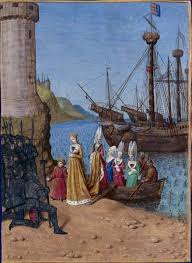
 The relationship between King Edward II and his wife Isabella of France is almost always depicted in negative terms. In Derek Jarman's film Edward II (1991), Tilda Swinton offers a sexually frustrated, ambitious Isabella who turns against her ineffectual husband and usurps his throne. In Mel Gibson's Braveheart (1995), Isabella enjoys a romantic affair with the Scottish landowner and hero William Wallace, perhaps because she experiences frustration and dismay with her husband Edward. The film even suggests that Wallace is the father of her son Prince Edward, despite the fact that Wallace died in 1305, three years before Isabella arrived in England and seven years before the birth of the prince. Biographers of Isabella have tended to characterise the queen as a passive victim of her cruel and merciless husband. She apparently was humiliated, hurt and shamed by his homosexual relationships. She was neglected at court and was mistreated by her husband's courtiers. Finally, her husband seized her children from her and took hold of all of her estates, lands and possessions. He probably allowed his lover Hugh Despenser to violate her. The long-suffering Isabella, who by now had had enough, departed for France alongside her lover Roger Mortimer and arrived back in England with foreign aid. The citizens of England, who loathed their king as much as she did, willingly rallied to her side, and together they marched through the country. Edward was removed from the throne and the popular Isabella achieved a resounding victory. Her son Edward was crowned Edward III and Isabella was celebrated forever after as a liberator.
However, the real story is not as simple as this version would like to make out. This version reduces Edward and Isabella to simplistic and unconvincing cardboard caricatures: Edward as a sexually depraved bully and Isabella as a passive, humiliated victim. This does no justice to the real people. King Edward and his queen actually enjoyed a close, supportive relationship for most of their lives together. They had four children with one another, and frequently departed for France on peace missions, where contemporaries, including Geoffrey of Paris in 1313, noted their love and respect for one another. Isabella sought her husband's support and assistance in her household governance, which he readily gave. Edward was so impressed with his young wife's success in the sphere of her household that he awarded her with possession of the great seal on two occasions, in 1319 and 1321, which greatly honoured the queen and confirmed his trust in her abilities.
Isabella was happy enough to approach Edward when she sought to intercede on behalf of individuals. The administrative documents at the National Archives are full of references to her seeking pardons from the king for those whom she felt to be oppressed and in need of assistance. Edward made sure his wife enjoyed a splendid household and she was afforded every dignity as queen. It is actually uncertain, contrary to popular belief, how she felt about Piers Gaveston, her husband's favourite and, possibly, lover, but it does not seem her relations with Gaveston were as hostile as is often believed. She assisted him financially in 1311 before his exile from England, and she sheltered some of his supporters in her household. There is no evidence of how Isabella personally felt about him.
The relationship between the royal couple did become more strained in the mid-1320s, probably because of Hugh Despenser's malign influence. He seems to have begun a concerted campaign of poisoning the king's mind against his wife, perhaps because he was attempting to replace her in Edward's counsels. In September 1324, the king seized all of Isabella's estates and lands. Yet this does not mean that Isabella gradually came to hate and despise her husband. On the contrary, when she was abroad a year or so later, she continually reiterated her desire to return to Edward, because she loved him and wished to obey his wishes. However, she felt that she could not do so on account of the enmity of Despenser and his father. She believed that her very life would be endangered if she returned to the country. Isabella also sought to protect her son Prince Edward's inheritance, who was with her in France: rumours were circulating at this point that he would be disinherited and not allowed to succeed to the throne on account of his refusal to return to England.
The evidence credibly suggests that Isabella loved her husband and longed to return to him, but could not do so on account of the malicious Despensers, who enjoyed the king's influence and protection. Edward came to view his wife as disobedient and treacherous, for he was unable to appreciate the danger she faced. Their marriage fell into ruin and they were never able to experience the happiness which they had enjoyed in each other's company for such a long period. Whether Edward was murdered in the autumn of 1327, or whether he died at a later date as an obscure pilgrim in Europe, Isabella certainly continued to honour his memory and, when she died in 1358, she chose to be buried with his heart. The relationship between Edward and Isabella was not one of abuse, hatred and murder. It was, for fifteen years, a loving, stable and supportive union. The royal couple were frequently in one another's company and were parents to four children. Contemporaries commented on their love for one another. Yet the malign influence of the Despensers and Edward's growing tyranny destroyed their once happy marriage.
 Above: Edward II's tomb effigy at Gloucester Cathedral.
Edward II, king of England from 1307, allegedly died at Berkeley Castle twenty years later, on 21 September 1327. As biographer Harold F. Hutchinson explains in his 1971 study of the king: 'The true story of the manner of Edward's death can never be known for certain'. The former king had been deposed in January 1327 and succeeded by his fourteen-year old son Edward, known as Edward III. His father's reign had, in the words of Natalie Fryde, been 'disastrous'. Edward's wife, Isabella of France, had invaded the country in September 1326 having initially departed to be involved in peace negotiations with the French king. Outraged by the power wielded by her husband's favourites, the Despensers, who had sequestrated her estates and virtually imprisoned herself and her servants, Isabella returned to England alongside her ally - and possibly lover - Roger Mortimer, later earl of March, and a host of supporters. City after city in England supported her, including London, which became her most imposing stronghold. Edward II was taken to Kenilworth Castle, where the bishop of Hereford demanded that he abdicate, charging the king with, amongst other things, being personally incapable of governing; of allowing himself to be led and governed by others; of devoting himself to unsuitable occupations while neglecting the government of his kingdom; of forfeiting the king of France's friendship, and losing the kingdom of Scotland and lands and lordships in Ireland and Gascony; and of exhibiting pride, cruelty, and covetousness.
Edward remained virtually imprisoned at Kenilworth until 2 April 1327, when he was transferred to the custody of Thomas Berkeley and John Maltravers, following a plot led by the Dominican John Stoke to free him. In July, a further conspiracy to release him occurred, and on 14 September, Sir Rhys ap Gruffudd's plot to liberate him was uncovered. A week later, at the parliament at Lincoln, it was announced that the former king had died 'a natural death' at Berkeley Castle in Gloucestershire. His corpse was moved to Gloucester for public display a month later, and on 20 December he was buried in St Peter's Abbey, Gloucester, in the presence of his son and his widow. A splendid tomb was erected by Edward III in his father's memory.
 Above: Berkeley Castle, where Edward II allegedly died in 1327.
Historians traditionally accepted that Edward II died at Berkeley Castle on 21 September 1327. Hutchinson, for instance, noted that although a mystery surrounded his end, 'the only fact which seems well established is that Edward of Caernarvon was murdered, if not to the instructions of, at least with the connivance of Mortimer, and probably also of Isabella [Edward's wife]'. But as Natalie Fryde correctly noted in her 1979 study of the last years of his reign, 'if we separate contemporary evidence about his [Edward's] fate from the legend which has accrued around it, we are certainly left with more mystery than certainty'. It is essential to bear in mind this point - legend has replaced concrete historical fact regarding Edward II's end. An obvious example of this is the lingering popularity of the notion that Edward died by having a red hot poker thrust into his anus, allegedly a gruesome parody of his enjoyment of homosexual sex. The chronicle of Geoffrey le Baker (died c. 1360), reported this, as did the Brut chronicle, composed in the 1340s. But both Ian Mortimer and Kathryn Warner have disputed the 'anal rape' narrative of the king's death, arguing instead that it reflected beliefs that he was the passive partner in male-male sexual relations. There is, in short, no compelling evidence for the red hot poker story. As Hutchinson incredulously noted, Baker 'asks his readers to believe that Edward's murderers were so inept, and the castle walls so thin, that townsfolk outside the castle were able to hear the king's dying shrieks'. He dismisses Baker's claims as being 'lurid fiction'.
 Above: Gloucester Cathedral, where Edward II may - or may not - be buried.
Other contemporary chronicles were more vague. This perhaps arises from the fact that the actual cause of the former king's death was never stated. Adam Murimuth, writing in the reign of Edward III, vaguely noted that Edward II was 'commonly said' to have been murdered as a precaution on the orders of Maltravers and Gurney. Edward's death has always invited suspicion. As Mark Ormrod notes, it was 'suspiciously timely', leading some historians to argue that the former king was murdered on the orders of the new regime. Kathryn Warner also noted in a blog post that Edward's 'death might have appeared suspiciously convenient for Roger Mortimer and Queen Isabella'. Professor Phillips, who wrote a magisterial account of the king's life, stated that murder was the likeliest fate of Edward II. He noted, however, that the king could have died of natural causes. Phillips dismissed reports of the former king's survival as being 'circumstantial', but noted the mystery about his supposed end.
Most historians have agreed that Edward II died at Berkeley Castle on the night of 21 September, perhaps of natural causes, perhaps through murder. Phillips stated that he may have been suffocated; Roy Haines speculated that the former king had been murdered and stated 'there is little reason to doubt that Edward of Caernarfon's corpse has remained there [at Gloucester Cathedral] undisturbed since December 1327 or thereabouts'; Michael Prestwich opined that Edward II 'almost certainly died at Berkeley'; Mira Rubin concluded that the former king was likely murdered; Joe Burden charged Mortimer with ordering Edward's death; and Chris Given-Wilson explained that Edward II was 'almost certainly' murdered on the night of 21 September, and died in any case.
 Above: Edward III, who succeeded in 1327 on the abdication of his father.
Yet, as Warner recognises, it was only after the downfall of Mortimer and Isabella in 1330 that Edward II was reported to have been murdered, at the parliament at Westminster. Edward III accused Mortimer of 14 heinous offences, including ordering the murder of his father. Thomas Lord Berkeley, son-in-law of Mortimer and former custodian of Edward II, reported at this parliament that 'he wishes to acquit himself of the death of the same king, and says that he was never an accomplice, a helper or a procurer in his death, nor did he ever know of his death until this present parliament', a sentence that has confused and puzzled historians ever since.
Other points of mystery exist. Maltravers was never accused or punished for his role in the former king's death. Berkeley himself was acquitted, as was Shalford. The former king's half-brother, the earl of Kent, conspired in 1330 to free Edward from captivity, writing a letter outlining his intent to release his half-brother with 'the assent of almost all the great lords of England'. William Melton, the archbishop of York, wrote a letter to Simon Swanland, a London merchant, in 1329/30 asking him to co-operate with William Clif in aiding the 'old king' upon his release, specifically describing the delivery of clothes and money to Edward.
Moreover, in the nineteenth century the so-called "Fieschi Letter" came to light. Written by Manuele Fieschi, a papal notary, Canon of York and Nottingham, and Bishop of Vercelli from 1342, the letter reports that Edward II escaped from Berkeley Castle in autumn 1327, making his way to Corfe Castle in Dorset, before departing for Ireland and later to Avignon clothed as a pilgrim. He spent two weeks with the pope, before making his way to Brabant, Cologne and later Italy. Recently, historians have generally tended to validate the letter's contents. Fryde stated: 'it is very difficult to think why Fieschi himself... should have manufactured such a letter'. Ian Mortimer believed it was genuine, and devoted considerable time in his studies of Roger Mortimer and Edward III to explaining his theory that Edward II was not, in fact, murdered at Berkeley Castle, and escaped to Europe. Ian Doherty and Alison Weir also accepted that the letter was genuine, and concluded that Edward did escape to Europe, living out his life as a pilgrim.
'William the Welshman' met Edward III at Koblenz in September 1338, claiming to be the king's father. Edward III spent some time with him. As Warner relates: 'other royal pretenders of the era definitely did not spend several weeks socialising with the royal personage they were pretending to be, or claiming kinship with'. She later concluded that 'Edward II or not, the whole episode is an oddity'.
 Above: another unlucky king. Edward II's great-grandson, Richard II, was also deposed in 1399, and probably murdered early the following year.
Plainly, there is a wealth of evidence to call into question the traditional notion that Edward II died (probably murdered) on 21 September 1327 at Berkeley Castle. While agreeing with Ian Mortimer that it cannot now be stated with any certainty that the former king's life came to an end in the autumn of that year, less than nine months after his forced abdication, I raised some issues with the survival story. There are nagging questions in my mind that Ian Mortimer, and other revisionist historians, have not sufficiently answered (if they have even considered them in the first place). Firstly: why did Edward III wish to get back in touch with his father, as Mortimer suggests? What did it achieve? Did he want to see if 'William the Welshman' was merely an imposter, or had he enjoyed a close and intimate relationship with the former king pre-1327 that he wished to continue?
Was Edward II content to live as a pilgrim in Europe? Evidence seems to me to compellingly indicate that Edward II firmly believed in the institution of monarchy and was convinced of his right to rule. He was anoited by God, chosen by Him to represent God on earth. Why, then, would he have been content to allow his son to rule? To remove a king unlawfully, which had been the case in 1327 (Edward II only abdicated under duress and coercion), constituted usurpation and a damnable offence in the eyes of God. Ian Mortimer suggested that father and son, reunited in Europe, met and talked with one another. Was there an agreement between them that Edward III would keep his father's identity secret, as long as his father did not make a bid for the English throne? Questions like these are never comprehensively answered.
Berkeley, at the parliament of November 1330, could have been lying in an attempt to save his own skin when he declared that he had never previously heard of Edward II's death. In the medieval context, deposition was usually followed by death. Edward II was the first king to be deposed, but consider later instances: Richard II is believed by historians to have been put to death, or forcibly starved, in 1400 when Henry IV took the throne from him; Henry VI was murdered in 1471, almost certainly on the orders of Edward IV who deposed him; the twelve-year old Edward V was deposed in 1483 and probably murdered, although mystery surrounds his fate and that of his brother; and the deposed Lady Jane Grey, the 'nine-days queen', was executed by her cousin Mary I in 1554. Mortimer and Isabella's regime was notably precarious and unstable, as historians like Fryde recognise. Would they really have been content to allow Edward to live out his days in context of repeated rebellions to release him? Even if they had nothing to do with his death, his jailers may have considered that putting him to death was the only viable way forward. Or, simply, he may very well have died of natural causes.
This article does not seek to refute revisionists' claims that Edward II survived. It is extremely possible that he did, for there is no conclusive evidence that he died, or was murdered, at Berkeley Castle in 1327. But equally, it cannot be stated with certainty that he escaped abroad and lived out the rest of his days in Europe. Whether Edward II, an ill-fated and complex king, met his end at Berkeley in autumn 1327 or not, is a profound and lingering historical mystery that may never be comprehensively solved.
