Showing posts with label anne frank. Show all posts

Friday, 27 January 2017

Holocaust Memorial Day


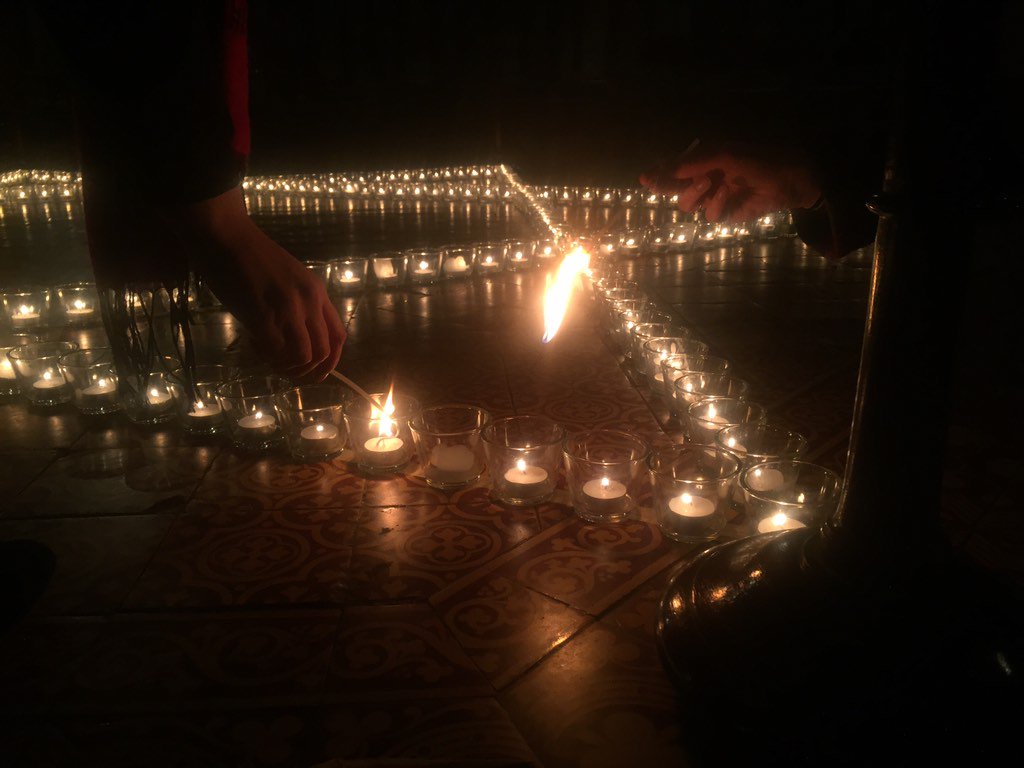
Above: York Minster's Star of David - image credit, York Minster.

The Holocaust, the genocide masterminded by the Nazis, took place between 1941 and 1945, at the same time as the Second World War was being fought. More than fifty years later, the horrors of this period continue to shock and continue to reverberate. Around six million Jews were murdered, while other victims numbered in the millions and thousands, including Soviet prisoners of war, the disabled, Jehovah's witnesses, homosexuals, Romani and ethnic Poles. These victims endured enslavement in concentration camps, imprisonment, torture and murder, and the testimonies of those who survived these horrors testifies to the dark depths of human hatred, intolerance and bigotry. 

Holocaust Memorial Day Trust's theme for 2017 is how can life go on? The survivor and prolific author Elie Wiesel, who died last year, explained that "for the survivor death is not the problem. Death was an everyday occurrence. We learned to live with Death. The problem is to adjust to life, to living. You must teach us about living." This year's theme incorporates issues including trauma and coming to terms with the past, displacement and seeking refuge, justice, rebuilding communities, and reconciliation and forgiveness. These issues continue to resonate today, and should be considered by each and every one of us.

Yesterday, I attended a memorial service at York Minster, and a beautiful Star of David was lit in the Chapter House using candles. The service was moving, and included a talk from a young man whose relative had perished in the Holocaust. Attending services such as that at York Minster always brings back memories for me of visiting Auschwitz in 2009 while at secondary school. While our teacher prepared us as much as she could for what we would experience, visiting the camp was something that I don't think any of us could forget. Emotions ran high that day, and subsequently, but how was it possible for any of us to imagine the suffering inflicted on those who walked through Auschwitz's gates, many of whom never left? How could any of us truly come to terms with the horrors inflicted at Auschwitz, and other killing camps such as Treblinka or Sobibor? 

I have included some photos taken from the trip. These serve as powerful reminders of how cruelty, intolerance and hatred can extend to unspeakable crimes and to loss of life. They remind us that racism, xenophobia, anti-Semitism, ethnic cleansing, homophobia and prejudice are still with us today. These issues will always be important. They are inextricably tied to human nature, and remind us of what can happen when scapegoats are sought for perceived unfairness or problems in society.

No automatic alt text available.

No automatic alt text available.

No automatic alt text available.

Recently, I attended an exhibition about one of the most famous victims of the Holocaust, Anne Frank, a diarist who died at Bergen-Belsen concentration camp at the age of fifteen. The exhibition's title was 'A history for today'. It was incredibly moving to revisit Anne's story and to consider her legacy, but two photos, in particular, caught my eye and provided a startling reminder that, perhaps, we have not really moved forward since the dark days of 1941-45. Genocides in Cambodia, Rwanda, Bosnia, and Darfur - among others - are a testament to the unwillingness, or inability, of subsequent generations to learn from the horrors of the past. These two photos, I think, speak a thousand words. 

Hatred, intolerance, bigotry and prejudice are still very much with us, and there are still lessons to be learned from the Holocaust. 

Image may contain: text

Image may contain: text


Wednesday, 12 June 2013

Anne Frank


The persecution of the Jews, known by the haunting Greek word the Holocaust, meaning sacrifice, by the Nazis in central and eastern Europe occurred over a period of three years, 1942-45, although it can hardly be doubted that the Jews have been persecuted since the beginning of the time. However, a collection of factors including the bleak economic climate in twentieth-century Europe, the devastating aftermath of WW1, and the desire of each country to strengthen and 'reborn' itself, meant that persecution, intolerance, and hatred were more prominent than they had hitherto been, and eventually led to mass murder, torture, and elimination. The Jews, of course, were the obvious and largest group of victims, although one must not forget about other persecuted groups such as gypsies, homosexuals, the disabled, Jehovah's Witnesses, and other races.

Anne Frank is known as one of the most discussed and famous victims of the Jewish Holocaust. On this day in history, 12 June 1929, she was born in Frankfurt, Germany as the second daughter to Otto Frank and his wife Edith; her sister Margot three years older. A Jewish family, the Franks lived in a time of increasing violence and anti-Semitism in Europe, of which Germany was a country which notably experienced such attitudes under the Nazi Party headed by Adolf Hitler. This family eventually fled Germany in the early 1930s for Amsterdam - they were among some 600,000 Jews who escaped Germany in the period 1933-39.

Anne's diary, known as The Diary of a Young Girl, is exceptionally intriguing as a document providing insights into the life of a Jewish family living in twentieth-century Europe on the brink of the Second World War. Anne's cleverness, wit, and outspoken nature shine forth throughout her diary, particularly in her often complex relations with her other family members while dwelling in the claustrophobic environment of the secret annexe. Also on this day, 12 June 1942, thirteen-year old Anne was first given her diary as a birthday present, and wrote in it regularly hereafter.

A photograph taken from the opposite side of the canal shows two four story buildings which housed the Opekta offices and behind them, the Secret Annexe

Anne's diary indicates her close relationship with her father, and illuminatingly details her blossoming friendship and, perhaps, romance with Peter van Pels, whose family also resided with the Franks in the secret annexe. Her relationship with her mother Edith was more strained, although she later expressed disgust at her earlier contempt for Edith. Anne's relationship with Margot also became gradually closer as the two became older. In this diary, Anne wrote regularly until the family were arrested in August 1944.

Who exactly betrayed those hiding is controversial, and will probably never be known for certain. They were all eventually taken to Auschwitz, separated from one another; Anne, by virtue of just turning 15 in June, escaped being gassed. In October, Anne, her sister and Auguste van Pels were transported to Bergen-Belsen concentration camp in Germany. In March 1945, both Anne and Margot died from a typhus epidemic which decimated the camp, killing some 17,000 prisoners.

Anne's story, expressed in her diary, is famous the world over. We need not concern ourselves with the outrageous allegations made by some that the diary is fake, a forgery. Eloquently, beautifully written, the reader is haunted throughout by the knowledge of the writer's horrific fate which she could never have realised. Read as a historical source as well as an incredibly moving book, The Diary of a Young Girl reminds us all of the darkness and evil possible in human nature, and how quickly dislike, contempt and racism can manifest itself in violence, brutality, and murder. One can only pray that such horrific events never take place again - but sadly, they are taking place, every day.