Showing posts with label history. Show all posts

Sunday, 2 June 2024

Jane and Katherine Grey


My article about Ladies Jane and Katherine Grey and their shared experiences of imprisonment in the Tower of London in 1553-4 and 1561-3 respectively has been published by EPOCH Magazine and is available to read here. 

Tuesday, 22 January 2019

Katherine Howard: History Press

Related image

I am delighted to announce that The History Press are publishing my biography of Henry VIII's fifth wife in April 2019, with the title "Katherine Howard: Henry VIII's Slandered Queen". It presents my years of research into Katherine's brief life and offers additional content to my 2014 biography. You can preorder the book here.

I was very fortunate to offer my thoughts about Henry's youngest wife on The History Press website. You can read the thoughts here, in which I note that

Every piece of surviving evidence we have indicates that, contrary to traditional perceptions, Katherine was a conscientious queen who fulfilled her ceremonial duties aptly. I argue in my book that Katherine’s style of queenship may have been directly shaped by Henry VIII’s changing expectations about the queen’s role. Too often it is assumed that she was uninterested in fulfilling her royal duties, but it is barely ever considered that perhaps her husband had a direct say in the way that Katherine responded to her role. Had Katherine given birth to a male heir and had the king never discovered her pre-marital past, then I do believe she would have been regarded as a very successful queen consort.

Thursday, 8 June 2017

Katherine Howard's Age

Related image

Five years ago, I published a blog post about the date of birth of Katherine Howard, fifth wife of Henry VIII. In the course of researching and writing about her life, I became increasingly aware of the influence that misconceptions about her continued to play in historical writing. Two years after that blog post, my full-length study of Katherine's life was published. In that book, I argued that Katherine was almost certainly the second daughter of Edmund and Jocasta Howard: her older sister Margaret was born by 1518, and her younger sister Mary was probably born by 1525. We know for a fact that all three girls, and their three surviving brothers Henry, Charles and George, were born by 1527, according to Edmund Howard's own correspondence.

Since that book was published, I have continued to research and reflect on Katherine's probable date of birth. Undoubtedly, when she was born is highly important, for it influences our interpretation of her adolescent relationships in the household of her step-grandmother, the dowager duchess of Norfolk. It also influences how we perceive her relationship with Henry VIII, whom she married in 1540. It is worth thinking about Henry's own marital and sexual preferences, a much-debated issue that perhaps, strangely, neglects the issue of age. 

Henry VIII was not yet eighteen when he married Katherine of Aragon, who was twenty-three, in 1509. Sixteenth-century women could legally marry at twelve years old, but it was rare for them to marry at so young an age. Women from the lower classes married, on average, at twenty-five or twenty-six, and even among the nobility, women tended to marry at about twenty, or in their late teens. Anne Boleyn's mother, for example, was probably married by the age of nineteen or twenty, and Jane Parker, wife of George Boleyn, was about nineteen at her marriage. During his marriage to Katherine of Aragon, Henry was involved in liaisons with Bessie Blount (who was born by 1500, if not before, and was therefore nineteen when she gave birth to the king's son in 1519) and Mary Boleyn, who had probably been born by 1501 and was therefore in her early twenties.

In 1527, Henry fell passionately in love with Anne Boleyn, younger sister of a previous mistress. Anne was probably six years younger than most historians assume. In 1527, she was probably twenty years of age. A variety of palace officials, servants and the likes of Cardinal Reginald Pole all characterised her as young. Gareth Russell has also pointed out that not once, during the six arduous and time-consuming years in which Henry fought to secure from the Pope an annulment of his first marriage, was Anne's age queried as a barrier to marriage. Undoubtedly, had she been as old as thirty or thirty-one during Henry's courtship, questions would have been raised as to whether she was a suitable partner for childbearing. 


When Anne married the king in late 1532, she was probably twenty-five, and according to an attendant of her stepdaughter Mary, the disgraced queen was not yet twenty-nine when she was executed in May 1536. Her successor Jane Seymour was, according to the Imperial ambassador Eustace Chapuys, a little over twenty-five when she became Henry VIII's bride in 1536, suggesting that she was about twenty-six or twenty-seven. At her funeral the following year, there was a female mourner for every year of Jane's life: twenty-nine in all. Probably, according to the contemporary tradition of marking one's age, this referred to Jane dying in the twenty-ninth year of her life, rather than having died at the age of twenty-nine: therefore suggesting that she was born in about 1509.

In 1540, Henry married Anne of Cleves, a twenty-four year old German noblewoman. It was rumoured before his marriage to Anne that Henry had been romantically interested in Anne Basset, a former maiden of Jane Seymour. Mistress Basset was born in 1521 and so would have been sixteen or so when the king's eye fell on her, however briefly. Before the negotiations to marry Anne of Cleves, Henry had expressed an interest in marrying the seventeen-year-old Christina of Milan.

Plainly, Henry's preference was for women in their late teens or early twenties. Bessie Blount and Mary Boleyn, his two most well-known mistresses, were in their late teens, Mary perhaps her early twenties. Katherine of Aragon and Anne of Cleves were both in their early twenties, while Henry first became interested in Anne Boleyn when she was about twenty, although she was in her mid-twenties when they married. Jane Seymour, on the other hand, was probably twenty-seven. The glaring exception to this rule was Katherine Parr, who was thirty-one when she married Henry VIII in 1543, but she had already been married twice previously and there does not appear to have been any expectation on the king's behalf that she would provide him with children, unlike all of his previous marriages. It was highly unusual for a noblewoman to remain unwed by her late twenties or early thirties. Indeed, so anomalous was the as-yet unwed Jane Seymour's position in early 1536 that the Imperial ambassador openly questioned both her virginity and her morals. Jane, at twenty-seven, was still unmarried.

Related imageRelated image


When Katherine Howard caught the king's eye in late 1539 or early 1540, contemporary observers not only praised her attractiveness, but they also commented on her youth. According to Richard Hilles, she was a 'young girl', while the French ambassador referred to her as a 'young lady'. The anonymous author of The Chronicle of Henry VIII expressly stated that she was about fifteen when Henry fell in love with her, and also referred to her as a 'mere child'. George Cavendish, in his verses about Katherine's life, mentioned youth ten times. Plainly, the implication was that Katherine's youth and beauty were noticeable. 

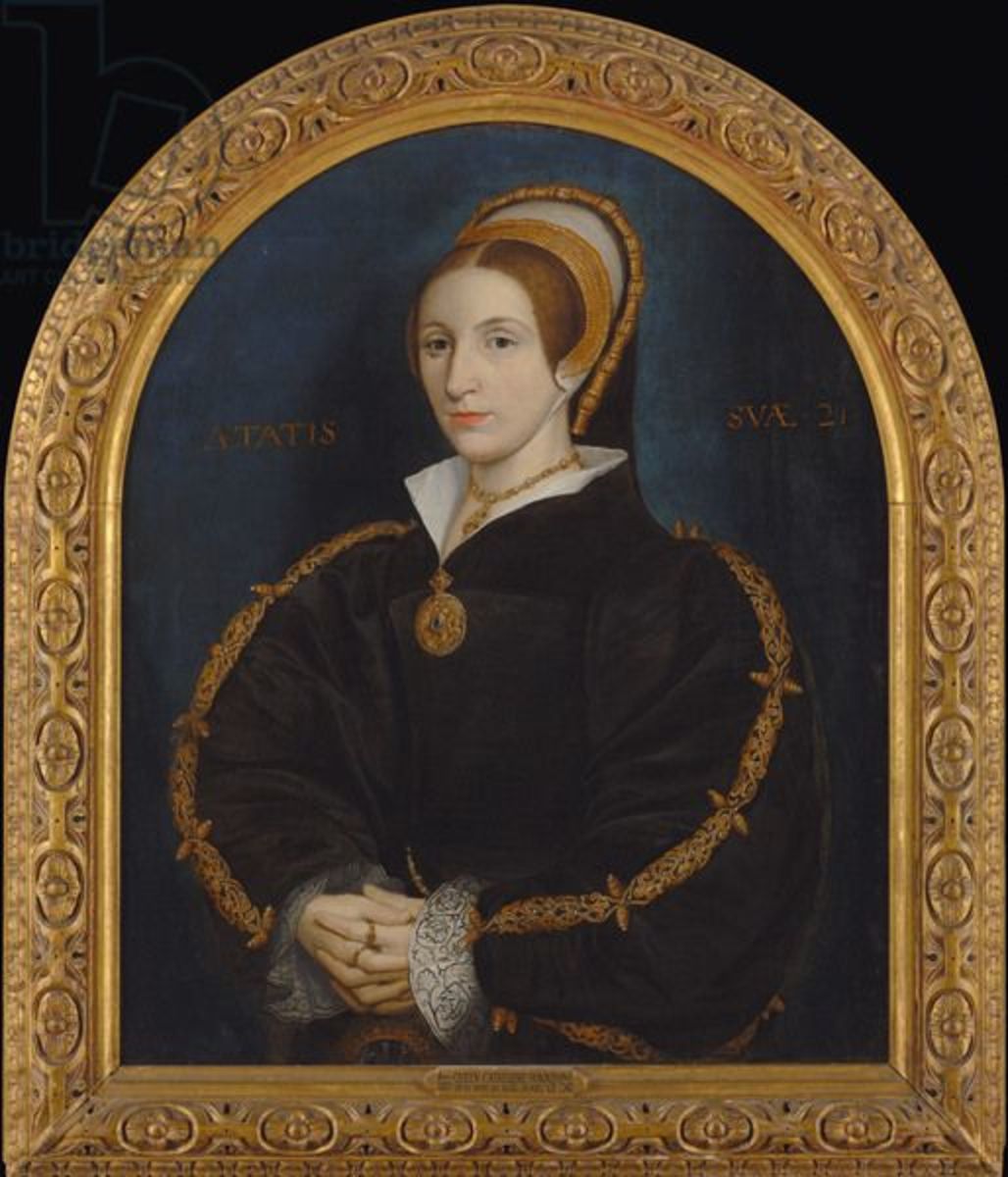
In the late twentieth-century, modern historians assumed that Katherine was born in 1520-1 because of a portrait housed in the Toledo Museum of Art, with versions also at the National Portrait Gallery and Hever Castle. The well-dressed sitter is, according to an inscription in the painting, in her twenty-first year. Quite why this portrait was identified as a portrait of Katherine remains unclear. The notion that it is an image of the hapless queen has been comprehensively debunked. Recently, it has been suggested that the sitter may plausibly be identified as any one of Frances Brandon, Eleanor Brandon, Margaret Douglas or Elizabeth Cromwell.

By contrast, a portrait housed at the Metropolitan Museum of Art in New York depicts a magnificently dressed young woman aged in her seventeenth year, according to the inscription, and it has been dated to c.1540-1545. A number of historians, including myself, Gareth Russell and Susan James, have suggested that Katherine may well be the sitter in the painting. Although the identification is speculative, if it is true then it would suggest that she was born in 1523 or 1524, assuming that the painting was painted in 1540-1. This identification, however, remains tentative.

When she was appointed a maid of honour to Anne of Cleves in late 1539, Katherine joined her cousin Katherine Carey and Mary Norris, who were born in 1524 and 1526, respectively. Undoubtedly, had she been born as early as 1520, Katherine's family would have attempted to arrange for her to serve Anne Boleyn or Jane Seymour in the years 1533-7. There is no evidence that they did so. It is probably significant that she only began receiving music lessons from Henry Manox and Master Barnes in 1536, when she was likely in her early teens.

However, the French ambassador commented that Katherine had been intimately involved with Francis Dereham from her thirteenth to her eighteenth year, thus suggesting a five year relationship. Modern historians have usually taken this comment as evidence that she was born in 1520-1, for the relationship probably ended in early 1539. I am persuaded by Retha Warnicke's argument, however, that the ambassador was probably unaware of Katherine's earlier liaison with Manox, which took place in 1536-7. In the wake of Katherine's downfall, it became apparent that she had appointed Dereham to her service and, it was rumoured, had met with him in a return to their previous relationship. If Katherine was about thirteen in 1536, then she might have been eighteen in 1541 when she confirmed Dereham's appointment to her household, therefore explaining the ambassador's reference to the ages of thirteen and eighteen.

The contradictory comments of the French ambassador and the unknown author of The Chronicle of Henry VIII clearly indicate that there was a degree of confusion about Katherine's exact age; possibly neither man knew for certain when she was born. However, Cavendish's ten references to her youth in his verses is probably significant, as are the other reported remarks about her young age when she became queen. That she was not born earlier than 1523 is a reasonable assumption in view of the ages of her fellow maids of honour, the date at which she began receiving music lessons (probably in readiness for her anticipated appointment to the queen's household) and the evidence of her grandparents' wills. In 1524, her grandfather John Legh's will did not refer to Katherine or her younger sister, but her grandmother Isabel's will, which was written three years later, referred to all three Howard girls. Whether this is evidence that Katherine and Mary were born between 1524 and 1527, however, is unclear, but at the very least it seems to suggest that they were either not yet born or were very young when their grandfather's will was penned. 

The traditional argument that Katherine was born as early as 1520-1 has been proven to be shaky and based on a dubious portrait identification. Most modern historians now believe that the portrait is not of the queen, but probably depicts one of the king's nieces or Elizabeth Cromwell, younger sister of Jane Seymour. It is probably significant that the three most recent biographers of Katherine - myself, Josephine Wilkinson and Gareth Russell - all advocate a later birth date. Wilkinson agrees with Joanna Denny that Katherine was born in 1525, probably the latest possible date for her birth. Russell suggests 1522 or 1523. The evidence available, in my opinion, seems to suggest a birth date of 1523. Sixteenth-century children were occasionally named for the saint on whose feast day they were born; St. Katherine's Day is 25 November. Whether this suggests that Katherine Howard was born in November 1523 is impossible to say, but the considerable evidence available to historians probably indicates without a doubt that she was born no earlier than 1523 and no later than 1525. This would mean that she was about seventeen when she married Henry VIII and had probably not yet attained the age of nineteen when she was executed in early 1542. 

Sunday, 23 April 2017

23 April 1445: The Wedding of Henry VI and Margaret of Anjou

Image result for margaret of anjou

On 23 April - some sources suggest 22 April - 1445, Henry VI married Margaret of Anjou at Titchfield Abbey in Hampshire. The king was twenty-three years old and his new bride was fifteen. Margaret, who was born in Lorraine, had arrived in England on 9 April and met Henry shortly afterwards. The marriage was expressly designed to achieve peace between the warring kingdoms of England and France, although Margaret's dowry was rather unimpressive. 

On her wedding day, the king provided Margaret with jewels, including a gold wedding ring. On 28 May, Margaret entered London and was crowned queen at Westminster Abbey two days later. The surviving evidence indicates that Henry and Margaret felt affection, possibly love, for one another, and the records demonstrate that king and queen cooperated on matters of policy during the early years of their marriage. However, Margaret's inability to conceive contributed to growing tensions at court and in the realm more generally. This childlessness, coupled with the perceived shortcomings of the Anjou alliance, meant that Margaret was unable to enjoy popularity among her subjects. 

Image result for titchfield abbey

In 1453, eight years after her marriage, Margaret finally conceived and gave birth to a son, Edward, on 13 October. However, the birth of her child coincided with Henry VI's illness and compelled Margaret to take a politically active role at the centre of government. Her bid for the regency failed and the duke of York was made protector. As is well-known, Henry's incapacity and the ensuing crisis of kingship led to civil war. 

In my book, Queenship in England - which can be purchased here - I examine Margaret's controversial tenure as queen:

Henry VI’s incapacity created a crisis at the centre of governance. Contemporaries feared the consequences of the king’s infirmity: ‘the reame of Englonde was out of all governaunce… for the kyng was simple… held ne householde ne meyntened no warres’. It is not true that the queen was an avaricious, grasping woman determined to enjoy power irrespective of the consequences; however, her husband’s collapse placed her in an ambiguous and uncomfortable position. Indeed, it was circumstances, including the collapse of her husband and growing discontent among the nobility, that required the queen to play a more directly political role after 1453, alongside her realisation that her son’s inheritance had to be safeguarded.

Friday, 27 January 2017

Holocaust Memorial Day


Above: York Minster's Star of David - image credit, York Minster.

The Holocaust, the genocide masterminded by the Nazis, took place between 1941 and 1945, at the same time as the Second World War was being fought. More than fifty years later, the horrors of this period continue to shock and continue to reverberate. Around six million Jews were murdered, while other victims numbered in the millions and thousands, including Soviet prisoners of war, the disabled, Jehovah's witnesses, homosexuals, Romani and ethnic Poles. These victims endured enslavement in concentration camps, imprisonment, torture and murder, and the testimonies of those who survived these horrors testifies to the dark depths of human hatred, intolerance and bigotry. 

Holocaust Memorial Day Trust's theme for 2017 is how can life go on? The survivor and prolific author Elie Wiesel, who died last year, explained that "for the survivor death is not the problem. Death was an everyday occurrence. We learned to live with Death. The problem is to adjust to life, to living. You must teach us about living." This year's theme incorporates issues including trauma and coming to terms with the past, displacement and seeking refuge, justice, rebuilding communities, and reconciliation and forgiveness. These issues continue to resonate today, and should be considered by each and every one of us.

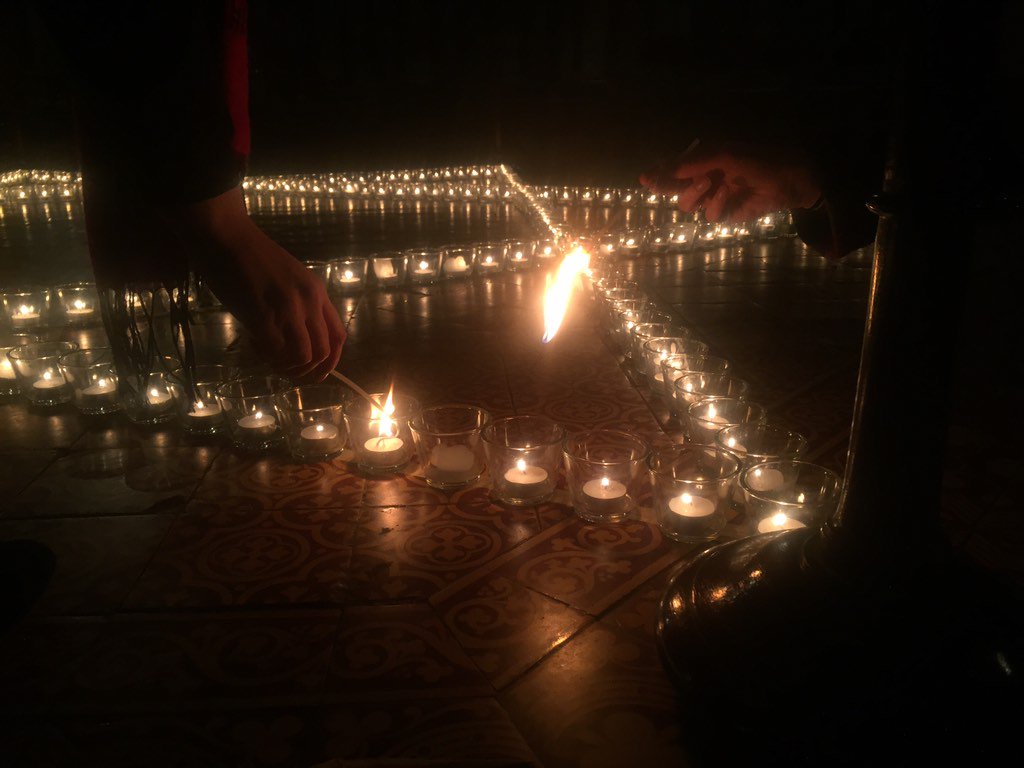
Yesterday, I attended a memorial service at York Minster, and a beautiful Star of David was lit in the Chapter House using candles. The service was moving, and included a talk from a young man whose relative had perished in the Holocaust. Attending services such as that at York Minster always brings back memories for me of visiting Auschwitz in 2009 while at secondary school. While our teacher prepared us as much as she could for what we would experience, visiting the camp was something that I don't think any of us could forget. Emotions ran high that day, and subsequently, but how was it possible for any of us to imagine the suffering inflicted on those who walked through Auschwitz's gates, many of whom never left? How could any of us truly come to terms with the horrors inflicted at Auschwitz, and other killing camps such as Treblinka or Sobibor? 

I have included some photos taken from the trip. These serve as powerful reminders of how cruelty, intolerance and hatred can extend to unspeakable crimes and to loss of life. They remind us that racism, xenophobia, anti-Semitism, ethnic cleansing, homophobia and prejudice are still with us today. These issues will always be important. They are inextricably tied to human nature, and remind us of what can happen when scapegoats are sought for perceived unfairness or problems in society.

No automatic alt text available.

No automatic alt text available.

No automatic alt text available.

Recently, I attended an exhibition about one of the most famous victims of the Holocaust, Anne Frank, a diarist who died at Bergen-Belsen concentration camp at the age of fifteen. The exhibition's title was 'A history for today'. It was incredibly moving to revisit Anne's story and to consider her legacy, but two photos, in particular, caught my eye and provided a startling reminder that, perhaps, we have not really moved forward since the dark days of 1941-45. Genocides in Cambodia, Rwanda, Bosnia, and Darfur - among others - are a testament to the unwillingness, or inability, of subsequent generations to learn from the horrors of the past. These two photos, I think, speak a thousand words. 

Hatred, intolerance, bigotry and prejudice are still very much with us, and there are still lessons to be learned from the Holocaust. 

Image may contain: text

Image may contain: text


Friday, 20 December 2013

Consent - the Moral and Psychological Issues


This is not, strictly speaking, a historical article. Nevertheless, consent is an intriguing concept and especially controversial in terms of current debates about sexuality, violence and assault seemingly ever present in the media today.

Oxford Dictionaries describes consent as:

"permission for something to happen or agreement to do something".

In criminal law in Britain the consent must be both positive and genuine in order to apply. Did the defendant honestly believe that the victim consented?

Philosophically speaking, it would be interesting to consider why people consent. In sexual matters, does a person consent because they love the other person and wish to participate in something intimate and loving? Does it signify an act of trust on their part? Of course, for many people, choosing, or consenting, to having sexual intercourse with someone else results from their placing trust in that person. They may have strong feelings and wish to act on them. They may be acting out of love.

Alternatively, does someone consent to sexual acts because they feel they have to? Historically speaking, in relation to female sexuality it has been noted that teenage girls, in particular, consent to sexual intercourse often because of social or cultural pressures, not because of biological compulsions. This can be especially damaging - why should people feel they have to consent to sex, in order to please someone? Paradoxically, you could say they are really being forced into sex, or pressured, as a means of retaining that person's interest. Of course, this can have profound psychological consequences, particularly at a youthful age.

In the early modern period, for example, it was believed that females, being carnal and licentious beings, were so desirous of sex that they wanted to be raped. This shocking view provided justification for men to rape them. Rape was punished, make no mistake about it, but it was punished as an offence against property, since women were viewed as belonging to their menfolk, whether husbands or fathers. Morally, women were viewed as to blame, even if they had not consented. But a belief in what is termed "interior consent" existed: even if women said they did not consent, they were believed to nonetheless have consented. If they said no to rape, in reality they were desirous of it. Perhaps this belief is still held by some today.

But consent affects men, too, in this sphere. Ally Fogg criticised existing perceptions of male sexuality so often seen as 'threatening', 'aggressive', 'dangerous', even 'frightening'. In fact, some have even argued that society does not view men as victims of sex crimes. Shockingly, sexual assault and male victims are often just not associated with one another. The controversy surrounding rapper Danny Brown this year exposes this point. Performing on stage, a female fan pushed her way on stage and performed sexual acts on Brown, in the middle of his performance, without obtaining his consent. This was, in effect, a sexual assault. Just because Brown is male does not mean that he cannot also be a victim. 

Male rape was only recognised by British law in 1994 - nineteen years ago. This demonstrates, perhaps, as nothing else can, how our society views the connections between consent, male sexuality, and assault. As Michael Amherst says, and he is quite right: "It is no longer acceptable to pretend, as some do, that rape and sexual assault are only committed by men against women". Because men are stereotyped as strong, masculine, hypersexualised, thinking of nothing but sex, male rape and sexual assault is often viewed ambiguously, even doubtfully. Yet 'both men and women can still be persecuted for not conforming to gender stereotypes'. 

Consent is often freely given, but it can be coerced, forced, misplaced. Consent is closely linked with control, manipulation, trust. How do you judge whether it's right to consent to something? Is it based on instinct, or experience? It may seem right to consent at the time but later experiences mean consenting to something can be viewed with regret. Whatever happens, however, consent should not be forced, but freely given.


Thursday, 21 March 2013

Margaret of Anjou - "She-Wolf"?


Stupidly, I've recently gone crazy with buying books - I currently have about 30 which need reading, 6 of which I'm trying to get through from the university library. As a history student, unfortunately, I get so passionate about wanting to discover the past that I feel I have to read constantly, and I've got this notion into my head that I need to know about every period and nation, not just early modern England. Anyway, I thought I'd post on someone who's fascinated me for a long time now, Margaret of Anjou, the subject of one of those said books I've taken out from the library.

Studying A Level Tudor History, with one module on the Wars of the Roses during the period 1450-1485, was incredible to me in allowing me to discover some of the most extraordinary women who lived in that period: Elizabeth Woodville, Margaret Beaufort, and of course, Margaret queen of England herself. Taking for this blog's post the book Margaret of Anjou: Queenship and Power in Late Medieval England by Helen E. Maurer, this post will explore Margaret's controversial but remarkable life as wife of the notoriously inept Henry VI of England. Was she the 'she-wolf' immortalised by Shakespeare's compelling lines? Or was she a powerful political player who genuinely sought to bring a measure of stability to a faction-ridden and corrupt English court?


Maurer makes the very true point when starting her book that the likes of Shakespeare have influenced our understandings of Margaret as 'a vengeful and a violent woman', 'a bitch, an adulterous she-wolf who mocks her captive enemy, Richard, duke of York, before killing him in cold blood'.[1] More to the point, Maurer insists that since Shakespeare, most modern historians have generally agreed with his verdict of Margaret, though recognising the inaccuracies and exaggerations which plague his play. Maurer laments that serious academics have spoken of ‘the queen’s harsh determination’, her ‘unforgiving severity’ towards the Yorkists.[2] One cannot but agree with Maurer when she notes somewhat ironically that this fails to take into consideration Margaret’s incredible leadership and political abilities at an unstable court. But there is a likely reason for such harsh judgments persisting in relation to this late medieval queen: ‘until quite recently all western history was male-centered as a matter of course. The problem that this poses for the inclusion and study of anachronistically prominent women is that they have had to be fitted into male standards and constructs, present as well as past. The result too often has been judgment rather than analysis’.[3]

This, of course, is true in relation to other queens of this period. Retha M. Warnicke critically notes that, writing of Anne Boleyn, ‘in histories that treat men as three-dimensional and complex personalities, the women shine forth in universal stereotypes: the shrew, the whore, the tease, the shy virgin, or the blessed mother’.[4] Similarly, Katherine Howard, who supposedly deviated from notions of the ideal woman in early modern England, was condemned as a whore and traitoress and suffered execution for it.[5] In view of this, Maurer’s insistence that we utilise gender as a central historical category of analysis is compelling: ‘just as the addition of gender helps to make the political story clearer, so the chaotic political history of the Wars of the Roses cast the gender issues into high relief’.[6]
In view of this, this article will attempt to survey the events (diplomatic, political, social, factional) of Margaret’s life through a gendered framework, paying critical attention to the difference her sex made and notions of the female sex. This is essential since ‘in order to move beyond the traditional picture of Margaret’s activities (ie. which eventually condemn her as an adulteress, a shrew and a she-wolf), the very real issue of gender must be engaged’.[7]

Born in March 1430 to René, duke of Anjou and his wife Isabelle daughter and heir of Charles II duke of Lorraine, Margaret was born into a prominent European royal family during this period and thus, in the words of Diana E. S. Dunn, ‘destined her from birth to be a pawn in the complexities of European diplomacy’.[8] European politics governed Margaret’s course of life, which must be considered from both French and an English perspective. In terms of England, Henry VI had acceded to the throne in 1422 aged just nine months following the death of his renowned father Henry V, who had brought prestige and glory to the English crown through his military victories abroad and his claims to the crown of France. This, however, provided a situation of conflict, crisis and factional discontent, a common occurrence when a minor acceded to the crown. Henry, having reached his majority, sought a bride in the early 1440s; an essential element of kingship was the fathering of a male heir who could then succeed his father peacefully following his father’s death. It is not surprising that Henry sought a French princess as his bride – the majority of queens since the Norman Conquest in 1066 had been of the French royal house.[9] Yet this did occur at a time when English dominance in France was slowly fading, since the French had managed to recover some English-held territory while attempts to achieve a settlement between the powers failed.

In terms of Margaret’s perspective, the marriage alliance with England represented a prestigious match for Margaret’s father, while it also brought a fundamental source of influence at the English court to the French monarch Charles VII. Margaret was able to bring important links with parts of the French kingdom, including the duchies of Lorraine and Bar, although her dowry was ‘meagre’.[10] Yet the English desire to effect an alliance with France probably dispelled any annoyance at the prospective queen’s unremarkable dowry.

How Margaret felt about her prospective bridegroom, Henry VI, we cannot tell. She may have held a negative opinion about his father, Henry V, gained from stories of his exploits in France and his undermining of the French kingdom during the early fifteenth century. Nonetheless, the opportunity to become queen of England was a significant and exciting one, and probably the best match she was ever likely to make. In 1445, aged fifteen – this youthful age was not seen as representing particular problems; Isabella of France had wed Richard II aged twelve, while Katherine Howard may have been only around fifteen at marriage – Margaret arrived in England and in May the king presented her with jewels fit for a queen, before marrying Henry at Titchfield Abbey and being crowned on 30 May in Westminster Abbey. [11] Margaret was later described as being ‘a most handsome woman, though somewhat dark and not so beautiful’ as Bianca Maria Visconti, duchess of Milan, although she had very long hair worn loose at her coronation.[12] Margaret was well aware of the duties she was expected to fulfil as queen: namely, produce a male heir in order to ensure the continuation of the Lancastrian dynasty, and to bring political and social stability to a faction-ridden and economically unstable kingdom. It is unsurprising, in view of this, that there was considerable hope and expectation at the royal wedding.

Margaret was granted 10,000 marks per annum as the new queen of England by parliament in March 1446, and estates worth £2000 per annum were settled on her from the duchy of Lancaster.[13] As has been noted in relation to Anne Boleyn, Margaret’s elevated status had meant she became a woman of considerable economic power as a landowner and a source of patronage in the English court.[14] Margaret’s marriage was initially successful, and she was a strong queen consort. However, her inability in the early years of her marriage to Henry VI to produce a son must have caused considerable concern at the court. Whether or not this was Margaret’s fault is impossible to discern. Viewing her life through a gendered framework, it is plausible to argue that, by virtue of their sex, failures in pregnancy were attributed to queens, as seen in the case of Henry VIII’s queens. Despite this, she was a strong figure, ‘a determined and effective distributor of patronage, and a woman concerned for the welfare of her household servants’.[15] Evidence of her patronage exists in her founding Queen’s College, Cambridge in 1448, shortly after her husband’s foundation of King’s College. Her excellent upbringing as a princess of the royal house of France undoubtedly benefited her, allowing her to act in her role with dignity, compassion and political sense. Yet unsettling events in her adopted country were soon to threaten Margaret’s stability as queen.

In April 1453, famously, Henry VI collapsed with a very serious physical and mental illness, commonly believed by historians to have been schizophrenia. This was highly unfortunate, for Margaret had fallen pregnant that year, and when in March 1454 her son Edward was born, the king was unable to recognise him. In view of both her son’s birth and her husband’s mental collapse, Margaret ‘was forced into the centre of the political arena, as control of her husband and son became the focus of competing groups among the nobility’.[16] We therefore must reconsider our interpretation of Margaret’s character and behaviour in view of these events. The argument that she was a cold and ruthless ‘she-wolf’ who ambitiously sought power and political advantage for both herself and her ‘party’ at court is nonsensical in view of the events which occurred in 1453-4. By stepping into the centre of power, Margaret was acting logically and common sensically, determined to preserve her lineage and ensure the position of her husband the king was not undermined further. We should recognise these actions as courageous and representative of a strong woman acting on her own in a ruthless court which viewed ruling women in a hostile manner. Of course, contemporary gender beliefs among courtiers did not lead to this view, and beginning with these events, Margaret became increasingly unpopular. Her bid for the regency failed, and Richard duke of York, later her enemy, filled that position instead.

Margaret probably viewed York as a very serious threat to her son’s position, for royal blood flowed in the veins of York and his family. Yet it is unlikely that there had been long-standing hostility and hatred between the two, as Dunn makes clear. Of course, factional discontent intensified following York’s appointment, culminating in the first Battle of St Albans in 1455 whereby Margaret’s ally, the duke of Somerset, was murdered, and York’s party emerged triumphant. However, York was forced to resign the protectorate in 1456, allowing Margaret to regain a sense of political authority within the English court. She and Edward departed from London to take up residence in Kenilworth, before being joined in August by the king, who later recovered miraculously from his illness. Margaret played a strong and active role in her son’s household, controlling appointments to his council and ensuring that her supporters within the Lancastrian monarchy filled vital roles. A reconciliation between the Yorkists and Lancastrians was sought by King Henry in 1458, known as the ‘Loveday’, where the queen was to walk with her enemy York hand-in-hand in a procession in the streets of London. However, it was nothing but a sham, and factional discontent had worsened by spring 1459.

Further battles, in what became known as the Wars of the Roses, occurred shortly afterwards, which Margaret was to play a prominent role in – allegedly, she watched the battle of Bloreheath from Mucklestone church tower, a story which Dunn dismisses as false.[17] Nonetheless, it does indicate that Margaret had taken over the reins of the Lancastrian government in this period of time following her husband’s intermittent illnesses and his ever-present political weaknesses and ineptitude. Following Henry’s capture at Northampton in 1460, Margaret and her son fled to Scotland, and following the Yorkists’ victory at Towton in 1461, which culminated in the accession of Edward IV, the Lancastrian royal family again fled to Scotland for safety.

The next 10 years saw Margaret attempting to regain the crown, which she saw as rightfully hers. Contemporaries, who resented powerful women in prominent government positions, characterised her as scheming and ruthless, but a more nuanced position allows us to view her efforts as commendable, in a way similar to those of Katherine of Aragon’s some seventy years later although in an entirely different context: she believed that she and her husband were the rightful king and queen of England, and she was determined to preserve her family’s inheritance. While prominent nobles, such as Somerset, Exeter and Pembroke remained loyal to the Lancastrians, a lack of money and committed political backing severely hampered Margaret’s efforts to regain the crown.


In 1462, Margaret and her son departed for France, perhaps hoping for more effective aid there. A meeting with the French king Louis XI was fairly successful: Margaret promised to renounce Calais to the French in return for a loan of 20,000 francs. A mutual friendship was later signed. Yet the period 1463-1468 was a dismal failure for Margaret, as Louis renounced his promises and the weakening of the Lancastrian cause. However, the growing disaffection of Margaret’s enemy York’s son Warwick, known as ‘the Kingmaker’, with the English king meant a new development in Margaret’s condition. Although Margaret initially refused to listen to Warwick when he journeyed to France, she was later encouraged to listen to his promises, agreeing to the marriage of her son Edward to Warwick’s daughter Anne Neville. Later sailing to England, Margaret’s cause fell irrevocably apart in 1471 following the brief return of her husband to the kingship. Margaret was informed of her son’s death in battle, something which must have meant her world fell apart. She was later brought in a carriage as a prisoner through the streets of London, followed by King Edward in his triumphant procession through London. Henry VI, her husband, was probably murdered that night in May 1471 in the Tower. The fact that both her husband and heir had died completely changed Margaret’s position, and the grief and shock she must have experienced is unimaginable.

Not much is known about Margaret’s final decade, but she died in August 1482, a tragic and obscure ending to an initially glittering career and eventual failure. She was buried in Angers Cathedral, neglected by her family, forced to renounce her claims to the Angevin inheritance by King Louis. Yet, as Dunn concludes, ‘of all medieval queens consort, Margaret has received some of the harshest criticism from both contemporary commentators and later historians’, which Maurer of course exemplifies through criticising conceptions of Margaret as a ‘bitch’ and ‘she-wolf’.[18] Dunn’s conclusion is compelling: ‘... she was subsequently forced, by political circumstance and the weakness of her husband, to take on a much more active role in politics in order to protect both her own position and that of her son’.[19] Yet, to most people, like Isabella queen of Edward II and Anne Boleyn, Margaret remains a ‘she-wolf’, an unnaturally ruthless and powerful queen consort who meddled in politics enthusiastically, a place not fit for a medieval woman. Surely we should alter our views of her and recognise her for what she was: a strong, intelligent, pragmatic woman who sought to preserve her family’s inheritance and retain stability within the English monarchy. Her husband’s madness and the factional discontent and corruption pervading the court can hardly be blamed on her. It is time to reappraise our views of this mysterious, but notorious, queen of England.


[1] H. E. Maurer, Margaret of Anjou: Queenship and Power in Late Medieval England (The Boydell Press, 2003), p. 1.
[2] R. A. Griffiths, The Reign of Henry VI (Berkeley, 1981), quoted in Maurer, Margaret of Anjou, p. 2.
[3] Maurer, Margaret of Anjou, p. 3.
[4] R. M. Warnicke, The Rise and Fall of Anne Boleyn: Family politics at the court of Henry VIII (Cambridge, 1989), p. 57.
[5] C. Byrne, ‘Katherine Howard and the Importance of Gender History’, The Historian 2 (March 2013), 58-62; also available on www.thehistoryfiles.com/katherine-howard-and-the-importance-of-gender-history/1100/.
[6] Maurer, Margaret of Anjou, pp. 4-5.
[7] Ibid., p. 4. See also my article on Katherine Howard for similar points.
[8] Diana E. S. Dunn, ‘Margaret [Margaret of Anjou] (1430-1482), queen of England, consort of Henry VI’, Oxford Dictionary of National Biography (2004).
[9] Maurer, Margaret of Anjou, p. 17.
[10] Dunn, ‘Margaret, queen of England’. 
[11] Dunn, ‘Margaret queen of England’.
[12] CSP, Milan, p. 19, quoted in Maurer, Margaret of Anjou, p. 23.
[13] Dunn, ‘Margaret queen of England’.
[14] Warnicke, Anne Boleyn.
[15] Dunn, ‘Margaret queen of England’.
[16] Ibid.
[17] Ibid.
[18] Ibid, Maurer.
[19] Ibid. 

Sunday, 13 January 2013

Feminism and the Wives of Henry VIII?

Divorced, Beheaded, Survived: A Feminist Reinterpretation Of The Wives Of Henry VIII

As I have suggested in my articles thus far on Queen Katherine Howard, one of which will be published in Exeter University's The Historian in March 2013, gender is certainly a useful concept to employ when interpreting the lives of female figures. I was drawn to writing this article after having become reacquainted with Karen Lindsey's entertaining Divorced, Beheaded, Survived: A Feminist Reinterpretation of the Wives of Henry VIII. Lindsey is a feminist scholar, and she is certainly not the first feminist to approach the lives of Henry VIII's queens. Yet how far can gender and feminism be taken in approaching these extraordinary women's lives? This article will see a brief summary of each woman's life and queenship, before considering how gender and feminism can influence our interpretations of them.

Katherine of Aragon (1485-1536), Married June 1509, Marriage annulled May 1533
Queen of England 1509-1533. One child, Mary I (1516-1558) - suffered at least five failures in pregnancy.

Katherine was the youngest daughter of the illustrious couple Ferdinand of Aragon and Isabella of Castile, a formidable queen who allegedly gave birth to Katherine in December 1485 shortly after being involved in warfare against the enemies of the Spaniards, the Moors. Henry VII of England, recognising the power and prestige which the 'Kings of Spain', as Katherine's parents were known, held in Europe, set about achieving an Anglo-Spanish alliance to ensure the security and wellbeing of his nation, while aiming to advance both his lineage and that of his heirs. In view of this, a betrothal was inaugurated between Henry's eldest son, Prince Arthur, and the Infanta Catalina, as Katherine was known in Spain. Numerous delays for the marriage increased the English king's impatience, largely because Katherine's parents appear highly reluctant to let their beloved daughter leave her homeland. Nonetheless, in October 1501 Katherine set sail for England, at the age of fifteen, in order to marry Prince Arthur. She was received at Dogmersfield by the prince and his father in a greeting ceremony typical of the late medieval period, and married Prince Arthur in November in a glorious ceremony at St Paul's Cathedral. Tragically, the prince died in April 1502 from the sweating sickness, while Katherine herself was gravely ill. Whether or not the couple ever consummated the marriage is a matter of fierce dispute, with momentous consequences for Katherine's later future. Most historians, in view of Arthur's physical weaknesses, believe that Katherine remained a virgin, although others such as Joanna Denny insist that it was consummated. 

Katherine was later betrothed to Arthur's younger brother, Prince Henry, but that was later renounced by the prince on the orders of his father. Katherine endured some seven years in considerable neglect before Henry VII's death in 1509 saw his seventeen-year old son, now Henry VIII, deciding to marry the admirable Katherine, aged twenty-three. Katherine was extremely short, with beautiful long red-golden hair and blue eyes. She was known to be deeply religious, but was much loved by the English people for her kindness, composure and generosity. Unfortunately, Katherine's failures in pregnancy eventually led to the loss of her marriage. She suffered no fewer than five failures, resulting in either a miscarriage, a stillbirth, or the death of her child soon after the birth. Tragically, three of these were known to have been sons. One prince, born in 1511, survived for almost two months before his premature death. Nonetheless, Katherine gave birth to a healthy daughter, Princess Mary, in February 1516. By 1519, however, when she was thirty-three, Katherine was no longer able to conceive a child. This led to her husband taking mistresses; his most famous Elizabeth Blount giving birth to a boy, Henry Fitzroy, that year. Mary Boleyn may also have given birth to one or two children by him. 

Feminists usually see Katherine as a much wronged figure, the beloved wife set aside by her unfaithful husband merely because she was ageing and was no longer to bear children. Unsurprisingly, many Englishwomen flocked to her support during the king's annulment of the marriage. From 1527, Henry's desire to marry Anne Boleyn was widely known. Katherine was revered as the rightful Queen and Anne a strumpet. Katherine, nonetheless, fought determinedly and bravely to retain her marriage and to protect the rights of her daughter Mary. She lost, but not without achieving the wholehearted support of her people. Katherine died, alone and neglected, in Kimbolton Castle in January 1536. This occurred in the context of the king sending her to numerous castles, each one more unhealthier than the last. Rumours circulated that she had been poisoned after a black growth was found on her heart, but most modern historians believe that she died of cancer. Typically from the feminist perspective, Lindsey interprets Katherine as a strong, determined woman who was motivated to protect everything she held dear, and was unwavering in her love for Henry, despite his cruel treatment of her. Unwittingly, however, Katherine's resistance ultimately was a decisive cause in the English Reformation and England's later shape.

Anne Boleyn (c.1500x1507-1536), Married January 1533, Marriage annulled May 17, 1536, Beheaded May 19, 1536
Queen of England 1533-1536. One child, Elizabeth I (1533-1603) - suffered two failures in pregnancy.

Undoubtedly the most notorious of Henry VIII's queens, Anne Boleyn's life, more than any other of his wives, is shrouded in mystery and controversy. Even her date of birth remains uncertain. She was the daughter of Sir Thomas Boleyn, an influential diplomat and courtier at Henry's court, and Elizabeth Howard, a member of the most powerful family in the kingdom. In view of this, Anne was of better birth than any of Henry VIII's other English queens. Historians are unsure when she was born, and yet this gravely affects our interpretation of her career. If she was born around 1501, then she was likely the second child of the marriage, with an elder sister Mary and a younger brother George. Yet if she was born later, in the summer of 1507 as other scholars maintain, then she was the youngest child.

Anne was undoubtedly an intelligent, bright child, and in the summer of 1513 her father afforded her the excellent opportunity of serving Margaret of Austria in her court in Burgundy. Anne later transferred to the service of Mary Tudor, queen of France, in 1514, before passing on to serve Queen Claude until 1521. Later contemporaries praised Anne's accomplishments, mainly in music, dancing, fashion, and her love of literature and religion. One wrote that she was more French than English. In 1521, Anne returned home because her father desired her to marry James Butler, a distant relative, in order to solve a dispute between the Boleyn and Butler families about which family had the right to the Ormonde title. This marriage never occurred, however. It is possible that in around 1523 Anne had a brief relationship with Henry Percy, later earl of Northumberland, yet the two were unable to marry because Percy was betrothed to Mary Talbot, and Anne's birth was seen as inferior to his. Not surprisingly, this may have angered Anne. Possibly, she was sent from court in disgrace, yet she had returned some years later.

Henry had briefly enjoyed a relationship with Anne's sister Mary, but in around 1526 he turned his attentions to the younger, and probably more fascinating, sister. She was a charismatic, confident young woman of medium height, with expressive black eyes, pale skin and glorious dark hair, yet was not a conventional beauty. In terms of the king's attentions, Anne, however, was highly reluctant. Lindsey suggests that, in the modern sense of the word, Anne Boleyn was the victim of sexual harassment on a grand scale, which Joanna Denny takes further, even likening Henry VIII to a modern day stalker! What is clear is that he sent her a barrage of letters and gifts, pleading her to become his mistress. However, Anne, who clearly was proud of her lineage, refused, and suggested something more respectable. By June 1527 the king was determined to marry Anne. Unfortunately, the couple waited more than six years due to frustrating delays, prevarications by the Pope, foreign policy - since Katherine was the aunt of the Holy Roman Emperor, most powerful man in Europe - and the king's unwillingness to take an active stand. Anne, not surprisingly, became increasingly frustrated, bewailing that her youth had been lost to no purpose. The couple probably secretly married while abroad in Calais in November 1532, before participating in a more official yet secret ceremony in Whitehall Palace in January, 1533.

Most historians and the general public alike continue to view Anne, probably influenced by 'The Other Boleyn Girl', as a cold-hearted, ruthless woman who instructed Henry VIII to leave his virtuous queen and marry her. Yet it is likely that the exact opposite was true. Anne was reluctant to become involved with the king, seen by the evidence of his letters, and she probably agreed to marry him because she was unlikely to achieve a greater prospect and because it would damage her family's honour if she refused. She was a brilliant, charismatic woman, a charming courtier and yet highly religious, who did much to reshape the English Church. Anne was already pregnant when she was crowned Queen of England in June - the last of Henry's queens to be granted this lavish honour - and she gave birth to Princess Elizabeth in September. While the child's sex was a disappointment, the royal couple were not overly concerned as the queen conceived again shortly afterwards.

Catholics slandered Anne violently, maintaining that she was a witch, a concubine and a poisoner, and the Spanish ambassador, who loathed Anne, suggested that she was maltreating her stepdaughter, Mary. Yet Anne often asked Mary to come to court and serve her, if she would only willingly accept that her mother's marriage was invalid. Mary, stubbornly, refused, and it was only after Anne's death that she saw who the real culprit was for her mistreatment - the king. Anne, meanwhile, suffered concerns of a different nature, when her second pregnancy mysteriously ended in the summer of 1534. No historian is entirely certain of what occurred. If she became pregnant around November, then the child would have been due in August 1534, but it seems that in around July the queen either suffered a miscarriage or a stillbirth. This probably led to a brief separation between king and queen, due to the king's disappointment.

Aside from her fertility concerns, Anne was a strong figure who participated enthusiastically in religious and political affairs. She was highly interested in the reform of the monasteries and churches. Anne was known to be exceptionally glamorous, renowned for her love of fashion and her desire to be portrayed well in portraiture. Somewhat ironically, none of her portraits from life survive, probably all destroyed in the wake of her death. 1535 was a disappointing year, with many troubles from the executions of a bishop to bad harvests being blamed on the queen by the people, who loathed her. Yet Anne was in a strong position at the end of the year, as she was again found to be pregnant. Her position was further secured by the death of Katherine in January. Many opponents of Anne alleged that she had poisoned the late queen, yet there was no evidence of this. While the king celebrated in yellow, Anne apparently wept, fearing that her predecessor's fate would become hers if she did not deliver a healthy son.

The queen, tragically, gave birth to a stillborn son of three months conception in January 1536. One theory is that the child was deformed, an act which horrified the king and convinced him that his wife was a witch, leading him to set in process the annulment of his marriage and her execution. There is, however, no evidence to support this theory. Other contemporaries referred to the son as beautiful. Jane Seymour, whom the king had been flirting with recently, became more of a threat to Anne at this time. Nonetheless, Anne may have remained in a somewhat strong position until April 1536, when shockingly, she suddenly fell from power. No historian is certain of why this happened; Lindsey suggests it was because Henry VIII merely hated her and wanted her dead. Whatever the truth, the queen was arrested with seven men, one her own brother, and was charged with adultery, incest, plotting the king's death, and possibly witchcraft. Five of those men were executed. Two days later, the queen was beheaded at the Tower. Her courage and bravery was referred to by all contemporaries. It is virtually certain that she was innocent, and died in what one historian has termed a terrible miscarriage of justice. Many feminists view Anne as an outspoken woman, ahead of her time, yet victimised by ruthless male figures at court. Perhaps she was, as Lindsey suggests, a victim of sexual harassment, however anachronistic a term for a period 500 years ago.

Jane Seymour (c.1509-1537), Married May 1536, Died October 24, 1537
Queen of England 1536-1537. One child, Edward VI (1537-1553).

Shockingly, the king married his former queen's maid of honour, Jane Seymour, merely eleven days after Queen Anne's execution. Even the English people, who had hated Anne, murmured how strange it was that in the same month that saw Anne 'flourishing, accused, condemned and executed, another was assumed into her place.' Jane Seymour, arguably, is the most mysterious of Henry's queens. Unlike the other five, we know virtually nothing of her personality, thoughts or beliefs; whether she truly believed her former mistress to be guilty, or whether she felt any remorse for it. Readers who have read my last post on Anne Neville may note similarities between these two queens in terms of their opaqueness. 

Probably the eldest daughter of Sir John Seymour and his wife Margery, Jane was born around 1509 in Wiltshire. She had experienced a long, if unremarkable, career at court serving both Katherine of Aragon and Anne Boleyn. She certainly was Anne's maid of honour by Christmas 1533, for she is noted to have received a gift, as other ladies did, from the king. When the king's flirtation with Jane occurred is unclear, probably either in the autumn of 1535 or in the early winter of 1536. Jane, by this time, was about twenty-seven, a considerably advanced age to remain single in the early modern era. Rumours alleged that she had been betrothed to William Dormer, yet nothing had come of the match. The Spanish ambassador, who supported her when Anne fell from power, implied that Jane was neither as innocent or as honourable as many believed her to be.

Jane was no great beauty, as portraits of her show. She was believed to be of middling height, with fair hair, a pale complexion and a quiet temperament. Probably the most unremarkable of Henry's wives, as David Starkey scathingly writes: 'How a woman like Jane Seymour became Queen of England is a mystery. In Tudor terms she came from nowhere and was nothing.' Most historians, such as Jane's biographer Elizabeth Norton, suggest that she actively played a crucial role in Anne Boleyn's downfall. Not surprisingly, Victorian historians castigated her while romanticising Anne.

Jane became Queen at  the end of May 1536, although she was never crowned. She appears to have been an effective consort in terms of managing her household and regulating her affairs, although her queenship lacked the charisma or brilliance of Anne's court, or the intellectual climate and religiosity of Katherine's. The king privately worried in the summer of 1536 that his new consort could not conceive, perhaps a sign that this period saw the beginning of his impotence. Jane graciously welcomed Mary, now twenty, to court, and she also showed some kindness to Elizabeth, although this child was largely neglected in the wake of her mother's death. The one instance where Jane dared to speak up to the king occurred in the autumn of 1536, when rebels rose in the Pilgrimage of Grace. She asked the king to stop the dissolution of the monasteries, but he brutally advised her to remember her predecessor's fate.

Jane became pregnant in January 1537, and in October she at last gave birth to the king's long-awaited son, Edward. Tragically, as England celebrated, the queen fell tragically ill. Her condition worsened until, in the early hours of 24 October, she died from childbed fever, a common killer of women in the early modern period. The king mourned her deeply, as did Lady Mary, who had been close to her. Whether the king really loved her best of all his wives is doubtful. She had provided him with the male heir, but their relationship lacked the passion of the marriage to Anne Boleyn, the king's devotion for Katherine Howard, or his gentle love for Katherine of Aragon. It was perhaps more  alike that of his marriage later to Katherine Parr - affectionate, but not passionate. Feminists interpret Jane as a strong figure who was well aware of what she was doing. That has, however, not prevented Lindsey labelling her 'the vessel'.

Anne of Cleves (1515-1557), Married January 1540, Marriage annulled July 1540
Queen of England 1540. 

Probably the most comical of Henry's queens, Anne of Cleves had a superb lineage as a German noblewoman. After being single for two years, the king desired to marry again in order to produce more male heirs. Not surprisingly, many European ladies trembled at the prospect; the seventeen-year old outspoken Duchess of Milan famously remarking that if she had two heads, one would be at the king's service. Cromwell, the king's minister, convinced him that an alliance with the Protestant German princes would be advisable for England's security, due to increasing hostility from both France and Spain. Henry, recognising this, agreed to marry Anne in order to cement an alliance between England and Cleves.

Anne was twenty-four at this time. She was believed to be gentle, composed, highly intelligent, kind and companionable, traits which would be proven with time, but her physical appearance, famously, was believed to be dubious, while she lacked many queenly skills necessary at the English court, including musical ability and enjoyment of dancing. In the strict Protestant climate of Cleves, these pasttimes were viewed as frivolous and ungodly. Nonetheless, Holbein, the king's painter, painted Anne in 1539, depicting her as delicate and pretty, although it seems likely that he exaggerated her charms. Anne arrived in England in December 1539, when the king, unable to conceal her impatience, decided to greet her formally in Rochester. He was reported to be devastated with his prospective bride. Whether Anne was really unattractive is difficult to fathom. Many modern critics have suggested that her portrait presents her as more attractive than the likes of Jane Seymour and Katherine Parr.

Nonetheless, Anne was a charming woman who quickly became popular with the English people, the French ambassador later remarking that they had never loved a queen more. Unwillingly, Henry married her in a splendid ceremony at Greenwich Palace on 6 January 1540. The new queen seems to have been unaware of her husband's discontent. Testimony confirms that the marriage was never consummated. Probably a reason for this was Henry's mounting worry that, because Anne was believed to have been precontracted to the duke of Lorraine earlier, she was not his wife in reality. Cromwell undoubtedly experienced increasing concern, even panic, as the king audibly voiced his discontent. One can only pity Anne. Lindsey maintains that she was a sensible, courageous woman, bearing her state and her marriage well. Unfortunately, despite her respectable qualities and her good relationships with the king's children, Anne's marriage was annulled in July 1540. The king quickly married her former maid, Katherine Howard, whom Anne appears to have shown no jealousy or unhappiness towards. She quickly settled down into an enjoyable routine in the country, occasionally visiting court and residing at Hever Castle, Anne Boleyn's childhood home. When Katherine was executed  two years later, German envoys enquired if the king might be persuaded to take Anne back as his wife, but both they and she were to be disappointed when the king later married Katherine Parr. Anne died in 1557, during Mary I's reign. Popular with many, she was undoubtedly the most fortunate of Henry's queens.

Katherine Howard (c.1524-1542), Married July 1540, Beheaded February 13, 1542.
Queen of England 1540-1541/2. 

In contrast with her predecessor, Katherine Howard was undoubtedly the most tragic of Henry's consorts. Uncommonly beautiful, charming and kind, this gentlewoman attracted the notice of the king in the early spring of 1540, when his discontent with the Queen was rife. Her family, perhaps sensing an excellent opportunity to further the prestige of their family, probably spurred her on, unaware of her the nature of her childhood. The king married Katherine on 28 July 1540 at the pleasant 'hunting-box' palace, Oatlands in Surrey. He was aged forty-nine and his new queen no older than seventeen. Not surprisingly, the age difference attracted comment.

Katherine showed some kindness towards Princess Elizabeth, her distant relative since she was a cousin to Anne Boleyn, but she endured a more difficult relationship with Mary, who was around eight years older than her new stepmother. It is unlikely to have been Katherine's 'frivolous' temperament which annoyed Lady Mary, as some historians suggest, but it may have been because Mary was aware of rumours circulating about the new queen's childhood, which had been reported to, and angrily dismissed by, the king in the summer of 1540. 

Katherine struck a friendship with her husband's favourite, Thomas Culpeper, in the spring of 1541. Lindsey, like other historians, fiercely believes that the two enjoyed a sexual relationship, and views this from her feminist perspective as evidence that Katherine was a thoroughly modern woman who listened to and gave in to her body's yearnings, of which she knew she had control over. In the book, this is probably the most dubious interpretation of any of the king's wives. There is little to no evidence that the couple enjoyed any sexual encounters, and it was probably no more than friendship, although evidence of a letter written by the queen to Culpeper suggests that she may have gradually fallen in love with him. Unfortunately, evidence of this came to the Council's attention in autumn 1541, when they also became aware of Katherine's premarital indiscretions with Francis Dereham, who had returned to court, probably hoping to reclaim the woman he viewed as his lawful wife. 

The queen denied everything, but evidence emerged of her encounters with Culpeper, assisted by Jane Rochford, while the councillors strongly suspected she had resumed a sexual relationship with Dereham. Both men were executed brutally in December, while the king mourned his bad luck in choosing wives. Katherine and Jane were beheaded in February 1542, the teenage queen terrified with fright and meekly submitting herself to the axe. Unsurprisingly, this led Victorian historian Agnes Strickland to write: '...without granting her the privilege of uttering one word in her own defence she was condemned to die... she was led like a sheep to the slaughter'. She was probably guilty of nothing more than a childhood relationship before her marriage and indiscreet meetings with a courtier at court, yet fertility politics interpreted this differently and sealed her fate.

Katherine Parr (1512-1548), Married July 1543, King died January 28, 1547, Died September 5, 1548.
Queen of England 1543-1547. 

Often unfairly viewed as the most unimportant of the six queens of Henry VIII, Katherine Parr is actually one of the most interesting. The eldest daughter of an influential courtier (similarly to Anne Boleyn) Thomas Parr and his wife Maud, Katherine experienced a privileged childhood where she learned several languages and essential feminine skills such as household management, embroidery, and dancing, taught by her ambitious mother, who at  this time was a lady-in-waiting to Katherine of Aragon. It is likely that Katherine was named after her. Tutors were also employed, and Katherine developed an interest in medicine.

In 1523, when Katherine was only eleven, her mother began to arrange a marriage between her and Henry Scrope, heir to Lord Scrope of Bolton, but nothing came of it. However, in 1529 Katherine married Edward Borough, yet historians doubt whether this was a satisfactory marriage. Following her mother's death, and that of her husband, Katherine later married John Neville in 1534, who was aged twenty years her senior. He was involved in the Pilgrimage of Grace, to some extent a Catholic rebellion, but ironically it is possible to suggest that Katherine developed an interest in the reformed religion, for which she would become famous, around this time. He died in 1543, leaving Katherine, once more, a widow aged thirty-one.

The previous year, Katherine had successfully achieved a place in the household of Princess Mary, whom she may have known well, since her mother had once served Mary's mother. Katherine probably obtained this due to the influence of her sister Anne at court, who had served Katherine Howard. It seems around this time that Katherine fell speedily in love with the influential courtier Thomas Seymour, brother to the late queen, although it is possible that he was more interested in her assets rather than her personal charm. However, this affair came to nothing, since the king became enamoured of Katherine's favourable attributes and proposed marriage. Apparently, she professed concern, but this did not prevent the marriage taking place in July 1543 at Hampton Court. 

Katherine was close with all of the king's children, and played a highly suitable  role as their new stepmother. The youngest two, Elizabeth and Edward, were highly scholarly, and it seems possible that  the new queen's Protestant sympathies indirectly, or directly, influenced their religious views. One of Katherine's greatest achievements came in 1544 when her husband selected her, like the first Katherine, to act as Regent during his wars abroad. She fulfilled  this role excellently, and attracted further praise from contemporaries for her abilities.

Unlike the king's previous queens, fertility politics did not play a significant role in this marriage, perhaps because the king realised that more children were no longer possible at his advanced age, while the queen, in her mid-thirties, was not regarded as young by Tudor standards. However, the queen's Protestant views made her vulnerable in a court seething with factional discontent. The conservatives, who probably deeply resented the loss of their influence following Katherine Howard's disgrace, used Katherine's sympathies to construct a plot against her in 1546. This was aided by Katherine herself, since the queen liked to engage in religious debates with her husband. This gradually irritated him, seeing his authority as weakened. The notorious execution of the heretic Anne Askew, whom Katherine was believed to have known and perhaps favoured, intensified the plot. A warrant for the Queen's arrest was drawn up, probably with the king's knowledge. Luckily, the queen discovered this, and was able to save herself, although she experienced severe shock, remembering her predecessor's fate. From then on, Katherine realised that discretion was needed with her personal religious views. Luckily, she survived, and her husband died in January 1547 aged fifty-five.

Katherine was a wealthy widow at the time she was widowed, yet scandalously three months later she married Thomas Seymour, alienating Lady Mary and other courtiers. Katherine probably did not know that Seymour had approached both Mary and Elizabeth previously to see whether they would agree to marry him. Tragically, rumours circulated that Elizabeth, who now resided in Katherine's household at Chelsea, enjoyed a notorious affair with the womaniser Seymour, which the dowager queen to an extent encouraged, probably not realising the risks involved. However, when the affair progressed too far, Katherine decided to send Elizabeth away, which deeply upset the princess. In December 1547 Katherine became pregnant, and was delivered of a daughter Mary in August 1548, who probably died shortly afterwards. Katherine, like Jane Seymour before her, contracted childbed fever, and passed away a week after the birth. She allegedly expressed sorrow to Seymour about his regrettable behaviour. 

Often viewed by historians as a nurse who looked after her ageing husband, Lindsey and other feminists make clear that she was a courageous, devoted woman who did much to shape religious affairs in England, and was a strong political figure in the English court.

This article hopefully conveys the usefulness of gender in historical analysis, and how it can shape our understandings of the past.