Showing posts with label england. Show all posts

Tuesday, 22 January 2019

Katherine Howard: History Press

Related image

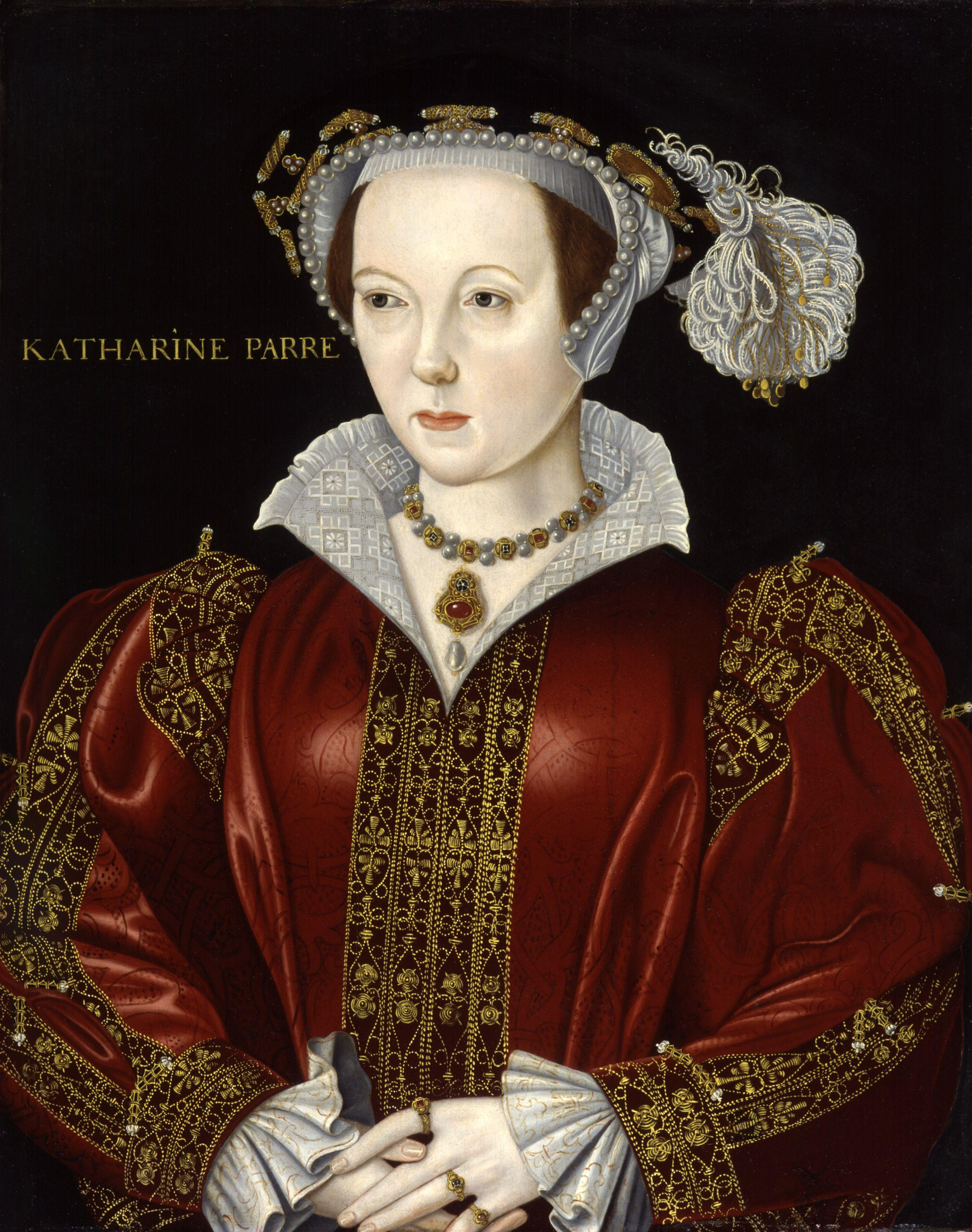
I am delighted to announce that The History Press are publishing my biography of Henry VIII's fifth wife in April 2019, with the title "Katherine Howard: Henry VIII's Slandered Queen". It presents my years of research into Katherine's brief life and offers additional content to my 2014 biography. You can preorder the book here.

I was very fortunate to offer my thoughts about Henry's youngest wife on The History Press website. You can read the thoughts here, in which I note that

Every piece of surviving evidence we have indicates that, contrary to traditional perceptions, Katherine was a conscientious queen who fulfilled her ceremonial duties aptly. I argue in my book that Katherine’s style of queenship may have been directly shaped by Henry VIII’s changing expectations about the queen’s role. Too often it is assumed that she was uninterested in fulfilling her royal duties, but it is barely ever considered that perhaps her husband had a direct say in the way that Katherine responded to her role. Had Katherine given birth to a male heir and had the king never discovered her pre-marital past, then I do believe she would have been regarded as a very successful queen consort.

Friday, 12 August 2016

Uncrowned Consorts 1066-1558


After the Norman Conquest of 1066, it became customary for the king's consort to be crowned, either alongside him or at a later date. In Anglo-Saxon England, it had not been usual for the queen to be crowned. However, William the Conqueror signalled a break with the past when he assented to the coronation of his wife, Matilda of Flanders, alongside him on Christmas Day 1066. Thereafter, the wife of the king was usually honoured with a coronation. 

As J. L. Laynesmith notes, the medieval coronation enhanced the quasi-religious nature of the royal dynasty and manifested a 'dynasty-bound divine right'. It conveyed divine favour while promising prosperity for the dynasty, provided that the king and his consort obey God's laws and govern their people equitably and justly. For the queen consort, the coronation was concerned with her role as an integral part of her husband's public body. Thus the coronation, as Laynesmith suggests, offered the consort 'a richer sense of her divinely ordained role'. 

Given that the majority of English queens in the period 1066-1558 were foreign-born, it was customary for the consort to be crowned after her arrival in England and subsequent marriage to the king. Indeed, no Englishwoman was crowned queen until Elizabeth Wydeville in 1465. The coronation, from the consort's perspective, functioned as a celebration of the ruling king's dynasty and more broadly demonstrated the wealth and magnificence of the realm which she had arrived in. 

However, not all consorts in the five hundred years after the Conquest were crowned, for a variety of reasons. These were complex in nature and included political troubles, financial difficulties, and domestic insurrection or rebellion that prevented the king from dedicating the time and expenses required to furnish his consort with a coronation. Whether or not a lack of coronation affected the consort's claim to legitimacy is a significant question that cannot always be answered straightforwardly, but it will be seen that at least in some cases, the consort felt slighted by the absence of this ceremony.

Margaret of France, second consort of Edward I
(1279-1318), consort 1299-1307


Margaret of France was the second wife of Edward I of England (1239-1307) and married the sixty-year-old on 8 September 1299 in Canterbury. The king's first wife, the beloved Eleanor of Castile, had died in 1290. Edward was desirous of achieving peace with France, which would enable him to more effectively pursue his wars with Scotland (France's traditional ally). It was agreed that Edward's son and namesake would marry Isabella, daughter of Philip IV of France, while the English king himself would marry Philip's sister, Margaret. The new queen was never crowned, although she did appear on public occasions wearing a crown and used the royal title in letters and documents. Margaret was queen for a short period, but she enjoyed some success in intercession and is credited with maintaining stable relations between her husband and her stepson (the future Edward II). Margaret was also revered for her piety and favoured the Franciscan order. She also fulfilled the queen's primary duty by giving birth to two sons: Thomas of Brotherton and Edmund of Woodstock (the latter was executed during the reign of his nephew, Edward III). Margaret died in 1318, aged about thirty-nine. She was the first uncrowned consort since the Norman Conquest, and was queen for less than eight years, but she enjoyed notable successes. 

Isabelle of France, second consort of Richard II
(1389-1409), consort 1396-1399


Traditionally, Richard II's second consort is said to have been crowned on or about 8 January 1397, but unusually, there is no extant evidence of the coronation festivities. If her coronation did take place, it must have been very low-key and this may partly be because of the hostility generated by Richard's choice of bride. The new queen was only seven years old and would be unable to bear children for some years to come. Given the uneasy political climate, it could be said that Richard had not chosen particularly wisely, although the marriage was designed to cement peaceful relations between England and France. If the coronation took place, it was apparently unworthy of being recorded for posterity; some historians doubt whether it actually took place. If it did not, Isabelle was only the second consort in over three hundred years not to be honoured with a coronation. 

Henry VIII's consorts (1536-1547)

Related image

After his failed marriages to Katherine of Aragon and Anne Boleyn, Henry VIII elected not to honour any of his subsequent four wives with a coronation. In two cases, evidence suggests that coronation festivities were planned but did not take place. Jane Seymour, his third consort, most likely would have been crowned had she lived after giving birth to her only son, the future Edward VI. Court observers reported that the king wished for Jane to be crowned in October 1536, six months after her marriage, but rumours of plague alongside insurrection in the north of England prevented the ceremony from taking place. The coronation could, and did, celebrate the queen's fertility, thus legitimising the king's dynasty. Had Jane survived the birth of Edward in October 1537, it seems reasonable to suppose that her grateful husband would have arranged for her coronation, but her unexpected death prevented this from coming to fruition. 

Henry's belief that Anne of Cleves was not his wife prevented her from receiving a coronation, while his final consort, Katherine Parr, was not favoured with a coronation for reasons that remain unclear. However, it is possible that Henry did consider crowning his fifth wife, Katherine Howard. The royal couple departed on a northern progress in the summer of 1541, partly because Henry was determined to ensure the north's obedience to him following recent rebellion in the area, and partly because he hoped to meet his nephew, James of Scotland, at York. One ambassador reported that Henry intended to have Katherine crowned at York, which would have marked a break with the past given that both Katherine of Aragon and Anne Boleyn, not to mention the medieval consorts, had been crowned in London. The coronation did not take place, perhaps because Henry was waiting for his consort to provide him with an heir. She did not, of course, and her execution the following year prevented her from being crowned.

Guildford Dudley, consort of Jane 
(c. 1537/8-1554), consort 1553


Whether Lady Jane Grey should in truth be referred to as Queen Jane I of England continues to be disputed by modern historians, but if she was rightful queen, as Eric Ives argues, then her husband Guildford Dudley should be viewed as her consort. Guildford, who was probably younger than his wife, most likely would have been crowned alongside his wife had Mary Tudor not successfully seized the crown from Jane and had the young couple imprisoned in the Tower of London. Contrary to popular belief, there is no evidence of animosity or dislike between Jane and Guildford and the young noblewoman continued to refer to herself as Lady Jane Dudley even while imprisoned. When Guildford requested to see Jane before their executions on 12 February 1554, Jane refused because the sight of one another would 'increase the misery in both, and bring much more suffering'. Fifteen or sixteen when he was beheaded, Guildford Dudley was the first male consort since Geoffrey of Anjou, husband of the Empress Matilda.

Philip II of Spain, consort of Mary
(1527-1598), consort 1554-1558

Portrait of King Philip II of Spain, in Gold-Embroidered Costume with Order of the Golden Fleece.jpg

Mary I's husband, Philip II of Spain, was never crowned. It is clear that he personally resented his wife's decision not to arrange for his coronation, because it confirmed that his wife took precedence at least in governing England. This absence of a coronation was part of a broader curtailing of Philip's powers and influence in Mary's realm. Philip was made king by an Act of Parliament stipulating that he 'shall aid her Highness... in the happy administration of her Grace's realms and dominions'. It is possible that the decision not to crown Philip was at least partly a result of the widespread antipathy to Mary's choice of a husband who was both Catholic and Spanish. 


In the period 1066-1558, the consort expected to be crowned alongside her husband (or more rarely, his wife). It was unusual for the consort not to be honoured with a coronation and usually, if the ceremony did not take place, it was due to extraordinary circumstances. These circumstances included political troubles, as in the case of Philip II; domestic insurrection and rebellion, as Jane Seymour and Guildford Dudley discovered, the latter being deposed alongside his wife; and the king's decision to wait for his consort to prove her fertility, as occurred with Henry VIII's later consorts. In the case of Margaret of France, it is unknown why her husband neglected to provide her with a coronation, although evidence suggests that she appeared wearing a crown on public occasions, a privilege denied to the other uncrowned consorts. Whether the consort accepted the absence of a crowning or not depended on their personality. No evidence survives for how Henry's later consorts felt, or perhaps Isabelle of France. Nor do we know whether Guildford Dudley minded, but given that his wife was also not crowned before she was deposed, it is unlikely that he had much say in the matter. But evidence suggests that Philip resented what he perceived as the curtailing of his rights in England; the absence of a coronation confirmed his supplication to Mary, at least in her own realm.

Monday, 30 May 2016

The End of Joan of Arc


On 30 May 1431, a young woman of nineteen years was burned to death in Rouen, Normandy. A year previously, Joan of Arc (known to the French as La Pucelle d'Orleans, the maid of Orleans) had been captured by the Burgundians, who handed her over to the English. She had almost single-handedly revived French fortunes during the Lancastrian phase of the Hundred Years' War between the traditional enemies England and France. Now, she was to die a shameful death, associated with witchcraft and heresy, a perversion of the natural order of things.

Joan had been born in northeastern France in around 1412, in an area that remained loyal to the French crown despite being close in proximity to Burgundian lands. At the age of thirteen, Joan reportedly experienced visions while in her father's garden. She saw the figures Saint Michael, Saint Catherine and Saint Margaret, who instructed her to bring about the expulsion of the English from France, and to bring the Dauphin to Reims for his coronation. Thus began Joan of Arc's mission, as she perceived it. Her experience thus far could be viewed as a sign of God's favour, uniquely bestowed upon her, but to others it betokened witchcraft.

Joan later visited the court of Charles VII, and she was financed with an army by the king's mother-in-law Yolande of Aragon. Joan requested to be equipped for war and to be placed at the head of the king's army; her requests were duly granted. Stephen W. Richey notes: 'Only a regime in the final straits of desperation would pay any heed to an illiterate farm girl who claimed that the voice of God was instructing her to take charge of her country's army and lead it to victory'. The king perhaps viewed Joan as sent from God, the means by which France could be delivered from subjection to England. Her presence offered the promise of French independence and French victory. Others, however, were concerned; they wondered whether Joan was a heretic or a sorceress, while her decision to wear the clothing of a soldier would later be brought against her. In response to initial concerns about Joan, a commission of inquiry at Poitiers concluded that Joan was 'a good Christian' and 'of irreproachable life'. Shortly afterwards, Joan visited the besieged city of Orleans in April 1429, and was present at the councils and battles thereafter.

Charles VII by Jean Fouquet 1445 1450.jpg
Above: Charles VII of France.

Joan believed that she had been instructed by God to drive the English from France and ensure that the dauphin was crowned; as she saw it, her mission was a holy one. The lifting of the siege at Orleans was perceived by contemporaries as evidence that Joan truly was God's messenger, and she gained the support of the archbishop of Embrun and the theologian Jean Gerson as a result. Joan later provided the Duke of Alencon with advice about strategy. After the lifting of the siege and the battle of Patay, which was a decisive victory for the French, Joan accompanied the victors on the march to Reims. 

Patay.JPG
Above: The Battle of Patay, June 1429.

Reims opened its gates on 16 July 1429, and the coronation took place the following morning. The French army accepted peaceful surrenders from towns near the capital. In December that year, Joan and her family were ennobled by a grateful Charles VII as a reward for her actions. Six months later, she was present at the siege of Compiegne, the scene of her final military action. Joan was ambushed and captured; later, she was imprisoned by the Burgundians at Beaurevoir Castle. She made several escape attempts, including jumping from a window 70 feet high, but miraculously survived, which was for her supporters another sign of her divine favour. Later, Joan was moved to Rouen. 

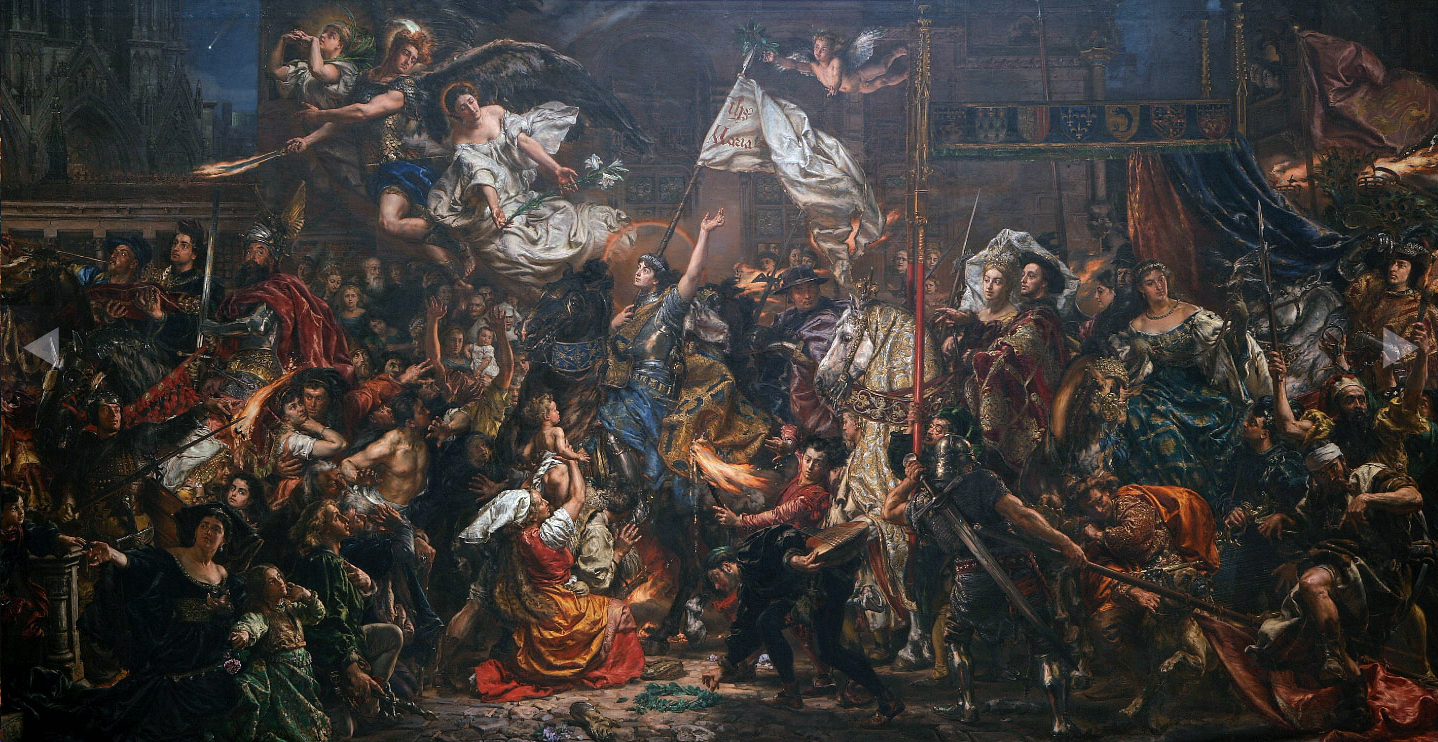
Above: Joan of Arc's entry into Reims in 1429; painting by Jan Matejko.

In early 1431, Joan's trial began. It was a contentious affair and several of the clergy had to be threatened with their lives to participate in it. These threats and the domination of the trial by a secular government actually violated the rules of the Church. Usually, a heresy trial should be conducted without secular interference. Ecclesiastical law was further violated by the refusal to allow Joan a legal adviser. Joan was charged with heresy and cross-dressing, a heinous offence in fifteenth-century eyes since it violated the natural order. Joan explained that she had chosen to wear male attire to protect herself from molestation; others testified that her dress had been taken by the guards and she had nothing else to wear. On 30 May, her execution took place. Burning at the stake was the customary method of execution for those found guilty of heresy. A crucifix was held before her by two of the clergy as she was tied to the stake. Her remains were cast into the Seine river. Some, at least, believed that a saint had been burned.

Two decades after her death, in 1452, a retrial was ordered, authorised by Pope Callixtus III at the request of Inquisitor-General Jean Brehal and Joan's mother, Isabelle. A formal appeal followed three years later, and in the summer of 1456, the court declared that Joan was innocent. She was canonised by Pope Benedict XV on 16 May 1920. 


In a short but extraordinary life, Joan of Arc was perceived in the contradictory guises of woman, warrior, saviour, heretic, witch, and saint. Following her death, she became something of a legendary figure and has inspired many by her bravery and willingness to die for her faith. She was certain that she had been chosen by God to ensure France's total victory over the English; it was the driving force in her life. Since her death, Joan has inspired artistic and cultural depictions for six centuries. Ultimately, although she did not live to see it, France's victory in the Hundred Years' War lent credence to the legitimacy of Joan's mission, signifying that she had indeed been favoured by God. Her retrial served to vindicate Joan, and in death she has been granted the admiration and awe that was largely denied to her in life. 

Friday, 9 October 2015

England's Queen Annes

Betting on The Favourite: Emma Stone, Olivia Colman and Kate Winslet.

It has been reported that an upcoming film about machinations at the court of Queen Anne of England, entitled The Favourite, will star Olivia Colman as the last Stuart monarch, Kate Winslet as the queen's intimate friend Sarah Churchill, duchess of Marlborough, and Emma Stone as Abigail Masham, favourite of the queen. What better time, then, to look at the women named Anne who rose to the position of queen of England?

Anne of Bohemia (1366-1394), consort of Richard II
Reigned 1382-1394.

Anne of Bohemia was the eldest surviving daughter of the Holy Roman Emperor Charles IV and his fourth wife Elizabeth of Pomerania. One of the more shadowy of England's medieval queens, Anne was reputed to be kind, charitable and was popular among her English subjects. The chronicler of Evesham described her thus: 'This queen, although she did not bear children, was still held to have contributed to the glory and wealth of the realm, as far as she was able. Noble and common people suffered greatly at her death'. On 20 January 1382, at the age of fifteen, Anne married Richard II of England. Her new husband was strikingly handsome, charismatic and intelligent; but he had a cruel streak and was known to be volatile, unpredictable and at times careless. The marriage was not particularly popular among the English nobility. Anne did not bring a dowry with her and the diplomatic advantages of the match were not regarded particularly favourably. As soon as she had disembarked in her new kingdom, Anne's ships were reportedly smashed to pieces - a troubling omen for superstitious observers. Despite these undercurrents of discontent, both nobles and commons alike came to regard Anne positively. She was a noted intercessor with her husband, procuring pardons for rebels involved in the Peasants' Revolt of 1381, and interceded for both John Northampton (a former mayor of London) and the citizens of London in the ceremonial reconciliation in 1392 between king and city. However, Anne failed to fulfil the most important duty of a queen consort: childbearing. There is no evidence that she was ever pregnant, leading some historians to speculate that Richard had agreed at his marriage to fulfil a vow of chastity. Anne died in 1394 at Sheen and her grief-stricken husband ordered the building destroyed. She was buried at Westminster Abbey, where her husband later joined her upon his death.

Anne Neville (1456-1485), consort of Richard III
Anne Neville portrait.jpg
Reigned 1483-1485.

Lady Anne Neville was the younger daughter of Richard Neville, sixteenth Earl of Warwick and Lady Anne de Beauchamp. Born at Warwick Castle, Anne's family was the premier noble family in the north of England. She spent her childhood at Middleham Castle in Yorkshire, residing with her kinsmen George of York and Richard of York (later to become her husband). In 1461, at the age of five, Anne's kinsman Edward earl of March became King Edward IV. In 1469, Anne's sister Isabel wed George duke of Clarence. Although her family was now closely tied to the ruling House of York, Anne's fortunes were to change drastically. Her father, immortalised as the 'Kingmaker', changed sides because of his disaffection and supported the return of the defeated Lancastrians. In 1470, at the age of fourteen, Anne was betrothed to Edward of Westminster, the only son of Henry VI and Margaret of Anjou, and was married to him later that year at Angers Cathedral, thus becoming Princess of Wales. How she felt about her husband we can only speculate; but given that Anne had been educated from birth to regard the Lancastrians as immoral, corrupt and deficient rulers, it cannot have been easy for her to suddenly regard the heir to the Lancastrian throne, her husband, with respect or affection. However, Anne's fortunes were to change again. In the spring of 1471, her former brother-in-law Edward IV returned from exile and seized the throne once more from the inept Henry VI, who was put to death in the Tower of London in May. This was a traumatic time for Anne. Her father was killed at the Battle of Barnet and her husband was killed at the Battle of Tewkesbury. Before her fifteenth birthday, the younger daughter of Warwick had lost both her husband and her father; her grief and inner turmoil can only be imagined. Richard of Gloucester, younger brother of Edward IV, was determined to wed her; whether out of genuine affection or shrewd ambition, we cannot say. Richard's brother Clarence opposed the match because he desired the entire Warwick inheritance, rather than splitting it with his brother. Anne and Richard, however, escaped Clarence's clutches and wed in the spring of 1472. A year after her first husband's death, Anne became Duchess of Gloucester, equal in rank to her sister. Perhaps in 1476, Anne gave birth to her only son Edward. Upon the death of Edward IV in 1483, Richard of Gloucester seized the throne and was crowned as King Richard III at Westminster on 6 July alongside his wife. He had usurped it from his nephew Edward V; whether Edward and his brother were put to death on Richard's orders, or escaped abroad, or were incarcerated for the rest of their lives is an issue that continues to arouse passionate debate. In the spring of 1484, Anne's son died while still an infant. She was not to bear any more children. She died on 16 March 1485. Rumours alleged that Richard had poisoned her in order to wed his niece Elizabeth of York, but he declared publicly that these rumours were false and that he had always loved Anne. 

Anne Boleyn (c. 1507-1536), consort of Henry VIII
Reigned 1533-1536.

Anne Boleyn was the younger daughter of Sir Thomas Boleyn and Lady Elizabeth Howard. She was most likely born in 1507 at Blickling Hall in Norfolk or Hever Castle in Kent, although later evidence indicates that her birthplace was London. Anne departed for the Continent in 1513 and served both Mary Tudor, queen consort of France, and Claude, wife of Francois I of France. She may also have known Marguerite of Alencon, Francois' sister. Anne was reputed to be charming, intelligent and witty and acquired an excellent education abroad. She was of medium height, with long dark hair, sparkling brown eyes, a wide mouth and elegant hands. Surviving evidence suggests that she was a skilled musician, a talented linguist and a shrewd intellectual with a fervent interest in the reformed faith. Anne returned to England to wed her relative James Butler, but the match did not come to fruition, and it is possible that she fell in love with Henry Percy, later sixth earl of Northumberland, and hoped to wed him. However, in 1526 or 1527 Henry VIII fell passionately in love with Anne and, after she refused to become his lover, proposed marriage to her. In 1533 she was crowned Queen of England upon the dissolution of his first marriage to Katherine of Aragon, and gave birth to Elizabeth in September. Hostile observers at court portrayed the new queen as a vindictive, cruel and outspoken woman who encouraged her husband to mercilessly kill his enemies, including his own daughter. These writers also claimed that Anne was responsible for the spread of heretical ideas. While Anne was undoubtedly an evangelical, she was not interested in the more extreme forms of Protestantism, and continued to favour traditional Catholic ideas such as the importance of good works. Anne was a charitable queen and concerned herself with education, providing generous assistance to the universities of Oxford and Cambridge. However, like Anne of Bohemia, she failed in her principal duty: to give birth to a son. In the spring of 1536, for reasons that remain mysterious and unfathomable to modern historians, the queen fell from favour and was arrested and imprisoned in the Tower of London alongside seven men, including her brother George Boleyn. She was found guilty of adultery and treason and was executed within the Tower walls on 19 May, and was later buried at the chapel of St Peter ad Vincula. Biographers and historians writing in the reign of her daughter Elizabeth stressed Anne's important contribution to the Elizabethan political and religious establishment, and were united in their belief that she was not guilty of the crimes for which she was put to death.

Anne of Cleves (1515-1557), consort of Henry VIII
Reigned 1540.

Henry VIII married Anne of Cleves on 6 January 1540 at Greenwich Palace in a bid to strengthen England's hand in the face of French and Imperial hostility. However, the ageing king was extremely reluctant to marry the shy and pleasant twenty-four-year old, perhaps because he found her unattractive but more likely because he believed she was already the wife of the duke of Lorraine. The marriage was never consummated. Anne was highly popular among her English subjects; the French ambassador reporting that she was viewed as 'one of the most sweet, gracious and humane queens they had had'. She enjoyed warm relations with her three stepchildren and was reputed to be especially close to her stepdaughter Elizabeth, daughter of Anne Boleyn. In the spring of 1540 Henry VIII fell in love with Anne's teenaged maid-of-honour Katherine Howard, and his marriage to Anne was annulled in July of that year. He wed Katherine less than three weeks later, on the day of Thomas Cromwell's execution. Anne died in 1557 and was buried at Westminster Abbey. Although she was rewarded with a generous settlement following the annulment of her marriage, whether she was truly relieved to be free from the tyranny of Henry VIII is open to question, since evidence suggests that she hoped to remarry him and was highly disappointed when he married Katherine Parr, rather than herself, in 1543.

Anne of Denmark (1574-1619), consort of James I
Anne of Denmark in mourning.jpg
Reigned 1603-1619. 

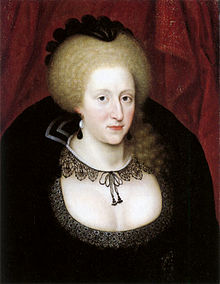
Anne was the eldest daughter of Frederick II of Denmark and Sophie of Mecklenburg-Guestrow. Born on 12 December 1574 at Skanderborg Castle in Denmark, Anne married James VI of Scotland in 1589. Her husband sailed from Leith in Scotland with a retinue of 300 to escort his wife personally to her new kingdom. They were married at the Old Bishop's Palace in Oslo later that year. Anne was described as being 'a princess both godly and beautiful... she giveth great contentment to his Majesty'. On 17 May the following year, the fifteen-year-old Anne was crowned queen in the Abbey Church at the Palace of Holyrood, the first Protestant coronation in Scotland. The royal couple's relations with one another were often tempestuous and strained, although they also viewed one another with affection. Anne's initial inability to provide her husband with an heir caused widespread consternation, but in February 1594 she gave birth to Henry Frederick, who later died at the age of eighteen from typhoid fever. When she discovered that she would have no involvement in her son's care, the queen reacted furiously and demanded that the Council resolve the matter. So upset was she that she suffered a miscarriage in the summer of 1595. The following month, it was reported that 'there is nothing but lurking hatred disguised with cunning dissimulation betwixt the King and the Queen, each intending by slight to overcome the other'. This episode seems to suggest that Anne was a resourceful, intelligent and proactive consort who was not afraid to pursue her rights. The royal couple were in conflict with one another over the issue of religion (Anne was rumoured to secretly favour Catholicism) and because of the king's favourites. Anne died in 1619 of dropsy and was buried in King Henry's Chapel, Westminster Abbey. Upon her husband's death in 1625, her second son Charles became king of England.

Anne (1665-1714), queen regnant
Anne1705.jpg
Reigned 1702-1714. 

Elizabeth I and Victoria remain England's most famous and celebrated queen regnants, but the only Anne to rule in her own right was the daughter of James II of England and Anne Hyde, duchess of York. Anne was highly popular upon her accession in 1702 at the age of thirty-seven, and described herself as being 'entirely English', in contrast to her Dutch brother-in-law. She promised to concern herself with attaining 'happiness and prosperity' for her country; like her fellow queen regnant Elizabeth I, Anne was careful to present the welfare of England as her abiding mission as ruler. The new queen, however, suffered ill health throughout her life. At her coronation, she had to be carried to Westminster Abbey in an open sedan chair because of her crippling gout. Anne's reign is especially memorable because the Act of Union was passed in 1707, thus uniting the kingdoms of England and Scotland in a single kingdom known as Great Britain. The queen attended a thanksgiving service at St. Paul's Cathedral immediately afterwards and was reported to be 'sincerely devout and thankful'. Anne was married to Prince George of Denmark, with whom she enjoyed good relations. The queen was devastated when her husband died in 1708. She had become pregnant seventeen times by him but, tragically, none of her children survived. Her son, Prince William, lived to the age of eleven before dying tragically in July 1700. Anne's health worsened during her reign and, in the final year of her life, suffered fevers and strokes. Anne has come to be regarded positively as a shrewd politician who achieved notable political and diplomatic achievements as queen regnant, including the Act of Union in 1707. 


Saturday, 25 July 2015

Queen Mary I's Wedding to Philip II of Spain

July 25, 1554 was a monumental day for England's first queen regnant, Mary Tudor. On the feast of St. James at Winchester Cathedral, the English queen married her cousin Philip of Spain. At thirty-eight years of age, Queen Mary was no longer the radiant beauty of her youth. Her famously beautiful golden-red hair was now streaked with gray, while the first lines were beginning to mark her earnest face. Notwithstanding this, the queen was attired magnificently in 'rich apparel', including a golden robe and a gown of rich tissue embroidered upon purple satin (purple being the colour of royalty) set with pearls and lined with purple taffeta, and a kirtle of white satin embroidered with silver. Mary was accompanied by loyal members of the nobility. Her soon-to-be husband was also splendidly attired in gold. The earl of Derby carried the sword of state before her, while her train was borne by the marquess of Winchester. Notable attendees included the bishops of Winchester, London, Ely, Durham, Chichester and Lincoln.  

The wedding was attended by vast numbers of observers, who 'gave a great shout' of joy upon witnessing their sovereign's marriage. The queen's absence of close male relatives meant that she was given away by the marquess of Winchester and the earls of Derby, Bedford and Pembroke. Following a nuptial mass, Philip and Mary proceeded to the bishop's palace under the canopy of state. The couple spent several joyous days in Winchester following their summer wedding. They then departed for Windsor and then to London, in order for the capital's inhabitants to welcome their queen and new king. Several weeks later, it was confirmed that the queen was pregnant. This could rightly be viewed as the happiest period of Queen Mary's tumultuous life. Sadly for her, however, she did not prove to be with child, and her 'pregnancy' ended in humiliation in the late summer of 1555, when it was confirmed that the queen had instead suffered from 'long-standing menstrual problems and a great deal of wishful thinking' (Weikel). 

Although Mary had joyfully anticipated her wedding to Philip, it proved to be a volatile marriage that was marked by the queen's love and loyalty to her husband on her part and restlessness and exasperation on his part. It is questionable whether Philip ever loved his wife. Almost certainly ambition played a greater role in his decision to marry the queen of England. At her death in the winter of 1558, he remarked that he felt only minor regret. Their marriage was marked by frequent absences from one another, and tragically for both king and queen, their union was never to be blessed by the birth of an heir with which to inherit the crowns of England and Spain.

Thursday, 14 August 2014

Margaret Tudor: the Forgotten Tudor?


Above: Margaret Tudor, queen of Scotland.
(accessed: http://www.nndb.com/people/074/000095786/).

Henry VIII tends to outshine all of his siblings, for obvious reasons. Even so, most people, thanks to The Tudors' brazen portrayal, have some knowledge of his younger, impetuous sister Mary Tudor, who married first the king of France and later her brother's best friend, Charles Brandon, duke of Suffolk. Henry's elder brother Arthur Tudor, heir to the throne until his death at fifteen, is generally known for being the first husband of Henry's first wife, Katherine of Aragon. Controversy raged as to whether Arthur and Katherine had consummated their marriage. 

But few are generally aware of Henry's elder sister, Margaret Tudor, who, like her younger sister Mary, was a queen. Margaret's life, in fact, was every bit as tumultuous and volatile as that of her younger brother. Her marriages and politics significantly shaped the future of both Scotland and of England. She was the grandmother of Mary Queen of Scots and the great-grandmother of James VI of Scotland and I of England. Her actions, in fact, played some part in the later union with England which was to result in the Act of Union in 1707. It might then be asked, how is it that Margaret remains so obscure a figure?


Above: Margaret's parents, Henry VII (left) and Elizabeth of York (right).

Margaret Tudor was the second child of Henry VII and Elizabeth of York, who had married in 1486. She was born on 28 November 1489 at Westminster Palace in London. Although her father surely hoped for a second son, royal daughters were extremely useful because, through their marriages to foreign powers, they allied their countries with powerful states in prestigious unions. She spent her early years at her father's favourite place, Sheen, near the Thames (the palace was later renamed Richmond Palace), until a fire caused the royal nursery to be moved to Eltham. Margaret at an early age learned to play the lute, clavichord and to dance, traditional skills associated with feminine royalty. She also studied Latin and French, and pursued archery. It is likely that Queen Elizabeth ensured that her daughter also learned the traditional female skills of embroidery, sewing, and housewifery. 

Henry was determined to bolster the prestige of the Tudor crown, particularly because pretenders continued to threaten its security. The Yorkist threat remained, meaning that the Tudor dynasty remained fragile. At the same time, England sought to achieve harmony with its northern neighbour, for the two had customarily experienced hostile and suspicious relations with one another. In view of these factors, it is unsurprising that the Tudor king arranged for his eldest daughter Margaret to marry James IV, King of Scots, a man sixteen years her senior. On 24 January 1502, the marriage treaty between England and Scotland was concluded. Henry promised a £10,000 dowry for his daughter's hand, while the Scottish king swore his bride would receive £1000 Scots per annum alongside lands and castles affording a further income of £6000 each year.

Above: James IV of Scotland, first husband of Margaret Tudor.

In February 1503, the royal family was plunged into tragedy with the death of the queen and Margaret's mother, Elizabeth of York, at the Tower of London aged thirty-seven. How Margaret felt is unknown, but at just thirteen years of age, it is reasonable to believe it impacted severely upon her. Nonetheless, preparations for her journey to Scotland continued, and on 8 July she commenced her journey north, her retinue led by the Earl of Surrey. The formal marriage service took place in Holyroodhouse on 8 August 1503. As historians have conjectured, Margaret may have found it discomfiting that her husband had seven bastard children, housed in her own dower castle of Stirling, and continued to visit his mistress Janet Kennedy. 

Margaret's most important role as queen was to produce a male heir to safeguard the dynasty, and she duly did so in 1507, but the prince, named James for his father, died at Stirling in February 1508. A daughter born in July of that year died the same day. Like her sister-in-law Katherine of Aragon, Margaret experienced some tragedies in childbirth, but she was later to produce a healthy son. On 11 April 1512, aged twenty-two, Margaret gave birth to James, who later became James V, on his father's death at the Battle of Flodden on 9 September 1513. 

Margaret was, according to her husband's will, to serve as regent, provided that she did not remarry. Four nobles headed a council to assist her in governing the realm. On 6 August 1514, less than a year after her first husband's death, Margaret remarried. Her husband was Archibald Douglas, sixth earl of Angus, the greatest Scottish magnate. Because of this decision, Margaret renounced her position as regent of the realm. Margaret's decision was perhaps regarded as impetuous and foolish, but she perhaps sought a measure of security and stability, being as she was a young widow with an infant son, alone in a foreign realm. 

Above: Mary Stuart, queen of Scotland, was the granddaughter of Margaret Tudor.

The council subsequently invited John Stewart, cousin to the late king, to become regent. Margaret was distrusted, for her husband was extremely unpopular with the other magnates, and because she was rumoured to favour England over her adopted realm. Margaret deeply distrusted and resent Stewart, duke of Albany, and encouraged her brother, Henry of England, to restore her authority by force. On 30 September 1515, desperate and disillusioned, the former queen fled to England, in a move that strikingly foreshadowed that of her granddaughter Mary Stuart some fifty years later. Both queens sought refuge and assistance in England. 

On 7 October, the heavily pregnant queen gave birth to a daughter, Margaret Douglas. The ordeal nearly killed her and left her very weak. When she lay seriously ill at Morpeth, her second son Alexander died in December of that year. On 3 May 1516, Margaret arrived in London and met her brother for the first time in thirteen years, since she had left for Scotland in summer 1503. She remained in England for over a year, separated from her husband, while the Scottish council promised to send the jewels after her and to pay her rents. While she received her jewels, her revenues were not in fact restored, forcing the humiliated queen to seek money from Cardinal Thomas Wolsey.

In May 1517, Margaret journeyed back to Scotland, having been promised in advance that she would be treated well and would not be arrested, nor would her company be. However, her marriage to Angus was coming under increasing strain. Her husband had taken a mistress while Margaret had resided in England, and he had taken the queen's rents from Methven and Ettrick Forest. When she discovered her husband's affair, Margaret begged Henry to let her return to England. He refused, and urged her to return to her husband. Because of this, coupled with Scottish diplomatic politics in which closer links were sought with France as a means of securing both powers in the case of an English invasion, Margaret had become a marginal figure in Scotland by 1519. 


Above: Margaret's younger brother, Henry VIII, king of England.

Conflicts between Albany and the Scottish nobles persisted, especially due to Albany's detainment in France. In December 1521, Albany returned to Edinburgh and was warmly welcomed by Margaret, who hoped that he would restore her revenues and help her obtain an annulment of her unsuccessful marriage to Angus. Henry VIII became aware of rumours that his sister was Albany's mistress and rebuked her in a letter, causing the indignant Margaret to write an emotional reply to his 'sharp and unkind letter'. Albany banished Angus and his brother George to France, and even gathered an army in September for the purpose of invading England; although the memory of Flodden deterred him from pursuing this course. Eventually, a truce was achieved. 

When Albany left again for France in 1524, Margaret won the support of the Hamiltons, a powerful Scottish noble family, headed by the second earl of Arran. A coup was achieved which brought to an end Albany's regency and on 26 July of that year, invested Margaret's twelve-year old son James with full royal authority. Margaret's government met with hostility and suspicion, however, for it was perceived that the queen lacked good counsel, and the duke of Norfolk wrote to Wolsey of how unpopular Margaret had become, as a result. Margaret continued to urge Albany, who resided abroad, to help her seek a divorce from Angus, who troubled her. She had determined to marry Henry Stewart, her treasurer. The Pope finally annulled the marriage in March 1527, on the grounds of Angus' pre-contract to Lady Jane Stewart. Soon afterwards, the infatuated Margaret married Henry Stewart, and acknowledged him as her husband for the first time about April 1528. Angus retaliated by arresting Stewart and confining him, but James V expelled not just Angus, but his own family, from government. Henry was created Lord Methven and the Douglases were found guilty of treason. Margaret, however, was furious when her brother sheltered Angus in England.

Margaret's relations with her son were complex, especially because of conflict regarding foreign policy. Margaret favoured closer relations with her home country, England, and encouraged her son to marry his cousin, Mary Tudor, daughter of Henry VIII and Katherine of Aragon. James, however, renewed the French alliance. The queen's hopes of an Anglo-Scottish alliance were dashed when her son married Madeleine of Valois in 1537.

James V of Scotland2.jpg
Above: James V of Scotland, son of Margaret Tudor.

Margaret's personal difficulties with her husbands continued, for Lord Methven had taken a mistress by the mid-1530s, causing her to send a stream of letters to Henry VIII and his ministers complaining. He had so wasted her revenues that she was 8000 marks in debt. She sought to divorce him but was unsuccessful, although she did try to escape to Berwick in autumn 1537 before being intercepted. Queen Madeleine had died in July of that year, and her son, who continued to favour an alliance with France, married Marie of Guise, whom Henry VIII had shown some interest in as a prospective bride after the death of his third consort, Jane Seymour. 

Margaret's final years were unsuccessful, lonely and unhappy. On 18 October 1541, aged fifty-one, she died after experiencing a stroke at Methven Castle. Her son did not arrive in time, although his mother had requested his presence at her deathbed. She was buried in St John's Abbey in Perth. 

Richard Glen Eaves writes of Margaret thus:

'It is difficult to gain a clear impression of Queen Margaret, in terms either of her personality or of her impact on events... It seems clear that her years in Scotland were generally unhappy. She was only twenty-three when her first husband was killed, her two subsequent marriages both failed utterly, and she had limited contact with both her son in Scotland and her daughter in England... But in one respect she was undeniably a successful queen, for it was from her first marriage that there sprang the line that eventually united England and Scotland'.