Showing posts with label mystery. Show all posts

Saturday, 24 October 2015

The Stereotyped Six Wives: Three: 'As Gentle A Lady'


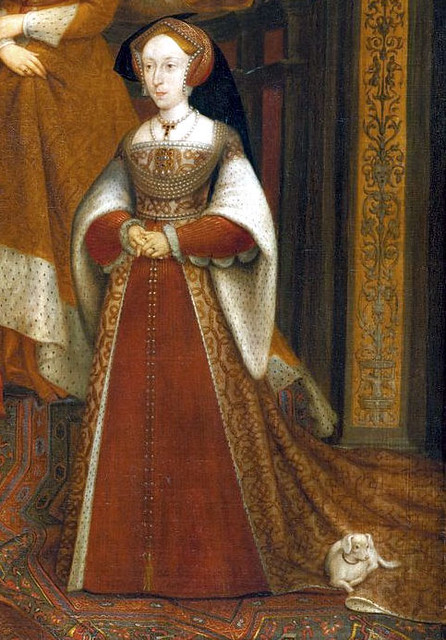
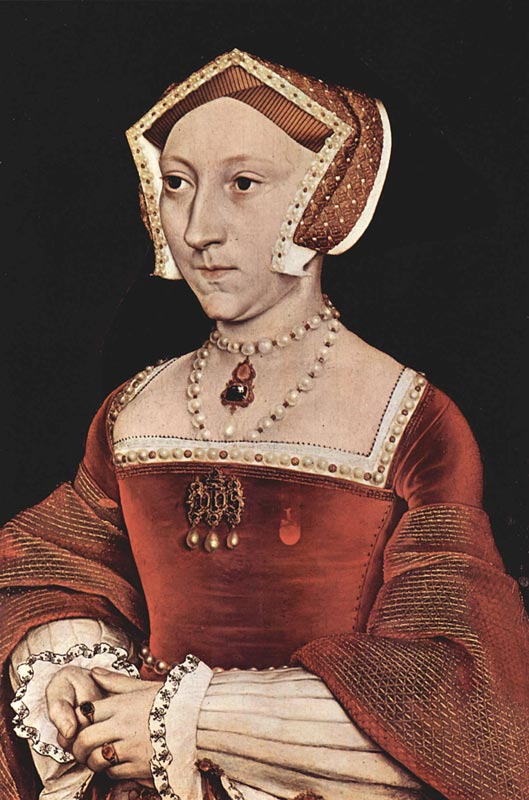
Jane Seymour, third wife of Henry VIII of England
Lifetime: c. 1508/9 - 24 October 1537
Reigned: May 1536 - October 1537 (1 year, 5 months)
Pregnancies: 1
Edward VI of England: 12 October 1537 - 6 July 1553

In this new six-part series, I will be reexamining the lives and personalities of Henry VIII's six wives, seeking to portray their lives realistically in a process that discards prevailing stereotypes. Much scholarly work has been done on Henry's reign in recent decades, affording fresh insights into the politics and achievements of the period. Understandably, widespread interest in Henry's marital affairs remains unabated. Yet stereotypes continue to bedevil our knowledge of the wives of this most enigmatic king. 

Jane Seymour, third wife of Henry VIII, became Queen of England upon her predecessor's execution for treason in May 1536. An unassuming woman in her late twenties, Jane is perhaps the most elusive of Henry's queens. Scarcely any evidence survives for her true personality. She was Henry's wife for merely seventeen months; yet her period as queen was tumultuous, in that it witnessed the restoration of Mary Tudor to favour, the unrest of the Pilgrimage of Grace, and the long-awaited birth of a healthy son to the king. Jane has attracted few biographers because of the shortage of evidence concerning her. In many ways, though, the mystery of Jane Seymour makes her as fascinating a person of study as Henry's other wives. Whether Henry VIII truly did love Jane, his 'entirely beloved' third wife, as legend has it, is an issue that has provoked considerable debate. In actuality, the tantalising evidence we have suggests that the story is more complex. Jane's queenship was passive and her famously meek, subdued character may have owed far more to the control of her domineering husband than is usually considered.

Above: Hampton Court Palace, where Jane Seymour died merely twelve days after the birth of her son.

Jane was the fifth child and eldest daughter of Sir John Seymour and Margery Wentworth. Twenty-nine ladies walked at her funeral procession in 1537 to mark her age: whether that means she had reached her twenty-ninth birthday, or whether she was in her twenty-ninth year, is uncertain, but it indicates that she was born either in 1508 or 1509. As with Anne Boleyn, Jane's father was much favoured by Henry VIII. Sir John Seymour, a 'gentle, courteous man', had been knighted by Henry VII at the battle of Blackheath in 1497 and later accompanied Henry VIII on the French campaign in 1513. By 1532 he had become a Gentleman of the Bedchamber, and had acted as Sheriff of Wiltshire and Dorset. Sometime in the late 1520s, Jane arrived at court to serve Queen Katherine of Aragon. It is often assumed, with little supporting evidence, that Jane was loyal to Katherine and modelled herself on her. Aside from Jane's preference for gable hoods, which Katherine also liked, and Jane's later friendship with Katherine's daughter Mary, there is barely anything to suggest that Jane particularly admired Katherine or empthasised with her during the annulment proceedings.

Although she is rarely termed stupid, Jane is often regarded as being poorly educated. Indeed, there is no evidence that she had an aptitude for languages, and unlike Anne Boleyn she was not selected to participate in court masques, which suggests that her dancing and musical ability were unexceptional. Yet she was renowned for her talent in needlework and embroidery, with some of her work surviving well into the following century. Her contemporaries were also not especially enthusiastic about her appearance. Polydore Vergil described her flatteringly as 'a woman of the utmost charm both in appearance and character', but the Spanish ambassador was of the opinion that she was 'of middle stature and no great beauty', with a 'pure white' complexion. He also reported rumours that she was both 'haughty' and 'proud'. 

Indeed, it is the very absence of evidence which makes it so difficult to grasp Jane's true personality. Most historians often refer to her piety and virtue, but aside from Luther's belief that she was 'an enemy of the gospel' - in other words, she was a devout adherent of the Catholic faith - there is barely anything to suggest that she was especially pious. In contrast to Anne Boleyn, who assisted religious reformers, or Katherine Parr, who wrote evangelical works of devotion, Jane was entirely conventional in her religious devotions and may not have been interested in taking an active role in religious politics. The absence of her involvement in court masques and dances, or poetry celebrating her talents, can tentatively be interpreted to mean that she was not talented musically or artistically. 


For whatever reason, by early 1536 Jane Seymour remained unwed. At the age of twenty-six, it was certainly strange that her father had not arranged an advantageous marriage alliance for her, and even more unusual given that she was the eldest daughter. Her younger sister, Elizabeth, had married in 1531 and later remarried, to the son of Thomas Cromwell. Why no marriage had been arranged for Jane remains a mystery. We can only wonder how she herself felt about this: did she passively accept her fate as God's will, something to be accepted with resignation? Did she rebel, passionately hoping for an excellent marriage one day? We can only guess. Jane's fortunes, however, took a dramatically unexpected turn in the spring of 1536. Devastated by his wife's miscarriage, and uncertain whether his second marriage had won him divine favour, Henry VIII was susceptible to a new flirtation. For reasons that have puzzled historians for centuries, the object of his affections was Jane Seymour, the unassuming and apparently unremarkable attendant of the queen. 

Historians have generally suggested that Henry VIII was attracted to Jane because she 'was unquestionably virginal' and because 'there was certainly no threatening sexuality about her'. In short, it was her virtue, her piety and her goodness that charmed the ageing king. By extension, these same historians seem to imply that these were qualities decidedly lacking in Anne Boleyn, thus conveniently ignoring the considerable evidence of Anne's piety and the importance she placed on her virtue. While Henry may have been captivated by Jane's demeanour, there may be a darker story at place here.

As queen, Jane selected the motto 'Bound to Obey and Serve', thus confirming her submission to Henry VIII's will both as her husband and as her king. How far the king himself directed his new wife in this, however, should be considered. Henry VIII had been dangerously obsessed by Anne Boleyn, an assertive, educated and independent young woman who had refused to become involved with him because it offended her piety and endangered her virtue. Anne's inability to provide the much-desired male heir had gradually reduced Henry VIII's burning love to burning hatred, leaving him with a strong desire to destroy her and rejoicing in her execution, to the surprise even of Ambassador Chapuys. With Jane, he had no wish to be denied and no wish to be told 'no'. Jane's motto confirmed her husband's control of her and signalled to the world that passivity and submission, rather than the proactiveness of Katherine of Aragon and Anne Boleyn, would characterise Jane's rule. 

Above: Edward VI of England was born on 12 October 1537, only child of Jane Seymour.

Just as it is problematic to view Anne Boleyn as directly responsible for Katherine of Aragon's rustication from court and ill-treatment, so it is erroneous to view Jane as responsible for Anne's brutal end, as Victorian historians often did. In questioning her morals and condemning her actions, as Agnes Strickland did, these historians failed to understand the position Jane was in and the character of the man she married. Like Anne, she simply could not say no. With the passing of time, Henry had become increasingly autocratic and, on the single occasion that Jane did dare to voice her true opinion, she was brutally put in her place by her irascible husband, who warned her to consider her predecessor's fate before involving herself in affairs of state. There is scarcely any evidence for Jane's supposed love and admiration of Queen Katherine, and there is next to no evidence that she was hostile to Anne or resented her rise to queenship. While she did offer friendship to Mary Tudor once she had married Henry, this is understandable given their closeness in age and their shared devotion to the Catholic faith. In 1536, perhaps Jane, mindful of Henry's rejection of Anne and indifference to his second daughter, wisely judged it best not to antagonise her husband by showing marked favour to her stepdaughter Elizabeth. 

The absence of evidence for her inner feelings means that we cannot suggest that Jane was hostile to Anne Boleyn or deliberately sought to bring her down because of her aversion to the reformed faith favoured by Anne or because of her supposed loyalty to Katherine. In rejecting Henry's advances, in refusing to accept presents of money from him, in behaving 'modestly' rather than flirtatiously, perhaps Jane intended to signal a lack of interest that may well have been genuine. Her true feelings for Henry are usually ignored in the rush to condemn her supposedly callous behaviour. Jane Seymour's personality and motivations are swathed in mystery and remain largely inscrutable. She may have been ambitious, but equally she may have felt that she had no choice, as Katherine Parr did when presented with an unwanted marriage proposal by the king in 1543. Perhaps Jane resented Anne, but equally she may have accepted her as her mistress and wished to show her no ill-will. What does seem likely, however, is that Jane was coached by her ambitious relatives to attract the besotted king. Certainly they profited handsomely from her rise: her brother Edward became Viscount Beauchamp and her brother Thomas was knighted. It is uncertain whether Jane was a willing participant in the schemes of 1536 or whether she was manipulated by her family to serve their own ends.

Jane was never crowned as queen and her reign was entirely passive, as Pamela Gross noted in her academic study of Jane. She has usually been credited with restoring Mary Tudor to favour, but it is more likely that it was Henry himself who approved and brought about his daughter's return to court only after she had grovelled to him for her disobedience: 'I beseech your Majesty to countervail my transgressions with my repentance for the same'. Jane may have been sympathetic to Mary but she was not responsible for the latter's return to favour. Even if she had wished to enjoy Mary's company, Jane would not have forgotten for a second that her primary duty as queen was to provide a male heir, and would have acknowledged that Mary's position as the bastard of an unlawful union was a foreboding reminder of her own perilous position. As Henry himself warned Jane ominously: 'She ought to study the welfare and exaltation of her own children, if she had any by him, instead of looking out for the good of others'. 


Despite the oft-repeated legend that Jane Seymour was Henry VIII's most beloved wife, there is, in fact, surprisingly little evidence of his love for her dating from her own lifetime. As noted earlier, when she had voiced sympathy for Mary her husband had bluntly advised her to concern herself with producing an heir herself. If the story of her plea for the abbeys to be saved from dissolution is true, then Henry's response, in brutally reminding her of Anne's fate, is indicative of a bullying husband seeking to control a wife and prevent her from becoming unruly. Within days of his marriage to Jane, Henry VIII reportedly was acquainted with two beautiful women and voiced regret that he had not met them before he had remarried. The Second Act of Succession, which was passed in the summer of 1536, vested the succession either in Jane Seymour's offspring or in the offspring the king might have with any future wife. How Jane viewed this Act cannot be known, but as the months passed without a pregnancy, she must have lived in considerable anxiety, if not fear.

Described by Cromwell as 'a most virtuous lady', Jane conformed entirely to Henry's wishes. If she had ambition, she suppressed it. If she held opinions, she chose not to voice them. If she disagreed with her husband's policies, she did not inform him. How far Jane willingly assented to her marginalisation, how wholeheartedly she embraced her motto 'Bound to Obey and Serve', are questions that simply cannot be answered. Yet she had witnessed Katherine of Aragon's determined refusal to obey Henry's wishes, and she had heard of the ill-treatment inflicted on the proud queen in consequence. Jane's own marriage had been made in blood: her former mistress had been imprisoned, tried and executed in less than three weeks mainly because she had failed to give her husband a son. 

Jane's queenship is characterised by most historians as passive, but they have not usually considered whether she was willing in the circumscribing of her queenly authority. In concerning herself solely with domestic affairs, Jane sought to please her husband, but his threatening behaviour on several occasions towards her was a chilling reminder of the danger she faced if she displeased him. By giving birth to her son Edward on 12 October 1537 at Hampton Court Palace, Jane earned Henry's undying love and appreciation, but during her own lifetime he never demonstrated the constant passion he felt for Anne Boleyn, or the unswerving devotion he experienced for Katherine Howard. In her own lifetime, Jane was a cipher. During her brief tenure as queen, she walked on a knife edge. Her two predecessors had been rusticated and had died, alone and shamed, for their failures to give birth to a son. This thought must have constantly been in Jane's mind, and her overriding emotion at providing the male heir in the autumn of 1537 may well have been relief.

Philippa Gregory's new novel The Taming of the Queen, which describes the life of Katherine Parr as queen, focuses on the circumscribing of the queen's authority, the restriction of her power and the utter submission of the queen to her husband. This portrayal could, with some fairness, apply to Jane Seymour. Her reign has been viewed as unremarkable and devoid of achievements, with the exception of Prince Edward's birth. Historians have appreciated that, outside of her immediate household, the queen was little more than a cipher, never exercising the militant authority of Katherine of Aragon or seeking to influence religious policies, as did Anne Boleyn. But they have, tellingly, failed to consider how willing Jane was in the restrictions she faced. Perhaps she willingly accepted them, perhaps she accepted her submission as the price of her queenship. Or perhaps she resented the limits imposed on her and bridled when faced with her husband's suffocating presence.

There is no evidence to suggest that Jane was unquestionably hostile to Anne Boleyn and sought her destruction, nor is there evidence that she admired and revered Katherine of Aragon. There is scarcely any evidence for Henry's supposed love for her. It was only after her death that Jane became 'entirely beloved' and her memory revered. Only in 1544 was she celebrated in Holbein's painting as Henry's one true wife, rather than Katherine Parr, his queen at the time. Jane Seymour's queenship was circumscribed, 'tamed'. She remains a mystery because she was a cipher at court. What emerges from the sources is the strong likelihood that it was Henry VIII who was responsible for holding her in submission and curtailing her authority to ensure that she pleased him and conformed to his will. 


Thursday, 13 December 2012

A Tudor Mystery: What Happened to Amy Robsart?

Portrait of a lady, possibly Lady Amy Dudley nee Robsart (1532-1560).

The death of Lady Amy Dudley nee Robsart on 8 September 1560 has generated considerable controversy. What led to the death of this prosperous gentlewoman, discovered at the bottom of a flight of stairs in Cumnor Place, Oxfordshire? The only child of Sir John Robsart, Amy married the wealthy and successful Robert Dudley, son of the Duke of Northumberland, in 1550 aged eighteen. Rumours circulated at the time and have intensified in modern times that the couple's marriage was unhappy, prominently because of Robert's close relationship - some believed love affair - with the Princess and later Queen Elizabeth. An impenetrable mystery surrounds the circumstances which caused Amy's death, although there are several possible explanations: suicide, cancer, murder (by either the Queen's agents, Dudley's agents, or Cecil's agents) or, simply but tragically, an accident. For an enjoyable - if taken with a pinch of salt - fictional take of Amy's relationship with Robert and her eventual death, readers should consider reading Philippa Gregory's The Virgin's Lover.

First, let us begin with the facts. Amy Dudley, despite being the daughter-in-law of a duke (later disgraced), did not accompany her husband Robert to court in 1559 when he served the new Queen, Elizabeth I, as her faithful courtier. She seems to have spent her time travelling around the country and visiting family friends, while she seems to have enjoyed spending money on clothes from London.

We do not know the personal details of Robert and Amy's marriage. In an age in which marriages between the gentry and aristocracy were arranged for social, material and political advantage, individual couples did not prioritise finding happiness or love in marriage, although of course it was beneficial when this did occur. The couple had no children, yet we do not know whether this was due to fertility problems or whether it was because the couple were often separated. Rumours have circulated that Dudley enjoyed a love affair with Queen Elizabeth, scandalously conveyed in Gregory's novel, yet again, we lack any real proof to fully substantiate this claim. However, courtiers did mention that for over a year before Amy died, the queen and her favourite had merely been waiting for Amy to die so that they could marry.

It is plausible, however, that Robert and Amy's marriage was not entirely happy. They were often separated, had no children, and since many believed after Amy's death that Robert had actually murdered his wife, it seems credible to argue that contemporaries were aware that the marriage was somewhat difficult. After the summer of 1559, Robert never saw Amy again.

On 8 September 1560, the day after the Queen's birthday, Amy Dudley sent away her servants from Cumnor Place, as described by Robert's steward Thomas Blount:

would not that day suffer one of her own sort to tarry at home, and was so earnest to have them gone to the fair, that with any of her own sort that made reason of tarrying at home she was very angry, and came to Mrs. Odingsells ... who refused that day to go to the fair, and was very angry with her also. Because [Mrs. Odingsells] said it was no day for gentlewomen to go ... Whereunto my lady answered and said that she might choose and go at her pleasure, but all hers should go; and was very angry. They asked who should keep her company if all they went; she said Mrs. Owen should keep her company at dinner; the same tale doth Picto, who doth dearly love her, confirm. Certainly, my Lord, as little while as I have been here, I have heard divers tales of her that maketh me judge her to be a strange woman of mind.

Perhaps suspiciously, she was later described as being angry when her three servants resisted her desire that they leave. Later that day, she was discovered at the bottom of a flight of stairs with a broken neck and two head wounds. So what caused Amy's death?

Firstly, this article will consider the modern explanation of Amy suffering a malady in her breasts which caused her death. It was assumed at the time of the death in 1560 that a simple fall could not have caused Amy's death - there were not particularly many steps as it was a short flight, while Amy's headdress was described as still remaining perfectly undisturbed on her head.  In 1956, Ian Aird proposed this theory, arguing simultaneously that "a verdict of misadventure, in the case of accident, [is] not easily acceptable". Aird's profession as a professor of medicine undoubtedly aided him in putting forward the theory that, rather than suicide, accident or murder, Amy was suffering from breast cancer and so may have meant that her neck was particularly fragile and could break easily. This theory has become somewhat popular in modern times. As he noted: "in a woman of Amy's age the likeliest cause of a spontaneous fracture of the spine would be a cancer of the breast..." Indeed, the Count of Feria reported in April 1559 that Amy Dudley "had a malady in one of her breasts". When one reads Aird's article, his argument that Amy's death resulted from a fall down the stairs, which was worsened than it would otherwise have been by a weakened spine caused by breast cancer, his viewpoint is compelling. Yet it has been attacked. Simon Adams, for instance, asserts that "this theory accounts for a number of the known circumstances, but a serious illness in April 1559 is difficult to reconcile with her extensive travelling in the following months".

An alternative explanation is suicide. If she was suffering illness or depression, even potentially breast cancer, this may have led her to commit suicide in an attempt to escape a life no longer bearable. This can be supported by evidence of her "desperation" in some sources, while some historians have put forward the hypothesis that Amy sent away her servants on the morning of 8 September in order to commit suicide secretly. Robert Dudley himself may have alluded to this possibility. However, Aird attacked this view, stating that "to project oneself down a flight of stairs would not occur to a suicide now, and would have occurred even less to an Elizabethan suicide at a time when the steps of staircases were broad and low, and the angle of descent gradual". Furthermore, it is difficult to believe that, if Amy killed herself, her headdress would still have remained upright on her head when she would not have been able to do this if she was dead by the time she fell to the bottom of the stairs.


Others have suggested that Amy's death was accidental. James Gairdner, in 1898, suggested that her death was a tragic accident. The coroner's verdict in 1561 was that Amy Dudley, "being alone in a certain chamber... accidentally fell precipitously down" the stairs next to the chamber "to the very bottom of the same". This caused two head injuries and injuries to one thumb. Tragically, she had broken her neck in the fall. Because of this, she "died instantly... the Lady Amy... by misfortune came to her death and not otherwise, as they are able to agree at present". However, historians have suggested that Robert Dudley, as an influential and powerful courtier, was able to influence the jury. Aird has argued that "there are several circumstances in relation to Amy Robsart's death which made her contemporaries, and which have made the historians of later times, a little hesitant to accept unreservedly the jury's verdict of misadventure". 


Perhaps most famously, it has been theorised that Amy was, in fact, murdered. Following her death, there was "grievous and dangerous suspicion, and muttering" in both court and country, as people murmured about Amy's death and the renewed relationship between the Queen and her favourite, Dudley. William Cecil, who was Principal Secretary and who has been argued felt threatened by Dudley's increasing influence, informed the Spanish ambassador in the aftermath of Amy's death that Elizabeth and Dudley had been plotting to murder Amy by poison, "giving out that she was ill but she was not ill at all" (which somewhat contradicts the evidence put forward earlier that she was ill). In 1567, Amy's half brother John Appleyarde, in irritation with Dudley, stated that he "had not been satisfied with the verdict of the jury at her death; but that for the sake of Dudley he had covered the murder of his sister". Contemporary evidence raises the possibility that Amy was murdered.


The discovery of the contemporary Spanish ambassadors' correspondence in the nineteenth century supported the theory of murder, reporting that Amy was ill and her husband had been trying to either poison or divorce her as early as the spring of 1559. The report from 11 September 1560, three days after Amy's death, states that Cecil believed that Dudley had murdered his wife. A 1563 chronicle, written by someone violently hostile to the Dudleys, suggested that Robert Dudley's retainer, Sir Richard Verney, murdered Amy by breaking her neck (this is fictionalised in The Virgin's Lover). Catholic exiles wrote the satirical Leicester's Commonwealth in 1584 and, hostile to Dudley, suggested that Verney sent Amy's servants to the market when he arrived at Cumnor Place before breaking Amy Dudley's neck and placing her at the bottom of the stairs. The Victorian historian James Anthony Froude, having found the Spanish ambassadorial correspondence, wrote in 1863 that: "she was murdered by persons who hoped to profit by his elevation to the throne; and Dudley himself... used private means... to prevent the search from being pressed inconveniently far". Alison Weir, in 1999, suggested that Cecil, rather than Dudley, arranged Lady Amy's death because he had a murder motive, ie. to prevent Dudley's potential marriage to his mistress, Elizabeth I, and because Cecil would benefit as a result of the scandal. Other evidence has been put forward: considerable time before Amy did die, both Robert and the Queen predicted to the Spanish ambassador that she would shortly die.


However, many historians have discredited rumours that Amy was murdered. Dudley's correspondence with Thomas Blount and William Cecil in the preceding days has been seen as evidence that he was innocent, while others have noted that both he and Queen Elizabeth were highly shocked when news of Amy's death were brought to them. It has, plausibly, been suggested that he would not have had his wife killed because of the tremendous scandal  that would ensue if he were implicated in his wife's murder. David Loades went so far as to state that "we can be reasonably certain that Lord Robert had no hand in his wife's death". Aird states that there "was no evidence that he [Dudley] had any thought of murdering his wife" even if he did wish to marry the Queen. He also asserts that "a staircase [is not] a convenient weapon for murder. To throw a person downstairs is too uncertain", it cannot be argued that "she was first murdered by some extreme violence and then thrown downstairs". Historians have also recognised that poison was a "stock-in trade accusation" in the sixteenth century to discredit political rivals and the fact that sources support one another in suggesting Amy was murdered was "no more than a tradition of gossip". As Catholic sources, and thus hostile to both Queen and Dudley, we should consider them very cautiously and sceptically. 


To conclude, I have to admit, personally, that I know too little about these mysterious events to put forward my belief of what actually happened on that day. I can only say, however, that it was very suspicious. Why did Amy send away her servants on that particular day? Was it because, to put it nicely but bluntly, she was going mad or even insane due to her illness; was it because she wished to be alone to commit suicide, or was it for some other reason? Why did the Queen and Dudley hint to the Spanish ambassador that Amy Dudley would soon die - was it because they knew she was fatally ill, or is it evidence of murder? Almost all of the sources we have about this event are highly suspect. Thus we cannot conclude with any real certainty about what happened. 


I have suspicions, however. Aird has discredited the notion that Amy was found with her headdress perfectly intact, but if this was true, surely suicide seems much less likely. If Amy threw herself down a flight of stairs, it seems highly unlikely that, dying shortly afterwards, her hood would still be perfectly in position on her head. I am also persuaded by Aird's arguments that falling down a short flight of stairs is hardly a foolproof method of suicide. However, if Amy was melancholy or despairing at this time, as some sources may indicate, perhaps she did have a motive in wishing to end her life prematurely, particularly if her marriage was unhappy, as possibly the case. Out of all the explanations, however, I believe that suicide is the least likely theory.


This leaves accident, murder, or illness. An accident is perfectly possible, but again, we are left with the simple fact that a short flight of stairs would not ordinarily kill a person. Therefore we must consider Aird's argument that Amy's body, because of the malady of her breasts, was weakened considerably, and so a short flight of stairs which, though usually would not result in death, may have caused her death if she was more fragile and physically vulnerable than a 'normal' person would be. This was the verdict recorded after her death, and many historians have suggested that it is what happened. Thus accident and illness are intertwined to provide an explanation, tragically, of accidental death.


A more unsettling interpretation is possible. If one literally accepts the Spanish ambassador's comments, bearing in mind that ambassadors occasionally spoke little to none of the language in the court in which they served, relied on informers, and were frequently deceived by officials and courtiers, it is possible to believe that Amy Dudley was murdered, either by Cecil's agents or Dudley's agents. I have to agree, however, with modern historians who argue that Dudley would not have dared have his wife murdered, as the scandal would almost certainly have meant that the Queen would not have dared marry a man who would only bring controversy and even ridicule to her status. But desperate people do desperate things - if Dudley was so determined to marry the Queen, and only saw his wife as an unnecessary complication, who knows what he might have done? 


To conclude, it is impossible to know what really happened. On the basis of the evidence, I would tentatively conclude that Amy's death was caused by both her breast cancer and an accident; ie. if she had been physically healthy, and had fallen down the stairs, she would not have died, but in tragic circumstances, when her body was physically much more fragile, a simple fall led to her death due to the thinning of her bones. I believe that we can reject suicide as a likely explanation. It is possible that she was murdered, but if one believes that much of the evidence we have for this theory is based on hostile Catholic sources which openly vilified both the Dudleys and Queen Elizabeth, this theory becomes much less tenable. Therefore, I would suggest that accidental death, acting in conjunction with breast cancer, caused Amy's death, but we cannot rule out murder.


Further Reading

Simon Adams, 'Amy Dudley, Lady Dudley (1532-1560)', Oxford Dictionary of National Biography (2008), online edition (Last accessed 13 December 2012).
Ian Aird, 'The Death of Amy Robsart', The English Historical Review 71 (1956), pp. 69-79.
James Gairdner, 'The Death of Amy Robsart', The English Historical Review 1 (1886), 235-259.
James Gairdner, 'Bishop de Quadra's Letter and the Death of Amy Robsart', The English Historical Review 13 (1898), pp. 83-90.

For a fictional take on Amy's death and Robert and Queen Elizabeth's relationship, Philippa Gregory, The Virgin's Lover (2004) (please take it with a pinch of salt, it's not fact, it's fiction!)

Wikipedia for a general overview.