Showing posts with label Nicholas Sander. Show all posts

Friday, 2 September 2016

Anne Boleyn's Hair Colour in Portraiture

Image result for anne boleynImage result for anne boleyn portrait

Mystery surrounds Anne Boleyn's appearance. Contemporaries were ambiguous in their descriptions of the appearance of Henry VIII's second queen: either she was a slim and very beautiful, small-breasted Venus, or a grotesque, deformed creature who had lured Henry VIII into breaking from the Roman Catholic Church and marrying her. Controversy centres, in particular, on the colour of Anne Boleyn's hair. 

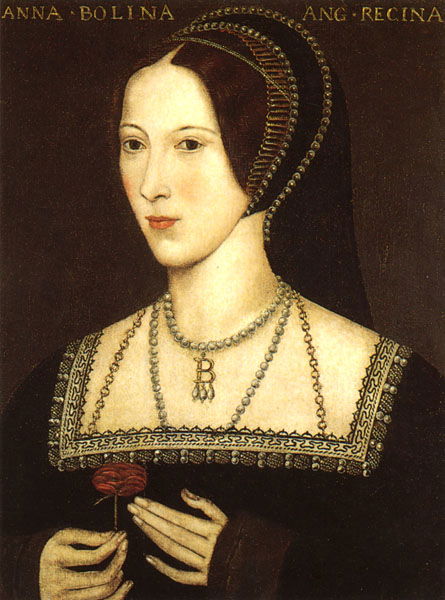
It is worth noting that no surviving portraits of Anne Boleyn date from her own lifetime. At the very earliest, they were painted in the reign of her daughter, Elizabeth I, and may have been based on lost originals; thus dating, at the earliest, fifty to sixty years after her execution in 1536. The standard portrait of Anne Boleyn, a copy of which is now housed in the National Portrait Gallery in London, depicts the queen wearing a French hood, black gown and pearls with a 'B' choker. In most of these portraits, Anne is portrayed with very dark brown or black hair. 

When examining these portraits, it is worthwhile to bear in mind the now infamous description of Anne Boleyn put forward by the Elizabethan Jesuit, Nicholas Sander, in his Rise and Growth of the Anglican Schism, published in 1585. Sander described Anne thus:

Anne Boleyn was rather tall of stature, with black hair and an oval face of sallow complexion, as if troubled with jaundice. She had a projecting tooth under the upper lip, and on her right hand, six fingers. There was a large wen under her chin, and therefore to hide its ugliness, she wore a high dress covering her throat. In this she was followed by the ladies of the court, who also wore high dresses, having before been in the habit of leaving their necks and upper portion of their persons uncovered. She was handsome to look at, with a pretty mouth.

Sander presented the queen as a witchlike figure who had cunningly seduced Henry VIII into abandoning his virtuous wife, Katherine of Aragon, and breaking with the true Church to marry her. Leaving aside the suggestion that Anne favoured high dresses - for which there is no other extant evidence - Sanders' description of Anne corresponds strikingly with the representation of the queen in the NPG pattern of portraits, two of which are provided at the top of the page. We can observe the queen's 'black hair', her 'oval face of sallow complexion' and 'pretty mouth'. His description of her raven hair, in particular, corresponded closely to contemporary notions of a witch's appearance. 

No other contemporary author described Anne Boleyn's hair colour as black. The Venetian ambassador, whose description of Anne's appearance has been viewed as largely accurate, stated that she had 'a swarthy complexion'. Simon Grynee, a professor of Greek at Basle, similarly noted that Anne was of a 'rather dark' complexion. It is possible that she had black hair, of course, but as Susan Bordo suggests, the notion that Anne Boleyn had raven tresses belongs largely to the work of Nicholas Sander, an author unquestionably hostile to the queen and her daughter, Elizabeth. 
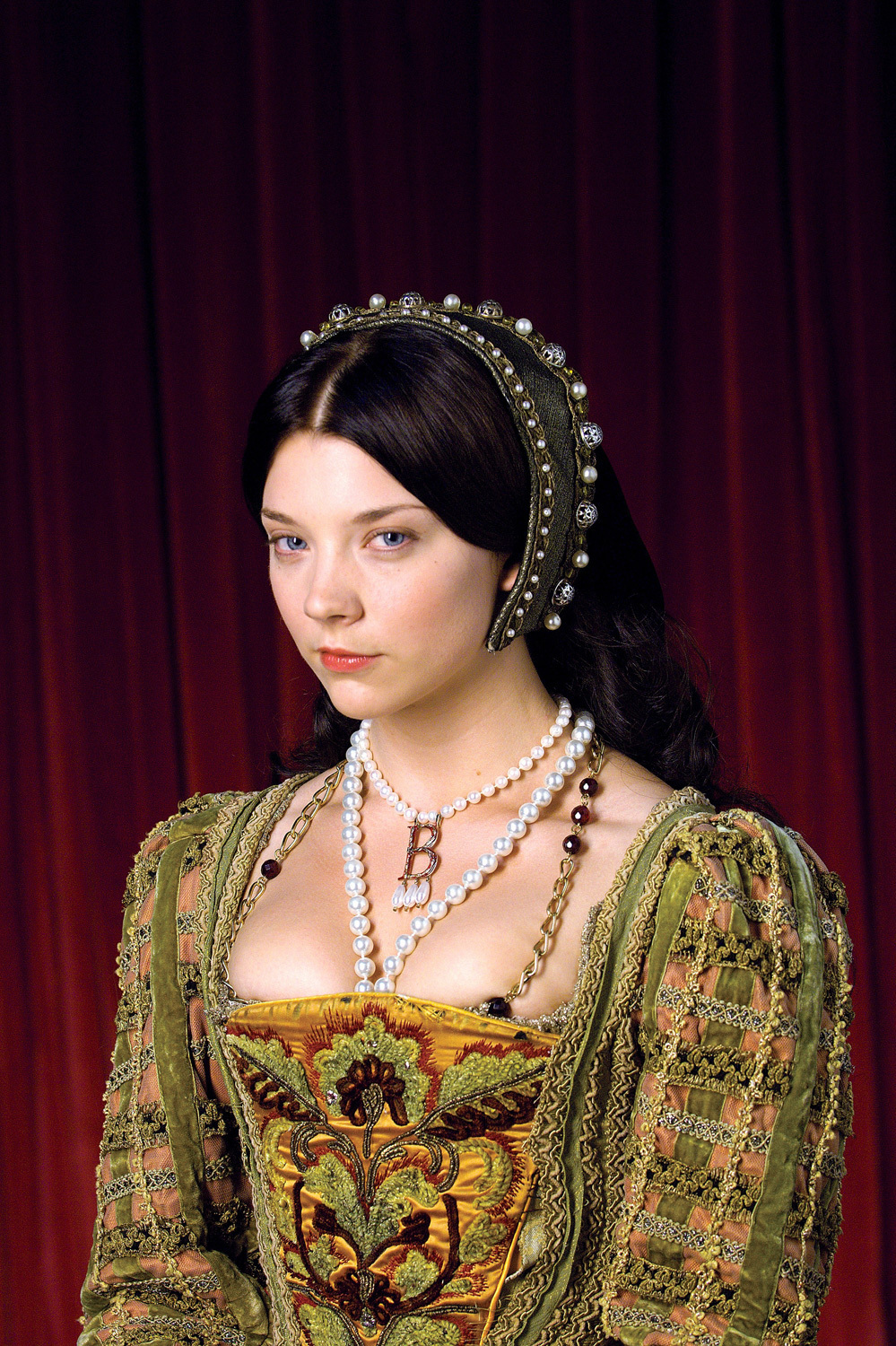
Image result for anne boleyn natalie dormerImage result for anne boleyn claire foy
Above: Often Anne Boleyn is portrayed in modern films and TV with black hair. Natalie Dormer (left) in The Tudors and Claire Foy (right) in Wolf Hall.

Anne Boleyn's hair was almost certainly dark. Cardinal Wolsey allegedly referred to her as 'the night crow', probably alluding to her appearance, and as we have seen, at least two other individuals described her as possessing a dark complexion. But it does not necessarily follow that her hair colour was black, and it is possible that it was the influence of Nicholas Sander's hostile description that meant that she was portrayed in portraiture as having black hair. It is important not to underestimate how influential Sanders' work was at the time. As Retha Warnicke explains, it formed the basis for every subsequent Catholic history of the Reformation, and by 1628 it had appeared in six Latin editions and was translated into six other languages. 

Other portraits depicted the queen's hair as lighter, whether medium brown or even reddish. It is possible that these portraits 'beautified' Anne, so to speak, giving that queens were customarily depicted in artistic mediums with fair hair, because it was associated with fertility, virginity and goodness. But it is also possible that these portraits more accurately represented the queen's true hair colour. 

Image result for anne boleyn portraitImage result for anne boleyn portrait
Above: Just how dark was Anne? Two reputed portraits of her that show her with lighter hair.


Sunday, 6 July 2014

Was Mary Boleyn Really 'The Mistress of Kings'?


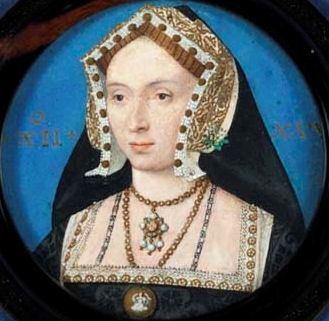
Above: Portrait of a woman thought to be Mary Boleyn, c. 1525.

Philippa Gregory's bestselling novel The Other Boleyn Girl (2001) revitalised fascination with the Boleyn family and in particular Mary, the mysterious and unknown sister of Henry VIII's second queen. Mary Boleyn was the daughter of Sir Thomas Boleyn, born before 1502, and married William Carey in 1520 before briefly becoming Henry's mistress in the 1520s, before his attention turned to her enigmatic and attractive sister Anne. After she was banished from court in 1534 for making a clandestine second marriage, Mary survived the destruction of her family and died in obscurity in 1543 in her early forties.

Traditionally, historians have suggested that Mary was 'an infamous whore' who was the mistress of two kings, Francois I of France and Henry VIII of England. While it seems certain that Mary was indeed Henry's mistress, probably beginning in 1522 and ending before 1525 - Henry himself admitted to the affair and had to secure a papal dispensation in 1527 to marry the sister of a woman with whom he had had sexual intercourse - it is by no means certain that Mary was the French king's mistress. Indeed, historical evidence indicates that Mary never resided at the French court as a teenager.


Above: the Boleyn sisters, Anne (left) and Mary (right).

As Retha M. Warnicke points out, there is no evidence that Mary Boleyn served as a maid of honour at the French court. In 1514, Anne Boleyn travelled to Paris to serve Mary Tudor, queen of France, and later transferred to the household of Claude, wife of Francois I, but there is no evidence that her sister was there. Household accounts documented a 'M. Boleyn', but it seems likely that the 'M' referred to 'Mademoiselle' or 'Mistress', rather than 'Mary'. Contemporaries commented on Anne's presence in France. For example, George Cavendish, gentleman usher to Cardinal Wolsey, stated: 'This gentlewoman, Mistress Anne Boleyn, being very young was sent into the realm of France'. No contemporaries, however, referred to Mary dwelling in France, where she supposedly acquired a reputation for promiscuity and licentiousness.

At the English court, it has been asserted, Mary was best known for her 'reputation in bed' (Lacey Baldwin Smith, 2013) and 'the evidence is overwhelming that Mary had a reputation for sexual improprieties' (Warnicke, 1985). As Alison Weir has thoughtfully demonstrated, however, there is in fact little to no evidence to support these views. Henry VIII's affair with Mary was discreet and secret, and few seem to have known of it. Mary remains a shadowy figure and we know nothing of her thoughts and feelings. How long her relationship with Henry lasted, and whether she truly loved him, is impossible to say. It is, however, certain that she was his mistress for a brief time in the 1520s and quite possibly bore him at least one, if not two, children.


Above: Francois I of France. It is unlikely that Mary Boleyn was ever his mistress.

While Mary was undoubtedly Henry VIII's lover for a time, it is almost certain that she was not the French king's mistress, despite persistent rumours to the contrary. In 1536, the French king informed Ridolfio Pio that he had known Mary in France 'per una grandissima ribalda et infame sopra tutte' - in other words, 'a great whore, infamous above all'. However, Mary never resided at the French court, so Francois cannot have insulted her in relation to her supposed sojourn there in the 1510s. Unlike Anne, who had departed for Europe to acquire a splendid education, Mary remained at home, probably Hever Castle, where she acquired a more traditional education befitting the status of an English gentlewoman.

So what then did Francois mean by his comment? Weir has pointed out that Pio was hostile to the Boleyns. Every member of the family was defamed and attacked by hostile political commentators who resented Anne and the rejection of Katherine of Aragon. Thomas Boleyn was slandered as heretical, grasping and scheming; his wife Elizabeth was defamed as a whore and former mistress of Henry VIII; George Boleyn was cast as a heretic and hedonist; and Anne was consistently portrayed as a whore, murderess, heretic and witch. It is therefore in keeping with this general defamation and slander of the Boleyn family that Mary, too, would have been dishonoured and abused by chroniclers and commentators hostile to their cause. Nicholas Sander, for example, slandered her in his works while abusing and defaming her sister Anne Boleyn. 

It would therefore be ridiculous to accept such comments at face value. It is unlikely that Francois was referring to his own previous experiences with Mary. Possibly, as Warnicke credibly suggests, he only became acquainted with the new Queen of England's sister in 1532, when Mary accompanied Henry VIII and Anne to Calais. Francois may well have learned of Mary's former liaison with Henry and allowed it to cloud his view of her. His comment can hardly be read as admittance of a former relationship with Mary when she supposedly resided at his court as a teenager.

Aside from this one disparaging, insulting comment, there is no evidence that Mary was ever the mistress of the French king. There is no documentation of her stay in France, for the simple reason that she never served at the French court alongside her sister. In 1513, Anne Boleyn departed for Burgundy and later for France to serve in royal households. Her sister Mary, possibly because she was younger or possibly because she was less intellectual and brilliant than Anne, remained at home, before marrying William Carey in 1520. Shortly afterwards, she became the mistress of Henry VIII. We can say with some certainty that she was the lover of the English king, but we can equally be sure that she was never the mistress of his counterpart, the king of France.