Showing posts with label appearance. Show all posts

Friday, 2 September 2016

Anne Boleyn's Hair Colour in Portraiture

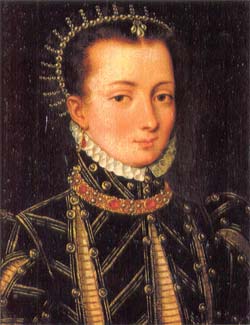
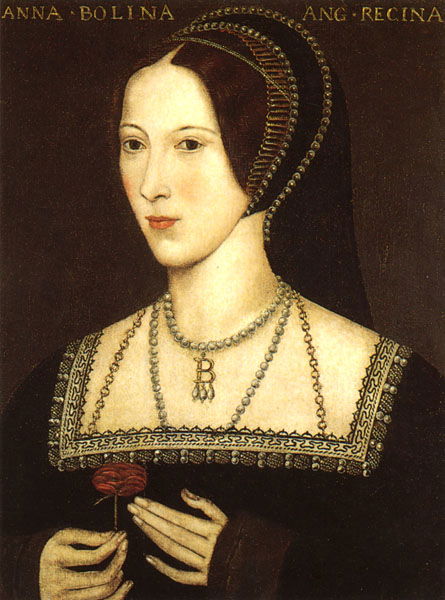
Image result for anne boleynImage result for anne boleyn portrait

Mystery surrounds Anne Boleyn's appearance. Contemporaries were ambiguous in their descriptions of the appearance of Henry VIII's second queen: either she was a slim and very beautiful, small-breasted Venus, or a grotesque, deformed creature who had lured Henry VIII into breaking from the Roman Catholic Church and marrying her. Controversy centres, in particular, on the colour of Anne Boleyn's hair. 

It is worth noting that no surviving portraits of Anne Boleyn date from her own lifetime. At the very earliest, they were painted in the reign of her daughter, Elizabeth I, and may have been based on lost originals; thus dating, at the earliest, fifty to sixty years after her execution in 1536. The standard portrait of Anne Boleyn, a copy of which is now housed in the National Portrait Gallery in London, depicts the queen wearing a French hood, black gown and pearls with a 'B' choker. In most of these portraits, Anne is portrayed with very dark brown or black hair. 

When examining these portraits, it is worthwhile to bear in mind the now infamous description of Anne Boleyn put forward by the Elizabethan Jesuit, Nicholas Sander, in his Rise and Growth of the Anglican Schism, published in 1585. Sander described Anne thus:

Anne Boleyn was rather tall of stature, with black hair and an oval face of sallow complexion, as if troubled with jaundice. She had a projecting tooth under the upper lip, and on her right hand, six fingers. There was a large wen under her chin, and therefore to hide its ugliness, she wore a high dress covering her throat. In this she was followed by the ladies of the court, who also wore high dresses, having before been in the habit of leaving their necks and upper portion of their persons uncovered. She was handsome to look at, with a pretty mouth.

Sander presented the queen as a witchlike figure who had cunningly seduced Henry VIII into abandoning his virtuous wife, Katherine of Aragon, and breaking with the true Church to marry her. Leaving aside the suggestion that Anne favoured high dresses - for which there is no other extant evidence - Sanders' description of Anne corresponds strikingly with the representation of the queen in the NPG pattern of portraits, two of which are provided at the top of the page. We can observe the queen's 'black hair', her 'oval face of sallow complexion' and 'pretty mouth'. His description of her raven hair, in particular, corresponded closely to contemporary notions of a witch's appearance. 

No other contemporary author described Anne Boleyn's hair colour as black. The Venetian ambassador, whose description of Anne's appearance has been viewed as largely accurate, stated that she had 'a swarthy complexion'. Simon Grynee, a professor of Greek at Basle, similarly noted that Anne was of a 'rather dark' complexion. It is possible that she had black hair, of course, but as Susan Bordo suggests, the notion that Anne Boleyn had raven tresses belongs largely to the work of Nicholas Sander, an author unquestionably hostile to the queen and her daughter, Elizabeth. 
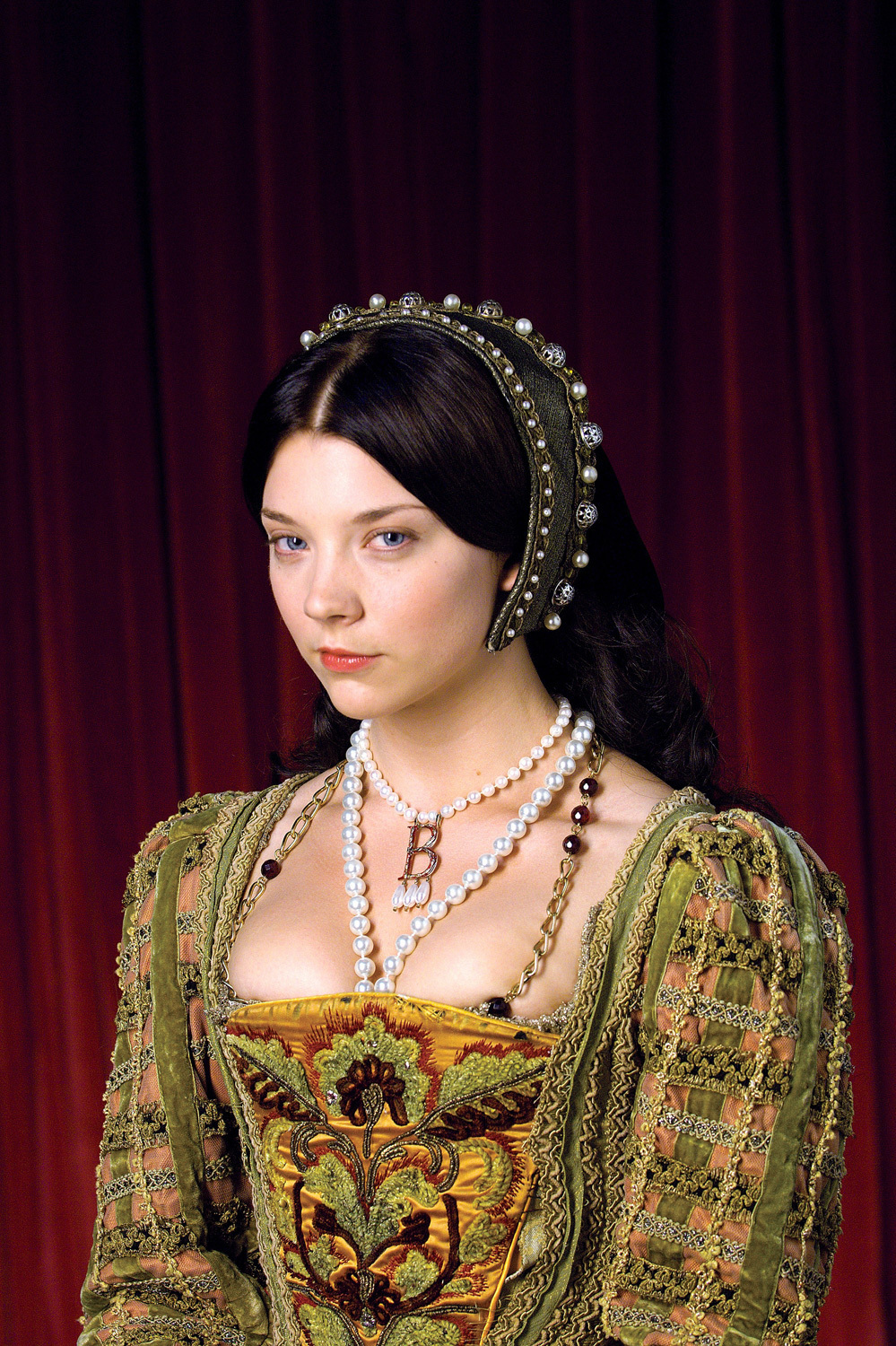
Image result for anne boleyn natalie dormerImage result for anne boleyn claire foy
Above: Often Anne Boleyn is portrayed in modern films and TV with black hair. Natalie Dormer (left) in The Tudors and Claire Foy (right) in Wolf Hall.

Anne Boleyn's hair was almost certainly dark. Cardinal Wolsey allegedly referred to her as 'the night crow', probably alluding to her appearance, and as we have seen, at least two other individuals described her as possessing a dark complexion. But it does not necessarily follow that her hair colour was black, and it is possible that it was the influence of Nicholas Sander's hostile description that meant that she was portrayed in portraiture as having black hair. It is important not to underestimate how influential Sanders' work was at the time. As Retha Warnicke explains, it formed the basis for every subsequent Catholic history of the Reformation, and by 1628 it had appeared in six Latin editions and was translated into six other languages. 

Other portraits depicted the queen's hair as lighter, whether medium brown or even reddish. It is possible that these portraits 'beautified' Anne, so to speak, giving that queens were customarily depicted in artistic mediums with fair hair, because it was associated with fertility, virginity and goodness. But it is also possible that these portraits more accurately represented the queen's true hair colour. 

Image result for anne boleyn portraitImage result for anne boleyn portrait
Above: Just how dark was Anne? Two reputed portraits of her that show her with lighter hair.


Thursday, 25 September 2014

The Eternally Beautiful Anne Boleyn


If your knowledge of Tudor history was gained from the Showtime television series The Tudors (2007-10), the profoundly successful novel The Other Boleyn Girl by Philippa Gregory, or the 2008 Hollywood adaptation of that novel starring Natalie Portman and Scarlett Johansson, your lasting impression would most likely be that Anne Boleyn was a stunningly beautiful young woman. A woman with dazzling dark eyes, long brown hair, creamy skin and rosebud lips; a woman who epitomised charm, elegance and dressed superbly. A woman who turned heads wherever she went, and who captured men's hearts with ease. 

Popular culture, as Susan Bordo notes in her study of Anne, tends to present Anne as a drop-dead-gorgeous creation who captivated Henry VIII the minute he laid eyes on her, solely because of her physical appearance. In The Tudors, for example, Natalie Dormer plays a stunningly attractive Anne who captures the king's heart when they meet at the Chateau Vert pageant in early 1522. From that moment on, all he can think about is Anne. Similarly, in the novel The Other Boleyn Girl, Philippa Gregory introduces a beautiful Anne, who coldly and ruthlessly manipulates besotted male suitors to fulfil her every whim. But, popular culture aside, how accurate are these interpretations of Anne Boleyn's physical appearance? More pertinently, what do these claims and ideas suggest about prevailing ideas about female attractiveness and whether or not a person's appeal is rooted in their physical looks? 


Above: The Tudors. Natalie Dormer introduced a stunningly beautiful Anne.

Henry VIII's second wife was, contrary to popular belief, not a great beauty. To be sure, we lack contemporary portraits of her, because in the wake of her disgrace and death in 1536, Henry VIII ruthlessly and efficiently destroyed everything he could find to do with her, including portraits of his once beloved queen. We therefore have very little knowledge about what Anne Boleyn actually looked like. There are some things we do, however, know about her appearance, relying on contemporary reports without taking their obvious biases and polarising viewpoints at face value. 

The Venetian ambassador, who met Anne in the late 1520s, recorded that the king's new love was:
'Not one of the handsomest women in the world; she is of middling stature, swarthy complexion, long neck, wide mouth, a bosom not much raised and eyes which are black and beautiful'. 

To this ambassador, then, with the exception of her 'beautiful' dark eyes, Anne Boleyn was very average in her physical appearance. His description conveys someone not particularly impressed or swept off his feet. 
Others, however, were more praiseworthy about Anne's looks. Lancelot de Carles, a Frenchman who wrote a poem detailing her disgrace in 1536, remarked that she was 'beautiful', with 'an elegant figure'. John Barlow, a cleric of Anne, recorded that she was 'reasonably good looking' - again, not a dazzling beauty, but attractive enough. George Wyatt, the grandson of Thomas Wyatt (who some suspect was Anne's admirer), admitted that her colouring was 'not so whitely' as then admired, and she had several 'small moles... upon certain parts of her body'. He also stated that she had an extra nail on one hand.

The most notorious description of Anne's physical appearance, however, came from the man who did the most to blacken her name: Nicholas Sander, a Catholic recusant writing in the reign of her daughter Elizabeth I. Viewing Anne as a bewitching temptress and witch who had craftily ensnared Henry VIII into marriage, encouraging him to commit heresy by breaking away from the Roman Catholic Church and his long-suffering and devoted first wife Katherine of Aragon, Sander recorded:

'Anne Boleyn was rather tall of stature, with black hair and an oval face of sallow complexion, as if troubled with jaundice. She had a projecting tooth under the upper lip and, on her right hand, six fingers. There was a large wen under her chin, and therefore to hide its ugliness, she wore a high dress covering her throat. In this she was followed by the ladies of the court, who also wore high dresses, having before been in the habit of leaving their necks and the upper portion of their persons uncovered. She was handsome to look at, with a pretty mouth'. 

The last sentence, in view of Sander's shattering and devastating description of Anne, is entirely contradictory. Regarding Anne Boleyn as the Devil's accomplice and the incarnation of evil, he gave her a witchlike appearance. This was an age, as Retha Warnicke notes in her study of Anne, when a person's outer appearance was believed to reflect and embody their inner character. Believing Anne to be utterly evil, Sander presented her as ugly, deformed, monstrous: she had a projecting tooth, an extra finger, a large wen. His statement indicated his complete lack of knowledge about fashion tastes at Henry VIII's court. A glance at portraiture from this era confirms that ladies-in-waiting did not tend to wear high dresses, including Anne.


Above: Another gorgeous Anne. Natalie Portman as Anne Boleyn in The Other Boleyn Girl (2008).

Putting to one side Sander's outrageous claims, Anne Boleyn is almost always depicted in cultural works as a ravishing beauty, a stunning woman who dressed fashionably, spoke beautifully, and enchanted all who knew her. But, as we have just seen, even observers who were at least neutral, if not friendly, to Anne confirmed that she was not jaw-droppingly beautiful. They confirmed that she was attractive, or reasonably good-looking, but none of them were swept off their feet by her physical appearance.

Most scholars agree that it was not Anne's physical looks so much as her charm, her intelligence, her accomplishments, her wit, her fiery nature, her uniqueness, in short, that captivated Henry VIII and kept his attention for the best part of 10 years. Bordo thinks our fixation with Anne's physical appearance in popular culture may lie in twentieth- and twenty-first century limits of the concepts of attraction, 'fixated as they are on the surface of the body'. Henry VIII certainly wasn't fixated on the surface of Anne's body. By all accounts, he was completely taken with her in a way he never was with any of his subsequent wives or mistresses. There was, in short, something special about Anne that cannot be restricted to her body. 

Looking at Anne's portraits in an attempt to discern what she really looked like is a futile exercise. As mentioned earlier, none of them are contemporary to her, the earliest ones being produced something like fifty years after her death, and many of them later. Lacey Baldwin Smith, author of books on both Anne Boleyn and Katherine Howard, wittily quipped: 'Tudor portraits bear about as much resemblance to their subjects as elephants to prunes'. 

Anne seems, in short, to have had style. Lancelot de Carles comments on the beauty of her dark eyes and her ability to captivate and entrance men merely by looking at them. One commentator reported than she was 'more a Frenchwoman' than she was English, and the French, of course, are renowned, then as now, for their style and elegance. Sixteenth-century England valued clear-skinned, blue-eyed, blonde women who were celebrated as the epitome of beauty, including Mary Tudor, younger sister of Henry VIII (below). Anne, with her 'small' breasts, dark complexion and dark hair, challenged these norms and brought in fashions and styles of her own to replace these ideals. 


Above: Mary Tudor, queen consort of France, was the epitome of Tudor ideals of beauty: clear-skinned, fair-haired and light-eyed. 

Bordo sums up what it was about Anne that enchanted the king:

Henry's attraction to Anne, in any case, seems to have been fueled not only by sexual attraction but by common enjoyments, compatible interests, intellectual stimulation, and shared political purpose.

Too often, as in the 2008 film The Other Boleyn Girl, Anne is characterised as a shallow, bosomy schemer who thrusts herself brazenly before the king. She is reduced, in short, to a sex symbol. But as Bordo's statement makes clear, Anne Boleyn was so much more than that. She was a devout evangelical; a keen intellectual; a woman interested in politics; possessed of a sharp mind; charitable and pious; loyal to her family and friends; musically gifted; and talented in languages. This was no floozy who wormed her way into the king's bed with seductive promises of bedtime pleasures. This was a woman who shone in the court of England as she had in the Flemish and French courts during her teenage years. 

Why is it, then, that popular culture tends often to reduce her to a sex symbol or an icon of perfect beauty? What does it suggest about our own narrow, constricting, possibly harmful views of attractiveness, particularly in relation to women? Does it indicate that a woman can only be truly attractive if she is physically stunning, regardless of her intellectual and personal accomplishments? Contemporary evidence makes it devastatingly clear that Anne Boleyn was not a woman who stole hearts merely on the basis of her appearance. Popular culture would stay truer to the real woman and her incredible legacy if it focused, instead, on her remarkable personality, her contradictions, her flaws, her religious outlook, her political activities, her charities, her charm, her culture, her fashion sense, her wit, her humour, her arrogance, her insecurities, her family loyalties and devotion to her friends - everything, in short, that made Anne Boleyn a bundle of contradictions.