Showing posts with label edmund tudor. Show all posts

Tuesday, 31 May 2016

31 May 1443: The Birth of Lady Margaret Beaufort


On 31 May 1443, Lady Margaret Beaufort was born at Bletsoe Castle in Bedfordshire. She was the daughter of John Beaufort, duke of Somerset, and Lady Margaret Beauchamp. Through her father, Margaret was a descendant of Edward III. Less than a year after his daughter's birth, the duke of Somerset died in suspicious circumstances while on campaign abroad. Some of his contemporaries believed that he had committed suicide, a heinous sin in the eyes of fifteenth-century individuals. Margaret probably did not learn of her father's death until she was older, but the knowledge that he may have killed himself would have brought shame and dishonour both to herself and to her family.

Shortly afterwards, Margaret's wardship was granted to the king's favourite, William de la Pole, first duke of Suffolk. As the heiress to her father's fortunes, Margaret was a highly valuable commodity. In early 1444, when she was less than three years old, Margaret was married to the duke's son John de la Pole. Occasionally, highborn children were married while still in infancy. Later, Edward IV's son Richard married Anne Mowbray when he was four years old and she five. Other evidence indicates that Margaret may actually only have married John in 1450, the year in which Suffolk was murdered. Irrespective of its date, the marriage was annulled in 1453 and Henry VI granted Margaret's wardship to his half-brothers Edmund and Jasper Tudor. 

Eddytudor.jpg
Above: Edmund Tudor, earl of Richmond.

On 1 November 1455, when she was twelve years old, Margaret was married to the king's twenty-four year-old half-brother Edmund Tudor, earl of Richmond. Usually when girls were married at a young age, consummation of the marriage was delayed until a later date. Edmund, however, elected to consummate his marriage immediately. At the age of thirteen, Margaret fell pregnant. Her husband, however, was not to learn the outcome of her pregnancy, for he died while in captivity at Carmarthen in November 1456, perhaps of plague. Two months later, his widow gave birth to her only child, Henry Tudor, at Pembroke Castle. Evidence suggests that the birth was a difficult one, and Margaret may have been physically and mentally scarred by the experience. A year after the birth of her son, the widowed countess remarried. Her husband was Sir Henry Stafford, son of the duke of Buckingham. Evidence suggests that their marriage was a happy one. 

Above: Pembroke Castle. Margaret gave birth to her son Henry there.

In 1461, the castle was captured by the Yorkists, and the infant Henry was placed in the custody of William Herbert, earl of Pembroke. Henry later departed for the Continent in the company of his uncle Jasper. The year her son departed for France, Margaret's husband died at the Battle of Barnet. 1471 was a tumultuous year. The Lancastrian king Henry VI was probably murdered in the Tower of London by the victorious Yorkists, and his only son Edward of Westminster was slain at Tewkesbury. Margaret, whose status had naturally inclined her to support the Lancastrian cause, dutifully made a show of supporting the new Yorkist dynasty. She understood that her son, Henry Tudor, was the only Lancastrian claimant still alive. Edward IV, understandably, was determined to gain custody of Henry. In a bid to protect both herself and her son's future, Margaret outwardly supported the house of York. 

A year after her husband's death, Margaret married for the last time, to Thomas Stanley. This marriage enabled Margaret to reside at court, and she appears to have enjoyed amicable relations with both the king and queen, later serving as godmother to one of their daughters. However, Edward IV's unexpected death in 1483 and the usurpation of Richard III changed Margaret's life forever. Margaret initially signalled her support of the new regime by carrying Anne Neville's train at her coronation, but she wholeheartedly supported the duke of Buckingham's rebellion against Richard III, perhaps with the backing of Edward IV's widow Elizabeth Wydeville. The rebellion was legitimated by rumours that Edward IV's sons had been murdered, perhaps on the orders of Richard III. It was agreed that, if the rebellion succeeded, Henry Tudor would marry Edward IV's daughter Elizabeth of York. However, the rebellion failed and Buckingham was executed. Margaret was stripped of her titles and estates and placed under house arrest; she was fortunate to escape with her life.

Above: Thomas Stanley, husband of Margaret Beaufort.

Despite this setback, Margaret continued to scheme for her son's accession. Evidence suggests that she had been content to support Edward IV and desired no more than her son's attainment of the earldom of Richmond. However, Margaret may have believed that Richard III was a usurper and perhaps viewed him as guilty of the murder of his nephews. It may have been this that encouraged her to press for Richard's deposition and his replacement with her son. At Bosworth in 1485, Henry Tudor defeated Richard and the final Yorkist king was slain. It was a moment of triumph for Margaret. Her son duly married Elizabeth of York, but Margaret's influence was considerable during her son's reign. Known as 'My Lady the King's Mother', Margaret held property independently from her husband, and she administered justice in the king's name at several courts. 

Margaret was revered for her education and her piety. In 1502, she founded the Lady Margaret's Professorship of Divinity at the University of Oxford, and three years later founded Christ's College, Cambridge. St John's was founded in 1511. She was politically astute, intelligent and resourceful. Historians have debated the nature of relations between Margaret and her daughter-in-law Elizabeth of York, but irrespective of their true feelings towards each other, the two women cooperated and worked together for much of Henry's reign. Margaret's death in 1509 followed that of her only son, for whom she had schemed and worked to ensure his accession to the throne. Lady Margaret Beaufort deserves to be remembered for her considerable successes. 

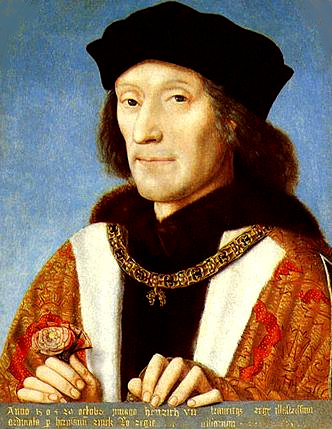
Above: Henry VII, son of Margaret. 

Tuesday, 28 January 2014

28 January - Tudor Life and Tudor Death of Two Kings

File:Portrait of King Henry VIII.jpg
Left: Henry VII (1457-1509).
Right: Henry VIII (1491-1547).

28 January was a highly significant date for the first two Tudor monarchs, Henry VII and his second son Henry VIII. It marked the birthday of the Tudor dynasty's first monarch, in 1457, and ninety years later, it would be on 28 January that Henry VIII died, ending his turbulent 38-year reign. It's perhaps a touch ironic that these two milestones occurred on exactly the same day.

Henry Tudor was born on 28 January 1457 at Pembroke Castle, the only son of Edmund Tudor, earl of Richmond, and his formidable wife Lady Margaret Beaufort, who was barely thirteen when she gave birth to Henry. Edmund had died three months before his son's birth as a result of plague, a lethal killer in late medieval and early modern Europe. Margaret devoted her whole life to promoting the cause of her son, whom she believed to be England's rightful king. Loyal Lancastrians, the eclipse of Henry VI meant that Margaret became obsessed with the idea of her son resurrecting the rightful Lancastrian line in the person of his kingship. Eventually, her ambition came to fruition, and in 1485, at the age of 28, Henry Tudor became king of England after defeating Richard III, the last Yorkist king, at the Battle of Bosworth. He took to wife Elizabeth, daughter of Edward IV, with whom he sired at least seven children, four of whom lived to adolescence (his eldest son Arthur died at fifteen). In 1509, after a reign characterised by dynastic tragedy, political instability and the threat of renewed civil war, Henry died aged 52. He did, however, successfully allow the crown to pass to his son Henry without the outbreak of pretenders laying claim to it. An uncontested succession had not been experienced in England hitherto since 1422.

Henry VIII had been born in 1491. He was extremely close to his mother Queen Elizabeth, and her death in 1503, when the young prince was not yet twelve, appears to have severely affected him psychologically. His relations with his father were, famously, less cordial, and were at times overtly hostile. In 1509, just before his eighteenth birthday, he succeeded to the throne of England, and took to wife Katherine of Aragon, the former consort of Arthur. Her inability to provide a male heir, however, and the king's passion for Anne Boleyn led him to seek an annulment of his first marriage and a remarriage to the alluring Anne. Although this indeed came to pass, it inflicted the English Reformation on the people of England and was characterised by much bloodthirst and destruction in the wake of Thomas Cromwell's reforms. Mary and Elizabeth were born to Henry by his first two wives; and Jane Seymour finally provided the king with his long desired male heir in 1537, Edward. Three short marriages followed; although the king did manage to enjoy a peaceful and fairly untroubled final marriage to Katherine Parr. In 1547, at the age of fifty-five, Henry VIII died. Despite his military shortcomings, marital disasters, and difficult political decisions, Henry has remained one of England's most enigmatic and famous kings, and was extremely popular among his subjects. His children, particularly Elizabeth, delighted in him; although Mary may have been less close to her father than her two younger siblings. Henry's death paved the way for his nine-year old son Edward's succession, who was to die, tragically, before his sixteenth birthday in 1553.

Thus 28 January was a monumental day for the Tudor ruling dynasty. It began with an extremely difficult birth in a secluded castle in Wales, endured by a thirteen-year old girl who would prove unable to bear any more children. The child's father was not absent, having died months earlier. Ninety years later, in an exceptionally different political, religious and dynastic climate in England, that king's son died at the age of fifty-five, leaving behind a controversial legacy of religious turmoil, dynastic bloodshed, and personal charisma which continues to prove irresistible to modern audiences today.

Friday, 8 March 2013

Winter King - the Dawn of Tudor England & Henry VII


I recently read Thomas Penn's highly acclaimed first historical study, Winter King: the Dawn of Tudor England (Penguin, 2011), a witty and compelling account of the reign of King Henry VII (1457-1509) from the middle years of his reign to its dark and complex end in 1509. Known to all Tudor lovers as the first Tudor, the king who defeated history's arch-villain King Richard III in battle at Bosworth, it seems possible to suggest that Henry remains the most mysterious, perhaps even to an extent the forgotten, Tudor, often eclipsed by his glamorous and energetic son Henry VIII and his enigmatic granddaughter Elizabeth I. Yet, like those other misunderstood Tudors Edward VI and Mary I, Henry VII's story is highly remarkable, and although he was certainly disliked for his meanness, corrupt methods of ruling and lack of charisma and charm - points often addressed in Penn's book - I'd argue that Henry VII was ultimately a very capable king who withstood every danger posed to his throne and ultimately established the conditions for a successful succession at his death.

Memorialised by the seventeenth-century biographer Francis Bacon as a 'dark prince', Henry Tudor was born on 28 January 1457 (incidentally the date his son died 90 years later) to Edmund, 1st earl of Richmond and a member of the Welsh Tudor family, and Margaret Beaufort, a formidable, religious and educated woman who was Countess of Richmond and later Derby. Margaret was only 13 when she gave birth to Henry, and the pregnancy so crippled her that it left her unable to bear any more children. Incidentally, Edmund died of plague the previous winter, leaving his 13-year widow heavily pregnant with their only son. At that time, the dynastic and political conflict known as The Wars of the Roses had just broken out, and Edmund as a Lancastrian had been taken prisoner by Yorkist forces. Margaret was taken under the arm of her brother-in-law Jasper  to Pembroke Castle, where she gave birth to Henry. A series of events would see Henry becoming the Lancastrian claimant for the throne, undoubtedly influenced by his mother's ambition and ruthless nature.

Henry Tudor had royal blood due to the fact  that his grandfather Owen Tudor had married the former queen consort Catherine of Valois, widow of Henry V, some years previously. However, their marriage was viewed by some as being illegal; while this was intensified by the fact that  the Beauforts had been identified as being illegitimate and unfit to inherit the throne. Thus, while Henry certainly had royal blood, these two facts meant that his claim to the throne was weak, at best. 

The Wars of the Roses famously resulted in the bloody deaths of the notoriously inept king Henry VI, who was probably mad, and his son Edward Duke of Lancaster in battle, which meant that Henry Tudor, by virtue of this dynastic conflict, became the prime Lancastrian claimant and a serious rival to the Yorkists, who had succeeded through their king Edward IV and later Richard III. Although Lady Margaret's fourth husband, Lord Stanley, was a Yorkist, she became increasingly influential by 1483 in promoting her twenty-six year old son Henry's claim to the throne following Edward IV's death and the mysterious deaths of his sons Edward V and Richard prince of Wales. Henry had spent his childhood in Europe, residing in both France and Brittany. Margaret began plotting with various political figures disaffected by the recent events leading to the usurpation of Richard, including Edward IV's widow and former queen Elizabeth Woodville. It is clear that Margaret was heavily ambitious for her son and was intent on making him king. This formidable woman would be at the centre of power throughout Henry's reign as king. When rebellions broke out in England in the autumn of 1483, led by the disaffected Duke of Buckingham (formerly Richard's staunch supporter), Henry seized the opportunity to invade, but a series of storms meant that the rebellion collapsed. Storms blew Henry back to Normandy; but at Christmas Henry vowed to marry Elizabeth of York, daughter of Edward and Elizabeth, and consequently disaffected Yorkists swore allegiance to Henry.

In 1485, after attaining greater support including from the earl of Oxford, Henry managed to gain support in money, ships and men from the French king Charles VIII which spurred him to seek the English crown once more. Landing in England in early August, Henry marched across Wales where he obtained substantial support. Richard, however, had amassed much greater support from Englishmen, meaning that he had the upper hand when the two armies met at Bosworth on 22 August. Yet the strong fighting of the earl of Oxford, who supported Henry, and the reluctance of Richard's supporters such as the earl of Northumberland to participate on the king's side, led to a shifting of momentum from the king to the pretender. The Stanleys, who were of course Henry's relatives, proved decisive in intervening on Henry's side, leading to Richard's demise. Henry was proclaimed king shortly after. 

However, as Penn wittily and dramatically makes clear in his book, Henry VII's accession as king only led to further instability caused by the dynastic problems of the English royal family. Many did not recognise him as king; while the Yorkists only swore to support him because of his marriage to their relative, Elizabeth. However, Elizabeth brought some security to English dynastic politics through bearing the king's son, Arthur, in September 1486, and proved to be a fertile bride in bearing Princess Margaret (1489), Henry (1491), and Mary (1496), as well as a host of other royal children who tragically died as either infants or newborns. Despite this, several rebellions developed which caused the English king considerable alarm. Lambert Simnel, a boy who was claimed by Yorkists to be the Earl of Warwick (Edward IV's nephew), was crowned King Edward VI in Dublin in 1487, before the King managed to defeat the rebel forces led by John de la Pole, earl of Lincoln (himself a royal claimant) at the battle of Stoke. Simnel, a mere child, was not killed but put to work in the king's kitchens.

Nonetheless, Perkin Warbeck's rebellion in the 1490s was an entirely different story, for this pretender attained far greater support than Simnel had ever achieved, including from royal European figures such as Margaret of York. Claiming to be Richard, the younger of the Princes in the Tower, Penn makes clear that his attempted invasions in 1491 and 1495 severely compromised any political stability Henry VII could hope to enjoy. Landing in Cornwall in 1497, Warbeck's rebellion fell apart and he was later executed with the hapless and simple Earl of Warwick at the Tower of London in 1499. These executions undoubtedly took place because of Henry's desire for his thirteen-year old heir Prince Arthur to marry the Spanish princess Katherine of Aragon, and the Spanish monarchs had expressed some concern about the continuing presence of pretenders in England which might jeopardise their daughter's security. Katherine, apparently, felt guilt for their deaths, later declaring that her marriage had been made in blood.

Penn emphasises how these pretenders severely troubled Henry; a problem which was worsened beyond all proportions with the premature death of his heir Arthur in 1502, just months after his lavish - but controversial - marriage to the Spanish Infanta Katherine. These problems intensified with the death of his beloved queen, Elizabeth, in 1503 on her 37th birthday, days after giving birth to a daughter Katherine who also died shortly afterwards. Henry, however, was intent on preserving the Spanish alliance in face of French threats to England, and in view of this it was arranged that his second son, Prince Henry, would marry Katherine when he became of age. However, the death of Katherine's influential mother Isabella of Castile wrecked the Spanish alliance, with the prince days before his fourteenth birthday ordered to renounce his vow to marry Katherine. One can only feel pity for this destitute Spanish princess, who by all accounts lived in poverty-stricken conditions following her failed marriage in 1502.

Personal problems almost certainly contributed to increasingly harsh measures in the early 1500s. This is, ultimately, what made Henry VII notorious, which Penn dramatically details in Winter King. I came away from this book realising just how threatened Henry was due to dynastic problems, and the real sense of fear he had about the succession (ironically, as his son would share some thirty years later). The Court of Star Chamber was used mercilessly to deal with troublesome nobles, a process later extended to the notorious Council Learned in the Law and the probably illegal use of bonds and recognisances, which placed heavy amounts of money on nobles which they would be bound to pay if they disobeyed the king's rule or plotted treason. Other nobles were forced to act as guarantors, something they must have heartily disliked. The king's eminent financial officials, Edmund Dudley and Richard Empson, became figures of hatred during this time, as they ruthlessly enforced the king's unpopular policies. Unsurprisingly, on his accession Henry VIII bowed to popular demand and ordered the executions of these hated ministers.

1502 and afterwards saw the king's worsening ill health, above all the king's declining eyesight and his struggle to write. He began to suffer periodic illness, especially from 1507 when he fell sick each year in the spring. Lady Margaret sprang into action during these times of crisis, ready to secure the mechanisms of succession for her grandson Henry if her son were to die. There was a growing feeling during Henry VII's last decade that he was becoming increasingly rapacious and greedy, epitomised by the discontent felt by Thomas More, a promising lawyer later beheaded by Henry VIII for his opposition to the Boleyn marriage. The nobility, such as Buckingham and Northumberland, greatly resented the king's heavy-handedness and mistrust, feeling that they weren't enjoying the political power and presence in the kingdom which they felt was theirs by hereditary right. Henry can justly be viewed as suspicious, even paranoid, but after the unstable reign of Henry VI and the problems experienced in the reigns of Edward IV and Richard III, one can understand his mistrust of the nobility and desire to undermine any power they felt they enjoyed.

Although Penn's book only deals with Henry VII's in a colourful manner, mainly the years after 1501, his points do suggest that Henry's foreign policy was successful, particularly in his desire to maintain the Spanish alliance and protect England from the threat of France. His daughter Margaret was married at 13 to the Scottish king, a policy which strengthened Tudor influence outside of England, and his youngest daughter Mary was betrothed to the heir to  the Holy Roman Empire, Charles (Mary later became Queen of France aged 18, during her brother's reign). 

However, one is left with the unmistakeable sense from Winter King that Henry VII's reign was plagued by succession troubles, political instability, financial corruption and mutual resentment between the king and his nobles. Can Henry VII's reign be termed a success? I would say, ultimately yes, because his son successfully acceded to the throne in a bloodless succession in 1509, but it's undeniable that this was also a matter of luck. Henry faced a series of pretenders, rebellions and questions of loyalty from a variety of men throughout his reign, meaning he never enjoyed any peace. These problems were, of course, worsened by the premature death of his son Arthur and the tragic loss of Queen Elizabeth. Margaret, the king's mother, was a key political figure in helping the king try to maintain some security at court and in his kingdom. 

Henry undoubtedly lacked the charisma and magnificence of his son Henry VIII, or the glamour of his granddaughter Elizabeth I. In a way, he can be compared to the other 'forgotten' Tudors, Edward VI (a child king who died aged 15) and Mary I (a detested monarch). Misunderstood by contemporaries and historians, Henry is shrouded in mystery, a complex figure who comes across in Penn's book as being dark, highly intelligent, suspicious, fearful, shrewd and ruthless in desiring to maintain his rule at all costs. Lady Margaret emerges as an enigmatic and powerful player at court, while the king's able advisers and financial officials take centre stage in this book. What I also enjoyed was the attention paid to the foreign merchants and scholars who the king favoured, mostly Italians. A well-written, insightful book, Winter King emphasises in compelling detail the darkness and corruption of Henry VII's life and reign, something we frequently overlook in our desire to glorify in Henry VIII's reign and his legion of wives. But this book is essential reading for anyone interested in the first Tudor, who was, ultimately, able to preserve his dynasty and ensure his son's succession - but only by the skin of his teeth.