Showing posts with label howard. Show all posts

Monday, 27 May 2013

Henry VIII's "Enforcer": Thomas Cromwell


Thomas Cromwell has never been so famous. With the BBC's program on Cromwell given by Dr Diarmaid MacCulloch of Oxford University, this intense interest in Henry VIII's 'enforcer' has continued to develop, enhanced particularly by Hilary Mantel's sensationally successful trilogy, with Wolf Hall and Bring Up the Bodies achieving international acclaim. Yet Thomas Cromwell, while certainly formidably intelligent, cunning, and shrewd, is somewhat of an enigma. But, as MacCulloch forcefully argues, it is he who the English people must thank for setting in place the initial processes which have led to the modern state of Britain as we know it today.

Before the phenomenal success of Hilary Mantel's novels, it's fair to say that Cromwell only inspired interest among Tudor academics within universities, or amongst historical novelists and dramatists dedicated to portraying the story of Anne Boleyn in their respective mediums (Cromwell, of course, playing a central role in both Anne's rise and fall). But many see, and continue to see (probably especially due to Mantel's characterisation), Cromwell as being 'a scheming, rapacious vulture'. Yet MacCulloch, in both his BBC program and in an article published in the March 2013 issue of BBC History Magazine, challenges this view.

Thomas Cromwell's rapid rise was nothing short of incredible. As MacCulloch puts it:

'Cromwell emerged from the back alleys of rural Putney (his father really was a thug) to become Earl of Essex, one of the oldest noble titles in the realm - yet in the moment of this greatest triumph, he was destroyed'.

Cromwell's birth date is unknown but it is likely to have been around 1485. He was born in Putney as the son of Walter Cromwell, a blacksmith, fuller and cloth merchant. Cromwell's notoriously low birth provided useful ammunition for his many enemies, instigating jealousy and hatred amongst the nobles who resented this low-born servant who had become the king's closest adviser. Cromwell's early life is very unknown, although he later informed his contemporary Archbishop Thomas Cranmer that he was a 'ruffian... in his young days'.

Cromwell's father was violent and an alcoholic, being fined by the local manor court on 48 occasions in the period 1475-1501. He was also later convicted of assault. Thomas left his family to travel in Europe and likely first joined the French army before fighting at the battle of Garigliano in 1503. He later joined the household of the merchant banker Francesco Frescobaldi, already establishing useful connections with international personages. In her books Mantel contends that Cromwell became fluent in several languages, which due to his extensive travels in Europe seems likely. Cromwell probably travelled next to the Netherlands where he may have worked as a cloth merchant.

Cromwell later, at an unknown date, returned to England where he married Elizabeth Williams, with whom he had his only surviving son Gregory (who would later marry the sister of Queen Jane Seymour). She died in 1527. At this time, according to Howard Leithead, 'Cromwell was... becoming established as a business agent', leading him into law. Consequently, 'by 1520 Cromwell was firmly established in London mercantile and legal circles'. During the next few years Cromwell acquired frequent contact with Cardinal Thomas Wolsey, the most powerful man in the kingdom after the king. In 1523 Cromwell entered the House of Commons, and a year or two later was made a member of Gray's Inn following his appointment as a subsidy commissioner in Middlesex; demonstrating his great success in law. By 1524 Cromwell had joined Wolsey's service due to his closeness with Thomas Heneage, another who served the cardinal.

In the early years of his service to the cardinal, Cromwell was involved in the suppression of religious houses which is surely ironic considering his later central role in leading the dissolution of the English monasteries. However, the suppression of religious houses in the 1520s occurred due to Wolsey's personal building projects (Cardinal College of the University of Oxford, and the founding of a grammar school in his hometown of Ipswich). Cromwell became very close to Wolsey through his personal skills, being appointed to the cardinal's council after 1526. Thus Cromwell 'increasingly supervised Wolsey's legal affairs and exercised considerable ecclesiastical patronage'.

At this momentous time, the King, disillusioned with his first marriage due to his queen's failure to bear a son, had fallen in love with a lady of the court, Anne Boleyn. However, Wolsey's failure to provide an annulment of the marriage to Katherine effected his downfall in 1529. According to George Cavendish, Wolsey's personal servant, Cromwell was distraught, fearing his own downfall as a result of his closeness to Wolsey. Yet this was not to be. Cromwell became greatly involved in the Reformation Parliament and may have taken a leading role in the Commons' campaign against the English clergy, leading to the Supplication of the Ordinaries in 1532.

According to Leithead:

'Cromwell's entry into the king's service is shrouded in myth. He has been credited with whispering into the king's ear a blueprint for all the revolutionary developments of the 1530s, whereupon he was immediately offered the task of putting his grand scheme into action. In reality his progress into the royal service was somewhat more prosaic'.

Leithead clearly disagrees with the famous theories propagated by Geoffrey Elton in 1953, who argued that Cromwell was essentially the author of modern, bureaucratic government which replaced the household nature of medieval government; in effect bringing about a 'Tudor Revolution in Government'. Reforms were introduced into the administration in the period 1532-40 which delineated the king's household from the state; while Cromwell drastically altered the role of Parliament. Yet Elton's theories have been intensely debated and criticised.

At the end of 1530 Cromwell became a member of the Council. He acted as Receiver-General and Supervisor of the acquired college lands from early 1531 and was officially appointed to these roles in 1532. He also supervised building works and was involved in law enforcement. Cromwell was extensively involved in drafting legislation related to the King's 'Great Matter' (his attempts to achieve an annulment of his first marriage). Soon 'Cromwell had taken control of the supervision of the king's legal and parliamentary affairs', working intimately with Thomas Audley (later Lord Chancellor of England). Around this time, Cromwell probably became closely involved with Anne Boleyn and her supporters due to their mutual evangelicalism, desiring to assert the Royal Supremacy over the English Church as a means of attaining the annulment. Yet, as Retha Warnicke stresses, any notion of an 'alliance' between Anne and Cromwell must not be taken too far.

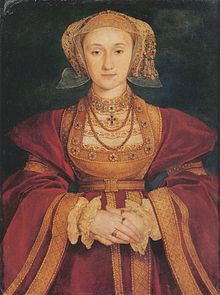
Left: Anne Boleyn. Initially Cromwell's 'ally'; he played a central role in Anne's downfall in 1536.
Right: Anne of Cleves, the bride favoured by Cromwell as a means of strengthening England's alliance with a Protestant nation. Yet the king was personally repulsed; this failed marriage led to Cromwell's execution.

Cromwell played a critical role in bringing about the annulment. A fervent evangelical reformer with close contacts with reformers such as Miles Coverdale and Stephen Vaughan, Cromwell encouraged the king to favour religious reform. Cromwell became increasingly wealthy and influential from 1532, particularly due to Thomas More's resignation from the Council in May. He became Master of the Jewels in April of that year and became Chancellor of the Exchequer in April 1533. With Cranmer's appointment as Archbishop of Canterbury, it can be argued that 'they were... a team'. (MacCulloch) They exerted considerable influence on Henry VIII, and, together with the evangelical Anne Boleyn, a definite atmosphere of religious reform developed in the English court.

In 1533 Henry VIII finally married Anne and her daughter Elizabeth was born that year. Cromwell was heavily involved in introducing a new bill curtailing the right to make appeals to Rome. The Act in Restraint of Appeals was passed in April 1533, ensuring further drastic reform of the Church. Cromwell also played a major role in making sure that the Pope was viciously attacked in official propaganda; and was involved in further measures such as the Act of Succession (which he strongly enforced throughout the country), the Dispensations Act, the Act for the Submission of the Clergy and the Act in Restraint of Annates.

Cromwell's power and influence increased dramatically when he was appointed principal secretary and chief minister in April 1534. Less well known perhaps, but which MacCulloch emphasises, was Cromwell's powerful involvement in social reform during these years, intending reforms in education, agriculture, trade, industry, poor relief and the common law (or 'common weal'.) Cromwell took action against enclosures, a particular agricultural method which aroused widespread resentment and opposition. The poor relief legislation of 1536 was notable, making parishes responsible for measures to combat local poverty. Cromwell is perhaps best known, however, for his ruthless enforcement of the Acts of Succession and Supremacy, punishing harshly those who refused to swear the oath. 'He was prepared to crush anyone who was perceived to be a significant threat', and in November 1534 Cromwell guided through the Treason Act which made it a crime to speak rebellious words against the royal family, insult the king, or deny their titles. Most incidents which came to his attention involved ordinary people's insults levelled at Queen Anne.

Cromwell's power within the Church also escalated, becoming royal vicegerent or vicar-general in January 1535. This saw him becoming actively involved in religious reform, leading to monastic visitations. Visitations of religious houses took place and from the spring of 1536 religious houses with an income of less than £2000 per annum were to be dissolved. Yet this caused a fall-out with Queen Anne, who resented the fact that the proceeds of the dissolved religious houses were to be paid into the coffers of the king and not instead be used on education or for charitable purposes. Anne's almoner at Easter denounced Cromwell publicly as her enemy and as an evil councillor. Historians fiercely dispute whether Cromwell 'masterminded' Anne's downfall in order to save himself, as she was a very real enemy due her opposition in religious affairs and matters of foreign policy (this view propagated by Ives and Weir). Others, such as Warnicke and Bernard, disagree for various reasons. It was probably Henry VIII's increasing disillusionment with his wife and love for Jane Seymour which led him to consider marrying again. Whatever the case, Cromwell promised his support to the so-called 'Aragonese' faction supporting Jane, and was involved in interrogating the Queen's supposed lovers and developing a case based on this. On 19 May the Queen was executed, along with the five men accused with her, and 11 days later the King married Jane.

Cromwell's position became even stronger; he was made Baron Cromwell of Wimbledon in July 1536 and Lord Privy Seal. However, this also meant that he acquired more enemies at court who resented his unprecedented influence and power. Cromwell was involved in further radical religious measures including the Ten Articles and the Injunctions, which sought to enforce these Articles throughout the kingdom. However, a series of northern rebellions erupted that autumn in response to these religious measures, demonstrating hostility to the radical nature of the English Church. Cromwell was blamed, along with others, for being an 'evil counsellor'. One can only wonder how the King responded to such sentiments.

During this time, and during the next few years, the dissolution of the monasteries proceeded apace. Yet the emergence of the Privy Council in around 1537, around the time of Queen Jane's death in childbirth, may have weakened Cromwell's religious position and strengthened that of nobles such as Norfolk and Suffolk. This made him even more reliant on the personal favour of the King as a means of ensuring his position remained secure. Yet, in the summer of that year, Cromwell's influence increased through being promoted to the Order of the Garter, a very selective and prestigious appointment shared by only 23 others.

The death of the queen saw Cromwell promoting a marriage alliance with the Protestant German princes, in particular with the relative of the Duke of Cleves, the Duchess Anne. This occurred in context of increasing hostility from the French and Spanish to the English - due to what they perceived as the 'heretical' religious situation there - leading England to require an ally urgently. As MacCulloch writes:

'...He became a busy and effective promoter of the new religion and its enthusiasts... in his latter years, he became a discreet organiser of contacts with the most radical European mainstream Reformations, in Zurich and northern Switzerland - far beyond anything the king could have approved, and highly dangerous for him'. 

In view of this, it is not surprising that Cromwell favoured an alliance with the 'Lutheran' Germans against the Catholic superpowers who threatened England's security. The situation in England was certainly dangerous since there is evidence that Henry VIII was beginning to become uneasy and unhappy about the development of religious reforms - at heart a religious conservative, these measures were disturbingly radical, even heretical, in his eyes. In 1538-9, according to Leithead 'the conservative faction was becoming a stronger and more cohesive force' which threatened Cromwell's security, leading him to mastermind the deaths of conservatives Edward Neville, Nicholas Carew, and the marquess of Exeter.

In 1539 Henry agreed to marry Anne of Cleves and she arrived in England in December of that year. However, the King found her personally repulsive and lashed out at Cromwell, blaming him for this travesty. The King reluctantly married Anne but refused to consummate the marriage. Possibly, conservatives at court noticed this and began to plot Cromwell's downfall. He was reported to be 'tottering' in April 1540. Yet, despite this, Cromwell was made Earl of Essex at that time.

The King's infatuation with the young Katherine Howard, occurring in context of his failed marriage to the Queen, provided the conditions for Cromwell's downfall. But it was the charges of heresy which led to Cromwell's death. As has been noted, the reforms instigated had been too radical for the King, and Cromwell's known communication with radical Protestants on the Continent was eagerly utilised by his enemies as evidence of treason. It did not help that Cromwell had personally angered the Duke of Norfolk - who, coincidentally, was Katherine's uncle - through dissolving Thetford Priory, which was the family burial place of the Norfolk dukes. As MacCulloch convincingly states:

'He [Cromwell] also died because members of the English nobility were affronted that this talented upstart usurped what they regarded as their natural place in government'.

In a court in which social status, wealth and closeness to the throne were pivotal, Cromwell's low birth, his richness, and his powerful influence with Henry VIII aroused deep resentment and hostility, particularly among established nobles such as Norfolk. The King's love for Norfolk's niece led Norfolk to espy an opportunity to bring down the hated Cromwell. In June, Cromwell was arrested at a Council meeting for treason and heresy, with Norfolk personally ripping the Garter badge of St George from Cromwell's clothing. He was imprisoned in the Tower of London, and executed on Tower Hill on 28 July 1540 - coincidentally, the same day that his master married Katherine.

MacCulloch characterises Cromwell as 'a cool, self-contained idealist who wanted to shape the kingdom of England in the name of  new religion - the remaker of this realm'. 

Did Cromwell really enact a 'Tudor revolution in government'? Did he play a pivotal role in the eventual triumph of the modern nation-state, and a secular society in Britain?

Perhaps Leithead is most accurate in suggesting:

'...Thomas Cromwell remains strangely elusive... it was through a life of service that he was able to become one of the richest and most powerful men in England... both the life and legacy of Thomas Cromwell have aroused enormous controversy. While opinions of him vary his effectiveness and creativity as a royal minister cannot be denied.'

It is surely significant that, just months after Cromwell's execution, Henry VIII lamented that:

'under pretext of some slight offences which he [Cromwell] had committed, they [the nobles] had brought several accusations against him, on the strength of which he had put to death the most faithful servant he ever had'.


Saturday, 24 November 2012

The Boleyn Marriage and the Birth of Anne Boleyn


Was Anne Boleyn a 'thin old woman' of thirty-six years old when she was executed on sensational charges of adultery, incest, and attempted regicide in May 1536, or was she actually a 'fearful beauty' of only twenty-eight?

Portraits: The Nidd Hall portrait (left) is often used to support the argument that Anne was born c.1501, since she is depicted as looking tired and aged. By contrast, the National Portrait Gallery portrait of Anne (right) depicts her, in the words of Joanna Denny, as 'radiant' and a 'beauty'. Readers should note that neither of these portraits was painted from life - they were both done years after Anne's death.

When Sir Thomas Boleyn, a rising courtier, married the daughter of the second duke of Norfolk, Elizabeth Howard, sometime between 1498 and 1501, he could surely not have envisaged the momentous consequences for the nature of English history that his union with this prosperous gentlewoman would eventually lead to.[1] Between the date of that marriage and c. 1505, Elizabeth gave birth to no less than five children who survived, although it seems likely that she also suffered miscarriages and/or stillbirths, a tragic series of events her daughter, Anne, would one day also experience. These children included two daughters, Mary and Anne, and three sons, Thomas, Henry, and George, the only one of whom to survive was George, later beheaded for incest with his sister Anne.


Thomas Boleyn was later to inform Sir Thomas Cromwell, the Master Secretary and a decisive player in the fall of Queen Anne, that his wife Elizabeth brought him ‘every year a child'.[2] If one takes the view that the couple had wedded in 1498 at the earliest and 1501 in the latest, this surely indicates that their eldest child must have been born in 1501-2 at the latest and possibly as early as 1499. There is considerable controversy about which of the Boleyn children was the eldest, with historians usually focussing on it being either of the Boleyn daughters, Mary or Anne. Eric Ives, the principal biographer of Anne Boleyn, suggested that Mary Boleyn was the elder daughter after carefully considering surviving contemporary evidence. In 1597, during the reign of Mary’s niece Elizabeth I, Lord Hunsdon, grandson of Mary, petitioned the Queen for the Boleyn earldom of Ormonde which had reverted back into Boleyn hands on the grounds that the Queen’s aunt Mary was the elder of the two Boleyn sisters. As one would expect, he would surely not have contemplated this had he been aware that his grandmother was younger than the queen’s mother. Furthermore, Mary Boleyn actually married before her sister Anne, in February 1520 to William Carey, a gentleman of the Privy Chamber who later died of the sweating sickness in the summer of 1528. As Ives indicates, ‘nor was a marriage for Anne discussed in England until nearly two years after Mary was Mistress Carey’.[3]

Opposing this argument, Warnicke argues that Hunsdon made a mistake and that his daughter Elizabeth ‘later confirmed his error by having it engraved on her tombstone that Mary was younger than Anne’. She also draws attention to the fact that Hunsdon was actually unsuccessful in his attept to obtain the title of Ormonde via this method.[4] Furthermore, the contemporary John Weever in his work Ancient funerall monuments (1631) stated that Anne was the elder daughter, not her sister Mary. [5] However, Warnicke’s argument that Mary Boleyn was never a maid of honour at the French court, along with her sister Anne, can be disputed. The name ‘M. Boleyn’ was on a list of ladies in the period October-December 1514, which indicates that she became a maid of honour the year after Anne was sent to the court of Margaret of Austria in the early summer of 1513. [6]

In considering which Boleyn daughter was elder, one has to consider social, religious, and cultural values prominent in the early Tudor period which would have influenced marriage customs, appointments at court, and family politics. Although it is strange that Anne was appointed a maid-of-honour a year before her sister Mary – in Warnicke’s words, ‘by contemporary custom, the younger child would not have been favored with such a splendid opportunity to the detriment of her older sister...’[7] – it would make even less sense why the younger daughter would have been married before the elder, since according to Tudor family customs, the eldest child was almost invariably married before other siblings as a means of extending family influence and securing prestige. From Ives’ perspective, ‘the decision to leave Anne to make her career in France’ surely suggests ‘there was no place for her in Boleyn family plans’ and her ‘failure to marry while in France suggests that she was not much of a prize’.[8] As has been suggested, there may have been a completely reasonable explanation why Anne was appointed a maid-of-honour in 1513 before her elder sister Mary the year after – it has long been supposed that Anne was intellectually superior to her sister, or perhaps Mary was ill or incapacitated at this time, or perhaps their ambitious father was hoping to secure an appointment for his eldest daughter at court to serve Katherine of Aragon in 1513 while his youngest daughter was appointed a maid-of-honour in France. On a balance of probability, however, it does seem likelier that Mary was older than Anne.

So if Mary was older than Anne, then when was she born? Estimates for Mary’s birth usually run between 1498 and 1502. Warnicke’s suggestion that she was born in 1508 is not supported by contemporary evidence.[9] If Mary was born in 1508, she would have been only eleven years old  when she married William Carey – since she married in February 1520, and as Warnicke herself admits, she may only have been born after March 1508 – which seems totally implausible. As Ives argues, only landed heiresses were married at the young age of twelve, which was something that the Boleyn sisters were not. [10] Warnicke weakens this argument by conceding that most Tudor women married at the age of twenty. [11] Considering court customs and prevailing social and cultural views about women, it seems likely that Mary was born considerably earlier than 1508. If she was appointed a maid of honour to the French queen in the summer or autumn of 1514, she must have been thirteen or fourteen years old at the least. The Emperor Maximilian was later to write that this was the minimum age a European teenage girl should be in order to expect an opportunity of being appointed a maid of honour to an aristocratic noblewoman. Bearing this in mind, it seems likely that Mary was born in around 1500. She was to marry William Carey in the early spring of 1520, when she would likely have been nearing her twentieth birthday, which was the average age that Tudor gentlewomen married at. If her parents, moreover, had married between 1498 and 1501, and she was the eldest child as is here being suggested, a birthdate of 1500 seems plausible.

As Weir suggested, if Mary was older than Anne, then Anne cannot have been born before around 1501.[12] Since the nineteenth century, there have been two schools of thought – or divergences between Tudor scholars – in terms of when this most controversial queen was born, arguing a date of either c.1501 or 1507. As Ives recognised, 1507 was the most popular date well into the early twentieth century. This is supported by contemporary evidence from the late sixteenth century. The memoirs of Jane Dormer (1538-1612), duchess of Feria and maid of honour to Queen Mary I, Anne’s stepdaughter, have been frequently cited as providing evidence of a 1507 birth date. Referring to Anne Boleyn’s execution on 19 May 1936, the Duchess stated: ‘but to come to her death... she was convicted and condemned [and] she was not twenty-nine years of age’, ie. suggesting that Anne would have celebrated her twenty-ninth birthday in the summer of 1536.[13] If she was correct, the Queen was therefore born in 1507. This birth date has been supported by other existing evidence from the sixteenth century. William Camden, who wrote a life of Queen Elizabeth I which was subsequently published in 1615, stated that Anne was born in 1507 – MDVII. However, Russell’s argument that 'the fact that he stated 1507 quite specifically cannot be dismissed, anymore so than the Duchess of Feria's pronouncement in her memoirs' should be reconsidered in light of alternative evidence which decisively challenges this argument that Anne was born in 1501. [14] Camden actually expressed confusion about Anne's date of birth. Besides recalling that she had been born in 1507, he later opined that the king had fallen in love with her aged thirty-eight (1529), when Anne was supposedly 'in the twentieth year of her age', providing a birth date of c.1509. In the same breath, Camden reported that Henry had been married to his first queen for seventeen years (1526) when these events happened. According to Camden, Anne's birth could variously be placed in 1506, 1507, or 1509, which does not suggest that he is the most reliable of sources for the date of birth of Elizabeth I's mother.


As has been established earlier in this essay, Thomas Boleyn decided to grant his youngest daughter Anne the prestige of being appointed a maid of honour to the Archduchess Margaret of Austria in the early summer of 1513. With reference to Mary Boleyn, it has been established also that a maid of honour had to be aged thirteen at the very youngest in order to enjoy such a prestigious appointment – as Warnicke states, girls had to be at least thirteen since ‘on ceremonial occasions they were expected to serve as “decorative foils” to their mistress’.[15] Surely then it makes little sense why a young girl of only six or seven years of age would have been chosen to act as a maid of honour to the new French queen, Mary, sister of Henry VIII, when other girls were aged at least thirteen or fourteen. By contemporary custom, this seems an implausible conclusion to make. In 1981 Hugh Paget, the art historian, analysed a letter which Anne wrote to her father Thomas in the summer of 1514, and concluded that Anne must have been born in 1501 at the very latest. Readers should bear in mind that this early date had actually been suggested in the nineteenth century by the prominent Victorian historian of the queens of England, Agnes Strickland.

Some historians continue to advocate a birth date of 1507, despite its inherent improbability; most famously Warnicke. Yet in Ives’ words she ‘requires us to believe that Henry VIII summoned a now seven-year-old Anne from Brussels in order that his sister could converse in French with a beginner in the language who would today be in a primary school’. [16] When one actually looks at a copy of the letter Anne wrote in 1514, it is clear that it is written in ‘the formed hand of at least a teenager’, not a seven-year old, as G.W. Bernard makes clear. [17]

The actual nature of historical sources which describe Anne Boleyn as being born in 1507 need to be rigorously challenged. As Joanna Denny indicated, Jane Dormer's memoirs should be viewed only with considerable caution, since she was hostile to Anne and resented her daughter Elizabeth, by virtue of her extremely close relationship with Queen Mary. It is entirely possible that she chose to characterise Anne as being a young and foolish woman in order to belittle her or weaken her status; instead of portraying her as an independent, fiery woman (as the hostile Nicholas Sander does; more importantly, he presented Anne as being born in around 1500), she remembered Anne as a worthless younger woman. William Camden, despite his different religious beliefs to Dormer, may have read her memoirs published by Henry Clifford - it has never been proved that he did not.

The archduchess’ reference to Anne Boleyn in a letter to Thomas in 1514 as ‘so bright and pleasant for her young age’ has often been cited as evidence that Anne must have been born in 1507 – if she had been born in around 1501, and was therefore the usual age of a maid of honour in European courts, it would make little sense why her youth was emphasised, in Warnicke’s words: ‘had she been twelve or thirteen and thus old enough to be a maid of honor, these reporters would not have regarded her age as noteworthy’. [18] Yet this approach is problematic. If one follows the argument that Anne was sent to the archduchess’ court in the early summer of 1513, when she would not yet have been twelve years old, it does not seem wholly impossible that she would have been seen as rather younger than most other girls. Indeed, if she was still only eleven, she would not yet have reached the minimum age of thirteen that the Emperor expected most maids of honour to be. Furthermore, this was only a minimum – many girls at court would have been somewhat older than thirteen or fourteen. The fact that Thomas Boleyn described his daughter as 'le petite Boulaine' is also likely to have been because of her status as his younger daughter, rather than her age.

The argument that Anne Boleyn may have been born in 1507 because another girl at the Burgundian court, Anne Brandon, was born around 1506 and so there were other pre-pubescent girls serving the archduchess, makes little sense for several reasons. First, as Warnicke states, Brandon’s birth date is actually unknown. [19] She may have been born in 1503 and would therefore have been aged ten or eleven, rather than merely seven. The suggestion, therefore, that Anne Boleyn may have been close to her twelfth birthday when she arrived in spring 1513 becomes a great deal more compelling. Second, she was the daughter of future Duke of Suffolk, Charles Brandon, a considerably more influential nobleman than Thomas Boleyn was as yet, and so Charles may have been granted special privileges in allowing his relative to reside at court at a young age which the daughter of Thomas Boleyn would simply not have enjoyed. Finally, as Ives has pointed out, Anne Brandon’s status at court was actually unknown and so it is unhelpful to attempt comparisons between her status and that of Anne Boleyn. [20]

There is, indeed, other contemporary evidence to support an earlier birth date of 1507, somewhere around 1500-1501. Lord Herbert of Chadbury, who was a prominent historian in the late sixteenth century, wrote that Anne returned to England at the age of twenty. We know that Anne returned in January 1522 in order to contract a marriage with her father’s chosen man, James Butler, an Irish relative, in order to settle family disputes over the earldom of Ormonde. If one follows Herbert’s claim, she must have been nearing her twenty-first birthday and so would have been born around 1501. Warnicke’s attempts to reinterpret this to mean that Herbert was referring to 1527 – based on her suggestion that Anne only became Katherine of Aragon’s maid of honour that year – makes little sense. It seems apparent that Anne was appointed as a maid of honour to the English queen on her return to England in the winter of 1522, and not as late as 1527. Indeed, if Herbert had been referring to Anne's age when she was at court in 1527, he would more likely have stressed that this was when the king fell in love with her, for by 1527 their relationship were certainly well-known. An Italian observer writing in 1600, furthermore, believed that Anne had been born as early as 1499, while the Spanish ambassador’s comment in February 1536, the last year of Anne’s life, that Anne was ‘a thin old woman’ would seem to make little sense if she was still a ‘radiant’ beauty of only twenty-eight. Admittedly, he often made spiteful comments about Anne, who he hated and viewed as a she-devil, but the Nidd Hall portrait of Anne (albeit only painted at least fifty years after Anne’s death) can cautiously be seen to support this view.

One must also consider attitudes to marriage and family customs in early Tudor England as a means of establishing Anne’s birth date. Having returned to England in early 1522 in order to marry her relative James Butler, Anne would confidently have expected to have become a countess sometime that year aged twenty-one. However, the marriage negotiations, mysteriously, failed, and nothing came of the proposed marriage. Her father made no more moves to marry his youngest daughter, until famously in 1526 the king himself fell in love with ‘this fresh young damsel’. Supporters of 1507 have argued that it is totally implausible that a Tudor gentlewoman would have been left unmarried as ‘old’ as twenty-five or twenty-six, yet this view does not take into account the fact that, aged twenty-one, Anne had expected to marry some four years earlier. Contemporary social customs do not support the suggestion that ‘having reached the age of 25 without a husband, Anne would have been sailing dangerously close to the "unmarriageable age," something which it is almost impossible to believe her father would have allowed’.[21] Martin Ingram’s research, for instance, has indicated that the mean age of women who married in early modern England was usually twenty-four, while in some areas of England it was as late as twenty-seven. Following Warnicke’s argument that most Tudor women married aged twenty, it makes little sense why a young lady of twenty-five would have been regarded as at an ‘unmarriageable’ age in 1526-7. Indeed, Anne’s later supplanter, Jane Seymour, was consistently referred to by the Spanish ambassador as ‘a young lady’ in 1536, when she was actually aged twenty-eight.

Furthermore, Henry VIII proposed marriage to Anne in 1527. If one believes that she was born c1501, she would have been around twenty-six and confidently expecting to marry the king that year and perhaps bear his long-awaited heir the year after. There is no reason to suppose that she had to have been only nineteen or twenty in order to be regarded as having ‘apparent aptness to procreation of children’. Surely no one at court could have envisaged that the king’s mission for an annulment of his marriage to Katherine of Aragon would take six long years – as Ives has pointed out, Anne and King Henry expected to marry immediately.
In 1529, Anne ‘worried aloud that her time and youth would all be spent for nothing’, famously railing at the king for his failure to bring about their marriage and, as a consequence, lessening the chances of her bearing a child.[22] It seems questionable why she would have made such an issue of this had she been aged only twenty-two; yet if she was closer to twenty-eight or twenty-nine, it becomes more apparent why Anne fretted about her diminishing chances of bearing a healthy male heir once she became queen. One writer has actually suggested that Anne made this comment in 1531, supposedly aged thirty, but Chapuys' dispatches make clear that she actually made the comment on St Andrew's Day, 1529.[23] A consideration of similar court ladies' experiences will justify a 1501 birth date in this context. Mary Boleyn, born in 1499-1500, married in 1520, aged 20-21; Jane Parker, born around 1505, was married in 1524-5, aged 19-20, and Elizabeth Howard, Anne's mother, born c.1480, had married in 1499-1500, aged 19-20. If Anne was only twenty-two in 1529, as supporters of 1507 believe, then it does not make any sense why she would have bewailed her lost youth, when she was actually at the perfect age for marriage in context of Tudor customs. Yet if she was 27 or 28, it becomes far more obvious.

There is other compelling evidence for Anne being born earlier than 1507, and around 1501. Gareth Russell, in his essay 'The Age of Anne Boleyn' writes:


'One question the 1501 side of the debate has never fully answered is the issue of Anne's suitability to be the mother of the King's children... Why did no-one highlight the fact that she was simply too old to be the mother of the next Heir to the Throne?' 


Russell then cites the letter to the Vatican in 1528-9 which stresses Anne's 'apparent aptness to procreation of children' which would seemingly indicate that she was a young woman of about 22, rather than an older court lady of 28 or 29.

However, reading evidence in a new light weakens this argument. Following Anne Boleyn's execution in 1536, her husband Henry VIII married her former lady-in-waiting Jane Seymour, and in the Parliament held in June 1536, Lord Chancellor Audley described the Queen Jane as such:

'that our excellent Prince... hath consented to accept that condition and has taken to himself a wife, who in age and form is deemed to be meet and apt for the procreation of children'.[24]


Jane Seymour's exact age is unknown, but if 29 women walked at her funeral only one year later, she must have been aged around 28 when Audley made this comment. Thus, it is entirely appropriate that Anne Boleyn, at about the exact same age, had been described as likely to bear children. 


To summarise, there is no reason to believe that a woman in her mid twenties was considered ‘old’ in context of early modern Tudor customs, nor is there any reason to suppose that her likely age of thirty-five at death is highly unlikely in view of the fact that Anne still became pregnant regularly during her queenship. It also seems tenuous to argue that Anne’s father and the archduchess would only regard Anne as being 'young’ if she was aged six or seven rather than being eleven or twelve, particularly in view of the sense that children this young were simply not appointed maids of honour in the first place. Although the discovery of the remains of a Tudor woman in the Tower of London aged between twenty-five and thirty was believed to have been Anne, this is not necessarily the case since Victorians commonly believed that Anne had been only twenty-nine at her execution and so this presupposition may have influenced their judgments. Furthermore, it is not certain that this woman was Anne – it may have been another, since, as has been recognised, there were four other decapitated females buried in the Tower: teenage queens Katherine Howard and Jane Grey, the Lady Jane Rochford, and Margaret, countess of Salisbury. All in all, a birth date of between 1500 and 1502, most likely 1501 has to be regarded as more likely than that of 1507.

Briefly, in view of Boleyn family history it seems apparent that George Boleyn was the youngest surviving Boleyn child and not, in Warnicke’s view, the eldest.[25] George took part in his first masque at court at Christmas 1514 and was later married in late 1524 to Jane Parker. It has been seen as significant that he was made his first grant in April 1522, perhaps when he was eighteen years of age. If one follows that Mary and Anne were older than George, being born in 1500 and 1501 respectively, and he married in 1524 perhaps aged twenty, a birth date of c1504 seems highly likely. His older brothers Thomas and Henry, who died aged young, were likely born in 1502 and 1503.

This article has refuted the notion that Anne Boleyn was born in 1507. It seems apparent that we should be regarding her birth date as likely to have been in the summer of 1501. Furthermore, it seems even less credible to claim that her sister Mary was younger and only eleven or twelve years old when she married in 1520. Surviving contemporary evidence and contemporary social and cultural customs indicate a birth date of 1499-1500, meaning that Mary was likely aged fourteen when she became a maid of honour to the French queen in 1514 and around twenty when she married Carey in 1520. Mary’s brother, George, was probably born in 1504 as the youngest surviving Boleyn child. This would, therefore, support Thomas Boleyn’s claim that Elizabeth Howard bore him every year a child, if the two married in around 1499 and their daughter Mary was born either that year or the next, followed by Anne, followed by Thomas and Henry, and lastly by George in 1504. It is also possible, of course, that Elizabeth suffered failures in pregnancy; her daughter Anne was to suffer at least two. If the Spanish ambassador’s depiction of Anne as a ‘thin old woman’ in the winter of 1536 can be regarded as spiteful, there is also a chance that it was, unfortunately, an accurate presentation of a queen whose miscarriage the month before had undoubtedly saddened and, plausibly, weakened her.


[1] The date of Thomas Boleyn’s marriage to Elizabeth Howard is unknown. Her jointure was settled on her in November 1501, which indicates that a marriage had taken place that year at the very latest; see Eric Ives, The Life and Death of Anne Boleyn (Oxford, 2005), p. 17. As Ives conjectures, 1498 is probably the earliest possible date for the marriage. R. M. Warnicke, The Rise and Fall of Anne Boleyn (Cambridge, 1989), p. 9 suggests a marriage date of 1501, but no evidence is provided to substantiate this suggestion.
[2] Ives, p. 17.
[3] Ives, pp. 16-17. It also seems implausible that Queen Elizabeth would actually have allowed Hunsdon to obtain the earldom of Ormonde if she was aware that her mother Anne was older than Mary, since she would have obtained it otherwise.
[4] Warnicke, p. 258.
[5] R. M. Warnicke, ‘Anne Boleyn’s Childhood and Adolescence’, The Historical Journal, Vol. 28, No. 4, Dec., 1985, p. 940.
[6] Warnicke, ‘Childhood’, p. 951. See also A. Weir, Mary Boleyn: The ‘Great and Infamous Whore’ (Jonathan Cape, 2011), for an argument which refutes this view.
[7]Warnicke, Rise and fall, p. 9.
[8] Ives, Anne Boleyn, p. 17.
[9]Warnicke, Rise and fall, p. 9. See also ‘Anne Boleyn’s Childhood and Adolescence’, pp. 939-952.
[10] Ives, Anne Boleyn, p. 369.
[11] Warnicke, Rise and fall, p. 35.
[12] A. Weir Mary Boleyn, p. 16.
[13] G. Russell, ‘The Age of Anne Boleyn’ (April 2010), http:// http://garethrussellcidevant.blogspot.co.uk/2010/04/age-of-anne-boleyn.html (last accessed 24 Nov 2012)
[14] Ibid.
[15] Warnicke, Rise and fall, p. 10.
[16] E. W. Ives, ‘Stress, Faction and Ideology in Early-Tudor England,’ The Historical Journal, Vol. 34, No. 1, Mar., 1991, p. 195.
[17] G. W. Bernard, Fatal Attractions (Yale, 2010), Chapter 1.
[18] Warnicke, Rise and fall, p. 12.
[19] Warnicke, Rise and fall, p. 259.
[20] Ives, Anne Boleyn, p. 368.
[21] G. Russell, ‘The Age of Anne Boleyn’ (April 2010), http:// http://garethrussellcidevant.blogspot.co.uk/2010/04/age-of-anne-boleyn.html (last accessed 24 Nov 2012)
[22] Warnicke, Rise and fall, p. 95.
[23] G. Russell, 'Age'.
[24] J.A. Froude, The Reign of Henry the Eighth, ii. xi., p173. 
[25] Warnicke, Rise and fall, p. 9.