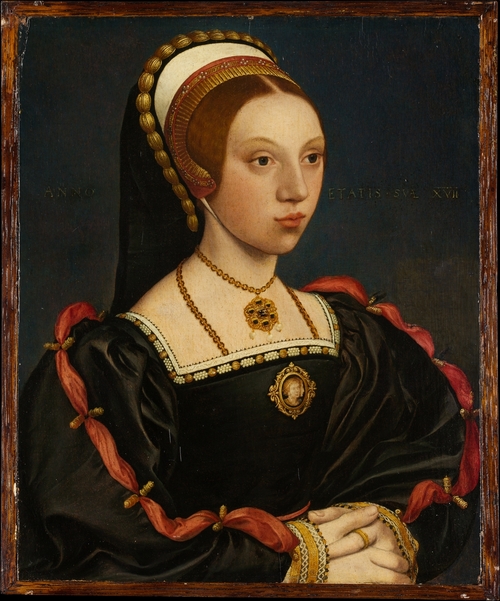
Katherine Howard, fifth wife of Henry VIII of England
Lifetime: c. 1523 - 13 February 1542
Reigned: July 1540 - November 1541 (1 year, 4 months)
Pregnancies: 0
In this new six-part series, I will be reexamining the lives and personalities of Henry VIII's six wives, seeking to portray their lives realistically in a process that discards prevailing stereotypes. Much scholarly work has been done on Henry's reign in recent decades, affording fresh insights into the politics and achievements of the period. Understandably, widespread interest in Henry's marital affairs remains unabated. Yet stereotypes continue to bedevil our knowledge of the wives of this most enigmatic king.
The pretty teenager Katherine Howard had been at court for only seven months when she became queen of England upon her marriage to Henry VIII on 28 July 1540 at Oatlands Palace. The niece of Thomas Howard, duke of Norfolk, Katherine had served as maid of honour to Queen Anne of Cleves. Henry was entranced by his wife's attractive attendant and began publicly favouring her in April. Katherine's downfall was as swift as her ascent. In November 1541, her unsavoury past was discovered by her husband and his Privy Council, who had been informed by the reformer John Lascelles, brother of Katherine's childhood acquaintance Mary Lascelles. The council also learned that the queen had met in secret several times with her husband's gentleman of the privy chamber Thomas Culpeper. Both Katherine and Culpeper insistently denied that they had engaged in sexual intercourse, but their pleas of innocence went unheard. Culpeper was executed alongside Katherine's former lover Francis Dereham, who had boasted that he would be sure to marry Katherine once Henry had died. The queen, accompanied by her lady-in-waiting Jane Rochford, followed them to the scaffold in February 1542. Katherine was reviled as an adulteress in her own time and has been systematically 'slut shamed' in modern times. However, the brief evidence of her queenship indicates that she was a noted intercessor, a patron and loyally provided for her family and friends. The traditional depiction of her as an older, knowing woman who quarrelled with her stepdaughter Mary Tudor, a woman who was 'airheaded' or 'dim', is one that is not fully supported by the extant sources. In continuing to 'slut shame' Katherine, modern historians merely perpetuate the prevailing misogyny of the period in which Katherine lived.
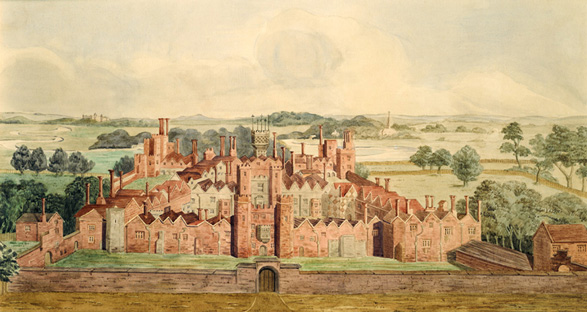
Above: Oatlands Palace, where Katherine Howard married Henry VIII.
Katherine Howard's origins are mostly unknown; we do not know her birth date, where she was born, or her exact number of siblings. Her contemporaries, however, were agreed that she was very young when she married Henry VIII. In his Metrical Visions, Wolsey's former gentleman usher George Cavendish referred to Katherine's youth no less than ten times; for example, he described her as 'floryshyng in youthe with beawtie freshe and pure'. The French ambassador Charles Marillac believed that Katherine was sexually involved with Dereham from the ages of thirteen to eighteen. However, he was not perceptive about women's ages: he had earlier affirmed that Anne of Cleves was thirty, rather than twenty-four, perhaps because he disliked her German clothing and manners. It is possible that Marillac was unaware of Katherine's relations with Henry Manox, but he would have known of Dereham given Dereham's position at court in Katherine's household. On the basis of hearsay that Katherine had been sexually active in 1536, and knowing that rumours had accused her of granting sexual favours to Dereham as queen, Marillac might have assumed that she was thirteen in 1536 and eighteen in 1541.
Other observers agreed that Katherine was younger than Henry's previous wives. Richard Hilles, in his letter to Henry Bullinger written in 1541, reported that the king had married 'a young girl'. Katherine herself blamed her youth for her mistakes, which indicates that she was still in her teenage years. Warnicke has advanced the suggestion that modern historians are usually reluctant in believing Katherine may have been younger than eighteen because it depicts Henry VIII in a negative light. However, following Jane Seymour's death he had been interested in marrying the sixteen-year-old Christina of Milan, and his mistress Bessie Blount had been perhaps only fourteen years old when Henry was first attracted to her. The abundance of references to Katherine's youth indicate that she was probably born around 1523 and was about seventeen when she became Henry's wife in 1540.
Henry was probably captivated by Katherine's beauty and charm, but he was perhaps also entranced by her youth. It signalled fertility and offered the promise of a second son to secure the Tudor succession. When Katherine married Henry, his only surviving son Edward was only two years old and, given that Henry's own elder brother had died as a teenager, the king must have been deeply concerned about the future of his dynasty. Katherine's family was highly fertile: she herself was one of about six children, and her father had ten siblings. Moreover, whereas Anne of Cleves' physical appearance had indicated to Henry that she was not a virgin, Katherine's slim figure confirmed that she was a virgin. Possibly because she was less than five feet in height - reportedly being 'diminutive' in stature - and he was a tall man of over six feet inches, on his wedding night Henry seems to have failed to discern that his new wife was not a virgin as he had believed.

Above: Portrait of a young woman, thought by some to be Katherine Howard.
The pretty teenager Katherine Howard had been at court for only seven months when she became queen of England upon her marriage to Henry VIII on 28 July 1540 at Oatlands Palace. The niece of Thomas Howard, duke of Norfolk, Katherine had served as maid of honour to Queen Anne of Cleves. Henry was entranced by his wife's attractive attendant and began publicly favouring her in April. Katherine's downfall was as swift as her ascent. In November 1541, her unsavoury past was discovered by her husband and his Privy Council, who had been informed by the reformer John Lascelles, brother of Katherine's childhood acquaintance Mary Lascelles. The council also learned that the queen had met in secret several times with her husband's gentleman of the privy chamber Thomas Culpeper. Both Katherine and Culpeper insistently denied that they had engaged in sexual intercourse, but their pleas of innocence went unheard. Culpeper was executed alongside Katherine's former lover Francis Dereham, who had boasted that he would be sure to marry Katherine once Henry had died. The queen, accompanied by her lady-in-waiting Jane Rochford, followed them to the scaffold in February 1542. Katherine was reviled as an adulteress in her own time and has been systematically 'slut shamed' in modern times. However, the brief evidence of her queenship indicates that she was a noted intercessor, a patron and loyally provided for her family and friends. The traditional depiction of her as an older, knowing woman who quarrelled with her stepdaughter Mary Tudor, a woman who was 'airheaded' or 'dim', is one that is not fully supported by the extant sources. In continuing to 'slut shame' Katherine, modern historians merely perpetuate the prevailing misogyny of the period in which Katherine lived.
Above: Oatlands Palace, where Katherine Howard married Henry VIII.
Katherine Howard's origins are mostly unknown; we do not know her birth date, where she was born, or her exact number of siblings. Her contemporaries, however, were agreed that she was very young when she married Henry VIII. In his Metrical Visions, Wolsey's former gentleman usher George Cavendish referred to Katherine's youth no less than ten times; for example, he described her as 'floryshyng in youthe with beawtie freshe and pure'. The French ambassador Charles Marillac believed that Katherine was sexually involved with Dereham from the ages of thirteen to eighteen. However, he was not perceptive about women's ages: he had earlier affirmed that Anne of Cleves was thirty, rather than twenty-four, perhaps because he disliked her German clothing and manners. It is possible that Marillac was unaware of Katherine's relations with Henry Manox, but he would have known of Dereham given Dereham's position at court in Katherine's household. On the basis of hearsay that Katherine had been sexually active in 1536, and knowing that rumours had accused her of granting sexual favours to Dereham as queen, Marillac might have assumed that she was thirteen in 1536 and eighteen in 1541.
Other observers agreed that Katherine was younger than Henry's previous wives. Richard Hilles, in his letter to Henry Bullinger written in 1541, reported that the king had married 'a young girl'. Katherine herself blamed her youth for her mistakes, which indicates that she was still in her teenage years. Warnicke has advanced the suggestion that modern historians are usually reluctant in believing Katherine may have been younger than eighteen because it depicts Henry VIII in a negative light. However, following Jane Seymour's death he had been interested in marrying the sixteen-year-old Christina of Milan, and his mistress Bessie Blount had been perhaps only fourteen years old when Henry was first attracted to her. The abundance of references to Katherine's youth indicate that she was probably born around 1523 and was about seventeen when she became Henry's wife in 1540.
Henry was probably captivated by Katherine's beauty and charm, but he was perhaps also entranced by her youth. It signalled fertility and offered the promise of a second son to secure the Tudor succession. When Katherine married Henry, his only surviving son Edward was only two years old and, given that Henry's own elder brother had died as a teenager, the king must have been deeply concerned about the future of his dynasty. Katherine's family was highly fertile: she herself was one of about six children, and her father had ten siblings. Moreover, whereas Anne of Cleves' physical appearance had indicated to Henry that she was not a virgin, Katherine's slim figure confirmed that she was a virgin. Possibly because she was less than five feet in height - reportedly being 'diminutive' in stature - and he was a tall man of over six feet inches, on his wedding night Henry seems to have failed to discern that his new wife was not a virgin as he had believed.

Above: Portrait of a young woman, thought by some to be Katherine Howard.
Modern historians have usually asserted that the new queen experienced conflict with her stepdaughter Mary Tudor. The Spanish ambassador reported that Katherine, offended because her stepdaughter had failed to treat her with the same respect shown to Jane Seymour and Anne of Cleves, had ordered two of Mary's maids to be removed from her household. However, Chapuys reported in January that Mary had not visited the queen yet. He did report that the New Year gift sent by Mary had greatly pleased the queen. In May, Katherine approved the king's decision to grant his daughter permission to reside at court. Katherine also cooperated with Mary in arranging the royal couple's visit to Prince Edward. When viewed in full, the surviving evidence hardly suggests that Katherine and Mary disliked one another and it does not indicate that Mary resented her stepmother's supposed greed or frivolousness. It suggests that their initial relations were rocky, but seems to indicate that they later experienced cooperative relations with one another.
Katherine sought to be a kind and generous mistress. She granted both her stepdaughters, Mary and Elizabeth, gifts of jewellery, and she also provided her niece-by-marriage Lady Margaret Douglas with jewels. The queen ensured that members of her family served in her household: her half-sister, for example, was the wife of Katherine's vice-chamberlain. One or two scholars have opined that Katherine was disliked by her husband's courtiers and failed to inspire loyalty; but given her youth, inexperience and newness at court, this is hardly surprising. Moreover, there is no conclusive evidence that she was unpopular or widely disliked. Chapuys was sympathetic in his reports of her, and like Jane Seymour her queenship was grounded in submission to her husband's authority, as her motto 'No Other Will But His' confirmed.
She was usually successful in the performance of her royal duties. In November 1540, she wrote to the archbishop of York requesting that he provide her chaplain with an advowson of the York archdeaconery, although she was unsuccessful. On several occasions Katherine successfully interceded; in late March she requested pardons for Sir Thomas Wyatt and Sir John Wallop, and in October she successfully beseeched her husband to pardon Helen Page. Katherine may also have been involved in the sending of clothing to the condemned Margaret Pole, countess of Salisbury, who was imprisoned in the Tower. Katherine was a loyal presence at Henry's side. In March, the king and queen travelled to Greenwich by barge and were granted by the saluting of the Tower cannons and the firing of ships' guns along the Thames, in the eyes of the chronicler Charles Wriothesley 'a goodly sight'.
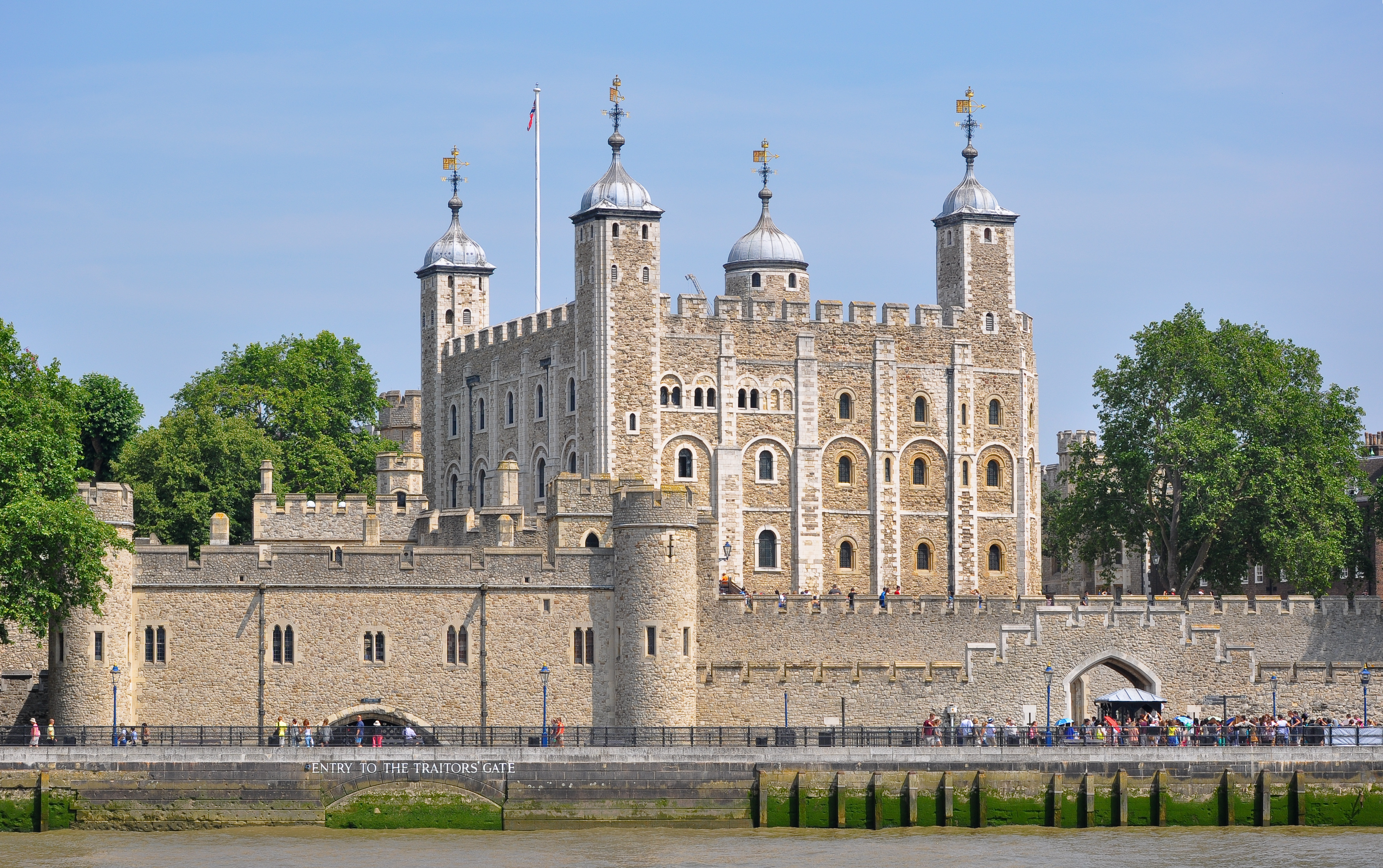
Above: The Tower of London, where Katherine was imprisoned and executed.
Unknown to her husband, Katherine had a murky past. As a young girl she had resided in the household of her step-grandmother the Dowager Duchess of Norfolk. In 1536, the Dowager Duchess arranged for a musician, Henry Manox, to provide the thirteen-year-old Katherine with music lessons. When Katherine's interrogators learned of her relations with Manox, they assumed that she was responsible for his seduction of her. Sixteenth-century observers viewed young women as sexually insatiable, believing that they were 'desirous to be married... to the end that they may be fruitful'. They were believed to provoke rape and were viewed as experiencing pleasure in it. If a woman was involved in sexual relations against her will, and subsequently fell pregnant, it was held that she could not have been raped.
Katherine's music master was in a position of authority over her. He entreated Katherine to secretly meet with him, where he fondled her and, although she showed reluctance, he reported that she was 'content' for him to do so. As Laura Gowing has noted, Manox's confession 'shows no signs of the sense of guilty self-implication' that appears regularly in women's testimony. When the dowager duchess discovered Katherine's relationship with Manox, she beat her step-granddaughter several times and warned them never to meet together again. Two years later, in 1538, Katherine was acquainted with Francis Dereham, who was perhaps a gentleman usher to the dowager duchess.
Whether Katherine was in love with Dereham is a question that has not often been debated. Most historians have assumed that theirs was a love affair, but as Warnicke notes, none of Katherine's later testimony suggests that she enjoyed Dereham's pursuit of her. The interrogators failed to ask her whether she had consented to Dereham's sexual advances. Katherine answered this, however, by confirming that Dereham's actions constituted 'importune forcement, and in a manner, violence, rather than of her own free consent and will'. Rather than proclaiming her knowledge of contraception, Katherine's comment 'a woman might meddle with a man and yet conceive no child unless she would for herself' can be viewed as 'a coded statement about her feelings for Dereham rather than a reference to birth control' (Warnicke). Contemporaries believed that females should enjoy sexual intercourse in order to successfully conceive. If Katherine had no wish to have sexual intercourse with Dereham, then she would have believed that she was forced to please him and would therefore not have enjoyed the experience. This explains her later denial that she was ever Dereham's wife. The church required that the marriage vows were freely given, rather than coerced.

Dereham's arrival at court in the spring of 1541 complicated matters for Katherine. Aware of the potential danger of his presence, she admonished him to keep silent about their former relationship and placated him with gifts of money in a misguided attempt to buy his silence. Perhaps fearful about the possibility that the king would discover that she was not a virgin, the queen agreed to meet with Thomas Culpeper, her distant kinsman, that spring. Culpeper was an experienced courtier and had an unfavourable reputation as a murderer and a rapist. Whether he deserved this reputation is uncertain, but certainly he was well aware of the treacherous nature of court intrigue. Simply by meeting with Culpeper in private, regardless of her intentions, Katherine placed herself in a position of great danger. Contemporaries warned that wives should not meet with men who were not their husbands. By meeting with Culpeper in secret, Katherine invited suspicion and her motives were to be interpreted in the worst possible light.
Possibly Culpeper had initially approached Lady Rochford, Katherine's attendant, because he was aware that she was closest to the queen on account of her position as Lady of the Bedchamber. Margaret Morton, who served Katherine, later reported that Lady Rochford was to bear the blame for Katherine's actions. The queen provided Culpeper with a velvet cap at their first meeting, perhaps as a reward for his promise to keep her childhood secret. Certainly, the timing of his meeting with Katherine was suspicious. In the spring of 1541, when they first met, Dereham arrived at court and openly bragged of his former sexual relationship with the queen, even claiming that, were the king to die, he would be sure to marry Katherine. At around the same time, Henry fell seriously ill and closed his doors to Katherine for several days, later inviting rumours that he had been displeased with her and had been considering annulling their marriage. It is often not appreciated how perilous Katherine's position was in the spring of 1541. As rumours emerged about her past, in the midst of her husband's incapacity, Katherine sought to silence those who knew the truth of her childhood.
The court departed on the northern progress in June and Katherine met with Culpeper on several occasions. At some point the queen wrote a letter to Culpeper, perhaps with the assistance of Lady Rochford given that the style of handwriting changes several words in. Interestingly, the letter was never mentioned in the indictments or by resident ambassadors at court, thus endowing it with mystery. Katherine's intentions cannot easily be read from the letter alone. The elaborate style and flowery sentences have usually been viewed as evidence of the queen's love for Culpeper, but the phrases were in keeping with those used in the period. Warnicke has suggested that the closing phrase, 'yours as long as life endures', provides evidence that danger and death, rather than love and romance, were on Katherine's mind at the time. She was surely well aware of Anne Boleyn's execution and knew that her actions could be interpreted in the same light. Unsurprisingly, she eventually informed Lady Rochford to instruct Culpeper not to meet with her again.
Certainly Culpeper reported later how nervous she had been in their meetings. She had instructed Lady Rochford to remain closely nearby as a chaperone, perhaps assuming that the older woman's presence would add an air of respectability to her meetings with Culpeper. Much of the queen's ladies' later evidence was speculative. Margaret Morton believed that Katherine had looked out of a window with an expression of lust directed towards Culpeper, but one wonders why the queen's attendants did not inform the king or his council of their suspicions at the time. More likely, having heard in the wake of Katherine's downfall that she had not been a virgin when she became queen, they viewed her meetings with Culpeper in this light. Viewing her as a loose, promiscuous woman, they believed that her nighttime meetings must surely have been sexually motivated rather than anything else. Yet the evidence is mostly ambiguous.
When the council discovered Katherine's past and interrogated her, she reacted with dismay and fell into a 'vehement rage', sobbing and weeping. Why her past came to light at this time cannot be known with certainty. Several historians have interpreted this as evidence of a court conspiracy led by the enemies of the Catholic Howards in an attempt to bring down the queen, a theory supported by the informer John Lascelles' devout Protestant faith. More likely the queen was caught up in circumstances beyond her control. In the spring her husband had fallen dangerously ill, prompting rumours of his imminent demise, and at the same time her former lover had arrived at court, boasting that he had previously enjoyed a sexual relationship with her and was hopeful of marrying her. Culpeper, perhaps hearing these rumours, approached the queen and was rewarded with gifts. She had granted Dereham money in a bid to buy his silence; it was perhaps the same with Culpeper. If so, Katherine's gift-giving was of no use.
Both Katherine and Culpeper denied that they had engaged in sexual intercourse, although Culpeper claimed that she was 'dying of love' for him and admitted he had sought sexual relations with her. He was executed alongside Dereham at Tyburn in December. Unlike Anne Boleyn, Katherine was not given the benefit of a public trial in which to proclaim her innocence. She and Lady Rochford were condemned by Act of Attainder and were executed within the walls of the Tower on 13 February 1542. The two women 'made the most godly and Christian end', asking the onlookers to pray for them and amend their own ungodly lives.
There is very little evidence for Katherine Howard's adultery. She admitted to a sexual relationship with Francis Dereham, and confirmed that, as a young girl, she had allowed the musician Henry Manox to fondle her. The interrogators failed to ask Katherine what she and Culpeper discussed in their lengthy meetings on the court progress, perhaps because they assumed that the two had committed adultery. It is entirely possible, as Warnicke has suggested, that they discussed her past, with Katherine seeking to buy his silence by offering him gifts and attention. Fearing the king's discovery of her sexual past, Katherine was condemned and executed, viewed by her contemporaries as a deceitful wife who had manipulated the unassuming king into marrying her.
In modern times, Katherine has been 'slut shamed' by historians, thus perpetuating the misogyny of the time in which she lived. David Loades, in his study of the Tudor queens, frequently refers to Katherine as 'a slut' or 'a whore', while Alison Plowden dubbed her 'a natural born tart'. These historians failed to consider the true nature of Katherine's relationships, focusing on the fiction rather than the fact of her involvement with men. As a young girl of thirteen, she had been seduced by Manox, who was in a position of authority over her, and two years later, she had been involved with Dereham, perhaps unwillingly. Then, she had married Henry VIII and had met with Culpeper in secret, not necessarily to commit adultery. By distorting the reality of her life, and ignoring the positive achievements of her queenship, modern historians have done Katherine a disservice. Dismissing her as an airheaded flirt or a scheming wanton perpetuates the misogyny and ignorance of Katherine's contemporaries. Despite advances made in historical scholarship, several historians continue to believe that she was born earlier than 1523, was immoral and scheming, and quarrelled with her stepdaughter out of spite.
Katherine sought to be a kind and generous mistress. She granted both her stepdaughters, Mary and Elizabeth, gifts of jewellery, and she also provided her niece-by-marriage Lady Margaret Douglas with jewels. The queen ensured that members of her family served in her household: her half-sister, for example, was the wife of Katherine's vice-chamberlain. One or two scholars have opined that Katherine was disliked by her husband's courtiers and failed to inspire loyalty; but given her youth, inexperience and newness at court, this is hardly surprising. Moreover, there is no conclusive evidence that she was unpopular or widely disliked. Chapuys was sympathetic in his reports of her, and like Jane Seymour her queenship was grounded in submission to her husband's authority, as her motto 'No Other Will But His' confirmed.
She was usually successful in the performance of her royal duties. In November 1540, she wrote to the archbishop of York requesting that he provide her chaplain with an advowson of the York archdeaconery, although she was unsuccessful. On several occasions Katherine successfully interceded; in late March she requested pardons for Sir Thomas Wyatt and Sir John Wallop, and in October she successfully beseeched her husband to pardon Helen Page. Katherine may also have been involved in the sending of clothing to the condemned Margaret Pole, countess of Salisbury, who was imprisoned in the Tower. Katherine was a loyal presence at Henry's side. In March, the king and queen travelled to Greenwich by barge and were granted by the saluting of the Tower cannons and the firing of ships' guns along the Thames, in the eyes of the chronicler Charles Wriothesley 'a goodly sight'.
Above: The Tower of London, where Katherine was imprisoned and executed.
Unknown to her husband, Katherine had a murky past. As a young girl she had resided in the household of her step-grandmother the Dowager Duchess of Norfolk. In 1536, the Dowager Duchess arranged for a musician, Henry Manox, to provide the thirteen-year-old Katherine with music lessons. When Katherine's interrogators learned of her relations with Manox, they assumed that she was responsible for his seduction of her. Sixteenth-century observers viewed young women as sexually insatiable, believing that they were 'desirous to be married... to the end that they may be fruitful'. They were believed to provoke rape and were viewed as experiencing pleasure in it. If a woman was involved in sexual relations against her will, and subsequently fell pregnant, it was held that she could not have been raped.
Katherine's music master was in a position of authority over her. He entreated Katherine to secretly meet with him, where he fondled her and, although she showed reluctance, he reported that she was 'content' for him to do so. As Laura Gowing has noted, Manox's confession 'shows no signs of the sense of guilty self-implication' that appears regularly in women's testimony. When the dowager duchess discovered Katherine's relationship with Manox, she beat her step-granddaughter several times and warned them never to meet together again. Two years later, in 1538, Katherine was acquainted with Francis Dereham, who was perhaps a gentleman usher to the dowager duchess.
Whether Katherine was in love with Dereham is a question that has not often been debated. Most historians have assumed that theirs was a love affair, but as Warnicke notes, none of Katherine's later testimony suggests that she enjoyed Dereham's pursuit of her. The interrogators failed to ask her whether she had consented to Dereham's sexual advances. Katherine answered this, however, by confirming that Dereham's actions constituted 'importune forcement, and in a manner, violence, rather than of her own free consent and will'. Rather than proclaiming her knowledge of contraception, Katherine's comment 'a woman might meddle with a man and yet conceive no child unless she would for herself' can be viewed as 'a coded statement about her feelings for Dereham rather than a reference to birth control' (Warnicke). Contemporaries believed that females should enjoy sexual intercourse in order to successfully conceive. If Katherine had no wish to have sexual intercourse with Dereham, then she would have believed that she was forced to please him and would therefore not have enjoyed the experience. This explains her later denial that she was ever Dereham's wife. The church required that the marriage vows were freely given, rather than coerced.
Dereham's arrival at court in the spring of 1541 complicated matters for Katherine. Aware of the potential danger of his presence, she admonished him to keep silent about their former relationship and placated him with gifts of money in a misguided attempt to buy his silence. Perhaps fearful about the possibility that the king would discover that she was not a virgin, the queen agreed to meet with Thomas Culpeper, her distant kinsman, that spring. Culpeper was an experienced courtier and had an unfavourable reputation as a murderer and a rapist. Whether he deserved this reputation is uncertain, but certainly he was well aware of the treacherous nature of court intrigue. Simply by meeting with Culpeper in private, regardless of her intentions, Katherine placed herself in a position of great danger. Contemporaries warned that wives should not meet with men who were not their husbands. By meeting with Culpeper in secret, Katherine invited suspicion and her motives were to be interpreted in the worst possible light.
Possibly Culpeper had initially approached Lady Rochford, Katherine's attendant, because he was aware that she was closest to the queen on account of her position as Lady of the Bedchamber. Margaret Morton, who served Katherine, later reported that Lady Rochford was to bear the blame for Katherine's actions. The queen provided Culpeper with a velvet cap at their first meeting, perhaps as a reward for his promise to keep her childhood secret. Certainly, the timing of his meeting with Katherine was suspicious. In the spring of 1541, when they first met, Dereham arrived at court and openly bragged of his former sexual relationship with the queen, even claiming that, were the king to die, he would be sure to marry Katherine. At around the same time, Henry fell seriously ill and closed his doors to Katherine for several days, later inviting rumours that he had been displeased with her and had been considering annulling their marriage. It is often not appreciated how perilous Katherine's position was in the spring of 1541. As rumours emerged about her past, in the midst of her husband's incapacity, Katherine sought to silence those who knew the truth of her childhood.
The court departed on the northern progress in June and Katherine met with Culpeper on several occasions. At some point the queen wrote a letter to Culpeper, perhaps with the assistance of Lady Rochford given that the style of handwriting changes several words in. Interestingly, the letter was never mentioned in the indictments or by resident ambassadors at court, thus endowing it with mystery. Katherine's intentions cannot easily be read from the letter alone. The elaborate style and flowery sentences have usually been viewed as evidence of the queen's love for Culpeper, but the phrases were in keeping with those used in the period. Warnicke has suggested that the closing phrase, 'yours as long as life endures', provides evidence that danger and death, rather than love and romance, were on Katherine's mind at the time. She was surely well aware of Anne Boleyn's execution and knew that her actions could be interpreted in the same light. Unsurprisingly, she eventually informed Lady Rochford to instruct Culpeper not to meet with her again.
Certainly Culpeper reported later how nervous she had been in their meetings. She had instructed Lady Rochford to remain closely nearby as a chaperone, perhaps assuming that the older woman's presence would add an air of respectability to her meetings with Culpeper. Much of the queen's ladies' later evidence was speculative. Margaret Morton believed that Katherine had looked out of a window with an expression of lust directed towards Culpeper, but one wonders why the queen's attendants did not inform the king or his council of their suspicions at the time. More likely, having heard in the wake of Katherine's downfall that she had not been a virgin when she became queen, they viewed her meetings with Culpeper in this light. Viewing her as a loose, promiscuous woman, they believed that her nighttime meetings must surely have been sexually motivated rather than anything else. Yet the evidence is mostly ambiguous.
When the council discovered Katherine's past and interrogated her, she reacted with dismay and fell into a 'vehement rage', sobbing and weeping. Why her past came to light at this time cannot be known with certainty. Several historians have interpreted this as evidence of a court conspiracy led by the enemies of the Catholic Howards in an attempt to bring down the queen, a theory supported by the informer John Lascelles' devout Protestant faith. More likely the queen was caught up in circumstances beyond her control. In the spring her husband had fallen dangerously ill, prompting rumours of his imminent demise, and at the same time her former lover had arrived at court, boasting that he had previously enjoyed a sexual relationship with her and was hopeful of marrying her. Culpeper, perhaps hearing these rumours, approached the queen and was rewarded with gifts. She had granted Dereham money in a bid to buy his silence; it was perhaps the same with Culpeper. If so, Katherine's gift-giving was of no use.
Both Katherine and Culpeper denied that they had engaged in sexual intercourse, although Culpeper claimed that she was 'dying of love' for him and admitted he had sought sexual relations with her. He was executed alongside Dereham at Tyburn in December. Unlike Anne Boleyn, Katherine was not given the benefit of a public trial in which to proclaim her innocence. She and Lady Rochford were condemned by Act of Attainder and were executed within the walls of the Tower on 13 February 1542. The two women 'made the most godly and Christian end', asking the onlookers to pray for them and amend their own ungodly lives.
There is very little evidence for Katherine Howard's adultery. She admitted to a sexual relationship with Francis Dereham, and confirmed that, as a young girl, she had allowed the musician Henry Manox to fondle her. The interrogators failed to ask Katherine what she and Culpeper discussed in their lengthy meetings on the court progress, perhaps because they assumed that the two had committed adultery. It is entirely possible, as Warnicke has suggested, that they discussed her past, with Katherine seeking to buy his silence by offering him gifts and attention. Fearing the king's discovery of her sexual past, Katherine was condemned and executed, viewed by her contemporaries as a deceitful wife who had manipulated the unassuming king into marrying her.
In modern times, Katherine has been 'slut shamed' by historians, thus perpetuating the misogyny of the time in which she lived. David Loades, in his study of the Tudor queens, frequently refers to Katherine as 'a slut' or 'a whore', while Alison Plowden dubbed her 'a natural born tart'. These historians failed to consider the true nature of Katherine's relationships, focusing on the fiction rather than the fact of her involvement with men. As a young girl of thirteen, she had been seduced by Manox, who was in a position of authority over her, and two years later, she had been involved with Dereham, perhaps unwillingly. Then, she had married Henry VIII and had met with Culpeper in secret, not necessarily to commit adultery. By distorting the reality of her life, and ignoring the positive achievements of her queenship, modern historians have done Katherine a disservice. Dismissing her as an airheaded flirt or a scheming wanton perpetuates the misogyny and ignorance of Katherine's contemporaries. Despite advances made in historical scholarship, several historians continue to believe that she was born earlier than 1523, was immoral and scheming, and quarrelled with her stepdaughter out of spite.