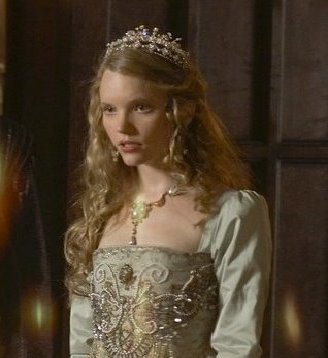
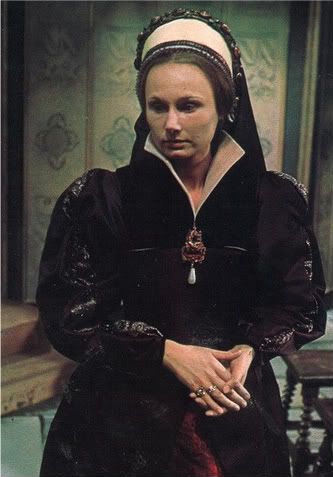
Above: Sheila Burrell as Lady Rochford in
The Six Wives of Henry VIII (1971).
Is it ever possible to really understand someone who lived in the past, particularly when it was as far back as almost 500 years ago? Whatever the case, history has not been kind to Jane Boleyn
nee Parker, Viscountess Rochford. From the moment of her sister-in-law Queen Anne Boleyn's downfall in the early summer of 1536, when dark rumours swirled that Jane had played a crucial role in the queen's demise, right up until the present day, Jane has been demonised, condemned and detested. I'm certainly not the first to tackle Jane's tale and attempt to separate myth from reality (check out Claire Ridgeway's excellent articles on Jane and Julia Fox's biography published in 2007), but since I have been extensively researching Katherine Howard's life, writing a post on Jane seems logical.
The daughter of Henry Parker 10th Baron Morley and his wife Alice St John, Jane's birth is unknown (like most English gentlewomen), but she is recorded as having been at court from 'a young age' and since she accompanied Katherine of Aragon as a maid-of-honour to France in 1520, she must have been aged at least thirteen, the minimum age for a maid-of-honour, and so must have been born by at least 1507, probably in 1505. Jane's birth and early appointment at court placed her in a position of prestige and enviable social wealth. What we know of her is very uncertain - her appearance, qualities and duties at court are completely unknown. Since she appeared in a masque in 1522 alongside the likes of Mary Tudor queen of France and Anne and Mary Boleyn, it has been suggested that she was attractive in looks; added to this, Queen Katherine was probably aware of Jane's suitability to participate in the masque and had had some role in her selection. Jane's father was a fairly remarkable man, with a strong interest in culture and education, and his printed works still survive today.
At that masque (the
Chateau Vert), one of numerous Jane probably participated in, she almost certainly met her future sister-in-law, Anne Boleyn, for the first time, a graceful and educated gentlewoman perhaps four years her senior. Anne's elder sister, Mary, also participated. Her relations with the Boleyn family were cemented at the end of 1524 when, aged about nineteen, she married the youngest surviving Boleyn child and heir George. Most historians, commentators and novelists have concluded that the marriage was unhappy, cold and unloving, particularly in light of the events of 1536. In Philippa Gregory's
The Other Boleyn Girl, George openly voices his disgust and intense dislike of Jane, taking male lovers behind her back, while in the Showtime series
The Tudors he does the same thing and anally rapes her, for good measure. Even historians such as Alison Weir conclude that the marriage was loveless, although Julia Fox romantically imagines the two 'snuggling up' together. Whatever the true nature of this mysterious marriage, it was unremarkable and usual for the time. Highly placed families at court arranged prestigious alliances with one another in order to strengthen their positions and increase their prestige - love did not play a hugely important part in these negotiations. Since Mary Boleyn was King Henry VIII's mistress around this time, and his desire for her sister Anne would develop a year or two later, it was a momentous time for Jane to join the rapidly prosperous Boleyn family.
Jane's position at this time was excellent; not only was she highly placed at court, serving Queen Katherine on a regular and intimate basis, but she was allied to an increasingly successful family. It must have been an exciting time for her. At this time, her husband became Viscount Rochford as a result of the king's favour for the Boleyns, and she became the Viscountess. The couple were awarded beautiful residences including Beaulieu Palace and Grimston Manor. However, even though they were living in lavish quarters and were enjoying ever greater wealth and fortune, many have assumed that Jane and George's marriage was very unhappy. Retha M. Warnicke suggests that this was the case because of George's homosexuality - something which, as an identity, did not actually exist until the 19th century, but which has been utilised in
The Other Boleyn Girl,
The Tudors and other works of fiction to create greater scandal. This is unlikely, since contemporary evidence compellingly suggests that George was a noted womaniser at court. However, it may be significant that the couple never had children. Perhaps Julia Fox's position is the safest one - although there is no evidence that the couple's marriage was blissful, there is equally little documentation to indicate that it was as unhappy and a failure as so often assumed.
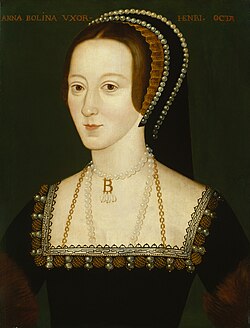
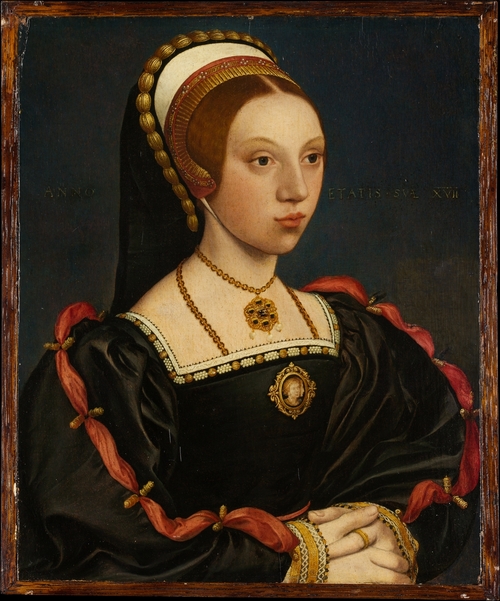
 Above: Anne Boleyn and Katherine Howard. Jane would feature heavily in both queens' downfalls.
Anne Boleyn's marriage to the King in the summer of 1533 strengthened the Boleyn family's power immeasurably, and Jane was at the centre of their glory and triumphs. She played a prominent role in Anne's coronation, and served her at court as queen. The exact nature of their relationship is, again, controversial. Jane helped Anne in 1534 to be rid of the king's mistress, and the Spanish ambassador reported that Jane had been dismissed from court as a result of her meddling (although, as has been noted, whether Jane left court for other reasons or whether she even left court at all is unknown). There is evidence dating from these years that Jane was something of a meddler, at least, although as with all historical evidence caution and scepticism is essential in using them to interpret the past. George Cavendish, who loathed the Boleyn family, offered a damning portrayal of Jane:
Withouten bridle of honest measure,
Following my lust and filthy pleasure,
Without respect of any wifely truth,
Dreadless of God, from grace also exempt,
Viciously consuming the time of this my youth.
The impression from this spiteful passage is, clearly, that Jane was not only irreligious and sinful, but that she was lusty - perverted even -, a failure as a wife, dishonest and vicious. Bearing in mind Cavendish's spite for Jane's family and the ever-present misogyny at the time, how accurate is such a description of Jane? Scandalous reports of her only surfaced in 1536 with the downfall of her husband's family. But other evidence suggests that she was involved in some murky matters - already the involvement with the Queen in 1534, and the possibility that in the autumn of 1535 she demonstrated alongside Lady William Howard in support of Princess Mary, thus setting herself up in opposition to her Boleyn relatives. Whether Jane had become disaffected with Anne and her relatives, possibly because of her own unhappy marriage, or whether the theory that she was involved in the demonstration is incorrect, is again unknown. The likelihood is that Jane had become disaffected with George, and by extension the Boleyn family, not because George was involved in homosexual relations as Warnicke believes, but because of religious differences. Jane was a traditional Catholic, as was her family, whereas the Queen and her relatives were noted evangelical reformers. It was religion, not sexual practices, which divided Jane and her husband's family.
Since Jane's father supported Princess Mary, it is possible that Jane transferred her support from the Boleyn family to Princess Mary and her supporters sometime in 1535-6. Certainly the situation at court may have influenced her, with Queen Anne's more uncertain position and the eventual rise of the Seymours. That has been the thinking of some historians, including Weir. Others, including Warnicke, downplay this, and suggest that Jane's scandalous reputation occurred only due to her involvement in Katherine Howard's downfall, not because of any involvement in Anne's, and argues instead that she turned against her husband because of the fact that he enjoyed sexual relations with other men (which cannot be proved).
Is it correct that 'the surviving evidence convincingly shows that Jane did testify to her husband having committed incest with his sister, and that she also confided to her interrogators some highly sensitive - and probably false - information'? (Weir) Fox, despite supporting Jane, thinks so, but insists that this only occurred because of the horrific environment Jane found herself in. In both
The Other Boleyn Girl and
The Tudors, once again, Jane plays a central role in her family's downfall. But whether or not this is historically correct is controversial.
In 1536, Anne Boleyn fell from power, caused largely by another miscarriage and the king's increasing disillusionment with his second marriage. She brought down five men with her, one of whom was her younger brother George, Anne's husband. As has been noted, Jane has traditionally been noted as being an essential part of these six people's deaths. George Wyatt, Anne's biographer, wrote of Jane as being a 'wicked wife, accuser of her own husband, even to the seeking of his blood. What she did was more to be rid of him than of true ground against him', while Bishop Burnet backed up this claim by writing how Lady Rochford 'carried many stories to the King... that there was a familiarity between the Queen and her brother beyond what so near a relationship could justify'. Another anonymous reporter wrote about 'that person who, more out of envy and jealousy than out of love towards the King, did betray this accursed secret, and together with it the names of those who had joined in the evil doings of the unchaste Queen' - although this evidence is particularly problematic since some writers have credibly argued that it doesn't refer to Jane at all, but another lady-in-waiting who supplied crucial evidence. However, the evidence against Jane is damning.
Julia Fox, however, who sees Jane as being a scapegoat, notes how Chapuys did not mention Jane as being the witness involved against Anne and George; the anonymous writer did not refer to 'that person' as Jane; Jane's eventual confession that she had lied about her husband and Anne was a forgery created years later; and other evidence, can counter the traditional belief that Jane, in a sense, was the 'particular instrument' in the Boleyns' downfall. That she was involved is certain. But what her role actually
was is impossible to discern. I agree with the likes of Fox and Ridgeway; Jane has been unfairly demonised in the case of the Boleyns' downfall in 1536, and she probably wasn't the one who ensured their deaths as many people have believed. But I also caution against going too far in the opposite direction, and completely exonerating her from any guilt. She
did play an important role, and I still believe that she was, at the very least, meddling.
George's execution severely crippled Jane, and she was forced to write to Master Secretary Thomas Cromwell for financial assistance, which he graciously provided her. She was further helped by being appointed one of Queen Jane Seymour's ladies in late 1536, thus enjoying social security and prestige at court once more. However, it is entirely possible that Jane had acquired a notorious reputation by now, although it is very unfair to present her as loathed by men and, in fact, insane, as Philippa Gregory has done. Jane's position became more prosperous still when her jointure was confirmed in 1539; she was later granted two manors in Warwickshire by Henry VIII. Following the queen's death in childbed, Jane served Anne of Cleves, and it has been conjectured that, once more, she played a prominent role in Anne of Cleves' divorce, providing crucial evidence that the marriage was never consummated. This, again, is uncertain. Warnicke suspects that the evidence was made up entirely. Jane probably supported Katherine Howard's cause because she came from a prominent Catholic family - since Jane was known to favour the Catholic religion, she probably viewed Katherine as a more acceptable queen than Anne of Cleves.
The winter of Jane's life, in a sense, began in the summer of 1540 when Henry VIII married Anne of Cleves' maid-of-honour, Katherine Howard, a relative of Jane's Boleyn relatives. The relationship between Jane and Katherine is entirely unknown. In Gregory's fiction, Jane manipulates and controls the young queen, largely due to the age difference between them, and manoeuvres her into working solely for the benefits of the Howard family at whatever cost. Conversely, in
The Tudors (where they are much closer in age), the two seem to become close friends, and confidants. Certainly it's mysterious. Jane was at least eighteen years older than Katherine, and Katherine had other female relatives whom she might have felt she could have better trusted, including her sister-in-law and the women she had known from her childhood, including Katherine Tylney. I suspect, however, that the queen actually disliked these childhood companions, of whom Joan Bulmer was the most infamous, and only employed them at court in a naive attempt to keep them quiet. It is therefore plausible that she became involved with Lady Rochford because she quite literally had no-one else, and Jane Rochford was, by virtue of having served four queens already, an experienced courtier.
I am not suggesting, however, that Lady Rochford became involved with Katherine in order to allow the queen to commit adultery. Finding Warnicke's arguments compelling, along with my own research, it seems plausible that in the spring and summer of 1541 a situation at court which had haunted the reigns of Henry's earlier queens began to stifle Katherine - that of fertility politics. Almost certainly, she was made well aware by her family of the need to provide the king with a second son, and with his illnesses in the spring, she probably became increasingly anxious for her own future. The example of not only Anne Boleyn but Anne of Cleves was clear for her to see. So why did Katherine meet with Thomas Culpeper, an individual who was very possibly violent and manipulative, a rapist in fact? The answer lies in this situation, too often misunderstood by historians. Since Culpeper was the closest courtier to the king, attending to his most intimate needs, the queen probably began communicating with him in an effort to understand what was going on with her husband, in effect, to protect herself. It is inconceivable that, with this going on in the background, she would have rashly decided to embark on an adulterous affair.
The evidence seems to suggest that Jane initiated these meetings, perhaps out of goodwill to the queen. Not all writers have suggested this. Baldwin Smith damns Jane as being 'a pathological meddler with the instincts of a procuress who achieves a vicarious pleasure from arranging assignations' has been highly influential in fiction (above all Gregory's book), while the queen herself later accused Jane of having 'a wicked imagination'. Jane, according to the interrogations later, promised Katherine that she would never reveal her meetings with Culpeper, while the queen was reported to have been skittish and afraid during these encounters, perhaps because she was aware of what these meetings looked like. Unfortunately, a host of factors instigated both women's downfall that autumn. Rumours had swirled menacingly since the queen's marriage that she was unchaste, and this worsened in the summer when one of Katherine's former confidants, Mary Lascelles, reported to her brother that the queen was a woman of evil reputation. He consequently informed the Archbishop, who informed the king. Bearing in mind Katherine's sexual relations during her childhood were probably characterised mostly by force and manipulation, perhaps even rape, it's difficult to work out why Mary suddenly confided this. This is, in fact, the greatest problem with the evidence. If Katherine's ladies found it so strange that she was staying up until the early hours of the morning with her doors locked, only Jane for company, it is weird that they never reported this to the king or anyone else until three or four months later. Quite plausibly, the evidence was exaggerated, if not invented. Both Katherine and Culpeper insisted that they had never had sex, although Jane reported otherwise. She perhaps did so in an attempt to save herself, believing that, although the queen might suffer death, she would not.
Unfortunately, it was not to be so. Jane was imprisoned in the Tower while the queen was confined at Syon Abbey, and she was condemned to death in January 1542, aged probably thirty-six. Jane suffered a nervous breakdown, and it is possible that she lost her sanity. An Act of Attainder was specifically passed in order to allow her execution to take place, and she was executed with the young queen on 13 February. The notion that she admitted her guilt for her husband and Queen Anne's death on the scaffold is a myth. A contemporary observer reported that she merely expressed her sinfulness and the fact that she deserved her punishment, although another felt she spent far too long speaking. Following the trembling queen's end, Jane was executed, and was buried in the nearby chapel.
George Cavendish remarked that her 'slander for ever shall be rife' and her sin would ensure that she would be remembered as 'the woman of vice insatiate' has proved to have been the case. One Victorian historian even opined that 'the infamous Lady Rochford... justly deserved her fate for the concern which she had in bringing Anne Boleyn, as well as her own husband, to the block'. Many have interpreted her execution as being a case of what goes around, comes around. This is probably unfair; it seems likely that her role in the downfall of the Boleyns was much smaller than has usually been assumed.
I am not convinced that Jane was as guiltless as some have suggested. I think it's plausible to argue that she instigated the meetings between Katherine and Thomas Culpeper; why she did so, we cannot know. She certainly did provide damning evidence against her husband and Anne Boleyn. But was she the monster of television series and Gregory's
The Boleyn Inheritance? Certainly not. At the very worst, Jane was meddling and probably hostile to her husband's family; maybe she instigated Katherine Howard's meetings out of a desire to help the queen in a desperate situation. It's hard to say. But her brutal end is certainly something to shy away from.