Showing posts with label 12 February 1554. Show all posts

Monday, 26 September 2016

Almost A King: Lord Guildford Dudley

Lord Guilford Dudley.jpg

Lord Guildford Dudley, son of the duke of Northumberland, is not usually depicted positively either in fiction or non-fiction. Often, Guildford is presented as a weak-willed, snivelling adolescent who sobbed on the scaffold, or as an abusive sociopath capable of bullying his gentle wife, Lady Jane Grey. In her study of the so-called nine days queen, Hester Chapman described Guildford as 'a spoilt, conceited and disagreeable young man', while in her novel Innocent Traitor, Alison Weir portrayed Guildford as a vicious abuser who mistreated Jane on their wedding night.

Guildford, who married Jane in 1553, could have become king of England, had events turned out differently. Little is known of him, but it is likely that he was well educated and was brought up to favour the reformist faith. It is possible that he was younger than his wife Jane, who was probably born in the spring of 1537. The Dudleys had a newborn son in March 1537, while one of Guildford's godfathers, Diego de Mendoza, visited England between the spring of 1537 and the summer of 1538. Thus making it likely that Guildford was born in 1537 or 1538 and inherently probable that he was younger than his wife. According to Grafton, Guildford was 'a comely, virtuous and godly gentleman'.

In the spring of 1553, Guildford married Jane Grey, the cousin of Edward VI. For the Dudleys, the Grey marriage was a notable triumph, for it allied them with the ducal house of Suffolk as well as to the Tudor dynasty. There is no evidence that John Dudley, duke of Northumberland, schemed to marry his son to Jane as part of his plan to have Jane made queen in the wake of Edward VI's death. Traditionally, it has been reported that Jane was bullied into marrying Guildford by her scheming family; some alleged that she had been physically beaten until she had submitted to the will of her parents. These stories are questionable. Certainly there is no evidence that she objected to Guildford on personal terms, although it could be said that the duke and duchess of Suffolk, Jane's parents, might have hoped for a more noble bridegroom for their daughter. After all, rumours had circulated in some quarters that Edward VI himself hoped to marry Jane. Once it became apparent that the king's demise was imminent, the Dudleys surely realised that Guildford might very well become king of England as the husband of Queen Jane, if the coup against Mary Tudor succeeded.

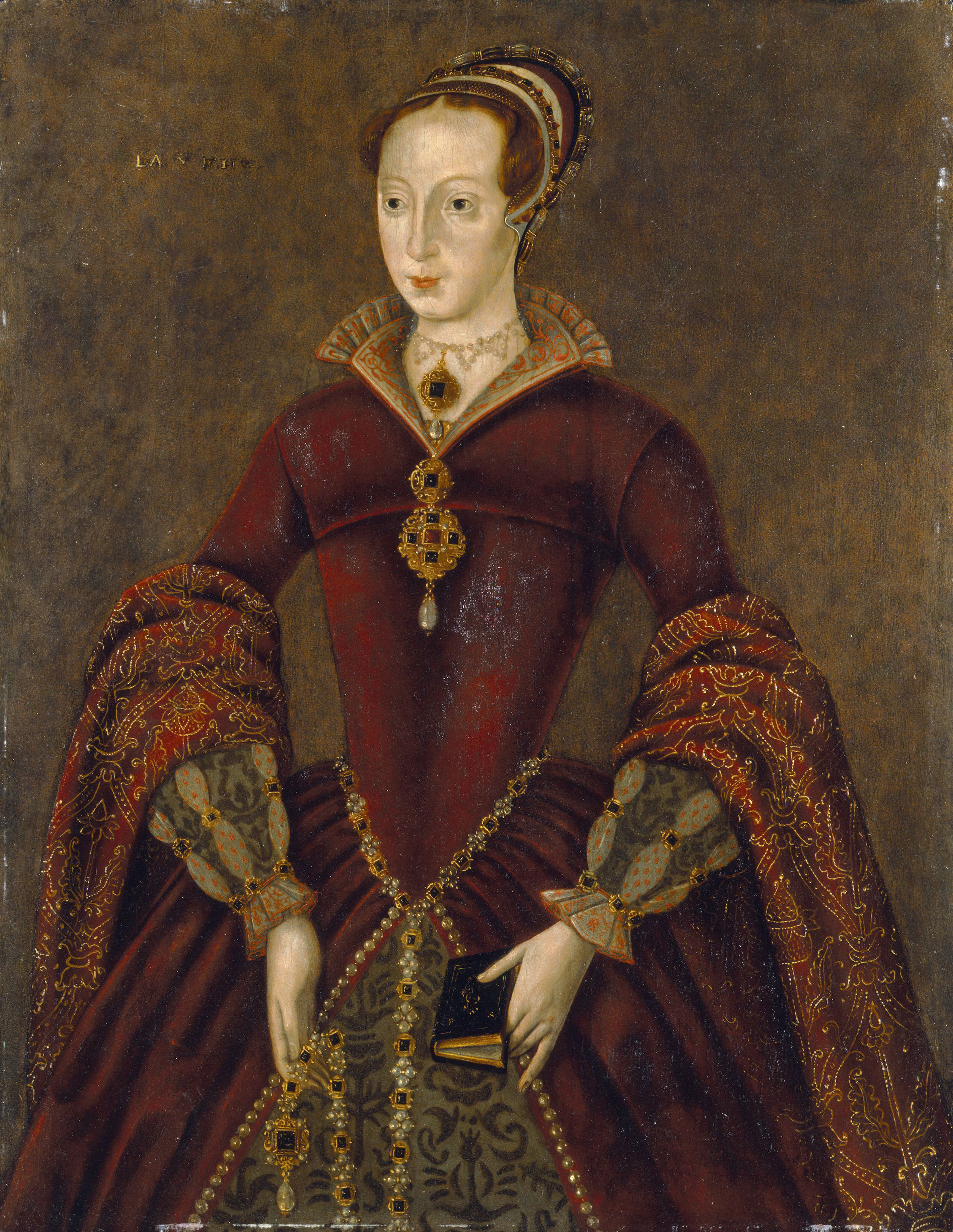
Image result for lady jane grey
Above: Lady Jane Grey. After her marriage, Jane referred to herself as 'Lady Jane Dudley'. There is no evidence that she objected to the marriage with Guildford on personal grounds.

Unfortunately for both the Greys and the Dudleys, Mary Tudor was highly popular in the country at large, and following Edward VI's death on 6 July, the displaced Mary immediately acted to ensure that she was accepted, and then crowned, as England's queen. Jane had arrived at the Tower of London shortly after the king's death, and she was presented with the crown jewels by the Marquess of Winchester. Reportedly, Jane explained that she did not wish her husband to be presented with a crown, because she wished to make him a duke, rather than honour him with the title of king consort. This was not because of personal feelings on her behalf, given that she was 'loving of my husband'. Indeed, after her marriage Jane consistently referred to herself as 'Lady Jane Dudley'. On 19 July, the last day of her 'reign', Jane acted as godmother to a son born to one of the Tower guards. The child was named Guildford.

Mary Tudor took the throne with triumph. Eric Ives and Leanda de Lisle have explained, in detail, how Mary seized the throne from Jane; whether or not she should be viewed as the rightful queen and Jane the usurper, or vice versa, continues to be disputed. On 22 August, Guildford's father, the duke of Northumberland, was executed. Three months later, both Jane and Guildford were tried and found guilty of treason, but the queen made known her wish that the two prisoners should be spared death. 

However, Sir Thomas Wyatt's rebellion in early 1554, which involved Jane's father, sealed the fates of both Jane and Guildford. Both wrote letters to the duke; Guildford signed himself 'youre lovyng and obedynent son', while Jane described herself as 'youre gracys humble daughter Jane Duddley'. On the day of their execution, 12 February 1554, it is reported that Guildford wished to see Jane one last time, 'desiring to give her the last kisses, and the last embrace'. Jane refused, however, because 'their sight would increase the misery in both, and bring much more suffering'. After their deaths, Jane believed, they would 'live perpetually joined in an indissoluble bond'.

Evidence suggests that Guildford, at  the age of only fifteen or sixteen, went to his death with dignity. He made a short, unrecorded speech on the scaffold and prayed without losing control of his emotions. No mention, in this contemporary account, of Guildford's supposed sobbing in the moments before his execution. 

Lord Guildford Dudley has traditionally been viewed as a weak-willed, vicious adolescent, who was loathed by his gentle, victimised wife Lady Jane Grey. There is no evidence of this, and the couple's closeness and loyalty to one another emerges from the sources even during the last hours of their lives. Had the events of the summer of 1553 gone differently, had Jane been blessed by fortune, Guildford could have become king of England as the husband of Jane I. It was not to be, and history has not been kind to him in the centuries since his passing. 

Friday, 12 February 2016

Remembering Lady Jane Grey


On 12 February 1554, Lady Jane Grey was executed within the walls of the Tower of London. Three months earlier, she and her husband Guildford Dudley had been found guilty of high treason. They had unlawfully usurped the throne from the rightful queen, Mary I. Traditionally, historians presented Lady Jane as an unwilling innocent, a much wronged young girl who had no desire whatsoever to be Queen of England. Recent research has disproved this legend. In actuality, Lady Jane was an intelligent, stubborn and resilient woman who was fiercely devoted to her Protestant faith. She regarded herself as appointed by God to rule England, and she likely regarded her Catholic cousin Mary Tudor as ungodly, even abominable in the eyes of God. He had chosen Jane to be Queen, and she believed it was her destiny to be sovereign of England.

Having been selected as Edward VI's heir, Jane was proclaimed queen in July 1553. As is well known, Jane's regime collapsed within days, and Mary was declared queen on 19 July. Jane's trial followed in November, and although she and her husband were found guilty, Queen Mary showed no desire to have them put to death. However, the outbreak of rebellion in early 1554, motivated by dislike of Mary's decision to marry Philip of Spain, coupled with the decision to reinstate the medieval heresy laws, sealed Jane's fate. Her own father was involved in the plot against the queen, and he followed Jane to the scaffold a few days after her own death. A courageous and resourceful young woman, Jane accepted her fate and bravely prepared for death.

Above: The traditional view of Lady Jane Grey, as portrayed in Paul Delaroche's nineteenth-century painting, as a wronged innocent.

Guildford Dudley was executed on the morning of 12 February 1554 on Tower Hill, where his father, the duke of Northumberland, had died the previous August. Guildford was himself still a teenager, perhaps no more than nineteen years old, and has been the victim of notable slanders. Modern historians have usually depicted him as a snivelling, weak-willed and vicious adolescent, loathed by Jane, but Leanda de Lisle's research questions whether this portrayal is accurate, as no contemporary source describes Guildford in such a negative way. Whatever the truth of Guildford's character, his end was tragic. Like Jane, he was the victim of his father's plotting, and he duly resigned himself to his fate. His wife was confronted by the sight of her husband's headless corpse, the fabric stained with his blood, returning on a cart from Tower Hill. She knew that her own demise was imminent.

Shortly afterwards, around ten in the morning, Lady Jane Grey walked out of her apartments and mounted the scaffold that had been built within the walls of the Tower. Onlookers commented on her braveness and her piety. Two versions of her scaffold speech survive, both of which confirm that she acknowledged that she was to die under the law, having been condemned by it. She confirmed that she had offended the queen and had behaved unlawfully. Most importantly, particularly for her posthumous reputation, Jane proclaimed that she died a true Christian woman, and looked to be saved only by Christ's mercy. This confirmed her commitment to the Protestant faith, for Catholics traditionally believed that good works also played an important part in one's salvation. She then asked the onlookers to pray for her.

Above: Queen Mary I, who ordered her cousin Lady Jane Grey's execution in February 1554.

Lady Jane's female attendants then helped her off with her gown and gave her a handkerchief to use as a blindfold. Groping about in the dark, she could not find the scaffold, and cried, "Where is it? What shall I do?" Someone came forward to guide her and she rested her head upon the block. Mercifully, she was decapitated with one blow, probably just a few months short of her seventeenth birthday. Her remains were interred in the nearby chapel of St. Peter ad Vincula. With her passing, Lady Jane Grey's story became the stuff of legend. In Protestant works, most notably John Foxe's Book of Martyrs, she was depicted as a pious, virtuous Protestant maiden who had died for her faith, condemned by the cruel Catholic tyrant, Mary I. Victorian historians depicted her as an innocent victim of her grasping, scheming family, and portrayed Jane's mother, Lady Frances Brandon, as a tyrannical woman and an abusive mother. Modern historians have usually followed this version of events. But modern research has demonstrated that reality was more complex. Lady Jane Grey was far more than merely an innocent child, and there is no contemporary evidence to suggest that Frances was cruel to her daughters.

Lady Jane Grey remains, in many respects, a mystery. Her beheading was the first of several calamities to befall the Grey family. Her father followed her to the scaffold only eleven days after her own death; like her, he was executed as a traitor to his queen. In spite of this, Jane's mother, Frances, remained close to Queen Mary, and her younger daughters Catherine and Mary were resident at court. However, Elizabeth I's accession proved to be the final undoing of the Grey family. While she did not behead either of the Grey sisters, as Mary had done, Elizabeth had both Catherine and Mary Grey imprisoned for their clandestine marriages, and the distraught Catherine died in 1568 while still in her twenties, deprived of her husband and children. Mary followed her to the grave ten years later, her own husband having predeceased her. Lady Jane Grey's story has been represented as a great tragedy, but her younger sisters were as much victims of their birth as she was.