Showing posts with label 1536. Show all posts

Saturday, 19 July 2014

Was Henry VIII A Bloodthirsty Wife Killer?


Above: Henry VIII of England.

In the public mind at least, Henry VIII is usually depicted as a bloodthirsty tyrant, suspicious and paranoid, bloodthirsty and brutal, a man who did not hesitate to chop and change his wives when he felt like it, and who on more than one occasion put to death his closest ministers and friends. The numbers and facts speak for themselves: between 57,000 and 72,000 people were put to death during Henry's 38-year reign, including two of his wives (Anne Boleyn and Katherine Howard), his two closest advisers (Cardinal Thomas Wolsey and Thomas Cromwell), several nobles (the Duke of Buckingham, the Marquis of Exeter, the Countess of Salisbury, and the Earl of Surrey) and several especially prominent courtiers (including George Boleyn, Viscount Rochford). It was even rumoured in the mid-1530s that Henry was considering executing his eldest daughter, Mary, because she refused to acknowledge that her parents' marriage was incestuous and unlawful, and because she refused to swear the Oath of Supremacy. Mercifully, Mary retained her life, but the same could not be said for possibly as many as 71,000 others.

Was Henry VIII what we might call 'a bloodthirsty wife killer'? I decided to write this blog post having read Suzannah Lipscomb's intriguing and engrossing book 1536: The Year That Changed Henry VIII (2009). As Dr Lipscomb correctly asserts, in popular culture this most famous king is frequently portrayed as a bloodthirsty and cruel king who had six, possibly eight, wives; women whose lives came to notoriously premature ends. But the reality is undoubtedly more complex. Henry was not necessarily a capricious, shallow and fickle man who willingly surrendered his consorts to the executioner when he was bored of them, or when they failed to provide him with a much-desired son. As respected historian Alison Weir recognises in her study of the queens of Henry VIII: 'Taking into account the ever-present problem of the succession, it is impossible to dismiss Henry VIII as the cruel lecher of popular legend who changed wives whenever it pleased him'. Truth is, in fact, stranger than fiction. 

Above: Anne Boleyn and Katherine Howard died prematurely, but were they married to 'a wife killer'?

This article considers whether Henry VIII can credibly be termed 'a wife killer' by looking at his two most infamous marriages, to Anne Boleyn and Katherine Howard, both of which ended on Tower Green. Henry's involvement with Anne was spectacular, for it catalysed the English Reformation as a result of breaking with the Roman Church, and it ushered in, as Lacey Baldwin Smith posits, the advent of the nation state. Married in 1533, Anne delivered arguably England's greatest monarch, Elizabeth I, in September that year. Boleyn biographers Eric Ives and G.W. Bernard both agree that Henry and Anne's marriage was volatile, 'sunshine and storms', although as Lipscomb intriguingly points out, observers commented on the royal couple's 'merry' times together more than they did with any of Henry's other wives. Although Anne was undoubtedly successful in promoting evangelicalism and was a responsible and enigmatic queen consort, she failed in her principal duty of giving birth to a much-longed for male heir. As everyone knows, in May 1536 she was accused of treason, incest and adultery with five men, and was executed as a result. Most scholars believe she was innocent of these crimes.

But, to turn to the question in hand: did ordering Anne Boleyn's execution render her husband, Henry VIII, 'a wife killer'? Lipscomb suggests not. Historical evidence credibly suggests that Anne was in high favour until barely three weeks before her death. Diplomatic correspondence indicates that Henry VIII was forcefully pressuring the European powers to recognise his second marriage and support Anne until as late as April 1536. It is therefore necessary to dispose of the myth that Anne's miscarriages caused Henry to tire of her. It is also a myth that Henry 'murdered' his wife because he had come to loathe and despise her. What, in fact, probably happened, as Lipscomb suggests in 1536, is that Anne's courtly behaviour with male courtiers caused her husband to believe that she was guilty of extramarital fidelity. She credibly suggests that Mark Smeaton, a lowly musician executed alongside the queen, was obsessed with Anne in a disturbing way perhaps reminiscent of a modern day stalker, and by extension admitted to sleeping with the queen as part of a misguided and disturbed fantasy. The queen then engaged in an exchange with Henry Norris, her husband's groom of the privy stool and personal favourite, in which she reprimanded him for seeking 'dead men's shoes' by looking to marry her when the king died. Speaking of Henry VIII's death was treason. Norris denied it and both he and Anne recognised their folly, the queen beseeching him to swear that she was a good woman as a result. When informed of these dangerous conversations, Henry VIII, shocked and in disbelief, ordered an investigation, which led to incriminations of several more men: Anne's own brother George, Francis Weston, William Brereton, and two others, Thomas Wyatt and Richard Page, who were later freed. They were all imprisoned, including the queen. 

Henry's behaviour during Anne's imprisonment, condemnation and execution was bizarre. He experienced severe distress and pain, on the one hand, for example comforting his illegitimate son Henry Fitzroy, duke of Richmond, and telling him that only by God's favour had Fitzroy and Mary Tudor, the queen's stepdaughter, escaped Anne's poisoning. Yet he also demonstrated happiness, leading the imperial ambassador to conclude that the king was only too pleased that his queen had supposedly cuckolded him, for it left him free to marry his new love, Jane Seymour. Henry also took a morbid, even disturbing, interest in the practical details of Anne's execution, and Weir credibly conjectures that he ordered for a French swordsman to execute his wife five or six days before her trial - meaning that he always intended to have her beheaded. This might seemingly suggest Henry was a wife killer, but let us not forget that sixteenth century social and gender norms dictated Henry's responses. The queen's alleged adulteries posed a severe threat to his masculinity by suggesting he could neither rule his wife nor his household, two crucial signifiers of successful manhood. Worse still, Anne had allegedly ridiculed Henry's sexual prowess, laughing with her brother about it. Whether she had in fact done so or not, it is possible to understand Henry's severe actions. Humiliated, enraged and devastated, he acted in this manner to restore his manhood, for his wife had supposedly undermined and threatened the social order of their world. It is essential to recognise that Henry had not been nourishing hatred for Anne for most of their marriage. He publicly and earnestly supported her until three weeks before her death. He ordered an investigation, examinations, and public trials for both her and the men accused with her. Henry did not hastily put his wife and five innocent men to death in a fit of bloodthirsty revenge. Baldwin Smith's belief that Anne 'was dispatched with callous disregard' is, therefore, not necessarily correct.


Above: Suzannah Lipscomb suggests that Henry VIII ordered portraits like the one above to be painted of him, depicting him as resolute, courageous and stern and celebrating his masculine glory, so fatally undermined by two of his wives.

While it is convincing to suggest that Henry VIII cannot be termed a wife killer regarding the downfall and death of Anne Boleyn, can the same be said of Katherine Howard? The grounds for designating Henry VIII a 'wife killer' regarding Katherine are even less firm. Henry adored his fifth consort, whom he married in the summer of 1540, and lavished jewellery and expensive presents on her. However, Katherine had an unsavoury past, and in the autumn of 1541, returning from a northern progress, the king was informed by Archbishop Thomas Cranmer of his queen's misdemeanours. The only evidence for Henry being 'a wife killer' comes in his initial response to this unwelcome news. When sitting with his Council, the king began weeping in a fit of sorrow, and called for a sword to execute that 'wicked woman' himself. Does this betray a bloodthirsty longing to be rid of a tainted wife? It is not necessarily that simple. Lipscomb convincingly indicates that after 1536, the year of Anne's execution, Henry became increasingly paranoid and suspicious, and reacted more and more brutally to personal betrayal. In a sense, he emerged as a tyrant. His response to Katherine Howard's behaviour can more plausibly be viewed as evidence of his views regarding betrayal. He refused to see Katherine ever again, and ordered her execution as a savage response to her betrayal, but which was fully justified and expected by the standards of the time. It was Katherine who was condemned for her behaviour, not her husband.

Again, historical facts need to be clearly understood here in order to explain Henry's response to Katherine's alleged adulteries. He was informed in November 1541 and that same month, the queen was imprisoned at Syon Abbey, while her supposed lovers and accomplice Lady Rochford were also incarcerated. The two men were executed the following month. However, it was only three months later, in February 1542, that Katherine and Lady Rochford were executed at the Tower of London. Again, this does not suggest that Henry VIII reacted hastily and bloodthirstily to news of his queen's betrayal. Some historians have conjectured that he considered saving Katherine's life and merely annulling the marriage, rather than beheading her, because he still loved her and was devoted to her. It is true that he did not grant his fifth queen and her servant a public trial. They were sentenced by Act of Attainder and were not given the chance to speak in their own defence. A unjust and, to our eyes, tyrannical move, perhaps motivated by personal vengeance and a desire to silence the woman he had once loved without letting her defend her actions, but in actual fact Henry VIII consistently used acts of attainder against those suspected of treason, as Lipscomb suggests, denying them the chance to speak out in open court. Katherine's relatives, the Earl of Surrey and the Duke of Norfolk, would both be sentenced to death this way. 

Henry VIII loved Anne Boleyn and Katherine Howard intensely, as his love letters to Anne show and his lavish gifts of jewellery and costume to Katherine also prove. His emotional responses to news of their alleged adulteries also prove how much he cared for and loved them: he wept openly, cursed his bad luck, and became increasingly paranoid and dark as a result. As Philippa Gregory, the novelist, credibly suggests, after Anne's execution in 1536, the Tudor court became a darker place ruled by a suspicious and irascible monarch fearful of being betrayed at every corner. Henry did not rush hastily to condemn or kill his wives. He allowed Anne and her supposed lovers the chance to speak out in open court at their trials, and he showed initial signs of mercy toward Katherine Howard. But, as those who crossed Henry VIII found to their peril, the Tudor king responded brutally when he was, in his eyes, deceived and betrayed. This does not make him 'a wife killer', necessarily, but a man intensely concerned with maintaining and protecting his honour and sense of manhood, as were the majority of sixteenth-century men. 

Wednesday, 4 June 2014

4 June 1536: Jane Seymour Proclaimed Queen

Related image
Above: miniature portrait of Jane Seymour by Lucas Horenbout.

On this day in history, 4 June 1536, Jane Seymour, third consort of Henry VIII of England, was proclaimed Queen of England at Greenwich Palace. The herald and chronicler Charles Wriothesley reported that: 
'the 4th daie of June, being Whitsoundaie, the said Jane Seymor was proclaymed Queene at Greenwych, and went in procession, after the King, with a great traine of ladies followinge after her, and also ofred at masse as Queene, and began her howsehold that daie, dyning in her chamber of presence under the cloath of estate'. Later, the king's fifth and sixth wives, Katherine Howard and Katherine Parr, would also be shown to the court publicly as queen and would dine publicly under the cloth of estate.

Jane had married the king five days previously, at Whitehall Palace. Only eleven days prior to their marriage, the king's second wife and Jane's mistress, Queen Anne Boleyn, had been executed within the Tower of London on charges of adultery, incest, and plotting the king's death. Historians have speculated endlessly about how Jane felt about her mistress' death - did she take an active role in it? Did she encourage Henry to destroy his wife, even in so bloodthirsty a manner? Did she delight in Anne's death? Victorian historian Agnes Strickland thought so. Terming Jane's conduct 'shameless', she wrote thus: 'Jane saw murderous accusations got up against the queen, which finally brought her to the scaffold, yet she gave her hand to the regal ruffian before his wife's corpse was cold'. Modern historians such as David Starkey, Joanna Denny, and Eric Ives have similarly refrained from offering overly sympathetic or positive interpretations of Jane's behaviour.


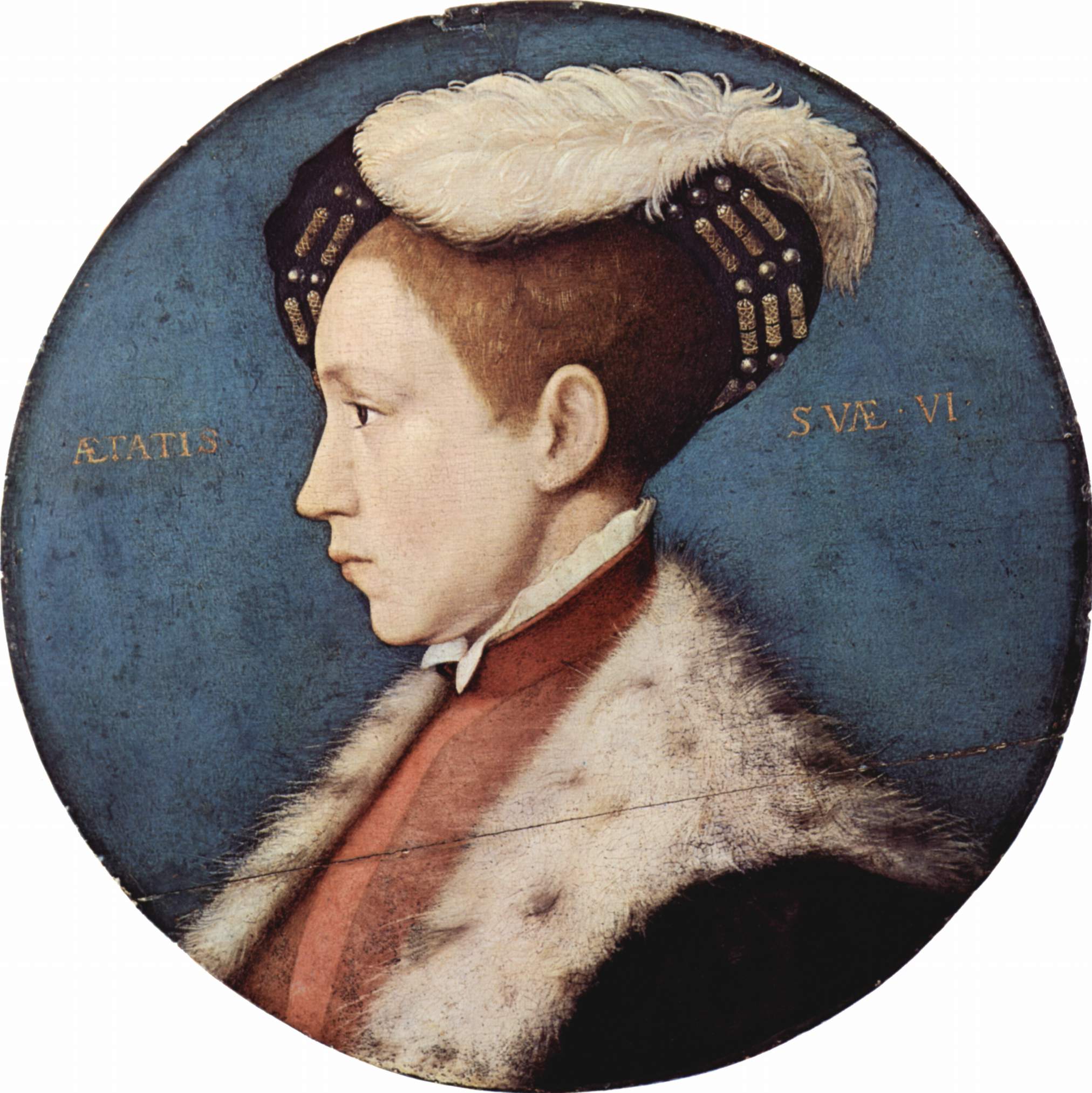
Above: Queen Jane Seymour gave birth to Henry VIII's only legitimate son, Edward (above). Edward succeeded to the throne in 1547 as Edward VI on his father's death.

Yet we have no clue how Jane really felt about the bloody and brutal events of spring 1536, when her mistress Anne Boleyn was dethroned and Jane was forced to step - literally - over her mistress' dead body to become queen of England. Whether she was personally willing or not, it cannot be denied that Jane's family were extremely ambitious and were determined that their relative should become queen in Anne's place. That they personally coached Jane on how to attract Henry seems likely.

Although Jane was presented to the English court as queen in June 1536, she was not crowned. There seem to have been plans for a coronation in the autumn of 1536, but an outbreak of plague derailed these plans. In the spring of 1537, the twenty-eight year old Jane fell pregnant, and that October gave birth to Henry VIII's only legitimate son, Edward, who became king of England aged nine years old in 1547 on his father's death. Tragically, however, Jane developed puerperal fever. The queen's attendants were blamed for allowing her to eat food that was unsuitable and to take cold. The queen developed septicaemia and she eventually became delirious. Just before midnight on 24 October, only twelve days after the birth of her son, Queen Jane died, aged twenty-nine. The king was grief-stricken, and wrote to his rival and fellow king, Francois of France, that: 'Divine Providence has mingled my joy with the bitterness of the death of her who brought me this happiness'. 

That Henry VIII loved Jane Seymour and sincerely mourned her is borne out by the fact that not only did he and the court wear mourning for her until Easter 1538, but Jane continued to be represented in Tudor portraits, most famously featuring in a 1545 depiction of the king and his son - although Henry was, at that time, married to Katherine Parr. By virtue of providing the king with a male heir, Jane Seymour's important role in the Tudor dynasty was enshrined forever and appreciatively celebrated, as conveyed in this mural below, which portrays Henry VIII and Jane alongside his parents, Henry VII and Elizabeth of York. Henry VIII may have been drawn to Jane and loved her because she, in some respects, resembled his beloved mother: not only in looks, but also because both were docile, gentle, shrewd, peaceful, and loving. When King Henry died in 1547, he was buried at Windsor alongside Jane, whom he viewed as his one true wife.


Above: Henry VII and Elizabeth of York; Henry VIII and Jane Seymour.

Thursday, 2 January 2014

'The Good Old Days': Rebellions and Nostalgia

‘The Good old Days’: Rebellions & Nostalgia

There’s something funny about rebellions in history and the feelings of nostalgia central to them. Take the Peasants Revolt of 1381 (pictured above), led by Wat Tyler in opposition to political and social grievances, economic problems resulting from heavy taxation, and instability in local leadership. The rebels (who weren’t even peasants, mostly) tried to justify their uprisings by claiming that they weren’t angry with the king himself, but were merely hostile to his advisers and law enforcers. They desired, they insisted, a return to “the good old days”, when serfs and lords were equal, instead of lords ruthlessly oppressing serfs economically and politically. Take the infamous rhyme which was ubiquitous during these events: “when Adam delved and Eve span, who was then a gentleman?” (ie. in the Garden of Eden, everyone was created equally – there were no such things as lords, serfs, and nobles).

But it was very ironic that these rebels looked ideally back to a golden past in which, or so they believed, social equality was respected, and lords and serfs worked peacefully together. Oppression and inequality were unknown. But the historical facts relating to medieval England don’t bear this out. Many modern historians, for instance, suggest that the conditions of serfdom were actually better in the fourteenth century, compared with the harsher preceding centuries. Proving that this misguided belief wasn’t just a one-off in the dire climate of 1381, insurgents in the 1549 Prayer Book Rebellion in southwest England demanded the deaths of gentlemen who they felt to be unlawfully oppressing them. Nostalgia for the not-so-distant past was present in a religious sense, for the rebels desired a return to the conservative ceremonies and practices of Henry VIII’s church.


Of course, nostalgic desire for the good old days surfaces not just in rebellions but in many other contexts. Medieval historians have suggested that women across Europe may have experienced a 'golden age' in terms of both living and working conditions, enjoying a degree of freedom harshly restricted in the early modern period. But specific to this article is rebellions and the feelings they produce of nostalgia and hatred of present day life as it stands. Rebels in both the 1381 and 1549 risings were deluded in thinking that the ‘good old days’ were infinitely better than they were at the time of the rebellions, but they can surely be forgiven for wishing to escape what may have seemed to them a life not worth living.

Saturday, 18 May 2013

The Execution of Queen Anne Boleyn


On this day in history, 19 May 1536, Queen Anne Boleyn, second wife and queen consort of Henry VIII of England, was beheaded within the Tower of London for alleged sexual crimes encompassing adultery and incest, and treason against the King in supposedly plotting his death. It was the first public execution of a Queen of England – but by no means the last – and, undoubtedly, encompassed the brutal end of England’s most captivating, controversial, and ultimately celebrated queen consort in history.


http://www.conorbyrnex.blogspot.co.uk/2013/05/the-downfall-of-anne-boleyn.html explored the various theories as to why Anne so shockingly, and quickly, fell from power in the early summer of 1536. It is disturbing that, being in an extremely secure position in January 1536 following Katherine of Aragon’s death and the announcement of Anne’s third pregnancy, just four months later, Henry’s second wife would be brutally decapitated for heinous crimes. As Retha Warnicke tellingly notes:

‘In January 1536... Anne could be optimistic about her future. She was pregnant again... Catherine was at long last dead... When her disgrace and downfall occurred, it was to catch Chapuys, that inveterate gossipmonger, with as much surprise and astonishment as it did the rest of Christendom’.[1]

Eric Ives seems to disagree, writing that:
‘The story of the events which led to the disgrace and death of Anne Boleyn need to begin almost a year before the tragedy itself’, referring to the royal couple’s visit at Wolf Hall, the home of the Seymour family, in the autumn of 1535.[2]

Whatever did lead to Anne Boleyn’s rapid downfall in the early summer of 1536 – whether it was factional conspiracy led by Thomas Cromwell (Ives), the miscarriage of a deformed son (Warnicke), the discovery of the queen’s actual adulteries (G. W. Bernard), a religious plot against the ‘Protestant’ Queen (Joanna Denny) or, simply, the result of Henry VIII’s long-standing ‘hatred’ towards his wife (Scarisbrick, Wilson), the events of May 1536 moved very quickly against the six involved, leading to six brutal deaths and a horrific tragedy.

As has been noted, the Queen and the seven men (two, Sir Thomas Wyatt, celebrated Tudor poet, and Sir Richard Page, were eventually freed) had been arrested and imprisoned in the Tower of London in late April and early May 1536 on scandalous charges of treason, adultery, plotting the king’s death, and, in Anne and her brother George Boleyn’s case, committing incest. All six experienced shock, horror and dread – particularly the Queen, whose moods fluctuated from hysteria to grief to joy, and the lowly Mark Smeaton, who underwent psychological – if not physical – torture to extract a confession of adultery. The four commoners accused of committing adultery with Queen Anne – Smeaton, Henry Norris, William Brereton, and Francis Weston, all of whom had served the queen and been close to her – were tried in Westminster Hall on May 12, 1536, and found guilty of treason through committing adultery with the queen. They were sentenced to be hanged, drawn and quartered as traitors, although ‘mercifully’, the king decided to commute the sentences to beheading. Particularly for Smeaton, this was merciful, since a man of such lowly birth could not often expect such a quick and efficient method of execution.

Queen Anne and her brother George were tried later, on Monday 15 May. It was believed that Anne’s ladies, including the Countess of Worcester, Lady Wingfield, and her own sister-in-law Jane Lady Rochford (who would later be executed with Queen Katherine Howard), had supplied the crucial evidence against her. The Queen and her brother had been tried in the King’s Hall in the Tower of London, with their own uncle, the Duke of Norfolk, presiding in his capacity as Lord Steward. The Queen was brought in first, according to Antonia Fraser: ‘she arrived in a calm frame of mind’.[3] The contemporary chronicler Charles Wriothesley opined that she gave ‘wise and discreet answers to her accusers’ when questioned ‘as though she was not actually guilty’.[4] Ives goes further, movingly claiming that ‘her sparing and effective answers quietly dominated the court’.[5] Certainly, those who were actually there – including Anne’s arch-enemy, the Imperial ambassador, who admitted that she had given plausible and convincing replies to the questions posed – support this claim. She denied committing adultery with any of the men, or incest with her brother; she had not hoped and plotted for her husband the King’s death; she had not poisoned the former Queen Katherine of Aragon or her daughter Princess Mary; but it made no difference. She was found guilty on all counts, despite, as Warnicke notes, being ‘unrattled by these lurid details’.[6] 

Her uncle, the Duke of Norfolk, with tears in his eyes, sentenced her to burning or beheading – but as Alison Weir notes, the method of execution – decapitation by the sword – had been agreed long in advance, and the executioner had already been sent for. Meanwhile, Henry VIII told his new love, Jane Seymour, that Anne would be condemned by 3 o’clock that afternoon. How can anyone not feel immense pity for the Queen, when discovering this brutal detail? It is little wonder that many view Jane Seymour as a sly, cold-hearted plotter who, as the Victorian historian Agnes Strickland wrote in outrage, literally stepped over her former mistress’ dead body to become Queen.

Yet the Queen was noted for her bravery, as even her enemy Cromwell – who many think plotted the whole conspiracy – admitted following her death, praising her courage. All Anne admitted to was: ‘I do not say that I have always borne towards the king the humility which I owed him... I admit, too, that often I have taken it into my head to be jealous of him... But may God be my witness if I have done him any other wrong’. When one considers that Anne swore before eternal damnation that she had never committed the crimes alleged against her, one is convinced of her innocence. As Weir concludes in her study: ‘the historian cannot but conclude that Anne Boleyn was the victim of a dreadful miscarriage of justice’. Following Anne’s trial, her brother George was tried after her, and despite his bravery – something which clearly ran in the Boleyn family – was also sentenced to death.

Two days later, the five men condemned for committing high treason through adultery with the Queen and plotting the King’s death were beheaded on Tower Hill, outside the Tower of London. George Boleyn, as the highest in rank went first, stating that: ‘I was born under the law, I am judged under the law and I must die under the law, for the law has condemned me’. The other men admitted their sins and the fact that they deserved to die; but this does not necessarily mean that they were admitting that they were guilty of the crimes alleged against them. In the Tudor period, everyone was believed to be universally sinful – these men were alluding to their own sins. Smeaton, the last to be executed since he was the lowliest in rank, continued to maintain his guilt, causing the Queen notable distress when she heard.

That day, Anne’s marriage to the King was annulled and her daughter, Elizabeth, bastardised. It was likely on the grounds of Henry’s previous sexual relationship with Anne’s sister – thus creating affinity between them – although Warnicke suspects it was annulled because Anne, believed to be a witch, had bewitched Henry into marrying her. Anne’s own execution, in her mind, was believed to take place the next day, but the day came and went with no summons for the scaffold, leading to Anne’s increasing concern. The Constable of the Tower, William Kingston, eventually told her that it was postponed to the following day, Friday 19 May 1536.

The execution was held within the grounds of the Tower, before a small audience, at nine o’clock in the morning. The Queen emerged from the Tower accompanied by four ladies, and probably would not have been pleased to see her enemies Thomas Audley, the lord chancellor, Charles Brandon duke of Suffolk, Henry Fitzroy, the bastard son of Henry VIII, and Thomas Cromwell himself prominent among the spectators. Anne was dressed in a mantle of ermine (emphasising her queenly rank) over a grey damask gown lined with fur with a crimson petticoat, accompanied with an English gable hood (somewhat surprisingly for her, as she usually preferred the considerably more fashionable French hood). Those who were present remarked that ‘The Queen had never looked so beautiful’, while a Spanish commentator wrote that she looked ‘as gay as if she was not going to die’.[7] Anne’s speech was given by Edward Hall, Henry VIII’s court chronicler, as follows:

‘Good Christian people, I have not come here to preach a sermon; I have come here to die. For according to the law and by the law I am judged to die, and therefore I will speak nothing against it. I am come hither to accuse no man, nor to speak of that whereof I am accused and condemned to die, but I pray God save the king and send him long to reign over you, for a gentler nor a more merciful prince was there never, and to me he was ever a good, a gentle, and sovereign lord. And if any person will meddle of my cause, I require them to judge the best. And thus I take my leave of the world and of you all, and I heartily desire you all to pray for me’.[8]

This is probably very close to Anne’s real speech, and in no way shows Anne admitting any guilt. Whether she did truly love Henry VIII, as she suggests, is impossible to know. Natalie Dormer, in the Showtime TV series The Tudors (despite its inaccuracies), gives a very moving portrayal of Anne’s execution, in which this speech is replicated:


Numerous versions of Anne’s scaffold speech were given by different writers present on that day. According to Wriothesley, Anne stated:

‘Masters, I here humbly submit me to the law as the law hath judged me, and as for mine offences, I here accuse no man. God knoweth them; I remit them to God, beseeching Him to have mercy on my soul. I ask Jesus Christ to save my sovereign and master the King, the most godly, noble and gentle Prince that is, and long to reign over you’.[9]

Despite their glaring inaccuracies (in The Other Boleyn Girl, it is implied that Anne might be given a reprieve before falling into hysterical tears, two things which never occurred; and in The Six Wives of Henry VIII, where Anne is executed indoors before a block, two huge inaccuracies) this is the speech given by Natalie Portman and Dorothy Tutin.


The Queen’s head was removed with a single stroke – mercifully – and she was buried that day in the Chapel of St Peter ad Vincula near Tower Green; where she would be joined less than six years later by her cousin and fellow queen, Katherine Howard, and her own sister-in-law, Jane Rochford, who may have supplied evidence against her. It was the end of the incredible career of Anne Boleyn. Her exact age is unknown but she was probably 34 or 35. She had been Queen for just under 3 years, but she had captivated the King and held his love for closer to 10 years, before being brutally eliminated in a murderous conspiracy – probably masterminded by her own husband – which also saw the deaths of 5 people close to her, including her own brother. One can only pity the Boleyn family, who saw two of their relatives bloodily removed in the space of a few short weeks.

The Independent on Sunday, in reviewing Eric Ives’ monumental – and to date, the best – biography of the Queen, termed Anne Boleyn ‘the most controversial woman ever to have been queen consort of England’. While this is undoubtedly true – just witness the numerous books, films, plays, and stories produced about her monthly – she was, as Ives rightly notes, the most important queen consort in English history. It is almost certain that Anne Boleyn was innocent of the crimes alleged against her. She was outspoken, highly intelligent, shrewd, calculating, at times vindictive, arrogant, and even spiteful; but at the same time she was deeply religious, kind, loyal to family and friends, charismatic, intelligent, attractive, highly talented, energetic, opinionated and bold. These qualities had commended her to a King because they so emphatically showed that she was not the typical sixteenth-century submissive ideal of a woman which Jane Seymour embodied.

Thomas Wyatt, Anne’s close friend – who had been imprisoned in the Tower as one of her accomplices – movingly wrote following these six deaths: ‘These bloody days have broken my heart’. While the Queen was by no means universally mourned – Catholic Europe openly rejoiced at her death and congratulated Henry VIII, while many English people, who hated Anne, saw it as divine retribution – a growing sense of pity emerged for Anne and the men killed with her; while others began to become increasingly suspicious towards the King. Jane Seymour was by no means universally popular, as scurrilous ballads circulated about her affair with the King. As one contemporary wrote:

‘It was thought strange by some, that in the same month which saw the Queen flourishing, accused, condemned and executed, another was assumed into her place’.

As Agnes Strickland, a Victorian historian writing in an era of high moral values, openly vilified the new Queen:

‘Jane saw murderous accusations got up against the queen, which finally brought her to the scaffold, yet she gave her hand to the regal ruffian before his wife’s corpse was cold. Yes; four-and-twenty hours had not elapsed since the sword was reddened with the blood of her mistress, when Jane Seymour became the bride of Henry VIII... The picture is repulsive enough, but it becomes tenfold more abhorrent when the woman who caused the whole tragedy is loaded with panegyric’.

Anne remains romanticised in today’s society, largely because of her brutal fate, an innocent Queen. She was far from perfect, but she deserved better than how she has been treated in recent fiction and film – whether that is Helena Bonham Carter’s shrewish and middle-aged Queen; Natalie Portman’s scheming and hysterical homewrecker; or the calculating and vindictive Anne of Hilary Mantel’s Bring Up the Bodies. To conclude, the last words should belong to Anne’s chief biographer, as they are very moving and aptly epitomise this blogger’s position:

‘She had been a remarkable woman... There were few others who rose from such beginnings to a crown, and none contributed to a revolution as far-reaching as the English Reformation... What Anne really was, as distinct from what Anne did, comes over very much less clearly. To us she appears inconsistent – religious yet aggressive, calculating yet emotional, with the light touch of the courtier yet the strong grip of the politician... Yet what does come across to us across the centuries is the impression of a person who is strangely appealing to the early twenty-first century. A woman in her own right – taken on her own terms in a man’s world; a woman who mobilized her education, her style and her presence to outweigh the disadvantages of her sex... taking a court and a king by storm.’ She was vindicated, 22 years later, when her daughter Elizabeth acceded to the throne.[10]

I agree. Anne Boleyn, an unbelievably complex person, was an incredible woman. In my research into English queens, there is none to compare with her. Her story continues to fascinate, entrance and captivate people across the world to an extent which few other historical personages are able to do. Innocent of the crimes she died for, Anne Boleyn was England’s most important queen consort – and perhaps the greatest.


[1]  Retha M. Warnicke, The Rise and Fall of Anne Boleyn (Cambridge, 1989), pp. 189-90.
[2] Eric Ives, The Life and Death of Anne Boleyn (Oxford, 2004), p. 291.
[3] Antonia Fraser, The Six Wives of Henry VIII (Phoenix, 1992), p. 308.
[4] Ibid.
[5] Ives, Anne, p. 340.
[6] Warnicke, Rise and fall, p. 228.
[7] Fraser, Six Wives, p. 315.
[8] Ives, Anne, pp. 357-8.
[9] Fraser, Six Wives, pp. 315-16.
[10] Ives, Anne, p. 359.


Thursday, 2 May 2013

The Downfall of Anne Boleyn


On this day, 2nd May 1536, Anne Boleyn, second queen of King Henry VIII of England, was arrested for sexual crimes (adultery with five men) and plotting to conspire the death of her husband, an act of high treason. The previous day, the Queen had attended the traditional May Day jousts with her husband at Greenwich Palace, where 'although Anne and Henry sat in their usual places, they had probably arrived separately at the tournament where two of her alleged lovers, Rochford and Norris, were to compete with each other, a public enactment of the charge that she had caused dissension and jealousy among them'. (Warnicke, p225) The Queen, most likely dressed in apple-green, was still an elegant and attractive woman of about thirty-four, even if the previous months had wearied, exhausted and depressed her. She cannot have failed to have been aware of the dark rumours swirling at court, the late-night meetings, the diplomatic difficulties, the mysterious behaviour of her husband, and her rapidly diminishing support, which must have inspired fear and apprehension in her. A quarrel with Master Secretary, Thomas Cromwell, over religious and political matters, and a very public row with her friend Henry Norris during the weekend did not help matters. But this was put to rest - briefly - by attending the jousts, where we are informed that the Queen smiled pleasingly and encouragingly at the jousters.

Much later, the hostile Nicholas Sander, writing in Elizabeth I's reign (asserting, amongst other things, that Anne was monstrously deformed, gave birth to a shapeless child, and was in fact the daughter of Henry VIII), wrote that the Queen deliberately dropped a handkerchief at the joust as a public demonstration of her love for one of the jousters. But this story was later exposed as malicious fiction designed to blacken Anne's name. Yet the joust came to an abrupt end when, in the middle of it, the King received a message, causing him to rise and leave the tournament, taking Henry Norris with him. Edward Hall, the court chronicler, reported that many individuals present 'mused but most chiefely the quene', who had been so humiliatingly deserted. She must have guessed that it related to something about herself (perhaps the sensational argument she had had with Norris two days earlier, in which she accused him of waiting for the king to die in order to marry her), but probably could not have foreseen that she would never see her husband again.

During their journey, the King accused Norris of committing adultery with his wife, Queen Anne. Norris, shocked and dumbfounded, protested that it was not true, but the King offered him a pardon, if he 'wolde utter the trewth' (George Constantine, who was present). Norris retorted, bravely and admirably, that 'he would not accuse her of anything; and he would die a thousand times, rather than ruin an innocent person'. The King, obviously, was extremely dissatisfied with this answer, and Norris was imprisoned in the Tower of London, where another of Anne's supposed lovers, the lowborn musician Mark Smeaton, had been incarcerated the previous day.

The next day, May 2, the Queen arose early and spent the morning at Mass, before journeying to watch a tennis match. Anne reportedly was in the midst of regretting she had not placed a bet on her favourite, as he was winning, when a messenger arrived from the King, ordering his wife to present herself before the Privy Council at once. The signs were ominous. According to Warnicke, her uncle the Duke of Norfolk, Sir William Paulet, and William Fitzwilliam (who had long detested her, being a supporter of the late queen Katherine of Aragon) accused her in front of her ladies-in-waiting of enjoying carnal relations with three men; only two of whom, Norris and Mark, were mentioned by name. Anne, plainly, was shocked, but later remarked that 'to be a Quene, and cruely handled was never sene'. She believed that the king was doing it 'to prove' her.

That day, the Queen's younger brother, George lord Rochford, was also taken to the Tower, accused of committing incest with his sister. At 2 o'clock in the afternoon, the Queen was publicly taken to the Tower of London, where crowds gathered on the sides of the river to jeer publicly at her (Anne Boleyn was never popular with the common people). Entering the Tower by the Court Gate, the Queen was met by Edward Walsingham, the Lieutenant of the Tower. She was then met by Sir William Kingston, the Constable of the Tower, where she dramatically questioned him as to whether she would be imprisoned in a dungeon. His reply was 'No, Madam. You shall go into the lodging you lay in at your coronation'. Kingston reported that Anne then fell to her knees, laughing but at the same time weeping, crying out that 'it is too good for me... Jesu have mercy on me'. When Kingston informed her of the arrests, the Queen showed understandable distress about the health of her mother, who 'wilt die with sorrow', and later laughed when Kingston assured her that every subject of the King would have justice.

According to Antonia Fraser, the Queen 'began screaming' during her imprisonment, but this is unlikely, as noted by Alison Weir, although clearly she was in a very delicate state. She later complained of her uncle Norfolk's sanctimonious 'tutting' during the journey to the Tower. Charles Wriothesley, another Tudor chronicler, wrote that: 'Anne Bolleine was brought to the Towre of London... entring in, she fell downe on her knees before the said lordes, beseeching God to helpe her as she was not giltie of her a accusement...' Later that day, Henry VIII met with his illegitimate son by Bessie Blount, Henry Fitzroy, and embraced him intimately, breaking down in tears and warning him that both he and Princess Mary Tudor were lucky to have escaped the hands of Queen Anne, who had planned their deaths by poison, due to her 'wicked intentions'. 

So what led to the sensational downfall of Queen Anne in the early summer of 1536? Historians have debated it intensely and powerfully during the twentieth and twenty-first centuries. In the April 2013 issue of BBC History Magazine, Dr Suzannah Lipscomb explored the various theories as to why Anne was arrested, accused of adultery, incest, and plotting the King's death, and later beheaded, dragging down 5 men with her. So what is the likely explanation? As someone who has read prominent works by Eric Ives, G. W. Bernard, Retha M. Warnicke, Joanna Denny, Antonia Fraser, Alison Weir, Karen Lindsey, and other noted historians, I believe that I have a clear perspective to offer in relation to this.

Contrary to traditional belief, Anne Boleyn had not been in a weak position over the last few months, when many believe that she had been living on 'borrowed time', which was only worsened by the King's developing love for Jane Seymour in the early winter of 1536. Most traditionalists believe that the King's once intense passion for Anne had quickly turned to hatred, which was significantly exacerbated by her second miscarriage in January 1536. J.J. Scarisbrick adheres to this traditional interpretation, as does Derek Wilson, who stress that the King's role in ordering Anne's downfall has been too often ignored or marginalised. They believe, essentially, that it was the sexual dynamics of the marriage which caused the downfall - having once been entranced and captivated by the radiant Anne, Henry became increasingly and, fatally, disillusioned with her sharp tongue, fiery temper and intelligent mind; coupled with her unsuccessful pregnancies and so ordered her arrest and execution in 1536 when evidence was presented to him by his Master Secretary Thomas Cromwell, on the basis of 'proof' brought by Anne's ladies-in-waiting, that the Queen had committed adultery and was planning Henry's death.

Is it perhaps as simple as that? Other historians believe no. Certainly, Anne Boleyn's last miscarriage (as I explored in my earlier article) considerably weakened her and may have destroyed Henry VIII's love and affection for her. George Wyatt offers a sinister interpretation of this event, writing how the King's last words to his grieving wife were that 'he would have no more boys by her', a cruel remark given that Anne had just lost her child and may have suffered a seriously traumatic pregnancy. According to later rumours at court, the King informed a courtier that he had been bewitched by Anne, by means of 'sortileges and charms', thus denying his paternity of her lost children and blaming his marriage on witchcraft. The Queen was reported to have an 'an utter inability to bear male children', which means that we can perhaps infer that her earlier miscarriage or stillbirth was also of a male child.

Yet, according to Retha M. Warnicke, traditional historians have not attached due importance to this miscarriage as they should perhaps have done. Drawing links with rumours of witchcraft made following the pregnancy, Warnicke asserts that the 'sole reason' for Anne's sudden and traumatic downfall was the fact that she miscarried a deformed male child in January, convincing Henry that this was 'an evil omen... he [thus] had her accused of engaging in illicit sexual acts with five men and fostered rumors that she had afflicted him with impotence... all of these are activities his contemporaries associated with witchcraft'. According to Warnicke, contemporaries believed that God delivered deformed children upon parents guilty of sexual deviance, thus meaning that Henry believed that, since the child could not have been his, his wife had engaged in adultery; and in Warnicke's opinion, these men (including her brother) were very probably sodomites. Warnicke suggests that further evidence is provided that the miscarriage was extraordinary because it was not kept secret, in comparison with other royal miscarriages. So the 5 men accused of sleeping with the Queen were 'chosen' because they were believed, basically, to engage in forbidden sexual encounters. Thus linking deformity, witchcraft, sorcery, adultery and social beliefs into an outrageous theory, Warnicke concludes that 'the real story is... more mundane: [Anne] was a victim of her society's mores and of human ignorance about conception and pregnancy'.

But Warnicke's theory for Anne's downfall has fallen apart, when subjected to critical scrutiny by fellow historians. For one thing, there is no evidence that the child was deformed in the first place - it was reported by contemporaries to be 'beautiful', while Anne's earnest enemy, the Spanish ambassador, made no mention of deformity, when he surely would have. This emphasis on witchcraft is also misplaced, since Anne was never accused of witchcraft; she was accused of sexual crimes. Anne died because she was believed to be a whore, not a witch. Thus Warnicke's version for Anne's downfall can be discarded.

Another traditional - and for many, convincing - theory for Anne Boleyn's rapid downfall and death in May 1536 has been put forward by Eric Ives and, later, Alison Weir. This suggests that it was not Henry VIII (who was still supporting his wife publicly a month before her death), but Master Secretary Cromwell, who engineered Anne's death, in a factional conspiracy designed to replace her with Jane Seymour. Joanna Denny and Antonia Fraser agree, Fraser writing how 'Cromwell took the lead in what became open season for the destruction of Anne Boleyn' and, drawing on Ives' argument, mentions how Cromwell actually told the Spanish ambassador how he 'thought up and plotted' Anne's downfall. This version of Anne's downfall is the most popular one: 'Cromwell... set out in cold blood to eliminate five of his political enemies in the privy chamber' (Warnicke, criticising it). But why did Cromwell turn against Anne? Had they not supported one another in Anne's rise to power? Well, according to Ives and Weir, Cromwell and the Queen had a vicious argument about the dissolution of the monasteries about to commence in England; while Cromwell was eager to seize the profits for the King, the Queen furiously reprimanded him, believing that the goal of the dissolution should be to provide education and reform. Further conflict occurred between the two due to foreign policy; Anne was believed to favour the Protestant German beliefs, while Cromwell was desperate for an alliance with the Spanish Habsburgs. Believing, in a sense, that it was either her or him, Cromwell suddenly concocted a plot, with the aid of Anne's enemies, to remove her, in order to save his own skin. Starkey believes that Cromwell had a very real fear of Queen Anne, as she was 'a brutal and effective politician' who could quite easily destroy him, if she chose. Ives concludes that it was politics, not sexuality, which destroyed Anne Boleyn.

The argument is fairly convincing. But others have strongly - and perhaps rightfully - criticised it. Some believe it is 'too neat'. Warnicke questions the choice of men executed; believing that, if a Boleyn 'faction' really existed, then surely male individuals more closely associated with the Queen would have been eliminated. This is a fair point, since one of the accused, William Brereton, for instance, had little connections with her. Warnicke believes Ives is relying far too heavily on the dispatches of the Spanish ambassador, who was Anne's enemy and deliberately misled by Cromwell. Others ask why Cromwell would have needed to have the Queen killed over matters as 'trivial' as the dissolution of the monasteries and foreign policy. Still others reckon that this marginalises the King excessively, and makes him look like a puppet in the hands of powerful men when it was he who was in control the whole time. The biggest drawback to this argument is the fact that the people Cromwell supposedly worked with to bring down Anne were, in fact, his own enemies. If they came to power, through Anne's death, then Cromwell would also face his own downfall. So why would he have plotted with them?

This theory has remained popular however, particularly in Hilary Mantel's Bring up the Bodies. Many respectable historians, including Ives, Starkey, and Fraser, believe that it is the closest we will ever get to understanding why Anne was executed, with 5 men. But others have disagreed. Most radically of all, G. W. Bernard, in his controversial book Fatal Attractions, suggests that the real answer is simple: Anne was guilty of the crimes alleged. He depicts her as a highly sexual woman who enjoyed flirtations and, perhaps terrified that the King would not be able to father a son, began sleeping around - though not with her own brother - in order to become pregnant and pass off a male heir as his. Yet is this true? Few historians agree with it. They criticise Bernard's reliance on one source for this argument - the work of Lancelot de Carles to the French government. They assert that there is no evidence that Anne was stupid enough to take lovers behind the King's back - in fact, she was extremely intelligent, even calculating. They also note that she would have needed the assistance of her ladies to help her - yet no woman was ever arrested. Furthermore, Anne swore on her soul before her death that she was innocent. Only one of the men admitted to the charges - Mark Smeaton - and many believe that this was because he was tortured and thus coerced into doing so. Yet Lacey Baldwin Smith, an American professor, in his recent book on Anne agrees, suggesting that she may have been guilty of adultery.

Others believe that it was the King's love for Jane Seymour which led to Anne's death; but why, then, would he have needed to have her arrested, convicted and beheaded? Could the marriage not just have been annulled and Anne sent to a nunnery, which Katherine of Aragon was threatened with? But on the other hand, Greg Walker, in an article published in 2002, suggested that theories for Anne's downfall have been way too complex. He believes that: 'Anne fell... not as a result of what she did, but of what she said during the May Day weekend of 1536, in a series of incautious conversations with the men who were to be tried and executed with her'. On the face of it, this is a rational argument - as noted earlier, Anne had had a public row with Henry Norris three days before her arrest, in which she accused him of waiting for the King to die so that he could marry her, and a day later, warned Mark Smeaton that he should not expect Anne to talk to him, because he was an 'inferior person'. Suzannah Lipscomb seems to agree with this version of events, terming it the 'cock-up theory': it was Anne's own amazingly indiscreet and rash comments to other gentlemen, surely a result of her fear and confusion at court, which convinced the King that she was truly guilty of the crimes presented by Master Cromwell. Walker also emphasises 'Henry's own intense emotional investment in the matter', disagreeing with Ives who marginalised the King's role. Walker concludes: 'it was this personal sense of injury and dishonour that drove Henry to root out the whole story and pursue the offenders to the death'. Anne was convicted because of her own indiscreet and careless remarks: 'to her brother, as they laughed about the king's sexual inadequacies... to Mark Smeaton, when she snubbed him publicly less than twenty-four hours before he was arrested, and most obviously to Henry Norris when she foolishly joked about the sacrosanct subject of the king's death'. 

Perhaps Walker comes the closest. But even this theory does not take into account other things: why, then, were Sir Francis Weston and Sir William Brereton executed, when according to surviving sources Anne never had indiscreet conversations with them, as she supposedly had with the other men? Why were Thomas Wyatt and Richard Page arrested? Why, during her trial, did Anne voice the suspicion that she was being executed for other reasons than those mentioned in the official charges? If it was only a result of Anne's behaviour during 29-30 April, then why have other scholars attributed Anne's downfall as early as February or March 1536?

Both Walker, Bernard, Scarisbrick and Wilson are correct in emphasising the central role played by the King. It seems nonsensical to believe that Cromwell could 'dupe' the King into playing the part he wanted him to in his own factional conspiracy to get rid of the king's wife - it was too high-risk and dangerous. The evidence does not support Warnicke's deformed-foetus story, so that can be dismissed. Weir, Ives and Starkey are all arguably guilty of relying too heavily on the flawed and biased dispatches of a man who was Anne's bitter enemy, Eustace Chapuys, and their version of Anne's downfall is, perhaps, too 'neat'.

A combination of factors probably explain Anne's downfall. Still in a strong position in January 1536, improved by the death of Katherine of Aragon, Anne suffered a bitter blow when she gave birth to a dead son some weeks later, but this was not the 'sole reason' that she later died, as Warnicke believes. The King, bitterly disappointed, began a flirtation with Jane Seymour, which gathered increasing momentum during the spring. Anne's enemies gathered together and plotted, but what this was related to cannot fully be adduced. Anne began to experience increasing fear and uncertainty about her future, but her husband publicly continued to support her, as late as four weeks before her death. A public quarrel with Cromwell worsened her position, and her own insecurity can be grasped with a furious argument with Henry Norris and irritation at Mark Smeaton's behaviour.

Walker's thesis can be coupled together with that of Scarisbrick and Wilson, with some of Ives' ideas. Disillusioned, perhaps even beginning to loathe, his queen, the King was informed of Anne's incredibly indiscreet behaviour at the end of April, in which she mentioned his death and marrying another man, and probably ordered Cromwell to get to the bottom of the matter. Cromwell, who was already hostile to Anne because of their religious and political disagreements, interrogated Anne's ladies and servants - probably hinting that they should provide him with evidence to bring about Anne's arrest - and discovered 'evidence' that she had been committing adultery and plotting the King's death. Reporting back to the King, the King, already angered, upset and full of hatred towards his wife, ordered her arrest, and she was later executed. This theory brings Henry into the centre - it was him who discovered Anne's indiscreet behaviour, became suspicious, and ordered an investigation. Cromwell did not plot Anne's downfall - he assisted the processes willingly and eagerly, because of his own hostility towards the Queen. So he was a willing servant of the King. The reason the Spanish ambassador heard that it was Cromwell, not the King, who brought about Anne's downfall, is because it could not be admitted that the King himself wanted his wife arrested and, presumably, killed. A scapegoat was needed, and Cromwell would look more powerful than he really was, thus bolstering his own position. In a sense, then, Anne was killed because of her own indiscreet behaviour, coupled with the King's hatred towards her and strong belief that she was guilty.

This is my personal interpretation, brought about through reading all the major works on Anne and the primary evidence. It also supports my version of Katherine Howard's downfall some 5 years later - there, too, the role of the King has been much played down, with historians telling us that a Protestant party at court plotted the Queen's downfall when rumours of her childhood past were dug up. But it was the King who created a new law to ensure her death and who ordered her execution, without even granting her a trial. It seems clear, in conclusion, that he too was the central player in Queen Anne Boleyn's downfall.

Bibliography

Bernard, G. W. Fatal Attractions (Yale, 2010).

Denny, Joanna, Anne Boleyn: a New History of England's Tragic Queen (Piatkus, 2004).

Fraser, Antonia, The Six Wives of Henry VIII (Phoenix, 1992).

Ives, E. W., The Life and Death of Anne Boleyn (Oxford, 2005).

Starkey, David, Six Queens: The Wives of Henry VIII (Vintage, 2004).

Walker, Greg, 'Rethinking the Fall of Anne Boleyn', The Historical Journal 45 (2002), 1-29.

Warnicke, Retha M. The Rise and Fall of Anne Boleyn (Cambridge, 1989).

Weir, Alison, The Lady in the Tower: the Fall of Anne Boleyn (Jonathan Cape, 2009).