Showing posts with label tower green. Show all posts

Friday, 19 May 2017

19 May 1536: Anne Boleyn's Execution


We have no way of knowing whether Anne Boleyn was greeted by warm sunshine and birdsong as she took her final steps out of the queen's apartments and towards the scaffold within the Tower of London. Likewise, it is impossible to say whether the queen and her attendants were showered with rain, or whether blustery winds tugged on the trains of their gowns. Films and television often portray Anne's execution day as beautifully sunny and warm (think Anne of the Thousand Days; The Tudors; Henry VIII, etc.), but contemporary writers writing about that momentous day were uninterested in the finer details of the weather, and it is questionable whether Anne Boleyn herself was all too concerned if her final moments were spent in brilliant May sunshine or unseasonable damp and cold. 19 May 1536 was the date on which an unprecedented act would take place: the execution of an English queen consort, the first of its kind.

Four days earlier, she had been tried and found guilty of adultery with five courtiers, treason and plotting the death of her husband, Henry VIII. Two days later, her marriage had been annulled (probably on the grounds of her sister Mary's liaison with the king a decade earlier) and her co-accused had themselves gone to the scaffold, including her brother George, lord Rochford. Anne's tortuous imprisonment in the Tower had been, understandably, emotionally charged for her: she had experienced hope, despair, confusion, sorrow, anxiety and humour. Sir William Kingston, the constable of the Tower, had been baffled by her behaviour: one minute she seemed ready and willing to die, he reported, but the next minute she would collapse in a fit of weeping. Archbishop Cranmer, who had received patronage and support from Anne and her family, had provided Anne with hope that she would be permitted to spend the rest of her life in a nunnery, but that hope was nothing more than a cruel illusion. As May 19 dawned, the queen was aware that her life would indeed end within the walls of the Tower, rather than behind the walls of a nunnery, but at least her death would be caused by decapitation, a relatively quick form of execution, rather than by being burned at the stake, as was originally feared.

According to Edward Hall, the lawyer and chronicler, Anne spoke these words on the scaffold:

Good Christen people, I am come hether to dye, for accordyng to the lawe and by the lawe I am iudged to dye, and therefore I wyll speake nothyng against it. I am come hether to accuse no man, nor to speake any thyng of that wherof I am accused and condempned to dye, but I pray God saue the king and send him long to reigne ouer you, for a gentler nor a more mercyfull prince was there neuer: and to me he was euer a good, a gentle, & soueraigne lorde. And if any persone wil medle of my cause, I require them to iudge the best. And thus I take my leue of the worlde and of you all, and I heartely desyre you all to pray for me. O lorde haue mercy on me, to God I comende my soule. 

Mercifully, Anne's head was swiftly 'stryken of with the sworde', and she was buried at the chapel of St. Peter ad Vincula. Modern readers might wonder whether Anne's last words in praise of her husband were spoken with irony, or contempt, or humour: but her speech actually followed contemporary protocol in almost every sense. The condemned was expected to praise the king and the justice of his law; to speak out against it threatened infamy and ruin to the condemned's family, and might result in an even harsher mode of execution for the condemned. Whether or not Anne was thinking of her daughter, the infant Elizabeth, when she spoke these words is uncertain, but it is possible that she was desirous of securing as stable a future as possible for her soon-to-be motherless, bastardised daughter. Criticising Henry or questioning his justice in public would hardly achieve that. In asking those present to judge the best of her case, however, Anne left the events of her ruin open to question and open to debate. 

The unexpected accession of her daughter, Elizabeth, in 1558 meant that Anne's memory could be honoured and her status as queen of England celebrated, but had it not been for Elizabeth's accession, it is possible that Anne would have been confined to history as an unpopular and possibly adulterous queen. Her name was rarely spoken, at least in public, during the reigns of Henry VIII and Edward VI, and Mary I, who understandably blamed Anne for her harsh treatment during the 1530s, openly referred to Anne as an adulteress and heretic, and was desirous of preventing her half-sister Elizabeth from succeeding her. Even during Elizabeth's reign, moreover, a degree of ambivalence remained. Protestant writers, including John Foxe, dutifully celebrated Anne's piety and charity, but they refrained from discussing the events that led to her downfall and execution. To do so, perhaps, would cast doubt on Henry VIII's motives. Elizabeth herself, who gloried in her father's memory, rarely referred to her mother and, unlike her half-sister Mary (who had proclaimed her parents' marriage to be valid upon her succession to the throne in 1553), Elizabeth did not legitimise herself and did not declare her parents' union to be valid. In doing so, she left herself vulnerable to accusations of bastardy for the rest of her reign, and in Catholic Europe, her cousin Mary Queen of Scots was always regarded as the rightful queen of England, by virtue of both her unquestioned legitimacy and her Catholic faith.


Above: Elizabeth I.

Why Elizabeth did not restore the legitimacy of her parents' marriage is understandable: her father had approved the dissolution of his marriage to her mother and had sanctioned her subsequent execution on charges of treason and adultery, charges that called into question Elizabeth's parentage. To have retrospectively declared the marriage to be lawful, rather than null and void, would have effectively cast Henry VIII as a murderer. As mentioned earlier, Elizabeth fondly recalled her father's memory on several occasions during her reign, including at her coronation festivities. Her relative silence concerning her mother need not be taken as evidence that she was ashamed of her, for there is other evidence to suggest that, privately at least, she honoured her mother's memory. Moreover, the likes of Foxe probably encouraged Elizabeth to view Anne Boleyn, correctly or otherwise, as an important patron and supporter of the Protestant faith, a faith with which Elizabeth identified with increasing militancy as her reign saw the introduction of gradually harsher measures against Catholics.

The silence that followed Anne Boleyn's death well into the reign of Elizabeth stands in stark contrast to today: as Susan Bordo notes, in modern times Anne is undoubtedly the most famous of Henry's wives. Countless biographies, novels, films, television dramas and documentaries are produced about her every year. She has been portrayed in virtually every guise, from revolutionary reformer to hapless victim, from scheming adulteress to feminist icon, from deformed witch to courageous intellectual. Everything about her is debated: her date of birth, her hair colour, her facial features, her religious opinions, her character, her sexual life, her relations with her siblings, her political activities, her relationship with Henry VIII and, most explicitly, the reasons for her downfall. She continues to make the headlines in newspapers, as witnessed recently with newfound theories about her portraiture. There is an insatiable lust and desire for all things Anne Boleyn. 

I recommend Susan Bordo's original and fascinating book, The Creation of Anne Boleyn, for an engaging analysis of Anne's status as an icon and her legacy, a legacy that transcended her brutal and bloody death in May 1536. Bordo also makes the important point - and one worth remembering - that "Anne Boleyn", in her many cultural guises, has by now largely overshadowed the historical remnants of the real Anne Boleyn. With so little documentary evidence for the historical figure - as noted earlier, even her date of birth is open to question - it is no wonder that historians, novelists and filmmakers alike delight in using their imaginations to fill in the gaps. It is the scarcity of surviving records that account for why Anne is such a polarising figure and why she has been portrayed in virtually every guise imaginable, even those of vampire and prophetess. 

Friday, 2 May 2014

The Arrest of Queen Anne Boleyn


On this day in history, Tuesday 2 May 1536, Queen Anne Boleyn, the second consort of Henry VIII, was arrested on charges of high treason and taken to the Tower of London. According to contemporary sources, the Queen had been watching a game of tennis when she was disturbed by a messenger arriving from the Privy Council, who informed her that she must present herself by order of the Council, 'by order of the King'. This must have appeared ominous and, given the mounting tensions in the past few weeks and the king's mysterious behaviour during the May Day jousts the day before, Anne must have been unsettled and, quite possibly, in fear for her life.

Anne was noted for her intelligence and wit, and it seems incredible to believe that she was ignorant that something momentous was afoot. On 26 April, six days before her arrest, she had, famously, entreated the future Archbishop of Canterbury Matthew Parker to take care of her infant daughter, Princess Elizabeth, should anything happen to her. A few days later, she had publicly berated the musician Mark Smeaton for his conduct towards her, and around the same time she accused the courtier Henry Norris of "seeking to have me", in effect, looking for "dead men's shoes" and wishing the death of the king. Norris was appalled at her suggestion, and Anne only belatedly realised the danger in what she had said. 


Appearing before the Privy Council as ordered, the Queen was informed that she was charged with committing adultery with three men: Smeaton, Norris and a third unnamed man; and she was also told that both Norris and Smeaton had confessed - a lie, for Norris had steadfastly maintained his innocence, and would continue to do so. Only Smeaton, perhaps because he was tortured, insisted that he had had sexual intercourse with Anne. At 2 o'clock that afternoon, she was escorted to the Tower, the first queen of England to be imprisoned there. She would not be the last, and she would never leave its walls except to take the short journey to the scaffold.

Anne was met by Sir William Kingston, the Constable of the Tower, upon her arrival. He was to treat her with respect, courtesy and admiration, although it is unknown whether or not he personally believed in her innocence. She asked him upon her arrival: "Master Kingston, shall I go into a dungeon?" When he promised her that no, she would instead occupy the suite in which she had housed during her coronation, she reputedly began laughing and cried: "It is too good for me". She began weeping at the same time. Anne then asked the Constable why she was in the Tower, clearly disbelieving the official statement that she was incarcerated because of suspected adultery. She was clearly aware that Norris was imprisoned alongside her, for she stated: "O Norris, hast thou accused me? Thou art in the Tower with me, and thou and I shall die together". Clearly she had little hope. Anne then feared that her mother would "die of sorrow" upon hearing the news, while also asking for news of her brother. 


Anne and George Boleyn, "Fallen in Love".


That very day, Henry Norris had also been imprisoned in the Tower. The king had, obviously, not believed Norris' adamant protestations of his innocence. The Imperial ambassador wrote to Emperor Charles V that Anne's brother, George Boleyn, Lord Rochford, "has also been lodged in the Tower, but more than six hours after the hours, and three or four before his sister". Kingston decided not to inform the hysterical Queen that her beloved brother was, in fact, imprisoned in the very same fortress as her. She would find that out soon enough. 

Thursday, 13 February 2014

The Deaths of Katherine Howard and Lady Rochford


Above: the Church of St Peter ad Vincula in the Tower of London, where the bodies of both Queen Katherine and Lady Rochford were buried.

On this day in history, 13 February 1542, the teenage queen Katherine Howard and her Lady of the Bedchamber, Jane Rochford, were executed within the walls of the Tower of London on charges of high treason. The former queen suffered first, reported to be "so weak that she could barely stand or speak", but managed to make a short speech in which she admitted that her execution was just, for she was deserving of "punishment". After the axe severed Katherine's head from her body, Lady Rochford was executed, also stating that she deserved to die and exhorting the people to pray for the king. Contrary to legend, Lady Rochford did not admit her guilt in the downfall of Anne Boleyn and George Boleyn, in which she reputedly accused them of incest.

There appears to have been uncertainty among the judges as to whether or not Katherine's actions actually constituted treason. She never admitted to adultery with Thomas Culpeper, and swore that Francis Dereham had forced himself upon her without her consent. Instead, she was attainted for not having "a pure and honest living before her marriage" and desiring to return to her "abominable" lifestyle with Dereham when she employed him into her household in the summer of 1541 - actually, it is more credible that she appointed the aggressive Dereham into her household as a naive means of keeping him silent about her past. Lady Rochford was convicted for helping the queen "to bring her vicious and abominable purpose to pass with Thomas Culpeper". But as Retha Warnicke argues, and I agree with her, it is more likely that Katherine only met with Culpeper because he was blackmailing, and later manipulating, her. She was never secure as queen, surrounded by hostile and ambitious individuals who perhaps regarded her as an easy mark.


Above: Portraits said to be of Katherine are, in fact, more likely to be of Margaret Douglas.

Katherine is an enigma. We know next to nothing about her: we do not know when she was born, where she was born, her exact number of siblings, her appearance, her personality, or her personal beliefs. Indeed, the more I have researched her, the more convinced I have become that myths and legends, rather than solid historical fact, attach themselves to this queen.

Portraits said to be of Katherine (above) are probably actually of Lady Margaret Douglas, Henry VIII's niece. The prevailing depiction of the queen in modern media remains close to Tamzin Merchant's portrayal of Katherine in the Showtime series The Tudors: a flighty, not too bright bimbo who revelled in male attention, committing adultery with Thomas Culpeper while continuing to seduce and enchant an ageing king. Philippa Gregory's Katherine, in her novel The Boleyn Inheritance, similarly portrays a stupid young girl who thinks of nothing but sexual pleasure. On the other hand, Angela Pleasance in the BBC TV series The Six Wives of Henry VIII offers a darker view of Katherine as a manipulative, sadistic young woman who bullied her lovers into doing her will.


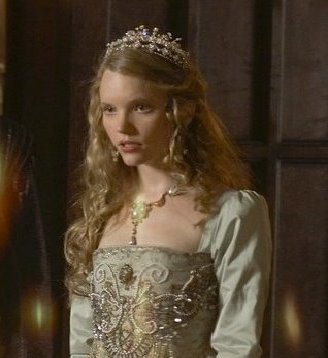
Above: A beautiful bimbo. Tamzin Merchant (left) as Katherine Howard in The Tudors. (left)
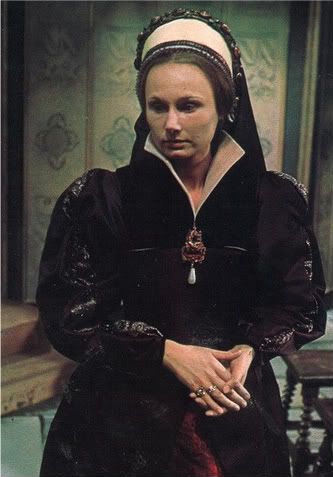
A scheming harlot. Angela Pleasance (right) as Katherine Howard in The Six Wives of Henry VIII.

All of these portrayals might be valid, we just don't know. There is virtually nothing in extant sources about Katherine, aside from her marriage to the king and her spectacular downfall in 1541-2, culminating in the gory details of her execution. Aside from that, it's free rein, for novelists, dramatists and historians alike. I personally do not subscribe to modern views of Katherine as an idiotic, sex-obsessed 'bimbo' who committed adultery with Culpeper - I think it is a very modern, twentieth/twenty-first century reading of the situation, which does not rely on any concrete fact whatsoever. As I have already explored in my article on this blog "Misconceptions of Katherine Howard", there is no evidence that she was stupid. My book rather explores the view that she took her duties as queen seriously, acting as patron and intercessor, traditional queenly roles. She also tried to act as a good stepmother, and kindly provided clothing to the doomed Countess of Salisbury shortly before that woman's grisly execution. The fragments of detail we have about Katherine suggest a kind, good-natured young woman who nonetheless was naive, but who never experienced security as queen; manipulated as she was by devious individuals from her youth while fully aware that the king expected her to provide a male heir, something she never managed to do.


Above: Left - perhaps a sketch of Jane Boleyn, Lady Rochford.
Middle - Joanne King as Jane in The Tudors.
Right - Sheila Burrell as Jane in The Six Wives of Henry VIII.

Jane Boleyn is, similarly, an enigma. Modern scholarship has not been kind to her, and she continues to be portrayed as a sadistic, sociopathic, even insane woman who plotted the downfall of her husband George, loathed Anne Boleyn, and eagerly provided evidence of incest between the two which led to their executions. But there is no historical fact to support this, and we have no way of knowing how the downfalls of the Boleyns personally and psychologically affected her in 1536, whether she was complicit or not. Why she became involved with Katherine is impossible to determine, but Warnicke suggests - and it is possible - that Culpeper blackmailed her into allowing him to meet with Katherine, and I think this theory is credible. Certainly it makes no sense why she would have initiated the meetings on her own, and there is no evidence to suggest that Katherine instigated the whole thing. But whatever the case, Lady Rochford was to pay dearly for her indiscretions, dying alongside Katherine in February 1542.

Both women deserve respect and sympathy. It is essential to recognise that modern portrayals of Katherine and Jane in a variety of media - including literature, film and TV - are often distorted, modernised, and even simplified; they do not necessarily present an accurate depiction of these figures or of the circumstances they experienced. But after 13 February 1542, they were dead and gone, forgotten at court and probably not much mourned. It has been left to a much later age to restore these women's reputations, although many continue to regard Katherine as a promiscuous wanton and Jane as a mentally deranged sociopath. Perhaps, one day, they will be portrayed in the media in a positive light, in which historical accuracy is respected while offering entertainment.


Saturday, 18 May 2013

The Execution of Queen Anne Boleyn


On this day in history, 19 May 1536, Queen Anne Boleyn, second wife and queen consort of Henry VIII of England, was beheaded within the Tower of London for alleged sexual crimes encompassing adultery and incest, and treason against the King in supposedly plotting his death. It was the first public execution of a Queen of England – but by no means the last – and, undoubtedly, encompassed the brutal end of England’s most captivating, controversial, and ultimately celebrated queen consort in history.


http://www.conorbyrnex.blogspot.co.uk/2013/05/the-downfall-of-anne-boleyn.html explored the various theories as to why Anne so shockingly, and quickly, fell from power in the early summer of 1536. It is disturbing that, being in an extremely secure position in January 1536 following Katherine of Aragon’s death and the announcement of Anne’s third pregnancy, just four months later, Henry’s second wife would be brutally decapitated for heinous crimes. As Retha Warnicke tellingly notes:

‘In January 1536... Anne could be optimistic about her future. She was pregnant again... Catherine was at long last dead... When her disgrace and downfall occurred, it was to catch Chapuys, that inveterate gossipmonger, with as much surprise and astonishment as it did the rest of Christendom’.[1]

Eric Ives seems to disagree, writing that:
‘The story of the events which led to the disgrace and death of Anne Boleyn need to begin almost a year before the tragedy itself’, referring to the royal couple’s visit at Wolf Hall, the home of the Seymour family, in the autumn of 1535.[2]

Whatever did lead to Anne Boleyn’s rapid downfall in the early summer of 1536 – whether it was factional conspiracy led by Thomas Cromwell (Ives), the miscarriage of a deformed son (Warnicke), the discovery of the queen’s actual adulteries (G. W. Bernard), a religious plot against the ‘Protestant’ Queen (Joanna Denny) or, simply, the result of Henry VIII’s long-standing ‘hatred’ towards his wife (Scarisbrick, Wilson), the events of May 1536 moved very quickly against the six involved, leading to six brutal deaths and a horrific tragedy.

As has been noted, the Queen and the seven men (two, Sir Thomas Wyatt, celebrated Tudor poet, and Sir Richard Page, were eventually freed) had been arrested and imprisoned in the Tower of London in late April and early May 1536 on scandalous charges of treason, adultery, plotting the king’s death, and, in Anne and her brother George Boleyn’s case, committing incest. All six experienced shock, horror and dread – particularly the Queen, whose moods fluctuated from hysteria to grief to joy, and the lowly Mark Smeaton, who underwent psychological – if not physical – torture to extract a confession of adultery. The four commoners accused of committing adultery with Queen Anne – Smeaton, Henry Norris, William Brereton, and Francis Weston, all of whom had served the queen and been close to her – were tried in Westminster Hall on May 12, 1536, and found guilty of treason through committing adultery with the queen. They were sentenced to be hanged, drawn and quartered as traitors, although ‘mercifully’, the king decided to commute the sentences to beheading. Particularly for Smeaton, this was merciful, since a man of such lowly birth could not often expect such a quick and efficient method of execution.

Queen Anne and her brother George were tried later, on Monday 15 May. It was believed that Anne’s ladies, including the Countess of Worcester, Lady Wingfield, and her own sister-in-law Jane Lady Rochford (who would later be executed with Queen Katherine Howard), had supplied the crucial evidence against her. The Queen and her brother had been tried in the King’s Hall in the Tower of London, with their own uncle, the Duke of Norfolk, presiding in his capacity as Lord Steward. The Queen was brought in first, according to Antonia Fraser: ‘she arrived in a calm frame of mind’.[3] The contemporary chronicler Charles Wriothesley opined that she gave ‘wise and discreet answers to her accusers’ when questioned ‘as though she was not actually guilty’.[4] Ives goes further, movingly claiming that ‘her sparing and effective answers quietly dominated the court’.[5] Certainly, those who were actually there – including Anne’s arch-enemy, the Imperial ambassador, who admitted that she had given plausible and convincing replies to the questions posed – support this claim. She denied committing adultery with any of the men, or incest with her brother; she had not hoped and plotted for her husband the King’s death; she had not poisoned the former Queen Katherine of Aragon or her daughter Princess Mary; but it made no difference. She was found guilty on all counts, despite, as Warnicke notes, being ‘unrattled by these lurid details’.[6] 

Her uncle, the Duke of Norfolk, with tears in his eyes, sentenced her to burning or beheading – but as Alison Weir notes, the method of execution – decapitation by the sword – had been agreed long in advance, and the executioner had already been sent for. Meanwhile, Henry VIII told his new love, Jane Seymour, that Anne would be condemned by 3 o’clock that afternoon. How can anyone not feel immense pity for the Queen, when discovering this brutal detail? It is little wonder that many view Jane Seymour as a sly, cold-hearted plotter who, as the Victorian historian Agnes Strickland wrote in outrage, literally stepped over her former mistress’ dead body to become Queen.

Yet the Queen was noted for her bravery, as even her enemy Cromwell – who many think plotted the whole conspiracy – admitted following her death, praising her courage. All Anne admitted to was: ‘I do not say that I have always borne towards the king the humility which I owed him... I admit, too, that often I have taken it into my head to be jealous of him... But may God be my witness if I have done him any other wrong’. When one considers that Anne swore before eternal damnation that she had never committed the crimes alleged against her, one is convinced of her innocence. As Weir concludes in her study: ‘the historian cannot but conclude that Anne Boleyn was the victim of a dreadful miscarriage of justice’. Following Anne’s trial, her brother George was tried after her, and despite his bravery – something which clearly ran in the Boleyn family – was also sentenced to death.

Two days later, the five men condemned for committing high treason through adultery with the Queen and plotting the King’s death were beheaded on Tower Hill, outside the Tower of London. George Boleyn, as the highest in rank went first, stating that: ‘I was born under the law, I am judged under the law and I must die under the law, for the law has condemned me’. The other men admitted their sins and the fact that they deserved to die; but this does not necessarily mean that they were admitting that they were guilty of the crimes alleged against them. In the Tudor period, everyone was believed to be universally sinful – these men were alluding to their own sins. Smeaton, the last to be executed since he was the lowliest in rank, continued to maintain his guilt, causing the Queen notable distress when she heard.

That day, Anne’s marriage to the King was annulled and her daughter, Elizabeth, bastardised. It was likely on the grounds of Henry’s previous sexual relationship with Anne’s sister – thus creating affinity between them – although Warnicke suspects it was annulled because Anne, believed to be a witch, had bewitched Henry into marrying her. Anne’s own execution, in her mind, was believed to take place the next day, but the day came and went with no summons for the scaffold, leading to Anne’s increasing concern. The Constable of the Tower, William Kingston, eventually told her that it was postponed to the following day, Friday 19 May 1536.

The execution was held within the grounds of the Tower, before a small audience, at nine o’clock in the morning. The Queen emerged from the Tower accompanied by four ladies, and probably would not have been pleased to see her enemies Thomas Audley, the lord chancellor, Charles Brandon duke of Suffolk, Henry Fitzroy, the bastard son of Henry VIII, and Thomas Cromwell himself prominent among the spectators. Anne was dressed in a mantle of ermine (emphasising her queenly rank) over a grey damask gown lined with fur with a crimson petticoat, accompanied with an English gable hood (somewhat surprisingly for her, as she usually preferred the considerably more fashionable French hood). Those who were present remarked that ‘The Queen had never looked so beautiful’, while a Spanish commentator wrote that she looked ‘as gay as if she was not going to die’.[7] Anne’s speech was given by Edward Hall, Henry VIII’s court chronicler, as follows:

‘Good Christian people, I have not come here to preach a sermon; I have come here to die. For according to the law and by the law I am judged to die, and therefore I will speak nothing against it. I am come hither to accuse no man, nor to speak of that whereof I am accused and condemned to die, but I pray God save the king and send him long to reign over you, for a gentler nor a more merciful prince was there never, and to me he was ever a good, a gentle, and sovereign lord. And if any person will meddle of my cause, I require them to judge the best. And thus I take my leave of the world and of you all, and I heartily desire you all to pray for me’.[8]

This is probably very close to Anne’s real speech, and in no way shows Anne admitting any guilt. Whether she did truly love Henry VIII, as she suggests, is impossible to know. Natalie Dormer, in the Showtime TV series The Tudors (despite its inaccuracies), gives a very moving portrayal of Anne’s execution, in which this speech is replicated:


Numerous versions of Anne’s scaffold speech were given by different writers present on that day. According to Wriothesley, Anne stated:

‘Masters, I here humbly submit me to the law as the law hath judged me, and as for mine offences, I here accuse no man. God knoweth them; I remit them to God, beseeching Him to have mercy on my soul. I ask Jesus Christ to save my sovereign and master the King, the most godly, noble and gentle Prince that is, and long to reign over you’.[9]

Despite their glaring inaccuracies (in The Other Boleyn Girl, it is implied that Anne might be given a reprieve before falling into hysterical tears, two things which never occurred; and in The Six Wives of Henry VIII, where Anne is executed indoors before a block, two huge inaccuracies) this is the speech given by Natalie Portman and Dorothy Tutin.


The Queen’s head was removed with a single stroke – mercifully – and she was buried that day in the Chapel of St Peter ad Vincula near Tower Green; where she would be joined less than six years later by her cousin and fellow queen, Katherine Howard, and her own sister-in-law, Jane Rochford, who may have supplied evidence against her. It was the end of the incredible career of Anne Boleyn. Her exact age is unknown but she was probably 34 or 35. She had been Queen for just under 3 years, but she had captivated the King and held his love for closer to 10 years, before being brutally eliminated in a murderous conspiracy – probably masterminded by her own husband – which also saw the deaths of 5 people close to her, including her own brother. One can only pity the Boleyn family, who saw two of their relatives bloodily removed in the space of a few short weeks.

The Independent on Sunday, in reviewing Eric Ives’ monumental – and to date, the best – biography of the Queen, termed Anne Boleyn ‘the most controversial woman ever to have been queen consort of England’. While this is undoubtedly true – just witness the numerous books, films, plays, and stories produced about her monthly – she was, as Ives rightly notes, the most important queen consort in English history. It is almost certain that Anne Boleyn was innocent of the crimes alleged against her. She was outspoken, highly intelligent, shrewd, calculating, at times vindictive, arrogant, and even spiteful; but at the same time she was deeply religious, kind, loyal to family and friends, charismatic, intelligent, attractive, highly talented, energetic, opinionated and bold. These qualities had commended her to a King because they so emphatically showed that she was not the typical sixteenth-century submissive ideal of a woman which Jane Seymour embodied.

Thomas Wyatt, Anne’s close friend – who had been imprisoned in the Tower as one of her accomplices – movingly wrote following these six deaths: ‘These bloody days have broken my heart’. While the Queen was by no means universally mourned – Catholic Europe openly rejoiced at her death and congratulated Henry VIII, while many English people, who hated Anne, saw it as divine retribution – a growing sense of pity emerged for Anne and the men killed with her; while others began to become increasingly suspicious towards the King. Jane Seymour was by no means universally popular, as scurrilous ballads circulated about her affair with the King. As one contemporary wrote:

‘It was thought strange by some, that in the same month which saw the Queen flourishing, accused, condemned and executed, another was assumed into her place’.

As Agnes Strickland, a Victorian historian writing in an era of high moral values, openly vilified the new Queen:

‘Jane saw murderous accusations got up against the queen, which finally brought her to the scaffold, yet she gave her hand to the regal ruffian before his wife’s corpse was cold. Yes; four-and-twenty hours had not elapsed since the sword was reddened with the blood of her mistress, when Jane Seymour became the bride of Henry VIII... The picture is repulsive enough, but it becomes tenfold more abhorrent when the woman who caused the whole tragedy is loaded with panegyric’.

Anne remains romanticised in today’s society, largely because of her brutal fate, an innocent Queen. She was far from perfect, but she deserved better than how she has been treated in recent fiction and film – whether that is Helena Bonham Carter’s shrewish and middle-aged Queen; Natalie Portman’s scheming and hysterical homewrecker; or the calculating and vindictive Anne of Hilary Mantel’s Bring Up the Bodies. To conclude, the last words should belong to Anne’s chief biographer, as they are very moving and aptly epitomise this blogger’s position:

‘She had been a remarkable woman... There were few others who rose from such beginnings to a crown, and none contributed to a revolution as far-reaching as the English Reformation... What Anne really was, as distinct from what Anne did, comes over very much less clearly. To us she appears inconsistent – religious yet aggressive, calculating yet emotional, with the light touch of the courtier yet the strong grip of the politician... Yet what does come across to us across the centuries is the impression of a person who is strangely appealing to the early twenty-first century. A woman in her own right – taken on her own terms in a man’s world; a woman who mobilized her education, her style and her presence to outweigh the disadvantages of her sex... taking a court and a king by storm.’ She was vindicated, 22 years later, when her daughter Elizabeth acceded to the throne.[10]

I agree. Anne Boleyn, an unbelievably complex person, was an incredible woman. In my research into English queens, there is none to compare with her. Her story continues to fascinate, entrance and captivate people across the world to an extent which few other historical personages are able to do. Innocent of the crimes she died for, Anne Boleyn was England’s most important queen consort – and perhaps the greatest.


[1]  Retha M. Warnicke, The Rise and Fall of Anne Boleyn (Cambridge, 1989), pp. 189-90.
[2] Eric Ives, The Life and Death of Anne Boleyn (Oxford, 2004), p. 291.
[3] Antonia Fraser, The Six Wives of Henry VIII (Phoenix, 1992), p. 308.
[4] Ibid.
[5] Ives, Anne, p. 340.
[6] Warnicke, Rise and fall, p. 228.
[7] Fraser, Six Wives, p. 315.
[8] Ives, Anne, pp. 357-8.
[9] Fraser, Six Wives, pp. 315-16.
[10] Ives, Anne, p. 359.


Wednesday, 13 February 2013

The Execution of That Young Girl Katherine and That Bawd, Jane Rochford


On this day, 13 February 1542, eighteen-year old Katherine Howard, fifth queen consort of Henry VIII of England, was beheaded privately on Tower Green for sexual crimes committed against her husband. Following her brutal end, her Lady of  the Bedchamber and relative Lady Jane Rochford was also executed.
Katherine, of course, was the second of Henry's queens to be beheaded, but she has not received the same compassion and pity which her more celebrated cousin, Anne Boleyn, has inspired. Often looked upon with scorn and contempt as being a scheming and spiteful whore, the true reality to the king's teenage queen is rather different.

Readers will know that I am currently researching and writing a biography of Katherine, largely because I think existing historiography on her is highly flawed, providing us with a totally false image of not only this young woman but her family, the Tudor court, her husband the king, and social and cultural beliefs in Tudor England. In 2012, I wrote an essay offering my version of why Queen Katherine fell so tragically from power in 1541, rejecting the popular belief that her sexual affairs, both before and after her marriage, were discovered by reformers who loathed the Catholic Howard family and eagerly informed the King, led by that fervent Protestant the Archbishop of Canterbury himself. There is very little evidence to support this interpretation, and my thesis is rather different concerning young Katherine's downfall in November 1541, eventually leading to her execution just 3 months later and leading to the deaths of 3 other people.

That essay led to me being invited to St Hugh's College, Oxford (I had submitted the essay for the 2012 Julia Wood Prize), as one of  the top ten applicants, something I was very honoured to participate in. Since then, I have actually modified my theories surrounding Katherine's downfall, and the reality is, I think, more disturbing. Scholars have largely neglected to realise how fundamental fertility politics were at Henry VIII's court. Bearing in mind, in its own way, fertility had destroyed the King's previous marriages - Katherine of Aragon and Anne Boleyn both rejected for failing to bear sons, Jane Seymour in the process of giving birth to one, and Anne of Cleves scandalously accused of rendering her husband impotent - it seems compelling that the fifth marriage also collapsed because of fertility issues. Rejecting the notion that Katherine, as an oversexed and lusty adolescent took multiple lovers behind her husband's back, I believe that not only did she never have sex with Thomas Culpeper, but these meetings were sinisterly interpreted by the Council as evidence of the Queen's desperate attempts to conceive a child due to Henry's impotence. That the King was impotent, I think, is obvious. It was an issue in both his marriages to Anne Boleyn and Anne of Cleves. Katherine Howard, in effect, was a scapegoat for her husband's impotence. Believing that she was trying to conceive a son since her husband could never provide her with one, this young woman was brutally destroyed, along with Jane Rochford, who was believed to be assisting her, and Francis Dereham, a manipulative individual who I believe was sexually violent towards Katherine, and Thomas Culpeper, an ambitious courtier who probably manipulated Katherine into granting him favours.

The year 1541 abounds with evidence of the royal couple's fertility problems. I won't go into it in detail here, for it will be explored fully in my biography, to be published this summer. However, what is clear is that in November 1541, days after being celebrated as the king's most loved queen in churches across England, Queen Katherine was confined to her chambers and forbidden to see her husband. Her shock, fear and confusion must have been evident. She was ruthlessly interrogated several times, but consistently maintained that she had never taken lovers behind the king's back and swore that Dereham had raped her. Most historians dispute both of these confessions, but I believe them to be true. In December, both Dereham and Culpeper were executed for treason, but Culpeper insisted that he had never slept with Katherine, which she insisted too. During this time, both the Queen and Lady Rochford were imprisoned, before being taken to the Tower of London.

Despite her repeated avowals of innocence, Katherine was condemned to die as a traitor, and Jane Lady Rochford was also condemned for misprision of treason. Jane's reputation has been abominable; with historians often arguing that it was she who brought forward charges of incest against her husband and Anne Boleyn, who were brother and sister. Whether this is true or not is unclear. Nonetheless, Jane seems to have had a full mental breakdown in the Tower, and the King passed a law allowing him to execute mad people, surely conveying his desire to be revenged upon this gentlewoman. Katherine, too, collapsed with shock and horror at what had befallen her. She was described often by several reporters as being in a highly weak state physically, and it was later suggested that she had to be physically helped up the scaffold.

On 13 February, the queen and her female attendant emerged from the Tower, proceeding on the short walk to Tower Green for their ultimate punishment. Katherine's execution has often been shrouded in a fair degree of mystery. The Spanish ambassador claimed that the night before her beheading she requested the block, in order to practice laying her head on it before the actual execution. In popular culture, she is often depicted as terrified with fright, as anyone who was seen Henry VIII (2003), with its harrowing depiction of Katherine's execution, will know. (Emily Blunt, playing the young queen, is shown screaming and crying with fear, protesting "I don't want to die!") In The Tudors, Tamzin Merchant presents Katherine as wetting herself on the scaffold with fear.

The reality is that Katherine was much braver, although the French ambassador reported that she was so weak that she could barely stand or speak. That she was in a state of shock seems clear. Her uncle had previously stated that she was tormenting herself with fear, as the Archbishop of Canterbury had also implied when he had interrogated her 3 months earlier. An eyewitness to the execution, a London merchant called Otwell Johnson, gave a very different account of Katherine and Jane's last moments. He stated that:

thay made the moost godly and christyan's end, that ever was hard tell of... uttering thayer faeth in the blode of Christe onely, and with goodly words and stedfast countenaces thay desyred all christen people to take regard unto thayer worthy and just punnishment with death for thayer offences, and agenst God hainously from thayer youth upward, in breaking all his commandements...

A notorious Catholic source, entitled The Chronicle of Henry VIII and written by an anonymous Spaniard living in London in the 1550s, gave a differing portrayal of Katherine's execution. Readers have to bear in mind that many of his reports are highly inaccurate. For instance, the king's marriages to Anne of Cleves and Katherine Howard are reversed, Cromwell interrogates Katherine (fact, he had died almost 2 years previously) and no mention is made of the executions of Dereham and Jane Rochford. He reported that the Queen apparently stated:

long before the King took me I loved Culpepper, and I wish to God I had done as he wished me, for at the time the King wanted to take me he urged me to say that I was pledged to him... I would rather have him for a husband than be mistress of the world... I die a Queen, but I would rather die the wife of Culpepper.

This famous detail, that Katherine apparently wished to die the wife of Culpepper, is entirely fictional. In the Spanish chronicler's account, the Queen embarks on a passionate love affair with this courtier, and the King is depicted as a cruel tyrant who breaks apart the couple's tender love by choosing Katherine for his wife. This, of course, is almost certainly untrue. The true reality of their relationship is complicated. I agree with David Starkey and Retha Warnicke that they never had sex, and I believe Warnicke is right when she claims that Culpeper manipulated the young and naive Queen, but I do believe Katherine had tender feelings for him. Nonetheless, my theory is that she only turned to Culpeper initially because of her mounting concerns about her husband's fertility problems, and sought out Culpeper because he was the King's closest attendant and thus fully aware about his sexual problems, and so could have enlightened her.

The Spanish chronicler described Katherine as only fifteen when she met the King, and depicted her as being very beautiful, remarking that she was the loveliest lady in the kingdom. Following Katherine's death, Jane Rochford was immediately executed. Apparently insane - as described controversially in Philippa Gregory's The Boleyn Inheritance - she made a long and rambling speech which irritated contemporaries. Fully double the Queen's age - she was born c. 1505 and so was aged around 37 - she was almost certainly not the pathological monster she has so often been depicted as. The legend that Jane admitted that she had provided evidence against Queen Anne and George Boleyn, and regretted it emotionally, is untrue. Whether it was she or Katherine who initiated the meetings with Culpeper is almost impossible to say.

I have covered the deaths of 3 Tudor Queens this month, 2 of whom were teenagers (Katherine not yet 19, Jane Grey 17). But Katherine Howard, out of all the Tudor women beheaded, is almost certainly the most misunderstood out of all of them, and yet I believe that in many respects she was the ultimate victim. A naive, kind-hearted girl who was manipulated by experienced and aggressive older men, she tried to do her best as Queen, showing genuine kindness towards several personages, and advanced her family in order to benefit them. It was not her adultery, her foolishness, her lustiness which eventually killed her. It was fertility politics, ultimately making her a scapegoat for her husband's inability to impregnate her. Increasingly suspicious and distrustful of his young queen, when evidence emerged that Katherine had employed her former lover (probably to appease him) and had had nighttime meetings with Thomas Culpeper, the King believed that she had betrayed him, hoping to fall pregnant by either, or both, these men and pass off their bastard as the King's son. Agnes Strickland described Katherine as being led like a sheep to the slaughter without having the opportunity to say a word in her own defence. Her innocence and naivety was rare in the Tudor court.

Tuesday, 12 February 2013

The Execution of Lady Jane Grey, Queen of England


On this day, February 12 1554, Lady Jane Grey, famously the Nine - or more accurately, Thirteen - Day Queen was beheaded privately on Tower Green, shortly after her teenage husband Guildford Dudley had been executed on Tower Hill. Last week I detailed the execution of Mary Queen of Scots, Jane's fellow queen who, like Jane, believed that she was dying as a martyr for her faith. Unlike Mary, however, Jane was dying as a fervent, even devout Protestant, and has ever since been mourned as a martyr for the Protestant faith and a victim of the Catholic queen Mary Tudor's bloody campaign of tyranny.

Lady Jane had been born sometime between the autumn of 1536 and the autumn of 1537 to two highly ambitious Tudor figures, Henry Grey, marquis of Dorset, and his notorious wife Frances Brandon, who was the daughter of Henry VIII's youngest sister Mary by her husband Charles Brandon, duke of Suffolk. Royal blood thus flowed in Frances' descendants. Jane's sisters, Katherine and Mary, were born in 1540 and 1545 respectively. Jane's childhood and the nature of her relationship with her parents is something of a mystery. The Victorian era, through portraying Jane as an innocent teenage victim and Protestant martyr, depicted Jane as ruthlessly bullied by her cruel parents, especially her tyrannical mother, apparently famously beating her when Jane refused to marry Guildford in 1553. This portrayal of the Grey parents' relations with their eldest daughter was famously described in Alison Weir's fictional historical novel Innocent Traitor, where Frances mercilessly punishes her daughter, often physically beating her and inflicting violence on her. Recent historians, however, have questioned the reality of the personal nature of the Grey family's relations with one another. Plowden, for instance, suggests that Jane's complaints about her parents' harsh treatment of her may not necessarily reflect reality but, instead, 'may... illustrate the attitude of a priggish, opinionated teenager, openly scornful of her parents' conventional, old-fashioned tastes'.

Whatever the case is, Jane was, famously, extremely intellectual. In the words of Alison Plowden, who has written extensively on her, she showed 'exceptional academic ability'. Aged thirteen, she was found by Roger Ascham, Princess Elizabeth's tutor, to be reading Plato, and she was learned in several languages, classics, history, religion/theology, and sciences. In the spring of 1547, aged around ten, Jane was sent into the household of Henry VIII's last and ultimately luckiest queen, Katherine Parr, who quickly showed fondness for her young charge. Jane was exposed to Katherine's radical Protestantism, and she later shared lessons with her royal cousins Edward and Elizabeth. It has been theorised by numerous scholars that these three developed a strong Protestant faith which they all shared equally passionately, although it seems unlikely, given what we know of her reign and personal beliefs, that Elizabeth was as puritanical in her Protestant religion as Edward and Jane were. Tragically, Katherine died in childbed in 1548, and Jane returned to her parents' home in Leicestershire.

Jane rapidly became an increasingly devout Protestant, and as a teenager she began, with her tutors' encouragement, to communicate with radicals on the continent, including Heinrich Bullinger, associated with the radical church in Zurich. By now, of course, Jane's teenage cousin Edward had become king of England, and Protestantism had been forcefully introduced into England through a swift and brutal campaign of destruction of all traces of late medieval Catholic religion. In 1551, aged fourteen, Jane began to attend court more, following her father's advancement through becoming Duke of Suffolk, a wealthy and prestigious title which further enhanced the status of the Grey family. Jane apparently came into conflict with her thirty-five year old cousin Princess Mary, since Jane, despite only being in her early teens, showed considerable distaste towards her cousin on account of her Catholic religion. When Mary kindly sent her a lavish and fashionable dress, Jane rejected it, viewing it as symbolic of the corrupt nature of Catholicism. She pointedly remarked that it was a shame that Mary did not dress like her sister Elizabeth who, in the true spirit of Protestantism, rejected lavish dress and instead wore plain, modest clothing.

What is clear is that during the early 1550s Jane, and her family, became increasingly important at court. There had even been talk that Jane would marry her cousin Edward and become queen, thus further strengthening the Protestant religion in a gradually radical England. In 1553, it was arranged between the Grey parents and John Dudley, earl of Northumberland, that sixteen-year old Jane would marry Guildford Dudley, a younger son of Northumberland. Famously, Jane refused, and the story goes that her parents beat her mercilessly until she agreed to marry him, although it is uncertain whether this in fact happened. The marriage occurred in May, on a day when three weddings occurred at Durham House in London. Jane's thirteen year old sister Katherine was also married. Dramatic developments entailed in July when the fifteen-year old king Edward tragically died. Of course, this signalled Jane's fantastic rise to power and, eventually, triggered her dramatic downfall.

Historians have debated intensely the processes which led to Jane becoming queen of England, with some arguing that it was a Grey-Dudley family plot which saw members of that family, prominently the duke, bullying the king into naming Jane as his successor. Others have doubted this and emphasised that it was the king's intention all along to pass the crown to Jane, to ensure the triumph of Protestantism in England. Even though his own sister Elizabeth was Protestant, both she and Mary were excluded from the throne on account of their status as bastards. According to Jane's later letter to Mary, she was 'stupefied and troubled' by the astonishing announcement in early July that she was now Queen of England, but accepted the throne as a means of inaugurating Protestantism further in England. This has been explored in fictional works such as the 1985 film starring Helena Bonham Carter, Lady Jane, where Jane, as a devout Protestant, accepts the crown due to her religious beliefs.

On 10 July, Jane was taken to the Tower; on the way, an Italian spectator watched the grand procession and described the teenage Queen as being red-haired, freckled, and very short and thin. Apparently, she was so  tiny that she had to wear high platforms on her shoes. Her husband, Guildford, was described as being blonde, tall, and strong. According to contemporary accounts, the new Queen was received with largely indifference, confusion, and even hostility. Very few people had actually heard of Jane, and of course her cousin Mary was highly popular in England. Jane was proclaimed queen at Cheapside, before news quickly emerged that Mary had assembled an army and was intending to march into London and recover her throne. Jane's Council fell apart, with Northumberland unable to defeat Mary, and Mary was soon afterwards proclaimed queen. Jane's father ripped up her canopy of state when he later met with her, and informed her that she was no longer Queen. Her reign had lasted thirteen days, from 6 to 19 July.

To begin with, Mary had promised to be merciful, and it does seem likely that, as a kind-hearted but ultimately inexperienced and naive woman, she intended initially to spare her seventeen-year old cousin, who she believed had not wanted the throne for herself, and was merely a pawn of her ambitious family. Northumberland, however, was executed in August 1553, despite his earnest attempts to save himself through converting to Catholicism shortly before his execution, to no avail. Jane allegedly voiced shock and contempt at her father-in-law's renouncing of his religious beliefs. In November, Jane and her husband were tried for treason, and were condemned to die. Jane's fate was to be beheaded on the Green or to be burned alive within the Tower. She was assured, however, that she would not die, and that Mary would save her.

Tragically, Wyatt's rebellion in early 1554 sealed Jane's fate. Up till then, the queen had granted her several freedoms, allowing her to continue studying and to walk in the Tower gardens, and Jane had had nothing to do with the Wyatt rebellion. Yet this confirmed to both Queen Mary and her Council  that she would never be truly safe until her cousin was dead, since she would always be the figurehead for strong Protestant plots who sought to remove Mary and replace her with a Protestant monarch. The Queen was no longer able to be merciful, and Jane's execution was scheduled for February. Again showing her merciful nature, Mary sent the new dean of St Paul's to attempt to convert Jane, who Mary viewed as a heretic on account of her Protestant faith and hostility towards Catholicism, but to no avail. Demonstrating remarkable bravery and single-mindedness, bearing in mind her tender years, Jane refused to renounce her faith.

On 12 February, both Jane and her husband Guildford were beheaded. Guildford was executed first, although Jane refused to bid goodbye to him. Jane apparently cried "Oh Guildford!" when Guildford's bloody body was brought by her window, before processing to Tower Green for her own execution shortly after 10am. Dressed in deep black, and described by the onlooker Richard Grafton as being "a gentle young Ladie with singuler gifts both of learning and knowledge", Jane made a short speech on the scaffold, admitting that she had done wrong in accepting the crown, but emphasising her innocency and love of God. She announced that she died as "a true christian woman", before kneeling down and saying Psalm 51.

The headsman stepped forward and Jane, finally, saw the dreaded block for the first time. Unlike Anne Boleyn, she was executed with an axe by kneeling before the block. Following her ladies tying a kerchief around her eyes, Jane experienced a brief moment of panic and distress, groping for the block and crying out, "Where is it? What shall I do?" before someone came forward to guide her. The execution was soon over quickly, and Jane's body was buried in the chapel of St Peter ad Vincula, along with her fellow queens Anne and Katherine, who had been buried there previously.

The execution of Lady Jane Grey has since given rise to a legend and a series of myths surrounding this unfortunate young woman. Plowden referred to her beheading as "the judicial murder... and no one ever pretended it was anything else". Yet Plowden also, wisely, cautions that "it is difficult now to see beyond the religious bias of such contemporary sources as Holinshed's Chronicles and Foxe's Acts and Monuments, or the uncritical later biographies of Agnes Strickland and Richard Davey." She was made an icon as a Protestant symbol, an innocent victim of the bloody and cruel Catholic Mary I, who was vilified and condemned as evil and corrupt in Protestant sources of the kind produced by Foxe.

The painting above, painted in the nineteenth century by a French painter, helped to promote the image of Jane as a guiltless, gentle teenage martyr, characterising her as a Protestant heroine, even a saint. The famous Tudor historian Eric Ives, who wrote a celebrated book about Jane, concluded in his study of the young Queen's life that "Truth to tell she counted for little. She was important for barely nine months, she ruled for only thirteen days... And yet her name still lives... But the fundamental justification for remembering Jane is the justification for remembering Anne Frank centuries later. They speak for the multitude of brutality's victims who have no voice".

As beautiful as this is, I also agree with Plowden, who wrote somewhat unsettlingly: "...the reality of Jane Grey, sacrificial victim of realpolitik though she undoubtedly became, was surely rather more disturbing than the sentimental myths surrounding her seem to suggest".

I agree. The picture we have of Jane, and the depiction of Queen Mary I, are the results of the triumph of Protestantism, and later secularism, in England today, thus identifying the Protestant Jane as a victim and martyr for England's faith and her cousin as alien, barbaric, cruel, un-English, unnatural. Imagine if Catholicism had triumphed, and Mary was celebrated as a good and highly effective ruler and Jane as a traitor. Historians need to remember that the pictures we have of historical figures are often influenced overwhelmingly by later national, political, and cultural developments. Thus the success of the Reformation in England has led to Anne Boleyn being celebrated as an important religious figure in her own right, rather than as a royal prostitute as she was identified in her own time, while the success of Elizabethan Protestantism has similarly led to harsh judgements about one of its victims, Mary Queen of Scots.

Truth be told, Jane Grey must be seen as a tragic and unfortunate figure. She was beheaded at the age of seventeen, in a highly cruel time which experienced bloodshed and political rivalry on a constant basis. But Jane held firm religious beliefs, she was highly confident that she would enjoy salvation, and I doubt very much that she saw her cousin Mary with anything but contempt and pity, perhaps. She was innocent in that she did not readily participate in family plots to seize the throne, but I do think Jane was more complex than Victorian writers made her out to be. There is evidence to suggest that she was stubborn, highly opinionated, ruthless, priggish, and very narrow-minded towards those who did not share her beliefs. Who knows - if she had defeated Mary, and continued as Queen Jane, there may have been a persecution of Catholics on the same scale as Queen Mary persecuted Protestant heretics.