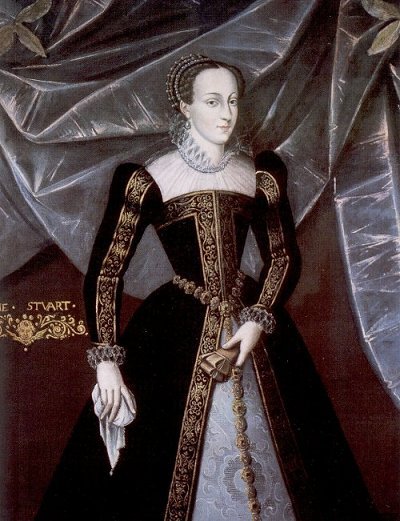
On 8 December 1542, a princess was born to Scotland. At Linlithgow Palace, Queen Marie de Guise, consort to James V of Scotland, delivered a daughter, who was named Mary; she would be their only surviving child. Six days later, Mary became queen of Scotland, following her father's death on 14 December. It was rumoured that James had lamented that his dynasty 'came with a lass, it will pass with a lass.' It is, however, questionable whether this legend has any truth to it. Mary was the first queen regnant of Scotland since Margaret of Norway (1283-90), who died at the age of seven.
Mary's early years at the Scottish court were tumultuous ones, for her kingdom was at war with England. Henry VIII was determined to secure the submission of Scotland, and engaged in what became known as 'the Rough Wooing', in which he sought to effect the marriage of Mary to his son and heir, Edward. The two kingdoms had signed the Treaty of Greenwich in 1543, which agreed to a marriage between Edward and Mary, but the Scots soon renounced it. Mary's mother, the dowager queen, favoured an alliance with France, rather than England, and it was to France that she looked with regards to her daughter's future.
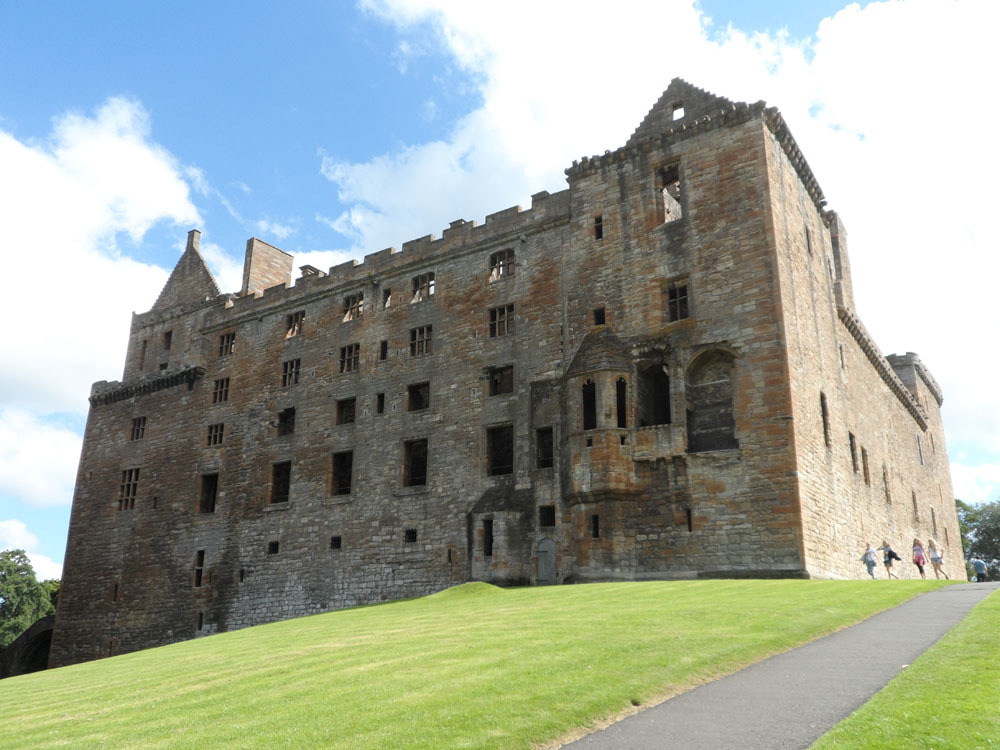
Above: Linlithgow Palace, where Mary was born in 1542.
In 1548, at the age of five, the Queen of Scots departed for France in the company of her four companions - all named Mary - and a sizeable retinue. She was betrothed to Francois, dauphin of France, and could thus anticipate a glorious future as queen consort of France, as well as queen regnant of Scotland. Mary was provided with an excellent education, in which she acquired expertise in dancing and music making, singing, needlework and horsemanship. She later became known as an accomplished poet. However, her language skills were somewhat rudimentary; certainly, she did not possess the linguistic talents of her cousin and rival, Elizabeth. As she grew to maturity, Mary was reported to be beautiful and charming. She was tall in stature, with auburn hair and dark eyes. Her love of France, and her French behaviour and customs, did not necessarily endear her to her Scottish subjects. Lord Ruthven, who was involved in the murder of her servant Rizzio, allegedly feared her wiles that she had developed while spending 'her youth in the Court of France.'
Mary was trained to regard herself as not only the queen of Scotland and France, but also the rightful queen of England and Ireland, in the event of her cousin Mary I's death. Henry VIII's will stipulated that, should Mary Tudor die without heirs, the crown should pass to her younger sister Elizabeth. However, Catholic rulers such as Henri II of France did not regard Elizabeth as the rightful heir to the English throne, on account of both her religion (Protestantism) and her bastardy (her parents' marriage had been annulled in 1536). From their point of view, it was Mary, Queen of Scots who had the right to succeed Mary Tudor. Naturally, as his son Francois was betrothed to the Queen of Scots, Henri was determined that she should be queen of England.

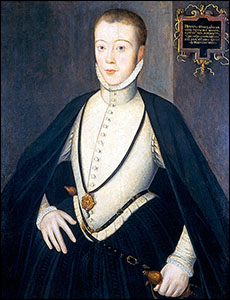
Mary's first two husbands: Francois II of France (left) and Henry, Lord Darnley (right).
It is this context that explains why 1558 was a crucial year for Mary, Queen of Scots. On 24 April, at the age of fifteen, she married the dauphin in a splendid ceremony at Notre Dame. Seven months later, Mary I of England died. The crown passed to her sister Elizabeth, but France did not recognise the new queen, at a time of war between the two kingdoms. Instead, Mary Queen of Scots and her husband quartered the royal arms of England with those of France and Scotland, in effect proclaiming themselves the rightful king and queen of England. It was a daring move, and it did not endear the Scottish queen to her cousin Elizabeth.
Henri II's death the following year meant that Francois succeeded him as king; the sixteen-year-old Mary was now queen consort of France. However her husband, who seems to have been sickly from an early age, died the following year, and it was intimated to Mary that there was no place left for her in France. In August 1561, she returned to Scotland, determined to rule as queen regnant. Occasionally, Mary has been disparaged as a frivolous ruler uninterested in affairs of government or politics, but she appears to have frequently attended council meetings and, moreover, was eager to maintain religious stability. The tensions between Catholics and Huguenots in France were steadily increasing, and culminated in the massacre of St. Bartholomew's Day in 1572. Mary I of England, moreover, had persecuted her Protestant subjects - almost 300 were burned at the stake - while Elizabeth I was responsible for the execution of almost 200 Catholic subjects. Mary Queen of Scots, who had perhaps gained an awareness of the religious violence that threatened to undo France during her years spent there, was determined to secure a religious rapprochement in Scotland.
The Scottish Reformation had been highly effective, and Mary returned to a country that was embracing Protestantism. However, she managed to hear mass privately in her chapel at Holyrood, although she was criticised by the militant preacher John Knox for doing so. Alongside her religious compromises, Mary sought to secure the recognition of Elizabeth as her heir, should the English queen die without an heir. Elizabeth, who had been the focus of rebellion during her sister's reign, had learned of the dangers in selecting an heir during her lifetime, particularly when that heir was Catholic and the ruler of a neighbouring kingdom. She was also aware that many Catholics, especially on the Continent, refused to regard her as the rightful queen. In view of this, Elizabeth made overtures to Mary but never granted her the recognition that Mary craved.


Above: Mary's cousin and rival, Elizabeth I of England. (left)
Mary's son and successor, James VI of Scotland. (right)
As a queen regnant of Scotland, Mary was eager to marry again. A variety of candidates were proposed, including Don Carlos of Spain, son of Philip II. Elizabeth, for reasons that continue to perplex modern historians, offered Mary the hand of Robert Dudley, earl of Leicester. The earl was rumoured to be the English queen's lover, and he was clearly greatly inferior to the Scottish queen in status. Moreover, he came from a family of traitors. Mary, offended, declined Elizabeth's offer. The English queen had stipulated that Mary could retain her friendship only by marrying Leicester or an English subject, or by remaining unmarried, and hinted that she might recognise Mary as her heir if she conformed to these conditions. In view of this, Mary's decision to wed Henry, Lord Darnley is explicable. Henry was the eldest son of Matthew Stuart, earl of Lennox, and Lady Margaret Douglas. He was, therefore, a grandson of Margaret Tudor and a great-grandson of Henry VII. He, like Mary, had a claim to the English throne, and it was perhaps in a bid to strengthen her own claim that Mary elected to marry her relative. They married at 29 July 1565 at Holyrood.
Henry was at least three - possibly four - years younger than his wife, and events would reveal that he was immature, spoiled, vindictive and arrogant. The marriage was not popular. The English refused to recognise the marriage and declined to refer to Henry as the king of Scotland, a title he was most anxious to enjoy. Elizabeth was enraged by her cousin's activities, and it was reported that there was much 'jealousies, suspicions and hatred' between the two queens, where previously there had been 'sisterly familiarity'. By marrying Henry, a Catholic with a claim to the English throne, Mary had undermined the fragile amity between England and Scotland.
Mary's remarriage placed her in a difficult position that was exacerbated by rebellion at home - known as the Chaseabout Raid - and by increasing tensions between her Catholic and Protestant councillors. Her new husband, moreover, was furious by what he perceived as his wife's refusal to grant him the crown matrimonial of Scotland, which effectively meant that his status as king of Scotland was a rather meaningless one. The reign of Mary I of England had evidenced the ambiguities and difficulties of authority and precedence when a queen regnant married. Moreover, Mary's friendship with her adviser David Rizzio, a Savoyard musician, enraged both her husband and the Scottish nobles more broadly. On 9 March 1566, Rizzio was brutally stabbed to death by several noblemen in the queen's own chambers; Mary herself was seized by her husband and was harrassed by Lord Ruthven. Mary was probably shattered by the experience, but her pregnancy meant that she had to focus on her health. On 19 June, she gave birth to a son, James, who would later succeed her as James VI.
Mary's growing problems with Henry perhaps led her to collude in plots against him, although it is unlikely that she actively intrigued for his death. On 10 February 1567, her husband was murdered at Kirk o'Field, near Edinburgh. The murder scandalised Mary's subjects and was reported across Europe; Elizabeth I proclaimed herself shocked by what had happened, and quickly admonished Mary for her apparent closeness to the chief suspect, the earl of Bothwell. Mary has often been criticised for her behaviour, but she seems to have suffered a complete mental breakdown. Amid reports that she was depressed, perhaps suicidal, Mary was captured by Bothwell and incarcerated at Dunbar. Having abducted her, Bothwell then proceeded to rape her. In a bid to protect her own honour, as well as that of her infant son, Mary married Bothwell in May 1567. She argued frequently with her new husband and reportedly called for a knife with which to end her unhappy life. Her suicidal tendencies, coupled with her depression and anxiety that had been exacerbated by the abduction, are powerful evidence against the simplistic view that she, besotted by Bothwell, had engaged in a passionate love affair with him and then encouraged him to murder Henry. Eventually, Mary was seized by the confederate lords at Carberry Hill, abandoned by her husband, and was transported through Edinburgh as crowds shouted 'Burn the whore!' She was imprisoned at Loch Leven, and forced to abdicate in favour of her son, James.


Above: Mary's parents, James V of Scotland and Marie de Guise.
At Mary's birth in December 1542, Marie de Guise could never have imagined the turbulence that would characterise her daughter's life, which arose as a result of dynastic conflict, political instability and religious tensions. Nor could she ever have imagined that Mary would be the only monarch in Scottish history to die on an English scaffold, nor could she have envisaged that Mary would be the fourth British queen in a century to suffer that humiliating death. Mary, Queen of Scots' reputation has rarely been positive or even nuanced; traditionally identified as a scheming adulteress, who colluded in her husband's murder, she has also been regarded as a virtuous martyr for the Catholic faith and the rightful queen of England, executed by her barbaric and unnatural cousin, the usurper Elizabeth. Perhaps what should most be appreciated is the difficulties Mary faced in attempting to govern a turbulent kingdom, at a time when queen regnants were viewed with suspicion or were actively disparaged. Elizabeth I proved that a woman could rule successfully and actively, but the difficult experiences of her sister Mary I and her cousin Mary, Queen of Scots provided telling evidence that such success was neither preordained nor necessarily even expected by one's subjects. More recently, historians have come to view the Scottish queen sympathetically, with a more nuanced understanding of the religious, political and dynastic conflict that severely undermined her kingdom and affected her attempts - genuine attempts - to rule successfully.