Showing posts with label Eustace Chapuys. Show all posts

Tuesday, 16 May 2023

Was Jane Seymour Pregnant in 1536?


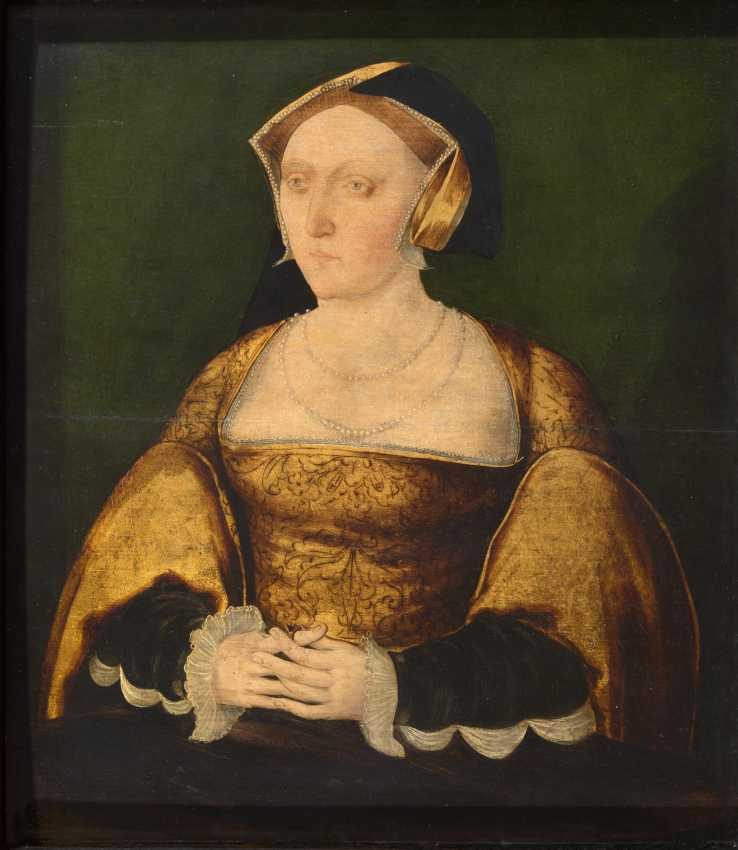
A hitherto overlooked statement in the Calendar of State Papers, Spain offers intriguing information about Henry VIII's relationship with his third wife, Jane Seymour. Sometime in late 1535 or early in 1536, the king began a liaison with Jane - initially courtly in nature - and married her in May 1536, only eleven days after the execution of his second wife Anne Boleyn. Born in about 1509, Jane had served Anne but there is little evidence concerning her relationship with the king and the circumstances in which it began. It was only in February 1536, for example, that the imperial ambassador Eustace Chapuys reported the king's 'treatment shown to a lady of the Court, named Mistress Semel [sic], to whom, as many say, he has lately made great presents'.

Thus, in view of the obscure origins of the relationship, the following report deserves attention. On 26 June 1536 from Rome, a month after the execution of Anne Boleyn and Henry VIII's marriage to Jane, Dr Ortiz informed Commander Molina that the king had married again, to 'a lady who was already in the family-way by him five or six months ago'. The 'family way' was a term used to describe pregnancy. For example, Chapuys reported in January 1534 that Anne Boleyn 'is now in the family way again, and in a state of health and of an age to have many more children'. Thus, if Ortiz is to be believed, Jane had conceived a child in December 1535/January 1536, several months before her royal marriage.

The suggestion in this report that Jane was the king's mistress in the physical - rather than courtly - sense is interesting in view of her posthumous reputation as a virtuous and chaste figure, allegedly the antithesis of her predecessor, the flirtatious Anne Boleyn. However, other ambassadorial dispatches written shortly before Jane's marriage were similarly ambivalent about her virtues, indicating that Jane's moral, upstanding reputation was not necessarily as widely shared as is generally assumed. On 18 May, the day before Anne's execution, Chapuys wrote to Antoine Perrenot with information about the king's new love, commenting that Jane was of medium height, fair, and 'no great beauty'. He confided his doubts as to whether, having long resided at court, Jane really was a virgin. The ambassador cynically remarked that 'he [Henry] may make a condition in the marriage that she [Jane] be a virgin, and when he has a mind to divorce her he will find enough witnesses'. However, once Jane had become queen and had demonstrated her desire to restore the king's eldest daughter, Mary (daughter of Katherine of Aragon) to Henry's good graces, the ambassador's attitude towards Jane became markedly more positive and complimentary.

It is highly likely, however, that Ortiz was mistaken. There is no evidence that Jane was pregnant as early as December 1535, and such a detail would surely not have escaped the attention of the perceptive, eagle-eyed Chapuys, who keenly watched for any sign that Henry's relationship with Anne was in danger. Ortiz's dispatches, moreover, contain many inaccuracies, based as they are on second- or thirdhand gossip and rumours about the English court; his account of the fall of Anne Boleyn testifies to his limited knowledge of actual events. This is perhaps unsurprising, writing as he was from Rome and thus not in physical proximity to the events he describes. As I have noted elsewhere, ambassadors serving in the royal courts were keenly interested in any sign of a queen's pregnancy. The references to the possible pregnancies of Anne Boleyn and Jane Seymour in this blog post, reported by ambassadors, testifies to the envoys' interest in the subject. Similarly, when Henry VIII married for the fifth time in 1540, it was reported in September in Brussels by the Venetian ambassador Francesco Contarini that 'the new Queen Katharine [Howard] is said for certain to be pregnant', a report that echoed the claim of the French ambassador Charles de Marillac in July that Katherine 'is already enceinte'.

Of course, Jane may have been Henry's mistress in the physical sense prior to their wedding in May 1536 and she may have conceived a child, but there is no other evidence to support Ortiz's claim and others, including Chapuys, surely would have reported a pregnancy if it was indeed the case. Chapuys only learned of their relationship in February 1536 and his dispatches suggest that the relationship between Henry and Jane was, at least initially, a courtly one, in which the king sent gifts and letters to his beloved but without the expectation of physical favours. By the spring, however, Henry was determined to set aside Anne and take Jane as his third wife. It is nonetheless interesting that several novelists have explored the idea that Jane conceived a child either before, or during the early months of, her marriage, but which resulted in a miscarriage or stillbirth. Whether or not that was the case, it is indisputable that she gave birth to the future Edward VI on 12 October 1537 at Hampton Court Palace, but the queen tragically died just days later, on 24 October, the only one of Henry's six wives to provide him with a surviving male heir.

Thursday, 20 November 2014

Fantasies of a Bitch: "Anne Boleyn", Mean Girls, and Culture


Everyone loves a bitch. In one guise or another, bitches have occupied centre stage within every culture in civilisation. Medieval mean girls, ancient vixens, Renaissance shrews and modern Reginas reign supreme throughout their generations, tormenting, tantalising, manipulating, wreaking havoc, creating misery and doing it all with a stunning smile. Regina George, played by Rachael McAdams in Mean Girls, is the archetypal bitch of twenty-first century American culture: manipulative; beautiful; tormenting; ruthless; spiteful; and dizzyingly intelligent. Very much the "Queen Bee" of her school, where she rules the roost and throws every other female into the shade, Regina epitomises modern bitchiness in its every facet. For many, the Tudor equivalent of Regina George in modern America is the very mother of Elizabeth I herself, Henry VIII's second and most infamous wife: Anne Boleyn.

Susan Bordo, in her excellent, original and provocative book The Creation of Anne Boleyn, ponders why Anne continues to be represented in cultural works as hell on earth, asking 'who let the bitch out?' Eustace Chapuys, imperial ambassador during the majority of Henry VIII's reign, created a nightmare vision of Anne that has powerfully shaped, to one degree or another, every cultural representation of her since. Presenting her as 'that accursed she-devil' who used witchcraft and magic to lure Henry into marrying her, Chapuys suggested that Anne was craftily and cunningly planning the deaths of her rival Katherine of Aragon and her stepdaughter Mary Tudor. When she wasn't busy making threats and acquiring poison to do away with enemies, she was spreading Lutheranism throughout the kingdom, luring the king into ridding England of its rightful religion. As Bordo notes: 'What this view of Anne has done is create a vivid, provocative "template" which later generations have responded to in different, often highly polarized ways'. In short, Chapuys portrayed Anne in so vile and hostile a light that represented her as the bitch of the Tudor court, a woman who stopped at nothing to attain her own ends. 


Chapuys's influence can be discerned in several contemporary works. Philippa Gregory's novel The Other Boleyn Girl presented Anne as a murderous, malicious and egotistical woman who bullied her siblings into doing what she wanted. She poisoned Katherine and several bishops, slept with her brother, and stole her sister's child in an act of coldblooded cruelty. The portrayal of Anne in Hilary Mantel's Wolf Hall and Bring Up the Bodies has been described as 'lethal' and so 'spitefully ambitious' that 'one feels any king would be justified in beheading her'. Yet there is very little to no evidence to support this. Aside from Chapuy's poison pen, and the later hostile account written by a Catholic priest, Nicholas Sander (who was himself a child when Anne was executed), contemporary accounts did not so vividly and fictionally present Anne as, in effect, the bitch of the Tudor court. 

As Bordo notes, the femme fatale, the bitch, is an archetype of all cultures throughout the ages. Just perusing a GoodReads discussion entitled 'Why did everyone hate Anne Boleyn?' brought up the following claims:


'I... think she deserved to die though innocent of adultery and to other sexual misconduct but because she made C. of Aragon suffer so, slowly poisoning her to death, and treating Mary so badly. In those days queens seemed to have a Queen Bee syndrome and Anne was viciously true to form'.


'Today, she would probably be diagnosed as being a sociopath'.


'She was just cruel and crazy!'


'...She was definitely a wack job'.


'She was political and manipulative'.


'She was manipulative... today she would probably be diagnosed with a personality disorder'.


'She was a manipulator for sure'.


'Anne Boleyn was a horrible person... she stole someone's husband... she also treated Mary Catherine's daughter so badly...she deserved what she got in the end'. 


What all of these views have in common is their underlying suggestion that Anne Boleyn was able to manipulate Henry VIII. She was the one who wielded power and control in their relationship. She pushed him around and made sure she got her own way. But, aside from the complete lack of evidence for this, this is in many ways an absurd and distorted characterisation of their relationship. Although some historians continue to view Henry VIII as malleable and easily led, they are very few and far between. Historians by and large generally agree that he held absolute power. Upon becoming king, he had two of his father's ministers summarily beheaded. He put to death two of his wives. He treated his elder daughter with remarkable cruelty. He put to death possibly as many as 72,000 people. He ordered the death of a 67-year-old woman innocent of any crime, who was then cruelly hacked to death. He was described as a 'tyrant' and 'worse than Nero'. 


It then invites disbelief to suggest, as these readers commenting do, that Anne was able to manipulate and control Henry. People continue to believe that she was responsible for Mary's ill treatment. Yet, when Anne was beheaded, Henry continued to treat his daughter cruelly. There were even rumours that he would put her to death for refusing to recognise him as Supreme Head of the Church and because she refused to agree that her parents' marriage was invalid. This is apart from the complete lack of evidence that Anne had in any way, shape, or form, what resembled a 'personality disorder'. 


So why do these views of Anne Boleyn persist? Partly, I suggest, is because history loves a bitch. Bitches are scapegoats. Queens are often closely aligned with bitchdom: consider Empress Matilda, Isabella of France, Margaret of Anjou and Elizabeth Wydeville just in relation to medieval England. They were blamed and condemned for their male relatives' behaviour. There remains a strange and very obvious reluctance to hold Henry VIII responsible for his actions. People automatically assume that he was a weak and easily led man who was manipulated by both his wives and advisers. When she wasn't luring him into bed, people think, Anne Boleyn was encouraging Henry to kill his first wife and her child. Evidence? None.


It's worth remembering, then, when readers stumble across a vengeful, demented Anne hellbent on revenge in a novel, or a particularly negative account of her actions in a serious academic study, or a TV portrayal of her as manipulative and sexually cunning, that these depictions of Anne the bitch are not grounded in, or informed by, any historical evidence. They derive from a culturally constructed archetype that has remained influential in every culture. Everyone loves a bitch, and for many, Anne Boleyn was the bitch of the Tudor period.