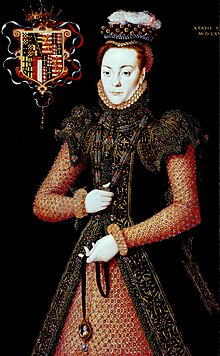
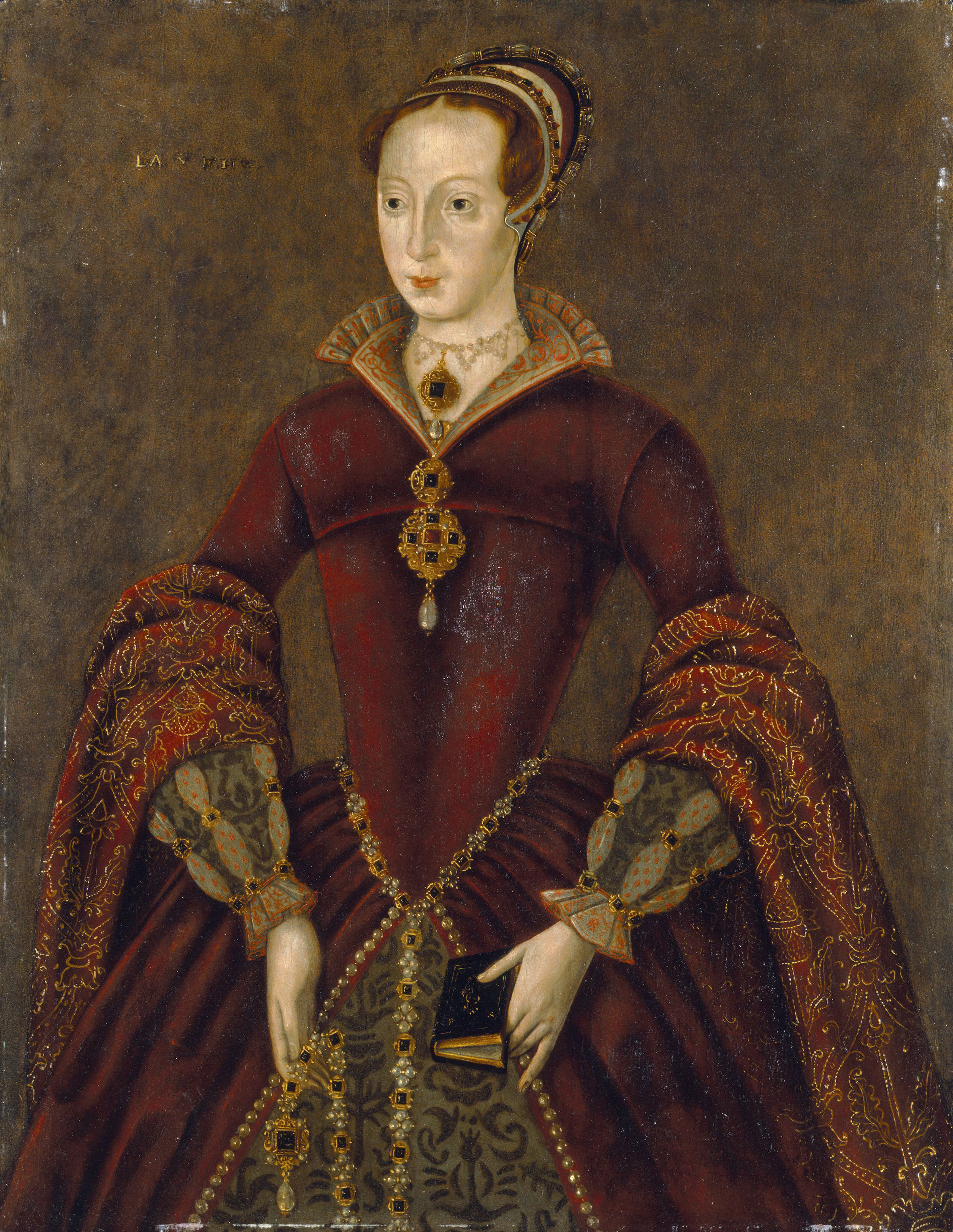
Showing posts with label mary tudor. Show all posts

Friday, 24 September 2021

Katherine Howard or Anne of Cleves?


Above: Portrait of a Lady, perhaps Katherine Howard; Royal Collection Trust

A portrait miniature in the Royal Collection Trust, dating to circa 1540, has for some time been identified as a likeness of Katherine Howard, fifth queen consort of Henry VIII, who was beheaded in 1542. There are two versions of the miniature; the second version is held in the Buccleuch Collection, and was originally owned by Thomas Howard, earl of Arundel. The sitter has customarily been identified as Queen Katherine based on her jewellery; the necklace, in particular, appears to be the same as that worn by Jane Seymour, the king's third wife, in the portrait created of her in 1536-7 (see below). 


Above: Portrait miniature of Katherine Howard (?), Buccleuch Collection

The item of jewellery in question also appears to have been passed to Katherine Parr, sixth wife of Henry VIII, when she married the king in the summer of 1543. Given the jewel's appearance in portraits of the king's third and sixth wives, thus identifying it as property of the queen consort, it would make sense that the sitter in Holbein's miniature (and in the version housed in the Buccleuch Collection) was also a Tudor queen consort of England. In 1540, Katherine Howard became queen of England when she married Henry VIII at Oatlands Palace on 28 July 1540, in doing so displacing the king's fourth wife, Anne of Cleves - and yet Anne was also, briefly, queen consort in the year 1540, from January to July.

Above: Jane Seymour and Katherine Parr, third and sixth wives of Henry VIII

The Holbein miniature in the Royal Collection Trust was described in 1660-61, during the Restoration, as 'A small peice Inclineing of a woman after ye Dresse of Henry ye Eights wife by Peter Oliver'. The sitter in the miniature, however, was not formally identified at that point. By 1735-40, however, the version in the Buccleuch Collection (above) had been named as a likeness of Katherine Howard, an identification subsequently associated with the miniature in the Royal Collection Trust. Interestingly, when the Buccleuch version was identified during the eighteenth-century, it was also mooted as a portrait of Henry VIII's younger sister, Mary Tudor, queen consort of France (1496-1533). The costume, however, which dates to the 1540s, clearly rules out Henry's sister - who was also the grandmother of Lady Jane Grey - as the sitter in the portrait.

Unfortunately, the sitter's age was not inscribed on the portrait, which might have been helpful in assisting modern identifications of the sitter's identity. While Katherine has been the most popular candidate for the miniature, other sitters have also been proposed: chiefly, Lady Margaret Douglas, niece of Henry VIII and grandmother of James I of England, and Mary, Lady Monteagle, who served in the household of Jane Seymour.

Although Lacey Baldwin Smith, who published a biography of Katherine in 1961, did not discuss the miniature in his account of the queen's life, and thus offered no opinion as to whether or not it depicted her, Katherine's modern biographers have, by and large, accepted the miniature as a likeness of her, including myself, Josephine Wilkinson, Joanna Denny and Gareth Russell. Denny was, perhaps, the most strident; responding to Susan James' theory that the miniature depicts Margaret Douglas, Denny asserted that 'this does not explain why she [Margaret] is wearing the royal jewels.' Katherine's love of jewellery and fine clothing was recorded by contemporaries: the unknown Spanish author of The Chronicle of Henry VIII, for example, noted that 'the King had no wife who made him spend so much money in dresses and jewels as she did, who every day had some fresh caprice.' Alongside receiving jewels as presents from her besotted husband, Katherine made gifts of them to her female attendants and to her royal relatives, including her stepdaughters Mary and Elizabeth. 

In his study of the six wives of Henry VIII, published in 2003, Dr David Starkey opined that the miniature is indeed a likeness of Katherine Howard, based on the inventory of her jewellery given to her when she married the king in July 1540. Starkey concluded that 'it can even be dated as a wedding portrait.' Specifically, the jewels given to Katherine that appear in the Holbein miniature include an 'upper biliment' or trimming for a French hood, 'of goldsmith work enamelled and garnished with 7 fair diamonds, 7 fair rubies and 7 fair pearls'; a 'square' necklace 'containing 29 rubies and 29 clusters of pearls being 4 pearls in every cluster' and an 'ouch', or pendant, 'of gold having a very fair table diamond and a very fair ruby with a long pearl hanging at the same'. The pendant also appears in portraits of Jane Seymour and Katherine Parr, as previously noted. Sir Roy Strong, at that time director of the National Portrait Gallery, also drew attention to the fact that the sitter wears the same jewel that appears in Holbein's portrait of Jane Seymour, thus suggesting that the miniature it is a likeness of Katherine Howard. Starkey may be incorrect, however, in suggesting that the portrait was undertaken in the summer of 1540; while she may have been misled in believing the miniature to be a likeness of Margaret Douglas, Susan James offered the convincing theory that the portrait was painted in the autumn or winter based on the style of the sitter's costume. Denny may, therefore, be more accurate in concluding that the portrait was 'very likely painted during her [Katherine's] first winter as queen'.

The costume itself, in which the sitter wears a French hood, may also lend itself to an identification with Katherine Howard. The French ambassador Charles Marillac, who observed the new queen while he was in attendance at court, wrote in September 1540, two months after her wedding, that 'she and all the Court ladies dress in French style'.

But was Katherine's portrait ever painted during her brief reign as queen? While I offer an extended discussion of her portraiture in my book Katherine Howard: Henry VIII's Slandered Queen, it is interesting to note curator and art historian Brett Dolman's suggestion that 'Catherine [Howard] left no documentary proof that her portrait was ever painted during her lifetime, and, perhaps, we are searching for the impossible.' In my book, I discuss other portraits associated with Katherine, including perhaps the most famous, now housed in the Toledo Museum of Art; it was formerly identified as a likeness of Henry VIII's fifth queen but is now generally agreed to be a portrait of Jane Seymour's younger sister Elizabeth, daughter-in-law of the king's chief minister Thomas Cromwell.

Dolman's recognition that Katherine may never have been painted during her brief queenship is significant in light of the recent suggestion made by art historian Franny Moyle, that the Holbein miniature is not a likeness of Katherine Howard, but a portrait of Anne of Cleves, Katherine's predecessor, who, as noted earlier, was also briefly queen consort of England in 1540, the year in which the portrait seems to have been painted. Moyle's theory is based on several pieces of evidence. Firstly, she notes that Holbein mounted the miniature on the four of diamonds, a playing card that Moyle believes to be significant, since Anne of Cleves was Henry VIII's fourth wife. Art historian Roland Hui, however, has challenged this point, however, in noting that a five of diamonds card appears on the back of Holbein's portrait of Jane Small (now housed in The Victoria and Albert Museum). Hui also clarified that 'part of a king' served as the backing to a miniature of Henry Brandon, the short-lived son of Henry VIII's favourite Charles, duke of Suffolk. In and of itself, therefore, the four of diamonds on the back of Holbein's miniature would not seem sufficient grounds on which to identify the sitter as Anne of Cleves.

Above top: Portrait of a Lady, perhaps Katherine Howard; Royal Collection Trust
Above below: Anne of Cleves, 1539
Historian Franny Moyle believes that both miniatures show the same sitter.

Moyle also argues that the sitter in the Holbein miniature shows an 'uncanny likeness' to Holbein's portrait of Anne (above), painted in 1539, shortly before her marriage to Henry VIII. Moyle draws attention to both sitters sharing a 'soporific expression', as well as distinctive heavy eyelids and thick eyebrows. Moreover, Moyle notes that the contemporary chronicler Edward Hall, who was an eyewitness to events at Henry VIII's court, described Anne the Sunday after her wedding as 'appareiled after the Englishe fassyon, with a Frenche whode [hood], whiche so set forth her beautie and good visage, that euery creature reioysed [rejoiced] to behold her.' Based on Hall's remark, Moyle suggests that, aware of Henry's initial lack of enthusiasm, Anne consciously set aside the - to English court observers, unfashionable - clothing that she had brought with her from Cleves and instead adopted the more stylish French dress favoured at court, in an attempt to please her husband. Taking this further, Moyle argues that the Holbein miniature was painted in the winter of 1540, perhaps in February, in order for the king to 'see a version of Anne that was more appealing.' 

As noted earlier in this post, Dolman concluded that there is no documentary evidence that Katherine Howard's portrait was painted during her short tenure as queen. Equally, there is no evidence that Anne of Cleves sat for Holbein in the early months of 1540 wearing a French hood in an attempt to secure favour from her unenthusiastic husband, who had thus far failed to consummate their union; indeed, the marriage was annulled just months later, in July, having never been consummated. While Moyle is correct that Anne is a credible candidate for the sitter in the Holbein miniature on the grounds that there were two queen consorts in 1540, of which she was one, other elements of Moyle's argument are problematic. 

Firstly, Moyle suggests that the Holbein miniature is unlikely to depict Katherine because it 'doesn't look like a child bride'. Katherine's date of birth is unknown. My research, which will be published in a forthcoming issue of The Royal Studies Journal, and expands on the arguments put forth in my book Katherine Howard: Henry VIII's Slandered Queen, indicates that she was born probably in 1523 or 1524, making her sixteen or seventeen when she married Henry VIII in 1540, while recent research suggests that Anne of Cleves was born on 28 June 1515, making her a few months short of her twenty-fifth birthday in January 1540 when her wedding took place at Greenwich Palace. Few historians today would characterise Katherine as 'a child bride', especially given how divergent early modern attitudes to childhood (and the life cycle, in general) were from modern perceptions of youth and adolescence. Interestingly, however, the unknown Spanish chronicler did characterise Katherine as 'a mere child', and the religious activist Richard Hilles identified her as a 'young girl' while describing the king's disaffection with Anne and his growing passion for Katherine. Either way, as noted earlier in this post, Holbein did not identify the sitter's age in the miniature, so it is impossible to ascertain how old the woman in the miniature was when she sat for the portrait. This arguably makes it pointless to speculate as to whether the sitter was 'a child bride' or not, as we have no way of knowing.

Secondly, Moyle indicates that the miniature, which apparently does not depict a beautiful woman, is more likely to portray Anne of Cleves, who was described by contemporaries as being 'of medium beauty', rather than Katherine Howard, whose beauty was said to be 'ravishing'. Conceptions of beauty in the sixteenth-century were, of course, very different to those prevalent in the twenty-first century Western world. Perhaps more to the point, surviving descriptions of both queens' physical charms are more complex than Moyle's belief would suggest. In the quotation of above, the chronicler Hall specifically drew attention to Anne's 'beautie and good visage'. The Cleves envoys, when arguing against a sea voyage to England in 1539 in the midst of preparations for Anne's wedding to the king, warned that a sea voyage would harm Anne's 'young and beautiful' appearance. While visiting Cleves, the English ambassadors reported widespread praise of Anne's beauty 'as well for the face, as for the whole body, above all other ladies excellent.' It was said that her beauty excelled that of Christina, duchess of Milan - another candidate for Henry VIII's hand in marriage - 'as the golden sun excelled the silver moon.' In December 1539, the lord admiral reported from Calais that he had heard reports of Anne's 'excellent beauty', which he perceived 'to be no less than was reported in very deed'. Clearly, then, it is somewhat misleading to suggest that Anne's beauty was widely reported as only 'medium'.

Likewise, reports of Katherine Howard's physical appearance were rather more complex than has been suggested. There is a widespread assumption among historians that she was the most attractive of Henry VIII's six consorts; her biographer Baldwin Smith noting in 1961, for example, that 'legend has it that she [Katherine] was Henry's most beautiful queen.' The unknown Spanish chronicler recorded that Katherine 'was more graceful and beautiful than any lady in the Court, or perhaps in the kingdom.' In his Metrical Visions, George Cavendish, who served in the household of Cardinal Wolsey, asserted that Katherine was 'floryshyng in youthe with beawtie freshe and pure'. By contrast, the French ambassador Marillac, who had described Anne of Cleves as being 'of medium beauty' and being neither as beautiful nor as young as everyone had been led to believe, depicted Katherine as a woman of mediocre beauty when he met her in the autumn of 1540. As Retha Warnicke has argued, 'a reasonable inference is that he [Marillac] considered Anne at least as pleasing in appearance as Katherine.' Arguably, it is problematic to identify the sitter in the Holbein miniature on the basis of differing, and somewhat contradictory, reports of the respective physical appearances of Anne of Cleves and Katherine Howard.


Above: Mary, Lady Monteagle (1510-before 1544) c. 1538-40, Royal Collection Trust

Finally, Moyle's belief that the sitter in the Holbein miniature is the same as that in Holbein's portrait of Anne created in 1539 due to shared physical features is also questionable. While both sitters do possess heavy eyelids and thick eyebrows, Anne does not appear to have had a double chin, while the sitter in the Holbein miniature does. It is also uncertain, mostly because Anne is facing the viewer, whether she shared the unknown sitter's nose. Perhaps most importantly of all, Anne's hair was described by the chronicler Hall on her wedding day as follows: 'hangyng downe, whych was fayre, yelowe and long'. The unknown sitter in the Holbein miniature does not have blonde hair, as Anne was said to have; instead, the colour can be described as auburn or light brown. 

The portrait above is a likeness of Mary, Lady Monteagle (1510-before 1544), and is held by the Royal Collection Trust. The daughter of Charles Brandon, duke of Suffolk by his second wife, Anne Browne, Mary served in the household of Queen Jane Seymour, who presented her with gifts of jewellery as a sign of favour. Before 1527, Mary married Thomas Stanley, 2nd Baron Monteagle. On the basis of jewels given to her by Jane Seymour, it is sometimes asserted that the sitter in the Holbein miniature is Mary, Lady Monteagle, especially given notable similarities between her facial features and those in the Holbein miniature. Arguably, there are greater similarities between the sitters in these two portraits than there are between the Holbein miniature and Holbein's portrait of Anne of Cleves. If one were to position Mary's portrait next to the Holbein miniature, a case could be made that they display one and the same sitter.


The above portrait is now thought to depict Elizabeth Cromwell, sister of Jane Seymour and daughter-in-law of Thomas Cromwell (who was executed in 1540), but it was identified as a likeness of Katherine Howard in 1898 and received support from historians including David Starkey; in recent decades, however, its identification with Katherine has been convincingly and overwhelmingly challenged by historians. Nevertheless, on the basis of the sitter's jewellery and physical appearance, some writers continue to believe it depicts Katherine; for example, Alison Weir suggests that the portrait is 'probably of Katherine Howard, by Hans Holbein, at Toledo, Ohio'. While the sitter in the Toledo portrait does not necessarily display the heavy eyelids or thick eyebrows in the Holbein miniature, some have perceived similar physical features between the sitter in the Toledo portrait and the sitter in the Holbein miniature. Yet these alleged facial similarities are ungrounded if the portrait depicts Elizabeth Cromwell.

To conclude, the Holbein miniature of c. 1540, displayed at the top of this post, almost certainly depicts a queen consort of England in that year, of whom there are only two candidates: Anne of Cleves and Katherine Howard. Some historians have posited reasons for identifying an alternative candidate as the sitter - for example, Lady Margaret Douglas or Mary, Lady Monteagle - but these theories are far less convincing. Moyle's belief that the miniature is a likeness of Anne of Cleves undertaken in the early months of 1540 is interesting, but further research is necessary before it can be conclusively identified as a portrait of Anne during her six-month tenure as queen consort. The arguments given in this post, however, indicate that Moyle's theory is somewhat problematic. While, as Dolman recognises, there is no documentary evidence that Katherine Howard's portrait was painted during her queenship, there is also no evidence that Anne sat for a portrait wearing a French hood in the period after her wedding. The physical charms of both women were described by contemporaries in more complex ways than is sometimes recognised, and both women were described as wearing French attire, which in and of itself is insufficient to use as evidence for the sitter's identity. Perceptions of beauty, both in the sixteenth-century and now, are subjective, and perceived similarities in facial features between the Holbein miniature and Holbein's portrait of Anne undertaken in 1539 are also subjective, especially since the unknown sitter in miniature has also been thought to bear similarities in appearance to other sitters, notably Mary, Lady Monteagle and (probably) Elizabeth Cromwell. Perhaps the greatest drawback to the argument favouring Anne as the sitter, however, is the chronicler Hall's statement that Henry VIII's fourth queen had blonde hair: the sitter in the Holbein miniature clearly does not. The weight of evidence, then, would seem to lean more in favour, even if slightly, of Katherine Howard. 

Monday, 29 January 2018

On The Tudor Trail - Anne Boleyn's Life, 1521-1527

I have recently written an article for the website On The Tudor Trail about Anne Boleyn's life in the years 1521-7, a period that remains frustratingly shadowy. In this article, I discuss Anne's return to England from the French court in late 1521; her anticipated marriage to James Butler, heir to the earldom of Ormond; her probable appointment to Katherine of Aragon's household in 1523 and her liaison that year with Henry Percy, heir to the earldom of Northumberland; her dismissal and probable return in late 1526. My approach is closely informed by the extant evidence concerning Anne's age and the Boleyn family goals and ambitions, in which it was anticipated that Anne would be ennobled as the countess of Ormond. As is well known, of course, the marriage did not come to fruition and Anne instead captured the heart of Henry VIII by 1527, four years after her affair with Percy, who inherited the earldom of Northumberland in 1527. You can read the article here.

Friday, 8 January 2016

Elizabeth's Heir: Margaret Stanley, Countess of Derby


Image result for eleanor brandon
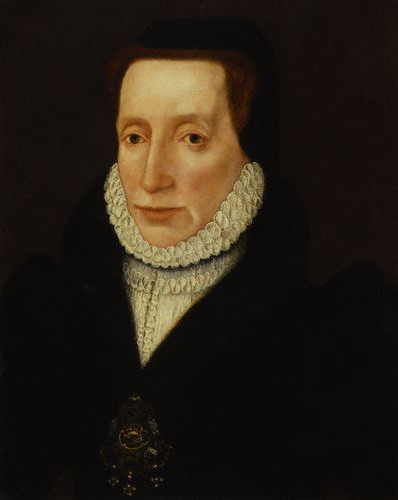
Above: A portrait thought to be of Lady Margaret Stanley, countess of Derby or her mother Lady Eleanor Brandon.


In recent years there has been an explosion of interest in the Elizabethan succession and, in particular, the extraordinary lives of Lady Jane, Catherine and Mary Grey. These women were, according to the will of Henry VIII, to inherit the throne of England in the event that Elizabeth I died with no heirs. Lady Jane was executed in 1554 for her role in seizing the throne unlawfully from the rightful queen, Mary I. As is well known, the fearful Elizabeth reacted furiously to news of the clandestine marriages of Catherine and Mary, and punished them both accordingly. Both Grey sisters were imprisoned, and Catherine's two sons by Edward Seymour, earl of Hertford, were declared illegitimate. Both sisters died fairly young, even by the standards of the time (Catherine was twenty-seven and Mary thirty-three). Their lives were undoubtedly highly tragic, but the public at large regarded the Greys as the rightful successors to Elizabeth, particularly in the wake of intensified concerns regarding Mary Queen of Scots.

After the deaths of Jane, Catherine and Mary, and the bastardisation of Catherine's sons, Elizabeth I's heir was, according to Henry VIII's will, Margaret Stanley, countess of Derby. The countess has received far less attention, both from academic historians and popular writers, regarding her role as a claimant to the English throne. However, Margaret's life was every bit as tragic, as tumultuous and as unpredictable as that of her Grey cousins. 

Above: Margaret's cousins: Jane, Catherine and Mary Grey (left to right).

Margaret was the daughter of Lady Eleanor Brandon, who was in turn the youngest daughter of Mary Tudor and Charles Brandon, duke of Suffolk. Eleanor was Henry VIII's niece and granddaughter of Henry VII. Her daughter Margaret, therefore, was Henry VIII's great-niece. She was born in 1540, the same year her cousin Catherine Grey was born. Her mother had married Henry Clifford, earl of Cumberland. He came from a respected northern family and the union between Brandon and Clifford meant that Margaret Stanley grew up amidst considerable luxury and wealth. Until her mother gave birth to a son, she was heiress to the Cumberland title. Eleanor did give birth to two sons, Henry and Charles, but both died in childhood.

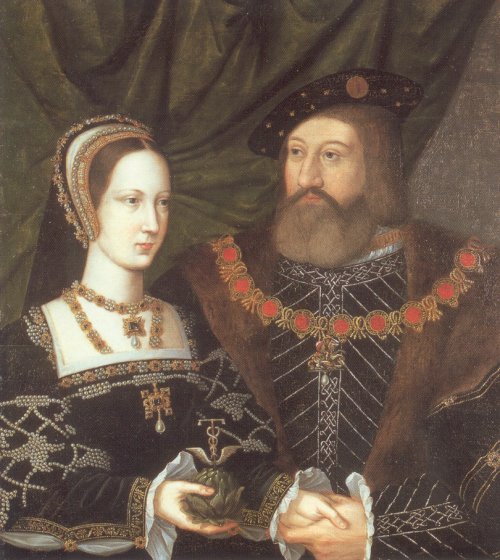
Above: Margaret Stanley's grandparents, Mary Tudor and Charles Brandon, duke of Suffolk. 

From an early age, Margaret was educated to view herself as a most important lady. She would have been proud of her position as Henry VIII's great-niece. Her cousins Jane, Catherine and Mary Grey were erudite, educated and opinionated young women, and like them Margaret was aware of her important position within the Tudor dynasty. There is no surviving evidence that her parents provided her with as remarkable an education as that enjoyed by her cousins, but undoubtedly she would have been brought up with skills regarded as fundamental in Tudor gentlewomen: needlework; embroidery; dancing; music; hunting; good manners; reading; and writing. 

When Margaret was seven years old, her mother died. That was a tumultuous year, given that Henry VIII also died at the age of fifty-five. Margaret first came to play an important role in political events in 1552, when the Duke of Northumberland proposed that the twelve-year-old marry his youngest son Guildford. The marriage came to nothing, and Guildford instead married Margaret's sixteen-year-old cousin Jane Grey. There were later rumours voiced at court that Margaret was to marry instead Northumberland's brother Andrew, but again the match came to nothing, perhaps because Margaret's father had voiced opposition. 

The year 1553 was a turning point for Margaret and her family. The young Edward VI had died while still a teenager. The determined king had refused to countenance the possibility of either of his sisters succeeding him, because he believed that both were illegitimate. Instead, he willed the crown to go to the heirs of Lady Jane Grey. Because Lady Jane had not yet given birth to children, she herself became queen upon his death. Margaret's cousin was now first lady in the land. However, she was dethroned and executed seven months later by Mary I. 

How Margaret felt about her cousin's brutal execution is unknown, but it is possible that she did not give much thought to it. Five days earlier, the fourteen-year-old had married Henry Stanley, earl of Derby. It was a highly significant marriage. Stanley, who was nine years Margaret's senior, was a kinsman of Queen Anne Boleyn and Queen Katherine Howard (his maternal grandfather was Thomas Howard, duke of Norfolk). The marriage took place at Whitehall and was attended by Queen Mary. The couple seem to have experienced a volatile marriage, for the countess later confirmed that there were 'breaches and reconciliations' between herself and Stanley. They had four children together: Edward, Ferdinando, William, and Francis.

Above: Henry Stanley, earl of Derby, husband of Margaret Clifford.

How Margaret regarded her dynastic position during the reigns of Mary I and Elizabeth I cannot be known with certainty, but she was surely aware that she had a strong claim to the throne if her cousins Mary and Elizabeth died without heirs. During these years, the countess occupied an important place at court, although she spent much of her time on her estates in childbirth. In the early 1560s, however, Margaret's life was changed forever. 

Her cousin Catherine Grey clandestinely married Edward Seymour, earl of Hertford, in late 1560. Hertford was of royal blood (he was the nephew of Queen Jane Seymour and son of the Lord Protector). Catherine subsequently fell pregnant, and was forced to inform Elizabeth I of what had happened. The queen was understandably furious: not only were her councillors pressuring her to name a successor in the event that she did not marry and provide an heir herself, but she seems to have personally disliked and feared Catherine. Elizabeth was well aware that Catherine was regarded by English Protestants (and some Catholics) as her heir, and in falling pregnant Catherine had strengthened her claim. The irate queen ordered her cousin's imprisonment in the Tower of London, and her husband was recalled from Europe and incarcerated there as well. The stricken Catherine, who was only twenty-one, gave birth to their first son Edward at the Tower in the autumn of 1561.

Elizabeth never forgave Catherine. She almost certainly remembered the treachery of the Greys in the reign of Mary I, and she remembered that she had been a figurehead for rebellion during her sister's reign. Elizabeth viewed her Grey cousins with suspicion and fear, and was determined to prevent their succession in the wake of her death. Catherine remained under house arrest at a succession of different houses until her untimely death in January 1568 at the age of twenty-seven, leaving two young sons and a bereaved husband. Only a few years previously, Catherine's younger sister Mary had also been incarcerated for her clandestine marriage to Thomas Keyes, a Sergeant Porter. With her disgrace and death in 1578, Margaret Stanley's dynastic importance increased tenfold. 

According to Henry VIII's will, Margaret Stanley was her cousin Elizabeth's heir. Despite the urgent entreaties of her Privy Councillors and her own passionate love for Robert Dudley, earl of Leicester, Elizabeth refused to marry. Historians have endlessly debated about the reasons behind her decision. Undoubtedly these reasons were political, psychological and personal. Regardless, Elizabeth's decision not to marry caused considerable uncertainty in England about who would succeed upon her death. Margaret's great-uncle, King Henry, had nominated her as her cousin's heir, and it is entirely likely that, by the late 1570s, the countess had began to view herself as a possible future Queen of England.

Above: Mary Queen of Scots, Lady Margaret Stanley's kinswoman and potential rival claimant. Some historians have suggested that Queen Elizabeth always preferred the claim of the Scottish queen to the claim of the descendants of Mary duchess of Suffolk.

However, any potential ambitions for the crown that Lady Margaret had were to remain unfulfilled. The countess landed herself in deep trouble and caused her own ruin through her rash actions. In 1579, just a year after the death of her cousin and potential rival Lady Mary Grey, Margaret was accused of sorcery and arrested. She had allegedly used sorcery to predict how long Elizabeth would live, and there were even rumours that she had plotted to poison her cousin. Furthermore, she had allegedly spoken out about the queen's proposed marriage to the Duke of Alencon because it threatened her own position as Elizabeth's heir. Like her cousins Catherine and Mary Grey, the countess was punished with house arrest. Her fellow accused William Randall, whom the countess claimed was her physician, was executed. No charges were brought against Margaret, but she was banished from court. She wrote highly emotional letters to Elizabeth, claiming that she was in a 'black dungeon of sorrow and despair'. If she hoped for forgiveness and a return to royal favour, she was to be sorely disappointed.

In 1596, Lady Margaret died at the age of about fifty-six. Her sons Edward and Francis had died in childhood, and her second son Ferdinando, who had inherited the earldom of Derby, had died two years earlier. Ferdinando's son, Lady Anne Stanley, was Margaret's heiress presumptive upon the countess's death. The will of Henry VIII stipulated that Anne Stanley was Elizabeth's heir following the death of her grandmother Margaret, but the queen preferred the claim of Mary Queen of Scots' son James VI, and upon her death in 1603 James duly became King James I of England.

Much of the life of Margaret Stanley, countess of Derby, remains shadowy and elusive. It is not difficult to understand why historians have focused their attention on her Grey cousins, because greater evidence survives for their lives, and their status as claimants to the throne was more viable than Margaret's claim. It is usually forgotten that, upon the death of Mary Grey in 1578, Margaret Stanley was heir to the throne according to the will of Henry VIII. Her disgrace in 1579 seems to indicate that she was a highly ambitious woman who was determined to enforce her claim as Elizabeth's heir. Realising that her cousin would never marry and give birth to heirs, Margaret seems to have hoped and dreamed that she would one day become Queen herself. It was not to be. The disgraced countess never recovered her place at court, for she had invited the suspicion and hostility of Queen Elizabeth, who was never particularly warm towards the descendants of Mary, duchess of Suffolk at the best of times. The queen's antipathy to her Brandon kin was demonstrated in her decision to appoint Mary Queen of Scots' son James her successor upon her death, rather than Margaret Stanley's granddaughter Anne Stanley, despite the fact that Anne was, according to Henry VIII's will, the rightful heir. 

Friday, 23 October 2015

The Stereotyped Six Wives: Two: A Dangerous Obsession


Anne Boleyn, second wife of Henry VIII of England
Lifetime: c. 1507 - 19 May 1536
Reigned: May 1533 - May 1536 (3 years)
Pregnancies: 3 
Elizabeth I of England: 7 September 1533 - 24 March 1603
Stillborn child: June/July 1534
Miscarried son: January 1536

In this new six-part series, I will be reexamining the lives and personalities of Henry VIII's six wives, seeking to portray their lives realistically in a process that discards prevailing stereotypes. Much scholarly work has been done on Henry's reign in recent decades, affording fresh insights into the politics and achievements of the period. Understandably, widespread interest in Henry's marital affairs remains unabated. Yet stereotypes continue to bedevil our knowledge of the wives of this most enigmatic king. 

The historiography of Anne Boleyn, Henry VIII's second consort, is paradoxical. More has been written about Anne than any of Henry's other wives, yet she remains the most maligned of his queens. An explanation for this can perhaps be found in the polarising nature of the surviving sources. Protestant literature that approved of the break with Rome and celebrated the accession of Elizabeth I presented Anne as 'that most holy Queen', a charitable and pious reformer who had married the king solely to further the reformed faith. By contrast, Catholic polemical works depicted Anne as a monstrous vixen who had vindictively encouraged Henry to destroy both his first marriage and the Church in England. In these accounts, the bewitching Anne was indeed guilty of the crimes of which she was charged and was punished with a shameful death for her sins.

It is unfortunate that the sources concerning Anne's life are so polarised, for they strip away the queen's humanity, presenting her as a figure not wholly human. In the Protestant works she is saintly, whereas in Counter-Reformation histories she is less than human, a worshipper of the devil. Only with difficulty can historians navigate their way through the conflicting stories of Anne's life and reach a realistic understanding of Anne as a person and as a queen. The true story is a sinister one of fatal obsession rather than love.

Hever Castle
Above: Hever Castle in Kent, where Anne Boleyn may have been born.

Anne was the younger daughter of the diplomat and courtier Sir Thomas Boleyn and his wife Lady Elizabeth Howard. While it is a myth that she was the most nobly born of Henry's English wives, her pedigree was impressive. On her mother's side, she was the niece of the Earl of Surrey and granddaughter of the Duke of Norfolk, while on her father's side she was related to the earls of Ormond. Anne's date of birth and birthplace are unknown. Traditionally it has been suggested that she was born either at Blickling Hall in Norfolk or at Hever Castle in Kent, but several of Anne's relatives were of the opinion that her birthplace was London, perhaps Norfolk House at Lambeth. The majority of modern historians favour a birthdate of circa 1501; however, the Elizabethan antiquarian William Camden confirmed that Anne was born in 1507, while the Duchess of Feria informed her biographer Henry Clifford that Anne had not yet reached twenty-nine years of age when she was beheaded in 1536. 

Cardinal Wolsey himself allegedly referred to Anne in 1523 as a 'foolish girl', while Cardinal Reginald Pole described Anne as a 'girl' when Henry VIII fell in love with her. In 1534, a year after her marriage, Anne was described by the Imperial ambassador Eustace Chapuys as being 'in a state of health and of an age to have many more children'. While she could have had more children, the adjective 'many' is questionable if she were actually 33 or 34 years old. Finally, when Anne was sent abroad to the court of Margaret of Austria, she was described by the regent as being 'so pleasing in her youthful age'. In the sixteenth-century, children of the nobility and gentry were routinely sent to noble households at an early age to acquire an education. Sir Thomas, an ambitious and well-educated diplomat, surely had similar hopes for his daughter. Recognising that she was 'bright and toward', it is entirely credible that he arranged for her departure to Europe at the age of only six years old. Perhaps it was only in 1519 or 1520 that Anne formally served as a maid of honour. 

From an early age, Anne would have been brought up to value her lineage. The Boleyns were not nobility, but they were an ambitious and enterprising family that had consistently married well. Sir Thomas's marriage to Elizabeth Howard had been a considerable achievement for him in that it allied the Boleyns with the Howards, the premier ducal family in England. The Howards, moreover, were closely linked to the Tudor dynasty, for Queen Elizabeth of York's younger sister Anne had married Thomas Howard, earl of Surrey and later duke of Norfolk. It is entirely credible that Anne Boleyn was named after her aunt. 

Bernard van Orley - Portrait of Margareta van Oostenrijk - WGA16689.jpg
Above: Margaret of Austria, duchess of Savoy (left) and Queen Claude of France (right). As a young girl, Anne Boleyn was closely acquainted with both ladies.

It is usually asserted that Anne's older sister Mary also accompanied her to France, but the list naming the maids of honour serving Mary Tudor when she married Louis XII of France in 1514 referred only to one 'M. Boleyn' rather than two. The initial 'M' referred to the title mistress rather than one's Christian name. A later inventory of ladies remaining in France referred to 'Mademoiselle Boleyn' which, again, almost certainly referred to Anne. Why Sir Thomas elected to send Anne rather than Mary to serve in the courts of Europe can perhaps be explained by the brightness and shrewd intellect that Anne already possessed. The ambitious Thomas was perhaps also hoping to wed Mary to a high-ranking English nobleman. Sending Anne abroad, rather than Mary, cannot necessarily be read as evidence of Thomas' preference for Anne or as evidence that Mary was intellectually inferior to her sister.

Anne's childhood in Europe profoundly influenced her worldviews and her inner character. Like Katherine of Aragon, she was acquainted with strong ruling women that were more than capable of governing kingdoms. Margaret of Austria was the shrewd regent of the Netherlands during Anne's stay there, and when Anne departed to France to serve Queen Mary she was acquainted with Marguerite de Navarre, sister of Francois I. The duke of Norfolk, Anne's uncle, was later to inform Marguerite that his niece was 'as affectionate to your highness as if she were your own sister, and likewise to the queen... My opinion is that she is your good and assured friend'. Two years later, in 1535, Anne herself informed Marguerite that 'her greatest wish, next to having a son, was to see you again'. While it is difficult to uncover the true nature of relations between Anne and Marguerite, it seems likely that the young Anne admired Marguerite. She was both an author and a patron of humanists and reformers. Her most famous work was Heptameron, which has been interpreted as a social and political critique, combining religiosity (pious dedication and high moral standards) with 'lurid voluptuousness'.  

If Anne was influenced by Marguerite, then she would have grew to value her own ideas, to think critically of the world around her, and to place a great emphasis on inner piety and spiritual enlightenment. Anne also served Claude, wife of Francois I. Claude was renowned for her piety, virtue and goodness, and she did not encourage the licentious intrigues that pervaded the French court. As a favoured companion of the French queen, Anne would have understood that female virtue was her greatest prize. She likely came to understand her own worth and arrived at a deep understanding of herself as a woman. Influenced from a young age by strong women on the continent, including the capable Margaret of Austria, the sophisticated and educated Marguerite de Navarre, and the virtuous Queen Claude, Anne Boleyn grew up to be a remarkable woman.

She was not the most beautiful of women, but she had something more. She valued her own ideas, she read widely in secular and religious literature, and she developed an intense fascination with the reformed faith. Eric Ives has speculated that Anne underwent something of a religious enlightenment while in France, and it is certainly possible given her receptivity to the beginnings of the reformed faith that were developing across Europe. Anne also became a highly skilled musician, an excellent dancer and an intellectual with a keen interest in the Renaissance movement. Although she had not been groomed for queenship like Katherine of Aragon, she was in many respects a highly suitable candidate for royalty given her piety, her intellect, her sensitivity to the artistic movement and her interest in the Reformation. Moreover, she came from a fertile family and, while not blessed with outstandingly good looks, was physically attractive. The Venetian ambassador recorded that she was of medium stature, with a swarthy complexion, a wide mouth, and 'black and beautiful' eyes. Her brown hair was lustrous and long and her hands finely formed.


Anne returned to England late in 1521. Her father had arranged a most advantageous marriage for her to James Butler, later ninth earl of Ormond, in a bid to settle the Boleyn-Butler dispute over the title of Ormond. An ambitious young lady who had been educated to advance her lineage, Anne would surely have been aware of the advantages presented to the Boleyn family by the alliance with the Butlers. For reasons that remain unsolved, however, the marriage did not take place. Around this time Anne was appointed to serve Katherine of Aragon, first wife of Henry VIII, and alongside her sister Mary and former mistress Mary Tudor, she appeared in a court masque in March 1522 in the role of Perseverance. If George Cavendish, gentleman usher of Cardinal Wolsey, is to be believed, Anne soon afterwards became acquainted with Henry Percy, heir to the earldom of Northumberland and the two fell in love with one another. He wrote that 'there grewe such a secret love between them that at lengthe they were ensured together intending to marry'. Percy was captivated by Anne's 'excellent behaviour and gesture'. He regarded Anne as 'a convenient wife', informing the enraged Cardinal thus when Wolsey discovered the secret relationship between them. Percy described Anne as being 'descended of right noble parentage' which, in truth, she was. Heartbroken, Percy was forced to separate Anne, and she seems to have been sent from court in disgrace.

As an assertive, intellectual young woman who valued her own ideas and was interested in both the Renaissance and the Reformation, Anne Boleyn attracted admirers. At some point she attracted the king himself. It is a lingering myth that Anne deliberately set out to become queen, calculatingly ensnaring the unsuspecting king and seducing him in a bid to become queen of England. If anything, the evidence indicates the exact opposite, as recent research has demonstrated. Anne may have been in love with Henry Percy and, when the king of England fell in love with her, she might not yet have recovered from the heartbreak she had endured over Percy. A charismatic, attractive woman, she provoked dangerous obsession in men who became interested in her, one of whom was the king, and another of whom was the musician Mark Smeaton. Only in the realm of fiction have these obsessions been interpreted in a sinister light, but it is possible that fiction, in this case, mirrors reality. 

For Henry's obsession with Anne was completely one-sided. She was not interested in becoming his mistress; neither did she, at least initially, wish to become queen. This perhaps is at odds with the admirable marital successes achieved by Boleyn ambition, but Anne had served several royal women on the continent and had been close to at least two of them. Her relations with Marguerite and Claude perhaps instilled in her a deep-seated loyalty to the traditions of monarchy. George Wyatt, a grandson of the poet Sir Thomas Wyatt, confirmed in his biography of Anne that she bare great 'love to the queen [Katherine] whom she served, that was also a personage of great virtue'. Loyal to Queen Katherine, and well aware that her sister Mary had been discarded by the king once her period as his mistress was over, Anne had no wish to become queen of England, and by ignoring the king's relentless stream of letters she likely hoped that he would leave her alone.


Related image
Above: Henry VIII wrote repeatedly to Anne beseeching her to become his love, but her replies were vague and she often neglected to reply, probably due to an earnest desire to be left alone.

However, Anne's behaviour served only to make the king more obsessive, often dangerously so. Nowadays his behaviour might be interpreted as stalking, which is what a handful of modern historians have interpreted it as. When she remained aloof, Henry reproached her by opining that her lack of enthusiasm 'seems a very poor return for the great love which I bear you'. She retreated from court to Hever and returned only in the company of her mother. Henry continued to entreat her 'earnestly to let me know expressly your whole mind as to the love between us'. Anne's replies, in reality, had not exactly suggested that she felt 'love' for him, as Henry disingenuously wrote. She surely knew that involvement with the king would constitute a betrayal of her mistress, and as Wyatt's evidence suggests, Anne was loyal to Katherine and had no wish to hurt her. Yet, in refusing to become Henry's mistress and in retreating from court in an attempt to escape his lust, Anne's situation only worsened. For the more she retreated, hoping that the king would respect her wishes to be left alone, the more his obsession was inflamed until it became fatal. Not, at this stage, fatal for Anne, but fatal for his kingdom and fatal for his first marriage. By the summer of 1527, Katherine was informed that her marriage was invalid on account of her previous marriage to Henry's brother Arthur. The king was certain that their lack of sons was because their marriage had offended God as an unclean union. 

Whether Anne was prepared for what was to befall her cannot be known with certainty. When she danced with Henry at a reception for the French ambassadors in May 1527, the court became aware that it was Sir Thomas Boleyn's younger, sophisticated daughter who would replace the beloved Katherine as queen of England. Anne's life became much harder around this time. Queen Katherine was reportedly 'much beloved in this kingdom' and the king himself, despite his desire to annul his first marriage, was well-liked by the people and respected by his courtiers. Who to blame, then, for the royal marital crisis? Anne herself. With the passing of time, in the exaggerated dispatches of ambassadors, the whispers of courtiers and the murmurs of discontent across the kingdom, Anne was gradually endowed with enormous power that was regarded as unthinkable in a woman. Her power was heinous, dark, supernatural: it was whispered that she had cast a spell on the unsuspecting king, manipulating him with the promises of sexual fulfillment to put aside his long-suffering wife and marry her, a younger woman, instead. Endowed with this unnatural power, Anne was figured as a witch, an enchanting siren who resorted to poisoning her enemies (including Bishop John Fisher in early 1531) and threatening the life of the Queen (that same year apparently wishing that all Spaniards were at the bottom of the sea). In short, she became a scapegoat for the annulment and a scapegoat for the king's relentless lust. 

Those who scapegoated her were ignorant of her admiration for Katherine, her love for Henry Percy and her insistent refusal to become involved with Henry. They either ignored, or were not aware, that Henry's obsession for her was lethal and could not be escaped from. She had sought to escape court, she had failed to reply to his letters, she had only given in after draining months of messages and gifts. She was an intelligent, shrewd and sophisticated young woman, but she placed great value on her own virtue and piety and had no desire to replace Katherine as queen. Whether her family respected her wishes and resigned themselves to the king's longing, or whether they actively encouraged her to cultivate his interest, cannot be known with certainty. But what seems clear is that Anne herself never set out to become queen and became the victim of a relentless campaign of hatred and lies beginning in the late 1520s and continuing to her death and beyond.


It is highly unlikely that Anne Boleyn had any initial desire to become queen of England. She sought to distance herself from Henry VIII's relentless obsession, but eventually resigned herself to her fate. 

In truth, Anne's individual involvement in the stages leading to the annulment was minor. As Warnicke has asserted: 'It is possible Henry... had considerably more control over their relationship than is sometimes alleged'. In his letters, he was able to deny her suits and requests, while comforting her during her absence from court in 1528. However, even if she had no desire to become queen, Anne seems to have gradually understood that she was a position to further the reformed faith. The Spanish ambassador described her and her brother George as 'more Lutheran than Luther himself', but Anne continued to respect the revered rituals and traditions of Catholicism. She read the Bible in the vernacular and increasingly afforded support to reformed scholars. Thomas Cranmer, who later became archbishop of Canterbury, was a chaplain of her family. Cranmer was later to confirm that he 'never had better opinion in woman, than I had in her'. She was also highly charitable as queen. The martyrologist John Foxe, writing in the reign of Elizabeth I, recorded: 'Also, how bountiful she was to the poor, passing not only the common example of other queens, but also the revenues almost of her estate... Again, what a zealous defender she was of Christ's gospel all the world doth know, and her acts do and will declare to the world's end'.

Given her receptivity to learned ideas on the Continent and her years of experience serving pious, virtuous royal women, it does not seem likely that Anne was the loose-living, vulgar woman of popular legend and the vitriolic dispatches of Ambassador Chapuys. Describing her as 'the concubine' or 'the whore', Chapuys believed that her primary ambition was to cause harm to Katherine and Princess Mary, asserting: 'the King's mistress has been heard to say that she will never rest until he [Henry] has had her [Katherine] put out of the way'. He had earlier opined that 'Anne might be further encouraged to execute her wicked design'. And yet Chapuys consistently refused to meet Anne and had no way of knowing her inner thoughts or the details of her conversations with Henry. Indeed, other evidence indicates that she was initially loyal to Katherine and, as queen, she consistently wrote to her stepdaughter Mary promising her that she would enjoy a favoured position at court if she would recognise that her father's marriage to Katherine was invalid. Henry's first wife had angrily referred to Anne as 'the scandal of Christendom' because, like her subjects, she blamed her husband's mistress rather than the king himself for the decision to break with Rome and the annulment of her marriage. But it seems unlikely that Anne was so consumed with hatred towards Katherine and Mary as Chapuys makes out that she would relentlessly plot their deaths.


Anne was close to her brother George and seems to have enjoyed warm relations with her mother Elizabeth. Her relationship with her older sister is uncertain, but Julia Fox's biography of Jane Boleyn, Lady Rochford, intriguingly suggests that Anne was closer to her sister-in-law Jane than to her sister Mary. Although Antonia Fraser commented that Anne had no interest in developing close friendships with other women, Anne enjoyed a warm friendship with Elizabeth, Lady Worcester, and was initially on good terms with Lady Bridget Wingfield. She also concerned herself with the marriage of her young cousin Mary Howard, arranging an excellent alliance for her with Henry Fitzroy, Henry VIII's bastard son by Bessie Blount. 

Anne's position during these years and during her queenship caused her grave anxiety. There is enough extant evidence to indicate that she never felt entirely secure in Henry's affections, while simultaneously revealing her to be a highly strung, anxious and occasionally fragile woman. At a banquet in January 1535 given in honour of the French alliance, Anne reportedly 'burst out laughing' upon seeing that her husband was engaged in conversation with a beautiful lady, bringing tears to her eyes. Upon news of Katherine's death in January 1536, Anne apparently withdrew to her apartments and wept because she feared that Katherine's fate would become hers. Although Chapuys absurdly stated late in 1535 that Anne 'now rules over, and governs the nation; the King dares not contradict her', Henry was always fully in control of his relationship with Anne, as demonstrated in his chilling reminder to her that he had the power to lower her. As with Katherine, Anne's queenship, in which she enjoyed noted successes as religious patron and as governor of her household, was undermined primarily by her failure to bear a healthy son. The queen had conceived soon after the birth of Elizabeth in the autumn of 1533, but probably gave birth to a stillborn child in the early summer of 1534. Anne was well aware that her position, and that of her daughter, remained uncertain. When the Admiral of France late in 1534 proposed a marriage alliance between Mary Tudor and the Dauphin, the queen was said to have reacted with 'anger', as well she might have, for it constituted a snub of her and her marriage. Having spent her childhood in France and having enjoyed good relations with the French ruling women, as a queen herself Anne might well have expected greater support from France. 

Although it is unlikely that she had ever plotted Katherine's destruction, Anne might have felt relief upon hearing of her former mistress' death in early 1536. She herself was pregnant at the time and perhaps anticipated a secure future as queen were she to present her increasingly irascible husband with the much-desired male heir. Having lived in fear during Henry's dangerous obsession with her, Anne was perhaps now apprehensive that his obsession for her was dead and feared the resulting consequences. When she miscarried a son at the end of January, the die was cast. Henry's growing infatuation with Anne's attendant Jane Seymour only worsened the perilous situation facing the queen.


Above: The Chapel of St Peter ad Vincula at the Tower of London, where Anne Boleyn was buried in May 1536.

Only four months after her final miscarriage, Anne was executed at the Tower of London alongside her brother George Boleyn, Lord Rochford, Henry Norris, William Brereton, Francis Weston and Mark Smeaton on charges of adultery and conspiracy to murder the king. The speed of the queen's downfall astonished her contemporaries and has perplexed historians ever since. A variety of complex explanations for her demise have been proffered, including the birth of a deformed foetus to Anne (thus convincing her husband that she was a witch); a court conspiracy masterminded by Anne's former ally Thomas Cromwell in alliance with those hostile to Anne and loyal to Mary Tudor; the influence of foreign policy; and more recently, that Anne was guilty as charged. Perhaps what all of these explanations lack is the human side of the story. 

Anne Boleyn's rise to queenship had occurred solely because the king of England had fallen dangerously, possessively, in love with her. His obsession for her had caused him to break with the Roman Catholic Church, annul his first marriage, and ruthlessly put to death those who opposed him, including his former friend Sir Thomas More and the aged bishop John Fisher, his own grandmother's chaplain and confessor. Anne had been blamed for all of this: by the English people at large, by foreign rulers in Europe, and by her former mistress Katherine and her daughter Mary. Only after Anne's brutal demise did they learn where responsibility for these momentous events truly lay. As mentioned, Anne's influence in the annulment proceedings was minor, and she exercised far less control, if any, in her relationship with Henry than is traditionally thought. She did not have the powerful protection of royal relatives abroad, as Katherine had. 

The best explanation for Anne's demise was offered by Amy Licence in her biography of Henry's wives and mistresses:

Henry was ruthless in his personal relationships... Once-beloved favourites were rejected suddenly, almost overnight, being sent away from court with little warning, never to be seen again. Once he had made up his mind, he never went back. He could no longer tolerate their existence and had a need to close a door upon them... The greater the love he had felt for them, the greater the suffering he needed to inflict upon them... It appears that Henry had a need to punish Anne, to exact a complete revenge on her that owed less to her reputed crimes than to his own monocracy. Thus, as he had dictated the path of her rise, he had to end it decisively. He had controlled and shaped her as a mistress and queen; she was his subject, his plaything, and he could not resist imposing the ultimate authority when he had tired of the game.

Anne Boleyn was not the tyrannical, monstrous witch of Catholic propaganda or the wily seductress of popular culture. An intelligent, sophisticated and principled woman, she had sought to distance herself from Henry's relentless advances but had eventually capitulated. Once she had assented to his demands, there was no way out. Responsibility for the ill-treatment of Katherine and Mary, the break with Rome, and the brutal persecution of those who refused to recognise the king's supremacy as Head of the English Church lies entirely with Henry, not Anne. Once his obsession with her had ended, she faced a brutal death because she had not provided him with a son and because she had disappointed him. Henry's great joy at her downfall and execution, publicly displayed to his courtiers and ambassadors, is indicative of the price Anne paid for having the misfortune to attract a dangerous ruler whose obsessions proved lethal. 

Thursday, 8 October 2015

8 October 1515: The Birth of Lady Margaret Douglas

Margaret Douglas.jpg
Today is the five-hundredth anniversary of the birth of Lady Margaret Douglas, daughter of Archibald Douglas and Margaret Tudor, former queen of Scotland. On 8 October 1515, at Harbottle Castle in Northumberland, the former queen was delivered of a 'fair' and healthy daughter, named Margaret after her mother. The day after her birth, Margaret Douglas was hastily baptised 'with such provisions as couthe or mought be had in this baron and wyld country', according to the northern Lord Dacre. Margaret Tudor was ill following the birth, which suggests the delivery might have been difficult, but she departed with her daughter the following spring to the court of her brother Henry VIII at Greenwich Palace, where Margaret Douglas resided in the royal nursery. In June 1517, the former queen and her daughter returned to Scotland.

Harbottleruin2.jpg
Above: The ruins of Harbottle Castle, where Margaret Douglas was born in 1515.

Lady Margaret Douglas has proven to be a popular subject among historians in recent times. Early this year, Mary McGrigor published a biography of her entitled "The Other Tudor Princess: Margaret Douglas, Henry VIII's Niece". Then Sylvia Barbara Soberton charted Margaret's life alongside her friends Mary Howard and Mary Shelton in her book "The Forgotten Tudor Women". Finally, Alison Weir's biography of Margaret Douglas, entitled "The Lost Tudor Princess", was published last week. Why Lady Margaret has suddenly intrigued historians is uncertain, but the likeliest reason is because of her extraordinary life. Replete with tragedy, scandal and love, Margaret was the daughter of a former queen of Scotland, the niece of Henry VIII and the granddaughter of Henry VII, the first Tudor king. She had a claim to the English throne and, it was rumoured, was strongly favoured by her cousin Queen Mary I to succeed her as queen upon her death. Eventually, of course, Queen Mary chose her younger sister Elizabeth to succeed her, but her fondness of her cousin Margaret is apparent in the fact that she considered choosing her as her successor.

Above: Lady Margaret's parents, Margaret Tudor (left) and Archibald Douglas, sixth Earl of Angus (right).

At an early age, Lady Margaret discovered that her parents' marriage was volatile and uneasy. In 1518, Margaret Tudor learned that her husband was keeping a mistress and violently quarrelled with him. The earl abruptly seized her daughter from her and took her to his fortress of Tantallon in Haddingtonshire before departing with her to France, then to England, and then finally to Scotland. Margaret Douglas' aunt Mary Tudor, youngest sister of Henry VIII, came to her rescue in 1530, when Margaret was aged fifteen, and invited her to London. She resided at Beaulieu on the orders of her uncle Henry VIII. 

Margaret was a great success at the English court. She was described as being 'beautiful and highly esteemed', and was close to the king's first daughter Mary. She also enjoyed good relations with her uncle's second wife Anne Boleyn. Margaret fell in love with the queen's uncle Thomas Howard and was engaged to him, but the furious king sent the couple to the Tower of London upon discovering their relationship. Margaret also resided at Syon Abbey, finally being released in late October 1537; unfortunately Thomas Howard had already died while imprisoned in the Tower. Margaret was declared illegitimate by the king following the birth of his son Edward. She then went on to serve both Anne of Cleves and Katherine Howard. Margaret foolishly fell in love with Queen Katherine's older brother Charles and was again incarcerated at Syon and Kenninghall for her 'lightness'. The couple's love was short-lived and was probably brought to a close by the queen's execution early in 1542. The following year, Margaret attended her uncle's wedding to Katherine Parr at Hampton Court Palace. In 1544, she married Matthew Stuart, earl of Lennox, at the age of twenty-eight. The following year, she gave birth to Henry Stuart, lord Darnley (who wed the Scottish queen Mary in 1565). She later gave birth to a second son, Charles Stuart.

Susan E. James proposed that a miniature painted by Holbein c. 154o, thought to depict Katherine Howard, actually portrayed Margaret Douglas, countess of Lennox. While I gave credence to James' theory in my biography of Katherine, I have since come to doubt that identification. More probably, the miniature is of the queen. However, the portrait above might depict Lady Margaret Douglas, of which three versions survive. In her biography of Margaret, Weir claimed that the portrait cannot depict Lady Margaret because it is a portrait of Katherine Howard. 

However, there are sound reasons to doubt this identification. The portrait was, according to the Toledo Museum of Art (which houses a copy of the portrait), painted between 1535 and 1540. It was therefore not definitively painted in 1540 as Weir claims. The Toledo Museum of Art reports that the painting belonged to the Cromwell family for centuries, making it possible, but not certain, that the sitter was a member of that family, perhaps Elizabeth Cromwell (younger sister of Queen Jane Seymour and married to Thomas Cromwell's son). Lady Margaret was in her twenty-first year between October 1535 and October 1536 at a time when, according to observers at court, she was much favoured by the king and his courtiers for her beauty and charm. The age of the sitter in the portrait is also difficult to reconcile with evidence of Katherine Howard's youth; most modern historians are now fairly certain that she was only seventeen or so when she became queen, rather than twenty-one or so. (See Warnicke, 2012; Byrne, 2014; Licence, 2014).

There are further reasons to doubt Weir's theory. The version of the portrait housed in the National Portrait Gallery in London dates from the late seventeenth century, many decades after Katherine's execution in 1542. There are no sound reasons why the disgraced queen would have featured as a sitter decades after her death. However, it is entirely possible that Lady Margaret Douglas would have been regarded as a subject deserving of representation in the following century. James I of England became king in 1603. He was the son of Mary Queen of Scots and Lord Darnley and, as such, was the grandson of Lady Margaret Douglas. James was proud of his lineage and appreciated his English ancestry as factoring importantly in the events that led to his becoming king of England. Revering his grandmother's memory, it is surely more plausible that the king would have approved continuing artistic depictions of her in portraiture; it is not likely that approval would have been given to the expense and time spent on painting the disgraced fifth wife of his great-great-uncle. 


It has been asserted that the portrait depicts Queen Katherine because the sitter is adorned in jewellery that belonged to the queen. However, the king's wife was able to exercise the privilege of allowing favoured women at court to wear her jewellery. Jane Seymour, for example, is known to have made gifts of her jewellery to her lady-in-waiting Mary, Lady Monteagle. Lady Margaret Douglas was the king of England's niece and the highest-ranking woman in the land immediately after the queen and his two daughters. Highly favoured at court, close to both the king and queen, Lady Margaret might well have been painted by Holbein around this time wearing royal jewels. 

Thus it is entirely possible that this portrait depicts Lady Margaret. In her article on Margaret's life, Rosalind K. Marshall described her appearance thus: 'she had heavy-lidded, deep-set eyes, a long nose, broad jaw, and fairly thin lips', and was both 'lively and attractive'. All of these attributes can be seen in the portrait. A favourite of Henry VIII until her misalliances caused him to doubt her loyalty, it is likely that Margaret sat for Holbein who, as the Toledo Museum recognise, had been employed by the king since at least 1533.