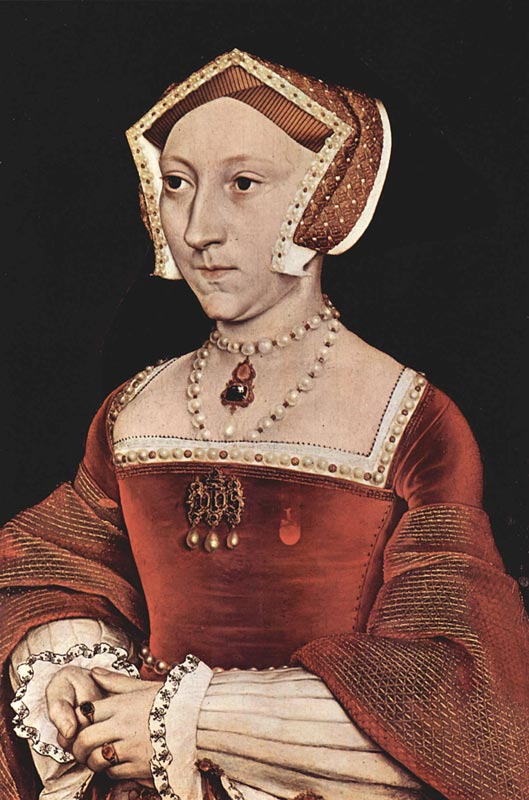
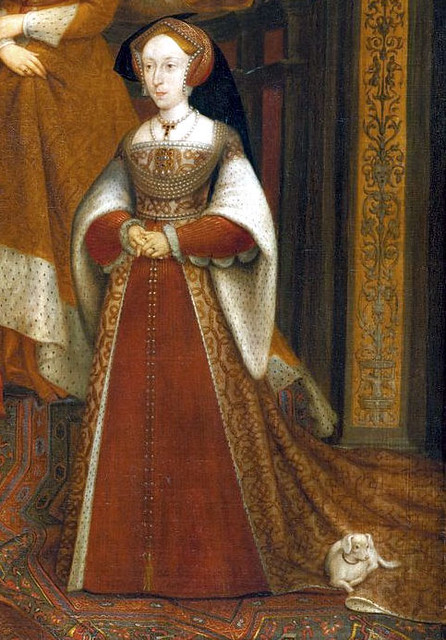
Katherine Parr, sixth wife of Henry VIII of England
Lifetime: 1512 - 5 September 1548
Reigned: July 1543 - January 1547 (3 years, 6 months)
Pregnancies: 0
In this new six-part series, I will be reexamining the lives and personalities of Henry VIII's six wives, seeking to portray their lives realistically in a process that discards prevailing stereotypes. Much scholarly work has been done on Henry's reign in recent decades, affording fresh insights into the politics and achievements of the period. Understandably, widespread interest in Henry's marital affairs remains unabated. Yet stereotypes continue to bedevil our knowledge of the wives of this most enigmatic king.
Katherine Parr was Henry VIII's sixth wife and in many respects she differed from his other consorts. She had been twice married when Henry's eye fell on her and, at thirty-one, she was somewhat older than her predecessors. The ageing king had wed Katherine Howard because her youth seemed to promise fertility. In marrying Katherine Parr, Henry perhaps acknowledged that he might not have any more legitimate children. The new queen was a charming, educated and well-liked woman who was known for her evangelical sympathies. Katherine can be termed the first truly Protestant queen of England and she was a noted patron of reformist scholars. She was also deeply interested in the Renaissance and spent considerable sums of money on clothing, works of art and jewellery. Like her predecessor Anne Boleyn, Katherine also enjoyed music, dancing and the finer things in life. In this respect she was an ideal consort. Yet her intelligence and devotion to reform threatened to be her own undoing. Towards the end of his life, rumours circulated that the king was rapidly tiring of his opinionated wife and was considering removing her. Fortunately, Katherine emerged unscathed but she was fortunate to escape potential arrest and even execution for heresy.
While Katherine's importance as queen was underestimated or even dismissed by nineteenth-century historians, modern scholars are keenly aware of her political, religious and cultural significance. The traditional and erroneous stereotype of her as merely her husband's nurse has been superseded by studies that demonstrate her importance to the advancement of Protestantism in England alongside her status as a Renaissance patron. She was a loving stepmother to Henry's children and was especially close to Elizabeth. Having at one time been perhaps the most misrepresented of Henry's wives, it is perhaps Katherine Parr, of all his queens, whose true character has most clearly emerged in light of advances in historical scholarship.

Above: Snape Castle in Yorkshire, where Katherine Parr and her stepchildren were held hostage during her time as the wife of John Neville.
Katherine Parr was the eldest daughter of Sir Thomas and Maud Parr, and was most probably born in around August 1512 at Blackfriars in London. Her brother William was born in 1513 and her sister Anne followed in about 1515. As with Anne Boleyn and Jane Seymour, Katherine's father was a close favourite of Henry VIII, while Lady Maud served as Katherine of Aragon's lady-in-waiting. Most probably the queen stood as Katherine Parr's godmother, for whom she was named. When she was five years old, Katherine's father died. Her mother, an ambitious and resourceful lady, successfully managed the family's estates, supervised her children's education, and arranged marriages for her two eldest children. In the words of Susan E. James, Maud 'set an example of female independence that was to have a lifelong effect on her elder daughter'.
Like Anne Boleyn, Katherine was well-educated and grew to be an articulate, assertive and remarkable young woman. She was not beautiful, but she was attractive. The Spanish ambassador recorded that she was 'of small stature, graceful, and of cheerful countenance'. The Duke of Najera's secretary Pedro de Gant similarly reported that she had a 'cheerful countenance' and was 'praised for her virtue'. Katherine's skeleton, unearthed in the nineteenth-century, showed her to have stood at 5'2 inches tall, making her about the same height as Anne Boleyn and Jane Seymour and probably slightly taller than both Katherine of Aragon and Katherine Howard, who was said to be 'diminutive' in stature. She had auburn hair, grey eyes and graceful, finely shaped hands. As the above testimony indicates, she had a gracious and merry temperament. She was also passionate, intense and outspoken.
Katherine had an aptitude for languages, acquiring a knowledge of French, Latin, and Italian, and as queen she sought to learn Spanish. In the summer of 1529, at the age of seventeen, Katherine married Edward Borough, who was perhaps four years her senior. Historians have conjectured that Katherine might not have been happy during her first marriage, for her father-in-law was overbearing and bullying. The young couple resided at Kirton in Lindsey, Lincolnshire, but their marriage proved to be a short one. Katherine's first husband died, only in his mid-twenties, in the spring of 1533. A year later, Katherine remarried. Her second husband was John Neville, Baron Latimer. This was an excellent marriage for Katherine and the ambitious Parrs, for it made her a baroness.
In puzzling over the origins of Katherine Parr's proclivity for the reformed faith, historians have wondered whether it began during her marriage to Latimer, for her husband was conservative in matters of religion. Dwelling at Snape Castle in Yorkshire, the new Lady Latimer received a fright when her husband was seized by an angry mob during the Pilgrimage of Grace in the autumn of 1536. Her husband was in a perilous position, in trying to please both the rebels and the suspicious king. In early 1537, believing that Latimer was about to betray them to the king, the rebels stormed Snape and seized Katherine and her stepchildren as hostages. Fortunately for them, Latimer managed to secure their release, and a few months later Lord and Lady Latimer departed for the south.
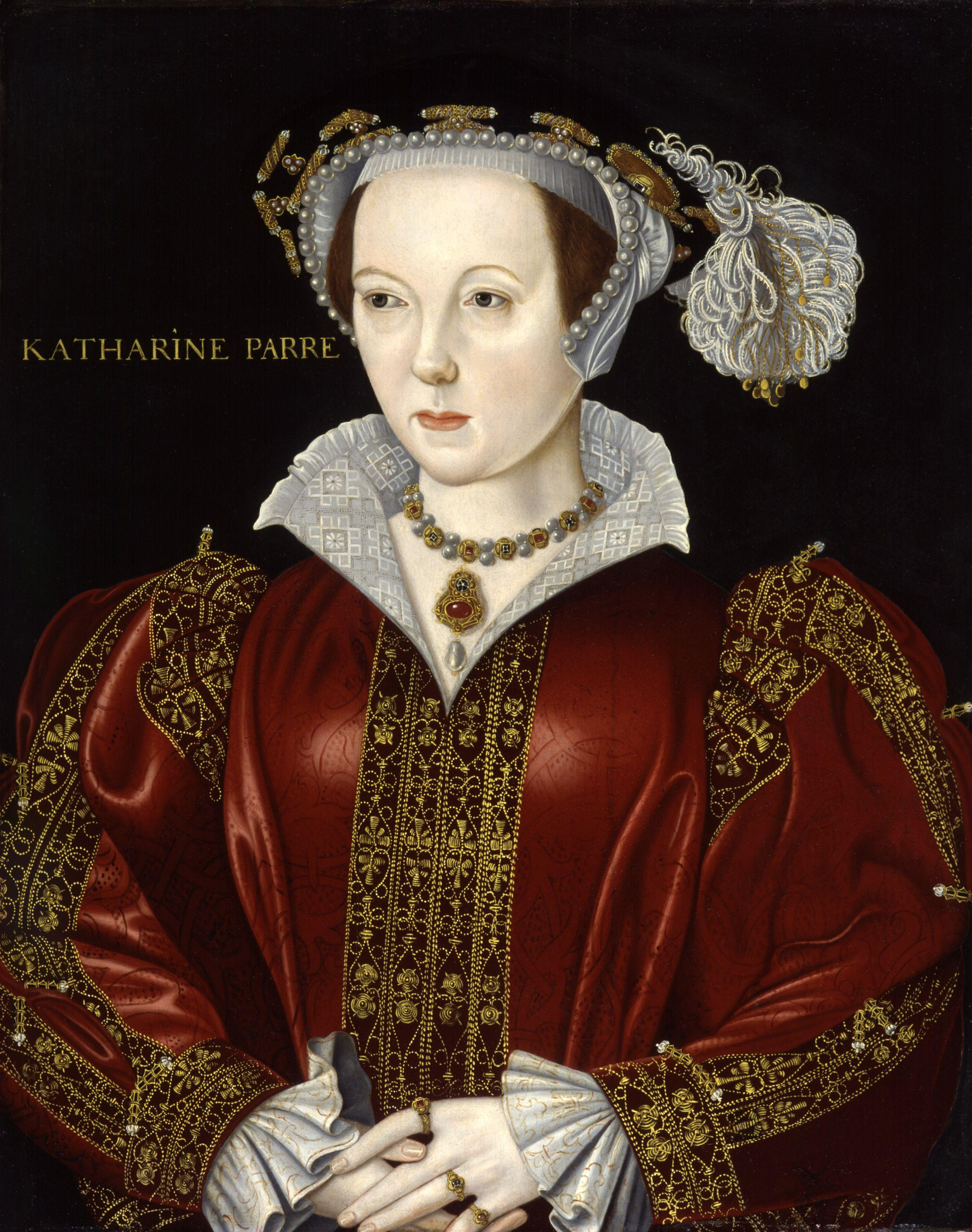
Whether Katherine was happy during her second marriage is unknown. If she had begun to harbour sympathies for the reformed religion around the time of the Pilgrimage of Grace, she might well have experienced tensions with her conservative husband. As in her first marriage, Katherine remained childless. In the spring of 1543, her fortunes changed drastically. Latimer died and, while serving at court in the household of Mary Tudor, Katherine attracted the ageing king. Like Anne Boleyn, Katherine reacted negatively when she learned that Henry wished to marry her. She seems to have harboured feelings for Sir Thomas Seymour, brother of Jane, and perhaps wished to marry him when her period of mourning for Latimer was at an end. Katherine, highly reluctant, eventually overcame her scruples upon concluding that it was God's will that she become queen. As she later wrote to Thomas: 'Howbeit, God withstood my will therein most vehemently... [and] made me to renounce utterly mine own will, and to follow his most willingly'. On 12 July 1543, Katherine married Henry VIII at Hampton Court Palace in a quiet ceremony.
Although Katherine Parr was fulsomely praised in her own lifetime and has been lauded by modern historians for her success as queen, she may initially have struggled for, like her predecessor Katherine Howard, she lacked experience at court. As Susan E. James writes, she was 'the only one of Henry's queens without either royal background or court service to train her for her new position'. Fortunately, Katherine quickly established excellent relations with her three stepchildren. She was already close to Mary on account of her brief time in Mary's household, and the new queen became closely involved in the education of both Elizabeth and Edward. The prince regularly wrote to Katherine informing her about the progress of his studies, while Elizabeth also frequently penned missives to her stepmother. Katherine's importance cannot be underestimated, for she was partly responsible for Henry's decision to include both Mary and Elizabeth in the line of succession.
Katherine Parr, like Katherine of Aragon, was an energetic, resourceful and active queen, and like Henry's first wife she was selected by the king to serve as regent in 1544 when he departed on a military expedition to France. Katherine's assertiveness may have caused resentment among the conservatives at court. She signed five royal proclamations as regent and was praised by her husband for her success in the role of regent. Henry appreciated Katherine's capability and aptitude for governance, but these same qualities later caused him irritation. It is interesting that Henry, after marrying the submissive Jane Seymour and Katherine Howard, once again selected an assertive and outspoken woman to be his final wife. Like Katherine of Aragon, Katherine Parr was, at least initially, not at all hesitant about speaking her mind in matters of religion and, perhaps, politics.

Above: "The Lamentation of a Sinner", published by Katherine in 1547 after Henry's death.
As stated in the introductory paragraph, of all Henry's wives, Katherine Parr's life has perhaps been described most realistically in modern times. However, one pervasive myth that concerns her is that she was something of an early feminist. Katherine's mother had been an independent, assertive and intelligent woman and, with her example in mind, it is unsurprising that Katherine grew up to value these qualities. Unlike Jane Seymour, who had submitted to Henry's control irrespective of her true feelings, or Katherine Howard, whose motto as queen was similarly grounded in her deference to Henry, Katherine Parr was outspoken, highly learned and opinionated, perhaps at times overbearing. These qualities were to place her in a position of danger. However, despite the example of her mother, Katherine was in no way a feminist transported back in time to Tudor England.
She was the first English queen to publish her own work. As she perceived it, her most important duty was to advance the reformed religion. It had been God's will that she marry Henry, and she believed that it was God's will that she bring about the triumph of the 'godly' faith. In her analysis of Katherine's The Lamentation of a Sinner, Susan E. James argues that Katherine associated Christ with qualities that were usually linked to women: 'Christ was innocent, obedient unto his father... meek and humble in the heart... [who] came to serve... [and] despised worldly honour'. By contrast, the writer described herself as having qualities that were usually associated with men; she was 'disobedient and most stubborn... most proud and vainglorious... I coveted to rule over [my brethren]'. The Lamentation contained an inversion of contemporary gender roles, which underscored Katherine's 'interpretation of her own self-image as one who was set apart by virtue of position and understanding from her sex in general and from those restrictions commonly imposed on that sex in particular' [Susan E. James].
Katherine's assertive queenship, in which she undermined and challenged the conventional understanding of women as passive, frail and corrupt beings, had a profound influence on her younger stepdaughter Elizabeth. Perhaps Elizabeth's own triumphant style of rule was deeply affected by her experience of Katherine's queenship. However, as Susan E. James notes, it is going too far to read an early form of feminism into Katherine's beliefs. She was not denying the contemporary notion of female inferiority. In the same work, the writer instructed women to be silent and obey their husbands in all things. Women should be, according to Katherine, sober, dutiful, and submissive. Their primary role was as mother and wife.
Even if Katherine was by no means an early feminist, her contemporaries viewed her as remarkable. John Foxe later described her as 'but a woman accompanied with all the imperfections natural to the weakness of her sex', but commented that she was 'very zealous towards the Gospel'. She was more assertive than Anne Boleyn, but she soon realised the dangers of appearing to question Henry's authority. Where Katherine of Aragon had occasionally dared to reprimand her husband, Katherine Parr was forced to deny her beliefs and submit herself entirely to her husband in order to survive.

Above: Sudeley Castle, where Katherine died in 1548.
Katherine's sympathies for the reformed religion, according to John Foxe, put her in a position of great danger. The conservatives, perhaps still harbouring resentment about the downfall and disgrace of Katherine Howard, harboured a secret desire to oust Katherine Parr from power. In the spring of 1546 Stephen Gardiner, bishop of Winchester, began plotting to destroy her and rumours of the queen's imminent disgrace began to circulate at court. In a moment of irritation, the king agreed to his wife's arrest. Fortunately for her, Katherine discovered the news of her impending arrest and, in a speech in which she submitted herself entirely to Henry's wisdom, secured her husband's forgiveness. It is possible that Katherine's speech of submission inspired that of Katherina in Shakespeare's The Taming of the Shrew. Katherine never again risked her husband's wrath and was more subdued in the final months of Henry's life.
Katherine Parr had been queen of England for three and a half years when her mercurial husband died on 28 January 1547 at Whitehall Palace in London. A few months later she remarried. Her fourth husband was the handsome Thomas Seymour, brother of Jane. Unfortunately, Katherine was not to experience lasting happiness in her new marriage. Her husband was reckless and irresponsible, and his scandalous relationship with Elizabeth Tudor caused Katherine dismay and despair. Elizabeth, who had resided in her stepmother's household, was banished. Katherine gave birth to her only child, Mary, on 30 August 1548. The child probably died before her second birthday. Katherine passed away less than a week later at the age of thirty-six. She was deeply mourned by her friends and family and was buried in Sudeley Chapel. Eleven-year-old Lady Jane Grey acted as chief mourner.
In recent years, there have been several excellent studies of Katherine. They have established that she was an extremely important queen of England who was a key player in both the Reformation and the Renaissance in England. She was involved in the founding of Trinity College, Cambridge, and she was deeply interested in educational reform. She was also a patron of the arts, in particular music, painting, and drama. Katherine's model of queenship may have greatly influenced her stepdaughter Elizabeth's style of rule. She and Katherine of Aragon, her namesake, were probably the two most assertive and active of Henry's queens. Both were selected by the king to act as Regent of the country while he was abroad, and both shared similar personalities: they were assertive; energetic; passionate; articulate; and opinionated. Both were highly popular and were admired not only by their subjects but by foreign visitors and ambassadors at court.
These studies have largely contributed to the dismantling of myths surrounding Katherine Parr, primarily the erroneous tale of her acting as her husband's nurse. Of all the wives, it is perhaps Katherine's personality which emerges most clearly. Admired in her own day, respected today, she is now perhaps the least stereotyped of Henry's queens.
Katherine Parr was Henry VIII's sixth wife and in many respects she differed from his other consorts. She had been twice married when Henry's eye fell on her and, at thirty-one, she was somewhat older than her predecessors. The ageing king had wed Katherine Howard because her youth seemed to promise fertility. In marrying Katherine Parr, Henry perhaps acknowledged that he might not have any more legitimate children. The new queen was a charming, educated and well-liked woman who was known for her evangelical sympathies. Katherine can be termed the first truly Protestant queen of England and she was a noted patron of reformist scholars. She was also deeply interested in the Renaissance and spent considerable sums of money on clothing, works of art and jewellery. Like her predecessor Anne Boleyn, Katherine also enjoyed music, dancing and the finer things in life. In this respect she was an ideal consort. Yet her intelligence and devotion to reform threatened to be her own undoing. Towards the end of his life, rumours circulated that the king was rapidly tiring of his opinionated wife and was considering removing her. Fortunately, Katherine emerged unscathed but she was fortunate to escape potential arrest and even execution for heresy.
While Katherine's importance as queen was underestimated or even dismissed by nineteenth-century historians, modern scholars are keenly aware of her political, religious and cultural significance. The traditional and erroneous stereotype of her as merely her husband's nurse has been superseded by studies that demonstrate her importance to the advancement of Protestantism in England alongside her status as a Renaissance patron. She was a loving stepmother to Henry's children and was especially close to Elizabeth. Having at one time been perhaps the most misrepresented of Henry's wives, it is perhaps Katherine Parr, of all his queens, whose true character has most clearly emerged in light of advances in historical scholarship.

Above: Snape Castle in Yorkshire, where Katherine Parr and her stepchildren were held hostage during her time as the wife of John Neville.
Katherine Parr was the eldest daughter of Sir Thomas and Maud Parr, and was most probably born in around August 1512 at Blackfriars in London. Her brother William was born in 1513 and her sister Anne followed in about 1515. As with Anne Boleyn and Jane Seymour, Katherine's father was a close favourite of Henry VIII, while Lady Maud served as Katherine of Aragon's lady-in-waiting. Most probably the queen stood as Katherine Parr's godmother, for whom she was named. When she was five years old, Katherine's father died. Her mother, an ambitious and resourceful lady, successfully managed the family's estates, supervised her children's education, and arranged marriages for her two eldest children. In the words of Susan E. James, Maud 'set an example of female independence that was to have a lifelong effect on her elder daughter'.
Like Anne Boleyn, Katherine was well-educated and grew to be an articulate, assertive and remarkable young woman. She was not beautiful, but she was attractive. The Spanish ambassador recorded that she was 'of small stature, graceful, and of cheerful countenance'. The Duke of Najera's secretary Pedro de Gant similarly reported that she had a 'cheerful countenance' and was 'praised for her virtue'. Katherine's skeleton, unearthed in the nineteenth-century, showed her to have stood at 5'2 inches tall, making her about the same height as Anne Boleyn and Jane Seymour and probably slightly taller than both Katherine of Aragon and Katherine Howard, who was said to be 'diminutive' in stature. She had auburn hair, grey eyes and graceful, finely shaped hands. As the above testimony indicates, she had a gracious and merry temperament. She was also passionate, intense and outspoken.
Katherine had an aptitude for languages, acquiring a knowledge of French, Latin, and Italian, and as queen she sought to learn Spanish. In the summer of 1529, at the age of seventeen, Katherine married Edward Borough, who was perhaps four years her senior. Historians have conjectured that Katherine might not have been happy during her first marriage, for her father-in-law was overbearing and bullying. The young couple resided at Kirton in Lindsey, Lincolnshire, but their marriage proved to be a short one. Katherine's first husband died, only in his mid-twenties, in the spring of 1533. A year later, Katherine remarried. Her second husband was John Neville, Baron Latimer. This was an excellent marriage for Katherine and the ambitious Parrs, for it made her a baroness.
In puzzling over the origins of Katherine Parr's proclivity for the reformed faith, historians have wondered whether it began during her marriage to Latimer, for her husband was conservative in matters of religion. Dwelling at Snape Castle in Yorkshire, the new Lady Latimer received a fright when her husband was seized by an angry mob during the Pilgrimage of Grace in the autumn of 1536. Her husband was in a perilous position, in trying to please both the rebels and the suspicious king. In early 1537, believing that Latimer was about to betray them to the king, the rebels stormed Snape and seized Katherine and her stepchildren as hostages. Fortunately for them, Latimer managed to secure their release, and a few months later Lord and Lady Latimer departed for the south.
Whether Katherine was happy during her second marriage is unknown. If she had begun to harbour sympathies for the reformed religion around the time of the Pilgrimage of Grace, she might well have experienced tensions with her conservative husband. As in her first marriage, Katherine remained childless. In the spring of 1543, her fortunes changed drastically. Latimer died and, while serving at court in the household of Mary Tudor, Katherine attracted the ageing king. Like Anne Boleyn, Katherine reacted negatively when she learned that Henry wished to marry her. She seems to have harboured feelings for Sir Thomas Seymour, brother of Jane, and perhaps wished to marry him when her period of mourning for Latimer was at an end. Katherine, highly reluctant, eventually overcame her scruples upon concluding that it was God's will that she become queen. As she later wrote to Thomas: 'Howbeit, God withstood my will therein most vehemently... [and] made me to renounce utterly mine own will, and to follow his most willingly'. On 12 July 1543, Katherine married Henry VIII at Hampton Court Palace in a quiet ceremony.
Although Katherine Parr was fulsomely praised in her own lifetime and has been lauded by modern historians for her success as queen, she may initially have struggled for, like her predecessor Katherine Howard, she lacked experience at court. As Susan E. James writes, she was 'the only one of Henry's queens without either royal background or court service to train her for her new position'. Fortunately, Katherine quickly established excellent relations with her three stepchildren. She was already close to Mary on account of her brief time in Mary's household, and the new queen became closely involved in the education of both Elizabeth and Edward. The prince regularly wrote to Katherine informing her about the progress of his studies, while Elizabeth also frequently penned missives to her stepmother. Katherine's importance cannot be underestimated, for she was partly responsible for Henry's decision to include both Mary and Elizabeth in the line of succession.
Katherine Parr, like Katherine of Aragon, was an energetic, resourceful and active queen, and like Henry's first wife she was selected by the king to serve as regent in 1544 when he departed on a military expedition to France. Katherine's assertiveness may have caused resentment among the conservatives at court. She signed five royal proclamations as regent and was praised by her husband for her success in the role of regent. Henry appreciated Katherine's capability and aptitude for governance, but these same qualities later caused him irritation. It is interesting that Henry, after marrying the submissive Jane Seymour and Katherine Howard, once again selected an assertive and outspoken woman to be his final wife. Like Katherine of Aragon, Katherine Parr was, at least initially, not at all hesitant about speaking her mind in matters of religion and, perhaps, politics.
Above: "The Lamentation of a Sinner", published by Katherine in 1547 after Henry's death.
As stated in the introductory paragraph, of all Henry's wives, Katherine Parr's life has perhaps been described most realistically in modern times. However, one pervasive myth that concerns her is that she was something of an early feminist. Katherine's mother had been an independent, assertive and intelligent woman and, with her example in mind, it is unsurprising that Katherine grew up to value these qualities. Unlike Jane Seymour, who had submitted to Henry's control irrespective of her true feelings, or Katherine Howard, whose motto as queen was similarly grounded in her deference to Henry, Katherine Parr was outspoken, highly learned and opinionated, perhaps at times overbearing. These qualities were to place her in a position of danger. However, despite the example of her mother, Katherine was in no way a feminist transported back in time to Tudor England.
She was the first English queen to publish her own work. As she perceived it, her most important duty was to advance the reformed religion. It had been God's will that she marry Henry, and she believed that it was God's will that she bring about the triumph of the 'godly' faith. In her analysis of Katherine's The Lamentation of a Sinner, Susan E. James argues that Katherine associated Christ with qualities that were usually linked to women: 'Christ was innocent, obedient unto his father... meek and humble in the heart... [who] came to serve... [and] despised worldly honour'. By contrast, the writer described herself as having qualities that were usually associated with men; she was 'disobedient and most stubborn... most proud and vainglorious... I coveted to rule over [my brethren]'. The Lamentation contained an inversion of contemporary gender roles, which underscored Katherine's 'interpretation of her own self-image as one who was set apart by virtue of position and understanding from her sex in general and from those restrictions commonly imposed on that sex in particular' [Susan E. James].
Katherine's assertive queenship, in which she undermined and challenged the conventional understanding of women as passive, frail and corrupt beings, had a profound influence on her younger stepdaughter Elizabeth. Perhaps Elizabeth's own triumphant style of rule was deeply affected by her experience of Katherine's queenship. However, as Susan E. James notes, it is going too far to read an early form of feminism into Katherine's beliefs. She was not denying the contemporary notion of female inferiority. In the same work, the writer instructed women to be silent and obey their husbands in all things. Women should be, according to Katherine, sober, dutiful, and submissive. Their primary role was as mother and wife.
Even if Katherine was by no means an early feminist, her contemporaries viewed her as remarkable. John Foxe later described her as 'but a woman accompanied with all the imperfections natural to the weakness of her sex', but commented that she was 'very zealous towards the Gospel'. She was more assertive than Anne Boleyn, but she soon realised the dangers of appearing to question Henry's authority. Where Katherine of Aragon had occasionally dared to reprimand her husband, Katherine Parr was forced to deny her beliefs and submit herself entirely to her husband in order to survive.

Above: Sudeley Castle, where Katherine died in 1548.
Katherine's sympathies for the reformed religion, according to John Foxe, put her in a position of great danger. The conservatives, perhaps still harbouring resentment about the downfall and disgrace of Katherine Howard, harboured a secret desire to oust Katherine Parr from power. In the spring of 1546 Stephen Gardiner, bishop of Winchester, began plotting to destroy her and rumours of the queen's imminent disgrace began to circulate at court. In a moment of irritation, the king agreed to his wife's arrest. Fortunately for her, Katherine discovered the news of her impending arrest and, in a speech in which she submitted herself entirely to Henry's wisdom, secured her husband's forgiveness. It is possible that Katherine's speech of submission inspired that of Katherina in Shakespeare's The Taming of the Shrew. Katherine never again risked her husband's wrath and was more subdued in the final months of Henry's life.
Katherine Parr had been queen of England for three and a half years when her mercurial husband died on 28 January 1547 at Whitehall Palace in London. A few months later she remarried. Her fourth husband was the handsome Thomas Seymour, brother of Jane. Unfortunately, Katherine was not to experience lasting happiness in her new marriage. Her husband was reckless and irresponsible, and his scandalous relationship with Elizabeth Tudor caused Katherine dismay and despair. Elizabeth, who had resided in her stepmother's household, was banished. Katherine gave birth to her only child, Mary, on 30 August 1548. The child probably died before her second birthday. Katherine passed away less than a week later at the age of thirty-six. She was deeply mourned by her friends and family and was buried in Sudeley Chapel. Eleven-year-old Lady Jane Grey acted as chief mourner.
In recent years, there have been several excellent studies of Katherine. They have established that she was an extremely important queen of England who was a key player in both the Reformation and the Renaissance in England. She was involved in the founding of Trinity College, Cambridge, and she was deeply interested in educational reform. She was also a patron of the arts, in particular music, painting, and drama. Katherine's model of queenship may have greatly influenced her stepdaughter Elizabeth's style of rule. She and Katherine of Aragon, her namesake, were probably the two most assertive and active of Henry's queens. Both were selected by the king to act as Regent of the country while he was abroad, and both shared similar personalities: they were assertive; energetic; passionate; articulate; and opinionated. Both were highly popular and were admired not only by their subjects but by foreign visitors and ambassadors at court.
These studies have largely contributed to the dismantling of myths surrounding Katherine Parr, primarily the erroneous tale of her acting as her husband's nurse. Of all the wives, it is perhaps Katherine's personality which emerges most clearly. Admired in her own day, respected today, she is now perhaps the least stereotyped of Henry's queens.