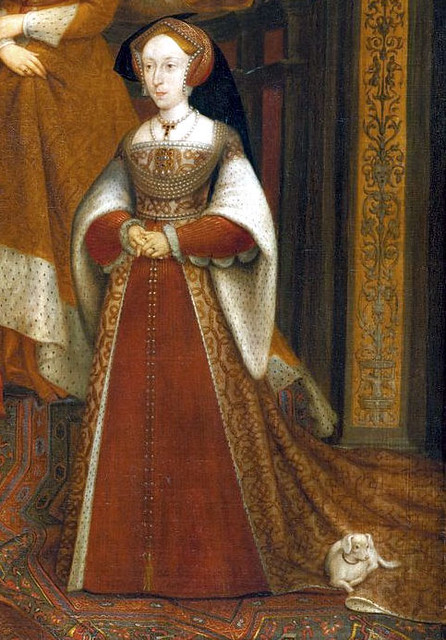
Showing posts with label edward seymour. Show all posts

Wednesday, 27 January 2016

The Death of Lady Catherine Grey


Above: Portrait of Lady Catherine Grey and her son Edward Seymour.


Even by sixteenth-century standards, the demise of Lady Catherine Grey, countess of Hertford, was tragic. On 27 January 1568 (some sources suggest the 26th), the middle daughter of the disgraced Henry Grey, duke of Suffolk died at Cockfield Hall in Suffolk at the age of twenty-seven. There has been considerable speculation about the cause of the countess' untimely death. Some have suggested that she died of tuberculosis (then known as consumption), while others have speculated that she had starved herself to death. Whatever the cause, Lady Catherine's death was greeted by her cousin Elizabeth I with relief, perhaps even joy, for it removed a serious threat to Elizabeth's throne. 

In many respects, Catherine was a victim of her inheritance. Her mother was the daughter of Mary Tudor, queen of France, and niece of Henry VIII. Catherine was therefore Henry's grandniece and was probably named for his fifth wife, who married Henry in 1540 (Catherine Grey was born in August of that year). In 1553, at the age of only twelve, Catherine's world fell apart. Her elder sister Jane was nominated heir to the throne by their cousin Edward VI and, following his death in July, Jane was proclaimed Queen of England. Few accepted her accession, however, and Jane's regime collapsed when Mary Tudor successfully claimed the throne. Jane was imprisoned alongside her husband Guildford Dudley, who like her was probably no more than sixteen or seventeen years old. Queen Mary refused to order her cousin's execution despite considerable pressure from the Spanish envoys. However, following the outbreak of rebellion in early 1554 - motivated in large part by antipathy to the queen's proposed marriage to Philip of Spain and the anticipated restoration of the Catholic religion - Mary decided to have Jane and Guildford executed. Catherine's father Henry Grey followed Jane to the scaffold eleven days later, following his treasonous involvement in the rebellion.

Catherine, therefore, had suffered considerably by her early teenage years. Her father and sister had both died a shameful death, and she would have grown accustomed to her position as the member of a traitorous family. Popular history has portrayed Catherine's mother, Frances, as a tyrannical, cruel woman who bullied her daughters; however, there is no evidence of this, and it seems that both Catherine and her younger sister Mary were close to their mother. Frances died in 1559, a year after Elizabeth I came to the throne.

Edward Seymour, Earl of Hertford, Attributed to Hans Eworth (1515 - 1574).jpg
Above: Edward Seymour, earl of Hertford.

Elizabeth's accession complicated Catherine's life. According to Henry VIII's will, Catherine was Elizabeth's heir presumptive and, given the queen's unwillingness to marry and have children, Catherine stood a very real chance of becoming Queen. This fact was not lost on English Protestants, many of whom placed their hopes in Catherine and looked to her as their future monarch. Foreign rulers were also interested in Catherine, including Elizabeth I's former brother-in-law Philip of Spain. Rumours circulated that Philip was intending to have Catherine spirited abroad and married to his son. 

These rumours were regarded with fear and resentment by Queen Elizabeth. Some historians have speculated that she personally disliked Catherine. Undoubtedly she feared her as a potential claimant to her throne, and the queen would never have forgotten that her brother had disinherited both herself and her half-sister Mary in preference for the Grey claim. In 1561, Elizabeth found herself with an opportunity to prevent Catherine ever becoming queen. 

The following year, Catherine had secretly wed Edward Seymour, earl of Hertford. The couple were passionately in love, and their testimony graphically described their lovemaking in different palaces. However, unfortunately for the couple, the only witnesses to their marriage were either dead (Hertford's younger sister, Lady Jane) or disappeared (the priest who performed the service). This meant that the legality of the marriage could not be proved. Catherine, who was forced to confess that she was pregnant, was incarcerated in the Tower of London. Her father and sister had both died there only seven years earlier. Elizabeth also ordered the imprisonment of Hertford, and both he and his wife were rigorously interrogated. Their marriage was declared invalid and, when Catherine gave birth to a son, Edward, on 24 September, the child was declared a bastard. Elizabeth was determined that Catherine should not succeed her as queen. Her fear and loathing only increased when the countess gave birth to a second son, Thomas, in 1563.

Above: Cockfield Hall, where Catherine was imprisoned and later died.

Catherine remained imprisoned for the rest of her life. Elizabeth never forgave her, although her husband was later received at court. The queen's actions appear cruel and merciless to us today, but her actions are understandable when her fears are given attention. Elizabeth had been the subject of many plots in Mary I's reign; disaffected traitors had plotted to incarcerate, or even assassinate, their monarch and install Elizabeth as queen instead. Now, Elizabeth feared that the same threat would befall her. She reacted aggressively, as she was to react when Mary, Queen of Scots became a figurehead for Catholic disaffection among English subjects.

In her isolation, Catherine succumbed to despair and depression. She never saw her husband and sons again, and her household voiced concerns that she would kill herself in her misery. Following her death in January 1568, she was buried at Yoxford, although her remains were subsequently interred at Salisbury Cathedral. Later, her husband Edward Seymour was buried alongside her. The Latin inscription celebrates the couple as 'Incomparable Consorts Who, experienced in the vicissitudes of changing fortune At length, in the concord which marked their lives, Here rest together'.

Although her subjects could understand Elizabeth I's actions, that did not mean that they all agreed with her. Evidence suggests that many believed that Catherine and Edward were legally married and their children were legitimate. In view of this, English Protestants continued to regard Catherine Grey as the rightful heir to Elizabeth's throne and, following Catherine's death, they argued that the throne should pass to her sons Edward and Thomas. The MP John Hales was imprisoned for writing a tract that proclaimed the marriage was legal. Those who did not wish to see Mary, Queen of Scots as queen of England argued that Catherine's son Edward should succeed Elizabeth following her death. Finally, in 1606, the marriage of Catherine and Edward was declared valid, in the reign of James I.

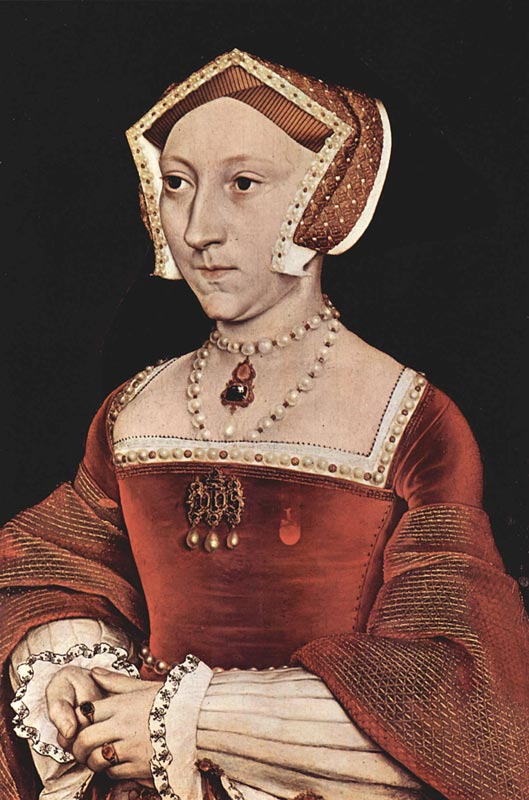
Saturday, 24 October 2015

The Stereotyped Six Wives: Three: 'As Gentle A Lady'


Jane Seymour, third wife of Henry VIII of England
Lifetime: c. 1508/9 - 24 October 1537
Reigned: May 1536 - October 1537 (1 year, 5 months)
Pregnancies: 1
Edward VI of England: 12 October 1537 - 6 July 1553

In this new six-part series, I will be reexamining the lives and personalities of Henry VIII's six wives, seeking to portray their lives realistically in a process that discards prevailing stereotypes. Much scholarly work has been done on Henry's reign in recent decades, affording fresh insights into the politics and achievements of the period. Understandably, widespread interest in Henry's marital affairs remains unabated. Yet stereotypes continue to bedevil our knowledge of the wives of this most enigmatic king. 

Jane Seymour, third wife of Henry VIII, became Queen of England upon her predecessor's execution for treason in May 1536. An unassuming woman in her late twenties, Jane is perhaps the most elusive of Henry's queens. Scarcely any evidence survives for her true personality. She was Henry's wife for merely seventeen months; yet her period as queen was tumultuous, in that it witnessed the restoration of Mary Tudor to favour, the unrest of the Pilgrimage of Grace, and the long-awaited birth of a healthy son to the king. Jane has attracted few biographers because of the shortage of evidence concerning her. In many ways, though, the mystery of Jane Seymour makes her as fascinating a person of study as Henry's other wives. Whether Henry VIII truly did love Jane, his 'entirely beloved' third wife, as legend has it, is an issue that has provoked considerable debate. In actuality, the tantalising evidence we have suggests that the story is more complex. Jane's queenship was passive and her famously meek, subdued character may have owed far more to the control of her domineering husband than is usually considered.

Above: Hampton Court Palace, where Jane Seymour died merely twelve days after the birth of her son.

Jane was the fifth child and eldest daughter of Sir John Seymour and Margery Wentworth. Twenty-nine ladies walked at her funeral procession in 1537 to mark her age: whether that means she had reached her twenty-ninth birthday, or whether she was in her twenty-ninth year, is uncertain, but it indicates that she was born either in 1508 or 1509. As with Anne Boleyn, Jane's father was much favoured by Henry VIII. Sir John Seymour, a 'gentle, courteous man', had been knighted by Henry VII at the battle of Blackheath in 1497 and later accompanied Henry VIII on the French campaign in 1513. By 1532 he had become a Gentleman of the Bedchamber, and had acted as Sheriff of Wiltshire and Dorset. Sometime in the late 1520s, Jane arrived at court to serve Queen Katherine of Aragon. It is often assumed, with little supporting evidence, that Jane was loyal to Katherine and modelled herself on her. Aside from Jane's preference for gable hoods, which Katherine also liked, and Jane's later friendship with Katherine's daughter Mary, there is barely anything to suggest that Jane particularly admired Katherine or empthasised with her during the annulment proceedings.

Although she is rarely termed stupid, Jane is often regarded as being poorly educated. Indeed, there is no evidence that she had an aptitude for languages, and unlike Anne Boleyn she was not selected to participate in court masques, which suggests that her dancing and musical ability were unexceptional. Yet she was renowned for her talent in needlework and embroidery, with some of her work surviving well into the following century. Her contemporaries were also not especially enthusiastic about her appearance. Polydore Vergil described her flatteringly as 'a woman of the utmost charm both in appearance and character', but the Spanish ambassador was of the opinion that she was 'of middle stature and no great beauty', with a 'pure white' complexion. He also reported rumours that she was both 'haughty' and 'proud'. 

Indeed, it is the very absence of evidence which makes it so difficult to grasp Jane's true personality. Most historians often refer to her piety and virtue, but aside from Luther's belief that she was 'an enemy of the gospel' - in other words, she was a devout adherent of the Catholic faith - there is barely anything to suggest that she was especially pious. In contrast to Anne Boleyn, who assisted religious reformers, or Katherine Parr, who wrote evangelical works of devotion, Jane was entirely conventional in her religious devotions and may not have been interested in taking an active role in religious politics. The absence of her involvement in court masques and dances, or poetry celebrating her talents, can tentatively be interpreted to mean that she was not talented musically or artistically. 


For whatever reason, by early 1536 Jane Seymour remained unwed. At the age of twenty-six, it was certainly strange that her father had not arranged an advantageous marriage alliance for her, and even more unusual given that she was the eldest daughter. Her younger sister, Elizabeth, had married in 1531 and later remarried, to the son of Thomas Cromwell. Why no marriage had been arranged for Jane remains a mystery. We can only wonder how she herself felt about this: did she passively accept her fate as God's will, something to be accepted with resignation? Did she rebel, passionately hoping for an excellent marriage one day? We can only guess. Jane's fortunes, however, took a dramatically unexpected turn in the spring of 1536. Devastated by his wife's miscarriage, and uncertain whether his second marriage had won him divine favour, Henry VIII was susceptible to a new flirtation. For reasons that have puzzled historians for centuries, the object of his affections was Jane Seymour, the unassuming and apparently unremarkable attendant of the queen. 

Historians have generally suggested that Henry VIII was attracted to Jane because she 'was unquestionably virginal' and because 'there was certainly no threatening sexuality about her'. In short, it was her virtue, her piety and her goodness that charmed the ageing king. By extension, these same historians seem to imply that these were qualities decidedly lacking in Anne Boleyn, thus conveniently ignoring the considerable evidence of Anne's piety and the importance she placed on her virtue. While Henry may have been captivated by Jane's demeanour, there may be a darker story at place here.

As queen, Jane selected the motto 'Bound to Obey and Serve', thus confirming her submission to Henry VIII's will both as her husband and as her king. How far the king himself directed his new wife in this, however, should be considered. Henry VIII had been dangerously obsessed by Anne Boleyn, an assertive, educated and independent young woman who had refused to become involved with him because it offended her piety and endangered her virtue. Anne's inability to provide the much-desired male heir had gradually reduced Henry VIII's burning love to burning hatred, leaving him with a strong desire to destroy her and rejoicing in her execution, to the surprise even of Ambassador Chapuys. With Jane, he had no wish to be denied and no wish to be told 'no'. Jane's motto confirmed her husband's control of her and signalled to the world that passivity and submission, rather than the proactiveness of Katherine of Aragon and Anne Boleyn, would characterise Jane's rule. 

Above: Edward VI of England was born on 12 October 1537, only child of Jane Seymour.

Just as it is problematic to view Anne Boleyn as directly responsible for Katherine of Aragon's rustication from court and ill-treatment, so it is erroneous to view Jane as responsible for Anne's brutal end, as Victorian historians often did. In questioning her morals and condemning her actions, as Agnes Strickland did, these historians failed to understand the position Jane was in and the character of the man she married. Like Anne, she simply could not say no. With the passing of time, Henry had become increasingly autocratic and, on the single occasion that Jane did dare to voice her true opinion, she was brutally put in her place by her irascible husband, who warned her to consider her predecessor's fate before involving herself in affairs of state. There is scarcely any evidence for Jane's supposed love and admiration of Queen Katherine, and there is next to no evidence that she was hostile to Anne or resented her rise to queenship. While she did offer friendship to Mary Tudor once she had married Henry, this is understandable given their closeness in age and their shared devotion to the Catholic faith. In 1536, perhaps Jane, mindful of Henry's rejection of Anne and indifference to his second daughter, wisely judged it best not to antagonise her husband by showing marked favour to her stepdaughter Elizabeth. 

The absence of evidence for her inner feelings means that we cannot suggest that Jane was hostile to Anne Boleyn or deliberately sought to bring her down because of her aversion to the reformed faith favoured by Anne or because of her supposed loyalty to Katherine. In rejecting Henry's advances, in refusing to accept presents of money from him, in behaving 'modestly' rather than flirtatiously, perhaps Jane intended to signal a lack of interest that may well have been genuine. Her true feelings for Henry are usually ignored in the rush to condemn her supposedly callous behaviour. Jane Seymour's personality and motivations are swathed in mystery and remain largely inscrutable. She may have been ambitious, but equally she may have felt that she had no choice, as Katherine Parr did when presented with an unwanted marriage proposal by the king in 1543. Perhaps Jane resented Anne, but equally she may have accepted her as her mistress and wished to show her no ill-will. What does seem likely, however, is that Jane was coached by her ambitious relatives to attract the besotted king. Certainly they profited handsomely from her rise: her brother Edward became Viscount Beauchamp and her brother Thomas was knighted. It is uncertain whether Jane was a willing participant in the schemes of 1536 or whether she was manipulated by her family to serve their own ends.

Jane was never crowned as queen and her reign was entirely passive, as Pamela Gross noted in her academic study of Jane. She has usually been credited with restoring Mary Tudor to favour, but it is more likely that it was Henry himself who approved and brought about his daughter's return to court only after she had grovelled to him for her disobedience: 'I beseech your Majesty to countervail my transgressions with my repentance for the same'. Jane may have been sympathetic to Mary but she was not responsible for the latter's return to favour. Even if she had wished to enjoy Mary's company, Jane would not have forgotten for a second that her primary duty as queen was to provide a male heir, and would have acknowledged that Mary's position as the bastard of an unlawful union was a foreboding reminder of her own perilous position. As Henry himself warned Jane ominously: 'She ought to study the welfare and exaltation of her own children, if she had any by him, instead of looking out for the good of others'. 


Despite the oft-repeated legend that Jane Seymour was Henry VIII's most beloved wife, there is, in fact, surprisingly little evidence of his love for her dating from her own lifetime. As noted earlier, when she had voiced sympathy for Mary her husband had bluntly advised her to concern herself with producing an heir herself. If the story of her plea for the abbeys to be saved from dissolution is true, then Henry's response, in brutally reminding her of Anne's fate, is indicative of a bullying husband seeking to control a wife and prevent her from becoming unruly. Within days of his marriage to Jane, Henry VIII reportedly was acquainted with two beautiful women and voiced regret that he had not met them before he had remarried. The Second Act of Succession, which was passed in the summer of 1536, vested the succession either in Jane Seymour's offspring or in the offspring the king might have with any future wife. How Jane viewed this Act cannot be known, but as the months passed without a pregnancy, she must have lived in considerable anxiety, if not fear.

Described by Cromwell as 'a most virtuous lady', Jane conformed entirely to Henry's wishes. If she had ambition, she suppressed it. If she held opinions, she chose not to voice them. If she disagreed with her husband's policies, she did not inform him. How far Jane willingly assented to her marginalisation, how wholeheartedly she embraced her motto 'Bound to Obey and Serve', are questions that simply cannot be answered. Yet she had witnessed Katherine of Aragon's determined refusal to obey Henry's wishes, and she had heard of the ill-treatment inflicted on the proud queen in consequence. Jane's own marriage had been made in blood: her former mistress had been imprisoned, tried and executed in less than three weeks mainly because she had failed to give her husband a son. 

Jane's queenship is characterised by most historians as passive, but they have not usually considered whether she was willing in the circumscribing of her queenly authority. In concerning herself solely with domestic affairs, Jane sought to please her husband, but his threatening behaviour on several occasions towards her was a chilling reminder of the danger she faced if she displeased him. By giving birth to her son Edward on 12 October 1537 at Hampton Court Palace, Jane earned Henry's undying love and appreciation, but during her own lifetime he never demonstrated the constant passion he felt for Anne Boleyn, or the unswerving devotion he experienced for Katherine Howard. In her own lifetime, Jane was a cipher. During her brief tenure as queen, she walked on a knife edge. Her two predecessors had been rusticated and had died, alone and shamed, for their failures to give birth to a son. This thought must have constantly been in Jane's mind, and her overriding emotion at providing the male heir in the autumn of 1537 may well have been relief.

Philippa Gregory's new novel The Taming of the Queen, which describes the life of Katherine Parr as queen, focuses on the circumscribing of the queen's authority, the restriction of her power and the utter submission of the queen to her husband. This portrayal could, with some fairness, apply to Jane Seymour. Her reign has been viewed as unremarkable and devoid of achievements, with the exception of Prince Edward's birth. Historians have appreciated that, outside of her immediate household, the queen was little more than a cipher, never exercising the militant authority of Katherine of Aragon or seeking to influence religious policies, as did Anne Boleyn. But they have, tellingly, failed to consider how willing Jane was in the restrictions she faced. Perhaps she willingly accepted them, perhaps she accepted her submission as the price of her queenship. Or perhaps she resented the limits imposed on her and bridled when faced with her husband's suffocating presence.

There is no evidence to suggest that Jane was unquestionably hostile to Anne Boleyn and sought her destruction, nor is there evidence that she admired and revered Katherine of Aragon. There is scarcely any evidence for Henry's supposed love for her. It was only after her death that Jane became 'entirely beloved' and her memory revered. Only in 1544 was she celebrated in Holbein's painting as Henry's one true wife, rather than Katherine Parr, his queen at the time. Jane Seymour's queenship was circumscribed, 'tamed'. She remains a mystery because she was a cipher at court. What emerges from the sources is the strong likelihood that it was Henry VIII who was responsible for holding her in submission and curtailing her authority to ensure that she pleased him and conformed to his will. 


Sunday, 21 December 2014

Anne Stanhope, Duchess of Somerset


Above: Anne Stanhope (c.1510-87), duchess of Somerset.

Anne Stanhope, duchess of Somerset, has long had a negative reputation. Mary Dewar described her in 1964 as 'the terror' of her husband Edward Seymour's household and as 'a hated meddler'. William Seymour, who was a descendant of Somerset's second son by his rejected first wife, characterised Anne Stanhope as a 'proud, domineering woman, with a passion for precedence and an overwhelming interest in personal aggrandizement'. Susan E. James referred, in her biography of Queen Katherine Parr, to Anne's 'myopic arrogance'. Finally, the popular writer Alison Weir wrote of Anne Stanhope's 'monstrous' pride; she was 'a termagant who exercised much influence over her weaker husband by the lash of her tongue'.

Like other elite Tudor women, including Frances Grey, duchess of Suffolk, Anne has been slandered and criticised for perceived faults in her character. Her character has been termed arrogant, overbearing, ruthless and haughty. If she was ambitious, she was, so it goes, monstrously so. If she sought the best for her family, writers believe, it was because of her pride and her desire to out manoeuvre those she disliked. The story goes that she was married to a weak and ineffective man who she was able to dominate and manipulate. In short, she was a 'wicked woman' who was cordially despised by her contemporaries. 

Popular culture either views Anne, duchess of Somerset, as a haughty she-wolf or, thanks to The Tudors, as a cunning nymphomaniac. Suffice it to say that neither can be supported with historical evidence. These negative depictions draw on polarising gender stereotypes of women that have featured in societies for millennia. The real Anne Seymour, duchess of Somerset, was a very different woman.


Above: The Duchess of Somerset in The Tudors.

Anne Stanhope was born in around 1510 to Sir Edward Stanhope and his second wife Elizabeth Bourchier. By her father's first marriage, Anne had two half brothers: Richard and Michael. Anne's uncle, John Bourchier, was earl of Bath. At an early age, Anne arrived at court and served in the household of Queen Katherine of Aragon. There, she seems to have met Edward Seymour, son of John and Margery. Edward was knighted in 1523 and became an esquire of the king's household and esquire of the king's body. His first marriage to Katherine Filliol was annulled because Edward questioned the paternity of the elder of his two sons by her. A later manuscript alleged that Katherine had had an affair with her father-in-law John Seymour, but there is no corroborative evidence to support this. 

By the spring of 1535, Anne had married Edward Seymour, with whom she had ten children: Edward (who died young); Anne; Edward; Henry; Margaret; Jane; Mary; Katherine; Edward; and Elizabeth. Henry VIII and Anne Boleyn stayed with the couple at Elvetham, Hampshire, in October of that year. Anne had married into an ambitious and enterprising family. Several months after his royal visit, the king was publicly favouring Anne's sister-in-law Jane Seymour, who was perhaps two years older than her. Anne and her husband Edward acted as Jane's chaperones at Greenwich Palace, when the king desired to spend time in his new love's company. In May 1536, Queen Anne was executed and the king married Jane several days later. Anne Seymour became sister-in-law to the new Queen of England and could therefore expect political and social rewards as a result. 

Hans Holbein the Younger - Jane Seymour, Queen of England - Google Art Project.jpgCatherine Parr from NPG.jpg
Above: Jane Seymour (left) and Katherine Parr (right). At different stages, Anne Seymour was sister-in-law to both of these queens of England. 

In June 1536, Edward Seymour was ennobled by the king as Viscount Beauchamp, and following the birth of the queen's son in October 1537, Seymour became earl of Hertford. As countess of Hertford, Anne Seymour enjoyed a prominent and important place at court. She was involved in the reception of Anne of Cleves at Greenwich in January 1540, and attended Katherine Howard when she became queen. The Countess of Hertford enjoyed a close and warm relationship with Mary Tudor, the elder daughter of Henry VIII, with whom she played cards and exchanged gifts. Anne also appears initially to have enjoyed good relations with Katherine Parr, last queen of Henry VIII. She petitioned Queen Katherine for Hertford's return in 1544 when he was engaged in Newcastle overseeing the Scottish Borders.

Anne Seymour's religious devotions were well known and respected. She sent ten shillings to the condemned heretic Anne Askew in 1546, suggesting that the countess harboured radical religious views. In the reign of Edward VI, which sought to eliminate Catholic forms of worship, Anne Seymour was permitted to openly celebrate her Protestantism. Eight different works were dedicated to her between 1548 and 1551. As Retha Warnicke notes, 'more publications were dedicated to her than to any other woman in early Tudor England'. These works were primarily translations of books used to uphold the doctrines of Protestantism. Walter Lynne, who dedicated a book to her, referred to Anne as 'the most gracious patroness and supporter both of good learning and also of godly men'. He found her to be 'the most worthy example of all noble women, whose Godly study all Christian hearts do rejoice in'. Clearly Anne's religious beliefs were well known, while she was respected and esteemed. This respect for her encouraged individuals to seek out her patronage. 


Above: Anne Seymour's tomb in Westminster Abbey.

Following Henry VIII's death in early 1547, his nine-year-old son Edward succeeded to the throne as Edward VI. Because of his youth, Edward Seymour, who at this time ennobled himself as Duke of Somerset, became Lord Protector and controlled the regency council appointed by the late king to govern the realm during his son's minority. The Lord Protector experienced growing tensions with his younger brother Thomas Seymour, who married some months later the dowager queen Katherine. This marriage caused considerable scandal and horror at court, as it was viewed as a sign of disrespect to King Henry. Both contemporaries and modern historians blamed Anne, duchess of Somerset, for the brothers' conflict. As Caroline Armbruster noted, 'allowing wives to take the blame for the misdeeds of their husbands was nothing new for sixteenth-century observers', as can be identified with the scapegoating of Anne Boleyn and Lettice Dudley for the actions of their husbands. In the fifteenth-century, Queen Elizabeth Wydeville had been blamed for the execution of her brother-in-law, the duke of Clarence; yet, as Charles Ross asserted, Elizabeth's husband Edward IV 'alone must bear responsibility for his brother's execution'. Armbruster noted that the same could be said for Edward Seymour, duke of Somerset.

Those who disliked Somerset's rule began to attack his wife as a way of attacking him. An anonymous Spanish chronicler described the Duchess of Somerset as 'more presumptuous than Luther', because she claimed precedence over the dowager queen Katherine, who was now her sister-in-law. The chronicler claimed that the duchess urged her husband to execute Thomas Seymour: 'My Lord, I tell you that if your brother does not die, he will be your death'. Writing in 1603, John Clapham specifically alleged that the dislike between the Duchess and the Queen Dowager was the cause of the hatred between Edward and Thomas: 'It hath been reported, a disagreement between Lady Somerset and Katherine [Parr] about precedency, a matter that... breeds many quarrels among women... This feminine quarrel was the first occasion of the breach between the Protector [Edward Seymour] and... his brother [Thomas Seymour]'.


Above: Edward Seymour, Duke of Somerset (left), husband to Anne; and Thomas Seymour (right). Anne was blamed for the execution of Thomas Seymour in 1549.

It seems clear that the Duchess of Somerset and the Queen Dowager disliked one another and were estranged from one another, but as Warnicke notes, 'the women did not cause their husbands' disagreements'. Both the Duke and Duchess objected to Thomas Seymour's hasty marriage to Katherine Parr. If anything, it signalled disrespect for the memory of the late king, and the Somersets were not alone in reacting negatively. Mary Tudor, who had formerly been close to her stepmother Katherine, was horrified and distanced herself from the affair. Katherine and the Duke of Somerset experienced conflict with one another. Katherine complained that the duke was ignoring her requests and was disputing with her over his leasing of her dower property, Fausterne Park. It was Somerset, rather than his wife, who Katherine was displeased with, although she appears not to have liked the duchess.

The evidence for Anne Seymour's haughtiness is problematic, for none survives from before the arrest of Thomas Seymour in early 1549. No statements from this time even accused the duchess of urging her husband to order Seymour's death. The Earl of Warwick and his supporters tended to be blamed for Seymour's end. Meanwhile, renowned scholars such as John Cheke, tutor to Edward VI, continued to seek Anne's assistance and support. Cheke wrote to her in praise of her 'singular favour' and expressed thanks for her 'undeserved...goodness'. 

From Henry VIII's death to the execution of the Duke of Somerset in January 1552, Anne Seymour, duchess of Somerset, was the most powerful and, arguably, important woman in England. In late 1551, Somerset was brought down by the Earl of Warwick and his allies. Following Somerset's execution for treason, Warwick ennobled himself as the Duke of Northumberland. He ordered Anne Seymour to be imprisoned in the Tower alongside her half-brother Michael, who was executed in February 1552. In the space of a few weeks, the duchess had been imprisoned and had lost both her husband and brother. Her emotional turmoil, anguish and despair can only be guessed at. The duchess remained imprisoned for two years. In August 1553, she was freed by Queen Mary, her close friend. 

By January 1559, Anne Seymour had remarried. Her husband was an esquire, Francis Newdigate. Newdigate had served Edward Seymour as a gentleman usher, which is probably how the duchess became aware of him. These years involved scandal for Anne. In 1561, her son Edward's clandestine marriage to Lady Catherine Grey, younger sister of the beheaded Jane, came to light. Because Lady Catherine was popularly viewed as successor to Elizabeth I, the marriage was greeted with horror and controversy. Queen Elizabeth ordered the unfortunate couple to be incarcerated in the Tower of London where, in November 1561, Catherine was delivered of a son, Edward. Catherine gave birth to a second son, Thomas, in February 1563. The marriage had been declared invalid the year before. The boys were declared bastards and barred from inheriting their father's estates. Catherine died in 1568.


Above: Lady Catherine Grey, daughter-in-law of Anne Seymour.

Anne's final years were less troublesome and tumultuous. She died on 16 April 1587, aged around seventy-seven, at Hanworth Palace in Middlesex, and was buried in Westminster Abbey. The Duchess of Somerset was respected and esteemed in her own lifetime for her extensive religious patronage. She was regarded by authors as a pious, godly matron. Her social rank undoubtedly made her an attractive patron. Anne's family loyalty and devotion to her husband, Edward Seymour, were also recognised. She bore him ten children, and enjoyed close relations with Mary Tudor, who later became Mary I. Anne was sister-in-law to two queens of England - Jane Seymour and Katherine Parr. She seems to have been close to Queen Jane, but experienced conflict with Queen Katherine, whom she disliked. Anne did not urge her husband to put to death Thomas Seymour; contemporaries identified the Earl of Warwick as the instigator, while some actually attributed Seymour's end to the Protector himself. Warnicke rightly explains that 'Lady Somerset's reputation as an aggressively proud woman, who greatly influenced the governmental policies of the lord protector is largely a myth'. 

Writers who did not know her, including the anonymous Spanish chronicler, identified her as a proud, greedy and insufferable woman who ruled her weak husband and manipulated his decisions. Historians have tended to accept these negative judgements alongside Katherine Parr's letters, in which she admitted her dislike of the duchess. Yet a wealth of other evidence offers a different view of Anne Seymour, duchess of Somerset. Those who did know her viewed her with respect and esteem, and her Protestantism encouraged religious writers to regard her as a pious and virtuous woman. In her own lifetime, Anne Seymour was never accused of promiscuity or wanton behaviour. The portrayal of her in the television series The Tudors, therefore, which depicts her as promiscuous and the mother of illegitimate children, could not be any further from the truth, for the real Anne Seymour was a loving and attentive wife who had 10 children by Edward Seymour. 

Friday, 5 September 2014

5 September 1548: The Death of Queen Katherine Parr

On this day in history, 5 September 1548, the former queen of England Katherine Parr died aged thirty-six at her home, Sudeley Castle, in Gloucestershire. It was a sad and tragic end to an extraordinary life and, in particular, provided a closing chapter to one woman's remarkable journey from minor gentry to queenship to comfortable nobility. Katherine's fate mirrored that of countless medieval and Tudor women: she died of puerperal fever shortly after giving birth to her first and only daughter, Mary. Tragically, her young daughter probably lived to be no more than two years old, although her exact fate is unknown. 

In spring 1782, Katherine's coffin was discovered by some ladies visiting the castle. They discovered the inscription which read:
"Here lyeth Queen Katheryne Wife to Kinge
Henry the VIII and
The wife of Thomas
Lord of Sudely high
Admy… of Englond
And ynkle to Kyng
Edward VI".

Katherine was unique in many ways: she was the first Protestant queen of England, she was the first English queen to publish books, she was the most married English queen (with four husbands in all), and perhaps most fortunately, she was the only one of Henry VIII's wives to 'survive' him (although the rejected Anne of Cleves actually survived all his wives, dying in 1557, nine years after Katherine Parr). Indeed, it is this which most people tend to remember about Katherine: she 'survived' her husband. Others believe she was an old nursemaid who dutifully and compassionately attending to the ailing and irascible Henry VIII in his old age. This is very far from the truth. Katherine was an educated, principled, pious and charitable woman who also loved fine clothing and jewellery, adored dancing, had a strong romantic streak, and was kind and loving to her family and friends. She was admired during her own lifetime and has legions of admirers to the present day, including Camilla, duchess of Cornwall. In many respects, Katherine was an excellent candidate for the position of queen of England.

Biographer Linda Porter believes that Katherine's influence was particularly important with her three royal stepchildren: Mary Tudor (who was only four years younger than her), Elizabeth, and Edward. She brought them to court and established loving and close relationships with all three. Although some of Henry's other queens, namely Anne of Cleves and Katherine Howard, had also attempted to bring the royal family together, it was Katherine Parr who provided a mother figure for Elizabeth and Edward, who had been cruelly deprived of their mothers at a very early age (Elizabeth's mother was beheaded when she was not yet three, while Edward's mother had died from puerperal fever only twelve days after his birth). To Mary, who had also suffered the loss of her mother in a humiliating and dragged-out annulment battle, Katherine was a warm and supportive companion, although the two experienced a more strained relationship after Henry VIII's death and Katherine's remarriage to Thomas Seymour. 

Katherine's life was truly extraordinary. Born in 1512 (historian Susan James, who published an academic study of the queen, thought that she was probably born in about July or August of that year), Katherine's family was respected northern gentry, and she appears to have been named after Katherine of Aragon who was, of course, the first wife of Katherine Parr's future husband, Henry VIII (Maud Parr, her mother, was a close favourite of Katherine of Aragon at court). She was later married for the first time in 1529 to Edward Borough in Lincolnshire, but her husband died only four years later, leaving Katherine widowed - not for the first time - aged twenty-one.

A year later her second husband was Lord Latimer, a man twenty years older than her with two children of his own. Katherine became, as with the Tudor children, a warm stepmother. She resided at Snape Castle in Yorkshire. Lord Latimer was a conventional Catholic, and historians such as David Starkey, aware that Katherine Parr later as queen developed strong reformist tendencies that we would now associate with Protestantism, have questioned whether she, too, was a traditional Catholic in these years, or whether she had already began to develop reformist ideas and beliefs that set her up in conflict to her conservative husband. The north of England was conservative as a whole, and in 1536 the most threatening rebellion of Henry VIII's reign, the Pilgrimage of Grace, occurred. Terrifyingly, Katherine herself and her stepchildren were seized as hostages in their own home. Cromwell later blackmailed Lord Latimer due to his involvement, even if unwilling, in the rebellion. Later, the couple departed for London, where they were living when Lord Latimer died in spring 1543.

Above: a family painting of Henry VIII sitting with his son, Edward, flanked by his two daughters: Mary to the left, and Elizabeth to the right. The queen who sits with Henry is his third wife Jane Seymour, although, painted as it was in 1544, his wife at that time was Katherine Parr.

Henry VIII's previous wife Katherine Howard had been executed in February 1542, and by spring 1543 the ageing king had still not remarried. At some point, he became attracted to the widowed Katherine Parr, and proposed marriage to her. Katherine felt doubt and discomfort. She appears to have been in love with Thomas Seymour, brother of the late queen Jane, at this point. But after much soul-searching, as she later admitted, she felt it was God's will that she marry the king. She perhaps also felt it would provide an excellent opportunity for her to bring about further reform within the church. On 12 July 1543, she became the sixth wife of Henry VIII at Hampton Court Palace.

While the king may not have passionately adored Katherine Parr, as he did Anne Boleyn, he does appear to have respected her deeply and to have felt genuine affection for her. Katherine, on her part, worked hard to be an effective and successful queen consort. Evidence of Henry's admiration and affection for his wife can be found in the fact that, in 1544, when he departed for France for war, he appointed her Regent. None of his other wives, with the exception of Katherine of Aragon in 1513, enjoyed this prestigious honour. Katherine was clearly ambitious. The following year, she began publishing religious works which outlined her reformist views that were bordering on the radical. Indeed, Katherine soon found herself in a position of danger when in 1546, if the martyrologist John Foxe is to be believed, the conservatives at court instigated a plot to accuse the queen of heresy. Anne Askew, who was associated with the queen, was burned at the stake in July 1546. Katherine supposedly discovered news of the plot and, falling into panic and distress, pleaded for forgiveness from the king and convinced him of her innocence. Luckily for her, she was successful. 

In January 1547, the king died aged fifty-five. We cannot know what Katherine felt, but only three months later she married for the fourth time to Thomas Seymour. This may have been a love match, but perhaps the dowager queen also felt she required a helpmate and strong man to support her. Since Seymour was uncle of the new king, Edward VI, it can be argued, as Linda Porter credibly did, that she regarded marriage to him as strengthening her hand and ensuring her continuing political relevance in the kingdom. Although her stepdaughter Elizabeth and the future queen Lady Jane Grey came to reside in her household, Katherine had to battle the Lord Protector Edward Seymour, elder brother of her husband and thus her brother-in-law, for control of her dower estates. 

What happened next has been shrouded in controversy, but it appears Thomas Seymour began a flirtation - some would call it abuse - with the thirteen-year old Elizabeth. Unbeknownst to Katherine, he had actually, before marrying Katherine, petitioned both Mary Tudor and Elizabeth for marriage, and later even considered marrying the nine-year old Jane Grey. Clearly, Seymour was an ambitious, perhaps even unscrupulous man, who desired greater political influence and power. What he was doing with Elizabeth cannot now be known for sure. Undoubtedly, it brought scandal to Katherine's name, and she banished Elizabeth from her household in spring 1548. Rumours circulated that Elizabeth was delivered of a child in secrecy, the offspring of Thomas Seymour.

At this time, Katherine was pregnant. At a time when most Tudor noblewomen married about twenty and, in some cases, in their teens (Katherine herself had been only in her seventeenth year when she married for the first time), Katherine, at thirty-five, was rather old to be expecting her first child. This is evident in numerous letters written by her friends and relatives, who anxiously warned her of the risks of childbirth and offered soothing and comforting messages and advice. After a difficult pregnancy, Katherine gave birth not to the much-desired son but to a daughter, who was named Mary, on 30 August 1548. Only six days later, between two and three in the morning, she herself died, only thirty-six. Supposedly, she had reprimanded her husband beforehand for his ill-treatment of her, probably referring to the scandal with Elizabeth, but this story cannot be corroborated.

Katherine Parr's end was tragic. But her life was extraordinary and deserves to be remembered, admired, even celebrated. She was a successful and diligent queen consort who brought family stability and a measure of much-needed dignity and calmness to court, following the king's previous marital scandals. For perhaps the first time, Henry VIII and his three children enjoyed, under Katherine's influence, a degree of harmony and closeness with one another. Katherine Parr was far more than merely the 'survivor' of a much-married monarch. 

Saturday, 12 October 2013

Edward VI, king of England


Above: Edward VI, portrait by William Scrots, c. 1550.

On this day in history, 12 October 1537, Henry VIII's third wife Jane Seymour gave birth to her only child, Edward, at Hampton Court Palace in Surrey. After twenty-eight years, the beginnings of the Reformation, a brutal and excruciating break from the Roman Church and the rejection of two queens, Henry finally had what he believed was essential to preserving peace and stability in England: a male heir. Tragically, however, Jane's efforts were ultimately fatal, for 12 days later, she died aged twenty-nine, a common fate of Tudor women. Henry apparently wept with joy when he held the baby Edward following his birth.

From the onset Edward was accorded a lavish lifestyle and excellent education afforded by his rank and status. He was initially placed in the care of Lady Margaret Bryan, who had also served his elder sisters, Mary and Elizabeth, during their childhoods. Until the age of six Edward was brought up 'among the women', although he was later taught by Richard Cox, Roger Ascham and John Cheke, as well as others, who instructed him in languages, philosophy, scripture, mathematics, music and liberal sciences. During these years he was close to his sisters, particularly Mary - despite the age difference of twenty-one years - and he is known to have informed her in a letter written aged nine: 'I love you most'.

Henry's marriage to Katherine Parr in 1543 changed Edward's life somewhat, for she became the only mother Edward had ever really known. As Dale Hoak writes: 'Queen Katherine brought Edward and his sisters into the royal household as members of an intimate family, providing Edward especially with an affection and attention that found endearing reflection in his frequent letters to her'. Her Protestant faith probably also had an important influence on Edward's religious beliefs and experiences. Under the influence of his Cambridge-educated humanist tutors, at an early age Edward was brought up in the Protestant religion.

On 28 January 1547, Henry VIII died aged fifty-five, and Edward, only nine years of age, became England's king. On Sunday 20 February, Edward was crowned at Westminster Abbey in a lavish coronation, wearing a crimson satin robe trimmed with gold silk lace, before showing himself to his people dressed in white velvet and cloth of silver and gold, set with patterned knots of diamonds and pearls. Because of the king's youth, it was arranged that the 16 executors named in Henry's will should act in a Regency Council on behalf of Edward until he reached the age of 18, when he would rule independently. However, the will was ignored and Edward Seymour, duke of Somerset, uncle of the king, became Protector of the Realm. The Council was Protestant-dominated following the removal of Catholic figures such as Stephen Gardiner, bishop of Winchester. Somerset was reported to 'govern everything absolutely' following his promotion.

A history of Edward VI's reign from the perspective of the king himself is difficult, for he died only fifteen before he could fully assume the mantles of government and kingship. As such, a history of his reign can be regarded as a history of Somerset's, and later Northumberland's, rule. During the early years of Edward's rule the Protestant Reformation was fully inaugurated in England. Archbishop Cranmer encouraged the king to destroy idolatry, particularly in the form of images. In July 1547 candles and shrines were banned, and by February 1548 stained-glass images and in wood and stone had gone the same way. Windows were reglazed, while chantries, processions, mystery plays, maypoles, church ales, and medieval rituals disappeared. It was an austere and forbidding environment.

In 1549, the first real challenge to Edward's rule appeared in what has come to be known as 'the year of rebellions'. These were motivated not solely by religious conservatism, but also by social unrest. By the early summer, a series of armed revolts broke out, the worst of them taking place in the southwest (Devon and Cornwall) and in Norfolk. The Prayer Book Rebellion, occurring in Devon/Cornwall, was motivated by hostility to the Protestant Reformation, while the Norfolk uprising occurred due to the encroachment of landlords on common grazing ground. Although Somerset appeared sympathetic to the rebels, the uprisings were eventually quashed, but the rebellions were perceived to be indicative of an unstable and corrupt government, thus setting the seeds for Somerset's eventual downfall.

By the autumn of 1549 Somerset was in real trouble and he was arrested in October. Edward showed little regret and did not lift a finger to save his uncle or restore his authority. In February 1550 John Dudley, duke of Northumberland, became the leader of the Council in Somerset's place. Eventually, Somerset was executed in 1552 following his initial release from the Tower of London. The only thing which Edward had to say about the affair was made in his diary: 'the duke of Somerset had his head cut off upon Tower Hill between eight and nine o'clock in the morning'. This passage perhaps supports the view of the king as a cold, unfeeling figure, who did nothing to support his uncle.

Northumberland was far more appropriate as Protector than Somerset. His administrative and economic achievements, in particular, have oft been recognised by modern historians. During these years, as he aged, Edward became more closely involved in government. The degree of his actual involvement has been controversially debated, but it seems possible that his greatest influence came in the field of religion, as the Protestant Reformation continued to flourish. Hoak believes that 'at fifteen [he was] an exceptionally capable student who was following, not directing royal affairs'. The king was depicted as a young Josiah, a godly king appointed by God to rid England of idolatry and superstition and restore truth to the realm. In context, Edward's relationship with his sister Mary became increasingly contentious, for her Catholic religion was abhorrent to him.

By February 1553, the fifteen-year old Edward, after barely six years on the throne, became seriously ill. The previous year he had fallen ill with measles and smallpox. Historians still debate what it was that killed him, with conflicting ideas of tuberculosis (consumption) or a pulmonary infection which led to septicaemia and renal failure. But it is also known that measles suppresses immunity to tuberculosis. By March, a Venetian envoy confirmed that the king was slowly dying.

Around this time, Edward drafted a 'Devise' for the English succession. Since he had never married nor fathered children, the crown by law on his death would pass to his eldest sister, the thirty-seven year old Mary. But her Catholic religion rendered her an unacceptable queen in the eyes of both Edward and his Council. In this line of thinking, if the crown should not pass to Mary, then it should go to twenty-year old Elizabeth, who, suitably, was a Protestant. But Edward subscribed to his father's will, which did not legitimate either sister - both were, despite their places in the succession, still officially bastards. Passing over the claims of his half-sisters, Edward instead willed that the crown should go to his cousin Lady Jane Grey, who was both legitimate and a Protestant.

Many historians formerly believed that Northumberland directed the whole 'Devise', because one of his sons Guildford was married to Lady Jane in May 1553, meaning that, by having a son on the throne of England, he would conceivably be the real power behind the throne. But this is an unlikely view in view of Edward's personal zeal and involvement in the affair, suggesting it was motivated by his own wishes, and in view of that Jane only married Guildford in May when the events behind the 'Devise' probably started a few months earlier.

On 1 July, Edward made his final appearance in public when he showed himself at his window in Greenwich Palace, horrifying onlookers with his 'thin and wasted' appearance. On 6 July, he died, three months before his sixteenth birthday. On 8 August he was buried in Henry VII Lady Chapel within Westminster Abbey.

Edward's reign was too short and his death at an early age means that is very difficult to tell what sort of king he would have become had he lived longer. But his greatest legacy was undoubtedly that of the Protestant Reformation, which was continued by his sister Elizabeth following Queen Mary's unsuccessful attempt at restoring Catholicism to England. Dale Hoak concludes his article with the passage:

'Edward's youth and unfulfilled promise have given rise to a number of misconceptions. But in one respect, at least, image and achievement have been found to coincide, in the perception of his image as having seen the foundations laid, with his encouragement, of one of the greatest transformations of English society and English-speaking culture, namely the Protestant Reformation'.