Showing posts with label feminism. Show all posts

Tuesday, 27 October 2015

The Stereotyped Six Wives: Six: 'Never A Wife More Agreeable to His Heart'


Katherine Parr, sixth wife of Henry VIII of England
Lifetime: 1512 - 5 September 1548
Reigned: July 1543 - January 1547 (3 years, 6 months)
Pregnancies: 0

In this new six-part series, I will be reexamining the lives and personalities of Henry VIII's six wives, seeking to portray their lives realistically in a process that discards prevailing stereotypes. Much scholarly work has been done on Henry's reign in recent decades, affording fresh insights into the politics and achievements of the period. Understandably, widespread interest in Henry's marital affairs remains unabated. Yet stereotypes continue to bedevil our knowledge of the wives of this most enigmatic king. 

Katherine Parr was Henry VIII's sixth wife and in many respects she differed from his other consorts. She had been twice married when Henry's eye fell on her and, at thirty-one, she was somewhat older than her predecessors. The ageing king had wed Katherine Howard because her youth seemed to promise fertility. In marrying Katherine Parr, Henry perhaps acknowledged that he might not have any more legitimate children. The new queen was a charming, educated and well-liked woman who was known for her evangelical sympathies. Katherine can be termed the first truly Protestant queen of England and she was a noted patron of reformist scholars. She was also deeply interested in the Renaissance and spent considerable sums of money on clothing, works of art and jewellery. Like her predecessor Anne Boleyn, Katherine also enjoyed music, dancing and the finer things in life. In this respect she was an ideal consort. Yet her intelligence and devotion to reform threatened to be her own undoing. Towards the end of his life, rumours circulated that the king was rapidly tiring of his opinionated wife and was considering removing her. Fortunately, Katherine emerged unscathed but she was fortunate to escape potential arrest and even execution for heresy. 

While Katherine's importance as queen was underestimated or even dismissed by nineteenth-century historians, modern scholars are keenly aware of her political, religious and cultural significance. The traditional and erroneous stereotype of her as merely her husband's nurse has been superseded by studies that demonstrate her importance to the advancement of Protestantism in England alongside her status as a Renaissance patron. She was a loving stepmother to Henry's children and was especially close to Elizabeth. Having at one time been perhaps the most misrepresented of Henry's wives, it is perhaps Katherine Parr, of all his queens, whose true character has most clearly emerged in light of advances in historical scholarship.


Above: Snape Castle in Yorkshire, where Katherine Parr and her stepchildren were held hostage during her time as the wife of John Neville.

Katherine Parr was the eldest daughter of Sir Thomas and Maud Parr, and was most probably born in around August 1512 at Blackfriars in London. Her brother William was born in 1513 and her sister Anne followed in about 1515. As with Anne Boleyn and Jane Seymour, Katherine's father was a close favourite of Henry VIII, while Lady Maud served as Katherine of Aragon's lady-in-waiting. Most probably the queen stood as Katherine Parr's godmother, for whom she was named. When she was five years old, Katherine's father died. Her mother, an ambitious and resourceful lady, successfully managed the family's estates, supervised her children's education, and arranged marriages for her two eldest children. In the words of Susan E. James, Maud 'set an example of female independence that was to have a lifelong effect on her elder daughter'. 

Like Anne Boleyn, Katherine was well-educated and grew to be an articulate, assertive and remarkable young woman. She was not beautiful, but she was attractive. The Spanish ambassador recorded that she was 'of small stature, graceful, and of cheerful countenance'. The Duke of Najera's secretary Pedro de Gant similarly reported that she had a 'cheerful countenance' and was 'praised for her virtue'. Katherine's skeleton, unearthed in the nineteenth-century, showed her to have stood at 5'2 inches tall, making her about the same height as Anne Boleyn and Jane Seymour and probably slightly taller than both Katherine of Aragon and Katherine Howard, who was said to be 'diminutive' in stature. She had auburn hair, grey eyes and graceful, finely shaped hands. As the above testimony indicates, she had a gracious and merry temperament. She was also passionate, intense and outspoken.

Katherine had an aptitude for languages, acquiring a knowledge of French, Latin, and Italian, and as queen she sought to learn Spanish. In the summer of 1529, at the age of seventeen, Katherine married Edward Borough, who was perhaps four years her senior. Historians have conjectured that Katherine might not have been happy during her first marriage, for her father-in-law was overbearing and bullying. The young couple resided at Kirton in Lindsey, Lincolnshire, but their marriage proved to be a short one. Katherine's first husband died, only in his mid-twenties, in the spring of 1533. A year later, Katherine remarried. Her second husband was John Neville, Baron Latimer. This was an excellent marriage for Katherine and the ambitious Parrs, for it made her a baroness. 

In puzzling over the origins of Katherine Parr's proclivity for the reformed faith, historians have wondered whether it began during her marriage to Latimer, for her husband was conservative in matters of religion. Dwelling at Snape Castle in Yorkshire, the new Lady Latimer received a fright when her husband was seized by an angry mob during the Pilgrimage of Grace in the autumn of 1536. Her husband was in a perilous position, in trying to please both the rebels and the suspicious king. In early 1537, believing that Latimer was about to betray them to the king, the rebels stormed Snape and seized Katherine and her stepchildren as hostages. Fortunately for them, Latimer managed to secure their release, and a few months later Lord and Lady Latimer departed for the south.
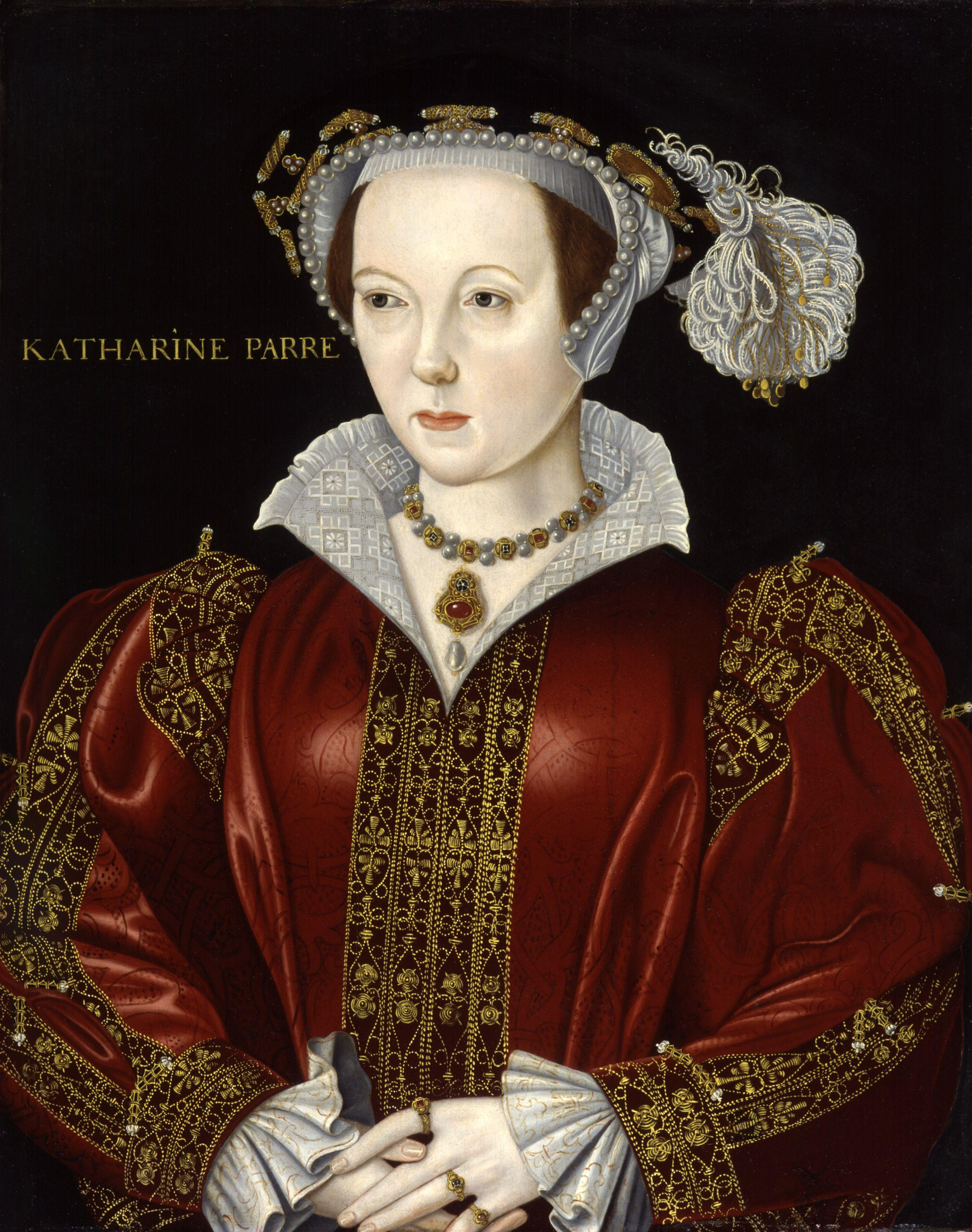


Whether Katherine was happy during her second marriage is unknown. If she had begun to harbour sympathies for the reformed religion around the time of the Pilgrimage of Grace, she might well have experienced tensions with her conservative husband. As in her first marriage, Katherine remained childless. In the spring of 1543, her fortunes changed drastically. Latimer died and, while serving at court in the household of Mary Tudor, Katherine attracted the ageing king. Like Anne Boleyn, Katherine reacted negatively when she learned that Henry wished to marry her. She seems to have harboured feelings for Sir Thomas Seymour, brother of Jane, and perhaps wished to marry him when her period of mourning for Latimer was at an end. Katherine, highly reluctant, eventually overcame her scruples upon concluding that it was God's will that she become queen. As she later wrote to Thomas: 'Howbeit, God withstood my will therein most vehemently... [and] made me to renounce utterly mine own will, and to follow his most willingly'. On 12 July 1543, Katherine married Henry VIII at Hampton Court Palace in a quiet ceremony.

Although Katherine Parr was fulsomely praised in her own lifetime and has been lauded by modern historians for her success as queen, she may initially have struggled for, like her predecessor Katherine Howard, she lacked experience at court. As Susan E. James writes, she was 'the only one of Henry's queens without either royal background or court service to train her for her new position'. Fortunately, Katherine quickly established excellent relations with her three stepchildren. She was already close to Mary on account of her brief time in Mary's household, and the new queen became closely involved in the education of both Elizabeth and Edward. The prince regularly wrote to Katherine informing her about the progress of his studies, while Elizabeth also frequently penned missives to her stepmother. Katherine's importance cannot be underestimated, for she was partly responsible for Henry's decision to include both Mary and Elizabeth in the line of succession.

Katherine Parr, like Katherine of Aragon, was an energetic, resourceful and active queen, and like Henry's first wife she was selected by the king to serve as regent in 1544 when he departed on a military expedition to France. Katherine's assertiveness may have caused resentment among the conservatives at court. She signed five royal proclamations as regent and was praised by her husband for her success in the role of regent. Henry appreciated Katherine's capability and aptitude for governance, but these same qualities later caused him irritation. It is interesting that Henry, after marrying the submissive Jane Seymour and Katherine Howard, once again selected an assertive and outspoken woman to be his final wife. Like Katherine of Aragon, Katherine Parr was, at least initially, not at all hesitant about speaking her mind in matters of religion and, perhaps, politics.


Above: "The Lamentation of a Sinner", published by Katherine in 1547 after Henry's death.

As stated in the introductory paragraph, of all Henry's wives, Katherine Parr's life has perhaps been described most realistically in modern times. However, one pervasive myth that concerns her is that she was something of an early feminist. Katherine's mother had been an independent, assertive and intelligent woman and, with her example in mind, it is unsurprising that Katherine grew up to value these qualities. Unlike Jane Seymour, who had submitted to Henry's control irrespective of her true feelings, or Katherine Howard, whose motto as queen was similarly grounded in her deference to Henry, Katherine Parr was outspoken, highly learned and opinionated, perhaps at times overbearing. These qualities were to place her in a position of danger. However, despite the example of her mother, Katherine was in no way a feminist transported back in time to Tudor England. 

She was the first English queen to publish her own work. As she perceived it, her most important duty was to advance the reformed religion. It had been God's will that she marry Henry, and she believed that it was God's will that she bring about the triumph of the 'godly' faith. In her analysis of Katherine's The Lamentation of a Sinner, Susan E. James argues that Katherine associated Christ with qualities that were usually linked to women: 'Christ was innocent, obedient unto his father... meek and humble in the heart... [who] came to serve... [and] despised worldly honour'. By contrast, the writer described herself as having qualities that were usually associated with men; she was 'disobedient and most stubborn... most proud and vainglorious... I coveted to rule over [my brethren]'. The Lamentation contained an inversion of contemporary gender roles, which underscored Katherine's 'interpretation of her own self-image as one who was set apart by virtue of position and understanding from her sex in general and from those restrictions commonly imposed on that sex in particular' [Susan E. James].

Katherine's assertive queenship, in which she undermined and challenged the conventional understanding of women as passive, frail and corrupt beings, had a profound influence on her younger stepdaughter Elizabeth. Perhaps Elizabeth's own triumphant style of rule was deeply affected by her experience of Katherine's queenship. However, as Susan E. James notes, it is going too far to read an early form of feminism into Katherine's beliefs. She was not denying the contemporary notion of female inferiority. In the same work, the writer instructed women to be silent and obey their husbands in all things. Women should be, according to Katherine, sober, dutiful, and submissive. Their primary role was as mother and wife. 

Even if Katherine was by no means an early feminist, her contemporaries viewed her as remarkable. John Foxe later described her as 'but a woman accompanied with all the imperfections natural to the weakness of her sex', but commented that she was 'very zealous towards the Gospel'. She was more assertive than Anne Boleyn, but she soon realised the dangers of appearing to question Henry's authority. Where Katherine of Aragon had occasionally dared to reprimand her husband, Katherine Parr was forced to deny her beliefs and submit herself entirely to her husband in order to survive.


Above: Sudeley Castle, where Katherine died in 1548.

Katherine's sympathies for the reformed religion, according to John Foxe, put her in a position of great danger. The conservatives, perhaps still harbouring resentment about the downfall and disgrace of Katherine Howard, harboured a secret desire to oust Katherine Parr from power. In the spring of 1546 Stephen Gardiner, bishop of Winchester, began plotting to destroy her and rumours of the queen's imminent disgrace began to circulate at court. In a moment of irritation, the king agreed to his wife's arrest. Fortunately for her, Katherine discovered the news of her impending arrest and, in a speech in which she submitted herself entirely to Henry's wisdom, secured her husband's forgiveness. It is possible that Katherine's speech of submission inspired that of Katherina in Shakespeare's The Taming of the Shrew. Katherine never again risked her husband's wrath and was more subdued in the final months of Henry's life.

Katherine Parr had been queen of England for three and a half years when her mercurial husband died on 28 January 1547 at Whitehall Palace in London. A few months later she remarried. Her fourth husband was the handsome Thomas Seymour, brother of Jane. Unfortunately, Katherine was not to experience lasting happiness in her new marriage. Her husband was reckless and irresponsible, and his scandalous relationship with Elizabeth Tudor caused Katherine dismay and despair. Elizabeth, who had resided in her stepmother's household, was banished. Katherine gave birth to her only child, Mary, on 30 August 1548. The child probably died before her second birthday. Katherine passed away less than a week later at the age of thirty-six. She was deeply mourned by her friends and family and was buried in Sudeley Chapel. Eleven-year-old Lady Jane Grey acted as chief mourner. 

In recent years, there have been several excellent studies of Katherine. They have established that she was an extremely important queen of England who was a key player in both the Reformation and the Renaissance in England. She was involved in the founding of Trinity College, Cambridge, and she was deeply interested in educational reform. She was also a patron of the arts, in particular music, painting, and drama. Katherine's model of queenship may have greatly influenced her stepdaughter Elizabeth's style of rule. She and Katherine of Aragon, her namesake, were probably the two most assertive and active of Henry's queens. Both were selected by the king to act as Regent of the country while he was abroad, and both shared similar personalities: they were assertive; energetic; passionate; articulate; and opinionated. Both were highly popular and were admired not only by their subjects but by foreign visitors and ambassadors at court. 

These studies have largely contributed to the dismantling of myths surrounding Katherine Parr, primarily the erroneous tale of her acting as her husband's nurse. Of all the wives, it is perhaps Katherine's personality which emerges most clearly. Admired in her own day, respected today, she is now perhaps the least stereotyped of Henry's queens. 

Sunday, 13 January 2013

Feminism and the Wives of Henry VIII?

Divorced, Beheaded, Survived: A Feminist Reinterpretation Of The Wives Of Henry VIII

As I have suggested in my articles thus far on Queen Katherine Howard, one of which will be published in Exeter University's The Historian in March 2013, gender is certainly a useful concept to employ when interpreting the lives of female figures. I was drawn to writing this article after having become reacquainted with Karen Lindsey's entertaining Divorced, Beheaded, Survived: A Feminist Reinterpretation of the Wives of Henry VIII. Lindsey is a feminist scholar, and she is certainly not the first feminist to approach the lives of Henry VIII's queens. Yet how far can gender and feminism be taken in approaching these extraordinary women's lives? This article will see a brief summary of each woman's life and queenship, before considering how gender and feminism can influence our interpretations of them.

Katherine of Aragon (1485-1536), Married June 1509, Marriage annulled May 1533
Queen of England 1509-1533. One child, Mary I (1516-1558) - suffered at least five failures in pregnancy.

Katherine was the youngest daughter of the illustrious couple Ferdinand of Aragon and Isabella of Castile, a formidable queen who allegedly gave birth to Katherine in December 1485 shortly after being involved in warfare against the enemies of the Spaniards, the Moors. Henry VII of England, recognising the power and prestige which the 'Kings of Spain', as Katherine's parents were known, held in Europe, set about achieving an Anglo-Spanish alliance to ensure the security and wellbeing of his nation, while aiming to advance both his lineage and that of his heirs. In view of this, a betrothal was inaugurated between Henry's eldest son, Prince Arthur, and the Infanta Catalina, as Katherine was known in Spain. Numerous delays for the marriage increased the English king's impatience, largely because Katherine's parents appear highly reluctant to let their beloved daughter leave her homeland. Nonetheless, in October 1501 Katherine set sail for England, at the age of fifteen, in order to marry Prince Arthur. She was received at Dogmersfield by the prince and his father in a greeting ceremony typical of the late medieval period, and married Prince Arthur in November in a glorious ceremony at St Paul's Cathedral. Tragically, the prince died in April 1502 from the sweating sickness, while Katherine herself was gravely ill. Whether or not the couple ever consummated the marriage is a matter of fierce dispute, with momentous consequences for Katherine's later future. Most historians, in view of Arthur's physical weaknesses, believe that Katherine remained a virgin, although others such as Joanna Denny insist that it was consummated. 

Katherine was later betrothed to Arthur's younger brother, Prince Henry, but that was later renounced by the prince on the orders of his father. Katherine endured some seven years in considerable neglect before Henry VII's death in 1509 saw his seventeen-year old son, now Henry VIII, deciding to marry the admirable Katherine, aged twenty-three. Katherine was extremely short, with beautiful long red-golden hair and blue eyes. She was known to be deeply religious, but was much loved by the English people for her kindness, composure and generosity. Unfortunately, Katherine's failures in pregnancy eventually led to the loss of her marriage. She suffered no fewer than five failures, resulting in either a miscarriage, a stillbirth, or the death of her child soon after the birth. Tragically, three of these were known to have been sons. One prince, born in 1511, survived for almost two months before his premature death. Nonetheless, Katherine gave birth to a healthy daughter, Princess Mary, in February 1516. By 1519, however, when she was thirty-three, Katherine was no longer able to conceive a child. This led to her husband taking mistresses; his most famous Elizabeth Blount giving birth to a boy, Henry Fitzroy, that year. Mary Boleyn may also have given birth to one or two children by him. 

Feminists usually see Katherine as a much wronged figure, the beloved wife set aside by her unfaithful husband merely because she was ageing and was no longer to bear children. Unsurprisingly, many Englishwomen flocked to her support during the king's annulment of the marriage. From 1527, Henry's desire to marry Anne Boleyn was widely known. Katherine was revered as the rightful Queen and Anne a strumpet. Katherine, nonetheless, fought determinedly and bravely to retain her marriage and to protect the rights of her daughter Mary. She lost, but not without achieving the wholehearted support of her people. Katherine died, alone and neglected, in Kimbolton Castle in January 1536. This occurred in the context of the king sending her to numerous castles, each one more unhealthier than the last. Rumours circulated that she had been poisoned after a black growth was found on her heart, but most modern historians believe that she died of cancer. Typically from the feminist perspective, Lindsey interprets Katherine as a strong, determined woman who was motivated to protect everything she held dear, and was unwavering in her love for Henry, despite his cruel treatment of her. Unwittingly, however, Katherine's resistance ultimately was a decisive cause in the English Reformation and England's later shape.

Anne Boleyn (c.1500x1507-1536), Married January 1533, Marriage annulled May 17, 1536, Beheaded May 19, 1536
Queen of England 1533-1536. One child, Elizabeth I (1533-1603) - suffered two failures in pregnancy.

Undoubtedly the most notorious of Henry VIII's queens, Anne Boleyn's life, more than any other of his wives, is shrouded in mystery and controversy. Even her date of birth remains uncertain. She was the daughter of Sir Thomas Boleyn, an influential diplomat and courtier at Henry's court, and Elizabeth Howard, a member of the most powerful family in the kingdom. In view of this, Anne was of better birth than any of Henry VIII's other English queens. Historians are unsure when she was born, and yet this gravely affects our interpretation of her career. If she was born around 1501, then she was likely the second child of the marriage, with an elder sister Mary and a younger brother George. Yet if she was born later, in the summer of 1507 as other scholars maintain, then she was the youngest child.

Anne was undoubtedly an intelligent, bright child, and in the summer of 1513 her father afforded her the excellent opportunity of serving Margaret of Austria in her court in Burgundy. Anne later transferred to the service of Mary Tudor, queen of France, in 1514, before passing on to serve Queen Claude until 1521. Later contemporaries praised Anne's accomplishments, mainly in music, dancing, fashion, and her love of literature and religion. One wrote that she was more French than English. In 1521, Anne returned home because her father desired her to marry James Butler, a distant relative, in order to solve a dispute between the Boleyn and Butler families about which family had the right to the Ormonde title. This marriage never occurred, however. It is possible that in around 1523 Anne had a brief relationship with Henry Percy, later earl of Northumberland, yet the two were unable to marry because Percy was betrothed to Mary Talbot, and Anne's birth was seen as inferior to his. Not surprisingly, this may have angered Anne. Possibly, she was sent from court in disgrace, yet she had returned some years later.

Henry had briefly enjoyed a relationship with Anne's sister Mary, but in around 1526 he turned his attentions to the younger, and probably more fascinating, sister. She was a charismatic, confident young woman of medium height, with expressive black eyes, pale skin and glorious dark hair, yet was not a conventional beauty. In terms of the king's attentions, Anne, however, was highly reluctant. Lindsey suggests that, in the modern sense of the word, Anne Boleyn was the victim of sexual harassment on a grand scale, which Joanna Denny takes further, even likening Henry VIII to a modern day stalker! What is clear is that he sent her a barrage of letters and gifts, pleading her to become his mistress. However, Anne, who clearly was proud of her lineage, refused, and suggested something more respectable. By June 1527 the king was determined to marry Anne. Unfortunately, the couple waited more than six years due to frustrating delays, prevarications by the Pope, foreign policy - since Katherine was the aunt of the Holy Roman Emperor, most powerful man in Europe - and the king's unwillingness to take an active stand. Anne, not surprisingly, became increasingly frustrated, bewailing that her youth had been lost to no purpose. The couple probably secretly married while abroad in Calais in November 1532, before participating in a more official yet secret ceremony in Whitehall Palace in January, 1533.

Most historians and the general public alike continue to view Anne, probably influenced by 'The Other Boleyn Girl', as a cold-hearted, ruthless woman who instructed Henry VIII to leave his virtuous queen and marry her. Yet it is likely that the exact opposite was true. Anne was reluctant to become involved with the king, seen by the evidence of his letters, and she probably agreed to marry him because she was unlikely to achieve a greater prospect and because it would damage her family's honour if she refused. She was a brilliant, charismatic woman, a charming courtier and yet highly religious, who did much to reshape the English Church. Anne was already pregnant when she was crowned Queen of England in June - the last of Henry's queens to be granted this lavish honour - and she gave birth to Princess Elizabeth in September. While the child's sex was a disappointment, the royal couple were not overly concerned as the queen conceived again shortly afterwards.

Catholics slandered Anne violently, maintaining that she was a witch, a concubine and a poisoner, and the Spanish ambassador, who loathed Anne, suggested that she was maltreating her stepdaughter, Mary. Yet Anne often asked Mary to come to court and serve her, if she would only willingly accept that her mother's marriage was invalid. Mary, stubbornly, refused, and it was only after Anne's death that she saw who the real culprit was for her mistreatment - the king. Anne, meanwhile, suffered concerns of a different nature, when her second pregnancy mysteriously ended in the summer of 1534. No historian is entirely certain of what occurred. If she became pregnant around November, then the child would have been due in August 1534, but it seems that in around July the queen either suffered a miscarriage or a stillbirth. This probably led to a brief separation between king and queen, due to the king's disappointment.

Aside from her fertility concerns, Anne was a strong figure who participated enthusiastically in religious and political affairs. She was highly interested in the reform of the monasteries and churches. Anne was known to be exceptionally glamorous, renowned for her love of fashion and her desire to be portrayed well in portraiture. Somewhat ironically, none of her portraits from life survive, probably all destroyed in the wake of her death. 1535 was a disappointing year, with many troubles from the executions of a bishop to bad harvests being blamed on the queen by the people, who loathed her. Yet Anne was in a strong position at the end of the year, as she was again found to be pregnant. Her position was further secured by the death of Katherine in January. Many opponents of Anne alleged that she had poisoned the late queen, yet there was no evidence of this. While the king celebrated in yellow, Anne apparently wept, fearing that her predecessor's fate would become hers if she did not deliver a healthy son.

The queen, tragically, gave birth to a stillborn son of three months conception in January 1536. One theory is that the child was deformed, an act which horrified the king and convinced him that his wife was a witch, leading him to set in process the annulment of his marriage and her execution. There is, however, no evidence to support this theory. Other contemporaries referred to the son as beautiful. Jane Seymour, whom the king had been flirting with recently, became more of a threat to Anne at this time. Nonetheless, Anne may have remained in a somewhat strong position until April 1536, when shockingly, she suddenly fell from power. No historian is certain of why this happened; Lindsey suggests it was because Henry VIII merely hated her and wanted her dead. Whatever the truth, the queen was arrested with seven men, one her own brother, and was charged with adultery, incest, plotting the king's death, and possibly witchcraft. Five of those men were executed. Two days later, the queen was beheaded at the Tower. Her courage and bravery was referred to by all contemporaries. It is virtually certain that she was innocent, and died in what one historian has termed a terrible miscarriage of justice. Many feminists view Anne as an outspoken woman, ahead of her time, yet victimised by ruthless male figures at court. Perhaps she was, as Lindsey suggests, a victim of sexual harassment, however anachronistic a term for a period 500 years ago.

Jane Seymour (c.1509-1537), Married May 1536, Died October 24, 1537
Queen of England 1536-1537. One child, Edward VI (1537-1553).

Shockingly, the king married his former queen's maid of honour, Jane Seymour, merely eleven days after Queen Anne's execution. Even the English people, who had hated Anne, murmured how strange it was that in the same month that saw Anne 'flourishing, accused, condemned and executed, another was assumed into her place.' Jane Seymour, arguably, is the most mysterious of Henry's queens. Unlike the other five, we know virtually nothing of her personality, thoughts or beliefs; whether she truly believed her former mistress to be guilty, or whether she felt any remorse for it. Readers who have read my last post on Anne Neville may note similarities between these two queens in terms of their opaqueness. 

Probably the eldest daughter of Sir John Seymour and his wife Margery, Jane was born around 1509 in Wiltshire. She had experienced a long, if unremarkable, career at court serving both Katherine of Aragon and Anne Boleyn. She certainly was Anne's maid of honour by Christmas 1533, for she is noted to have received a gift, as other ladies did, from the king. When the king's flirtation with Jane occurred is unclear, probably either in the autumn of 1535 or in the early winter of 1536. Jane, by this time, was about twenty-seven, a considerably advanced age to remain single in the early modern era. Rumours alleged that she had been betrothed to William Dormer, yet nothing had come of the match. The Spanish ambassador, who supported her when Anne fell from power, implied that Jane was neither as innocent or as honourable as many believed her to be.

Jane was no great beauty, as portraits of her show. She was believed to be of middling height, with fair hair, a pale complexion and a quiet temperament. Probably the most unremarkable of Henry's wives, as David Starkey scathingly writes: 'How a woman like Jane Seymour became Queen of England is a mystery. In Tudor terms she came from nowhere and was nothing.' Most historians, such as Jane's biographer Elizabeth Norton, suggest that she actively played a crucial role in Anne Boleyn's downfall. Not surprisingly, Victorian historians castigated her while romanticising Anne.

Jane became Queen at  the end of May 1536, although she was never crowned. She appears to have been an effective consort in terms of managing her household and regulating her affairs, although her queenship lacked the charisma or brilliance of Anne's court, or the intellectual climate and religiosity of Katherine's. The king privately worried in the summer of 1536 that his new consort could not conceive, perhaps a sign that this period saw the beginning of his impotence. Jane graciously welcomed Mary, now twenty, to court, and she also showed some kindness to Elizabeth, although this child was largely neglected in the wake of her mother's death. The one instance where Jane dared to speak up to the king occurred in the autumn of 1536, when rebels rose in the Pilgrimage of Grace. She asked the king to stop the dissolution of the monasteries, but he brutally advised her to remember her predecessor's fate.

Jane became pregnant in January 1537, and in October she at last gave birth to the king's long-awaited son, Edward. Tragically, as England celebrated, the queen fell tragically ill. Her condition worsened until, in the early hours of 24 October, she died from childbed fever, a common killer of women in the early modern period. The king mourned her deeply, as did Lady Mary, who had been close to her. Whether the king really loved her best of all his wives is doubtful. She had provided him with the male heir, but their relationship lacked the passion of the marriage to Anne Boleyn, the king's devotion for Katherine Howard, or his gentle love for Katherine of Aragon. It was perhaps more  alike that of his marriage later to Katherine Parr - affectionate, but not passionate. Feminists interpret Jane as a strong figure who was well aware of what she was doing. That has, however, not prevented Lindsey labelling her 'the vessel'.

Anne of Cleves (1515-1557), Married January 1540, Marriage annulled July 1540
Queen of England 1540. 

Probably the most comical of Henry's queens, Anne of Cleves had a superb lineage as a German noblewoman. After being single for two years, the king desired to marry again in order to produce more male heirs. Not surprisingly, many European ladies trembled at the prospect; the seventeen-year old outspoken Duchess of Milan famously remarking that if she had two heads, one would be at the king's service. Cromwell, the king's minister, convinced him that an alliance with the Protestant German princes would be advisable for England's security, due to increasing hostility from both France and Spain. Henry, recognising this, agreed to marry Anne in order to cement an alliance between England and Cleves.

Anne was twenty-four at this time. She was believed to be gentle, composed, highly intelligent, kind and companionable, traits which would be proven with time, but her physical appearance, famously, was believed to be dubious, while she lacked many queenly skills necessary at the English court, including musical ability and enjoyment of dancing. In the strict Protestant climate of Cleves, these pasttimes were viewed as frivolous and ungodly. Nonetheless, Holbein, the king's painter, painted Anne in 1539, depicting her as delicate and pretty, although it seems likely that he exaggerated her charms. Anne arrived in England in December 1539, when the king, unable to conceal her impatience, decided to greet her formally in Rochester. He was reported to be devastated with his prospective bride. Whether Anne was really unattractive is difficult to fathom. Many modern critics have suggested that her portrait presents her as more attractive than the likes of Jane Seymour and Katherine Parr.

Nonetheless, Anne was a charming woman who quickly became popular with the English people, the French ambassador later remarking that they had never loved a queen more. Unwillingly, Henry married her in a splendid ceremony at Greenwich Palace on 6 January 1540. The new queen seems to have been unaware of her husband's discontent. Testimony confirms that the marriage was never consummated. Probably a reason for this was Henry's mounting worry that, because Anne was believed to have been precontracted to the duke of Lorraine earlier, she was not his wife in reality. Cromwell undoubtedly experienced increasing concern, even panic, as the king audibly voiced his discontent. One can only pity Anne. Lindsey maintains that she was a sensible, courageous woman, bearing her state and her marriage well. Unfortunately, despite her respectable qualities and her good relationships with the king's children, Anne's marriage was annulled in July 1540. The king quickly married her former maid, Katherine Howard, whom Anne appears to have shown no jealousy or unhappiness towards. She quickly settled down into an enjoyable routine in the country, occasionally visiting court and residing at Hever Castle, Anne Boleyn's childhood home. When Katherine was executed  two years later, German envoys enquired if the king might be persuaded to take Anne back as his wife, but both they and she were to be disappointed when the king later married Katherine Parr. Anne died in 1557, during Mary I's reign. Popular with many, she was undoubtedly the most fortunate of Henry's queens.

Katherine Howard (c.1524-1542), Married July 1540, Beheaded February 13, 1542.
Queen of England 1540-1541/2. 

In contrast with her predecessor, Katherine Howard was undoubtedly the most tragic of Henry's consorts. Uncommonly beautiful, charming and kind, this gentlewoman attracted the notice of the king in the early spring of 1540, when his discontent with the Queen was rife. Her family, perhaps sensing an excellent opportunity to further the prestige of their family, probably spurred her on, unaware of her the nature of her childhood. The king married Katherine on 28 July 1540 at the pleasant 'hunting-box' palace, Oatlands in Surrey. He was aged forty-nine and his new queen no older than seventeen. Not surprisingly, the age difference attracted comment.

Katherine showed some kindness towards Princess Elizabeth, her distant relative since she was a cousin to Anne Boleyn, but she endured a more difficult relationship with Mary, who was around eight years older than her new stepmother. It is unlikely to have been Katherine's 'frivolous' temperament which annoyed Lady Mary, as some historians suggest, but it may have been because Mary was aware of rumours circulating about the new queen's childhood, which had been reported to, and angrily dismissed by, the king in the summer of 1540. 

Katherine struck a friendship with her husband's favourite, Thomas Culpeper, in the spring of 1541. Lindsey, like other historians, fiercely believes that the two enjoyed a sexual relationship, and views this from her feminist perspective as evidence that Katherine was a thoroughly modern woman who listened to and gave in to her body's yearnings, of which she knew she had control over. In the book, this is probably the most dubious interpretation of any of the king's wives. There is little to no evidence that the couple enjoyed any sexual encounters, and it was probably no more than friendship, although evidence of a letter written by the queen to Culpeper suggests that she may have gradually fallen in love with him. Unfortunately, evidence of this came to the Council's attention in autumn 1541, when they also became aware of Katherine's premarital indiscretions with Francis Dereham, who had returned to court, probably hoping to reclaim the woman he viewed as his lawful wife. 

The queen denied everything, but evidence emerged of her encounters with Culpeper, assisted by Jane Rochford, while the councillors strongly suspected she had resumed a sexual relationship with Dereham. Both men were executed brutally in December, while the king mourned his bad luck in choosing wives. Katherine and Jane were beheaded in February 1542, the teenage queen terrified with fright and meekly submitting herself to the axe. Unsurprisingly, this led Victorian historian Agnes Strickland to write: '...without granting her the privilege of uttering one word in her own defence she was condemned to die... she was led like a sheep to the slaughter'. She was probably guilty of nothing more than a childhood relationship before her marriage and indiscreet meetings with a courtier at court, yet fertility politics interpreted this differently and sealed her fate.

Katherine Parr (1512-1548), Married July 1543, King died January 28, 1547, Died September 5, 1548.
Queen of England 1543-1547. 

Often unfairly viewed as the most unimportant of the six queens of Henry VIII, Katherine Parr is actually one of the most interesting. The eldest daughter of an influential courtier (similarly to Anne Boleyn) Thomas Parr and his wife Maud, Katherine experienced a privileged childhood where she learned several languages and essential feminine skills such as household management, embroidery, and dancing, taught by her ambitious mother, who at  this time was a lady-in-waiting to Katherine of Aragon. It is likely that Katherine was named after her. Tutors were also employed, and Katherine developed an interest in medicine.

In 1523, when Katherine was only eleven, her mother began to arrange a marriage between her and Henry Scrope, heir to Lord Scrope of Bolton, but nothing came of it. However, in 1529 Katherine married Edward Borough, yet historians doubt whether this was a satisfactory marriage. Following her mother's death, and that of her husband, Katherine later married John Neville in 1534, who was aged twenty years her senior. He was involved in the Pilgrimage of Grace, to some extent a Catholic rebellion, but ironically it is possible to suggest that Katherine developed an interest in the reformed religion, for which she would become famous, around this time. He died in 1543, leaving Katherine, once more, a widow aged thirty-one.

The previous year, Katherine had successfully achieved a place in the household of Princess Mary, whom she may have known well, since her mother had once served Mary's mother. Katherine probably obtained this due to the influence of her sister Anne at court, who had served Katherine Howard. It seems around this time that Katherine fell speedily in love with the influential courtier Thomas Seymour, brother to the late queen, although it is possible that he was more interested in her assets rather than her personal charm. However, this affair came to nothing, since the king became enamoured of Katherine's favourable attributes and proposed marriage. Apparently, she professed concern, but this did not prevent the marriage taking place in July 1543 at Hampton Court. 

Katherine was close with all of the king's children, and played a highly suitable  role as their new stepmother. The youngest two, Elizabeth and Edward, were highly scholarly, and it seems possible that  the new queen's Protestant sympathies indirectly, or directly, influenced their religious views. One of Katherine's greatest achievements came in 1544 when her husband selected her, like the first Katherine, to act as Regent during his wars abroad. She fulfilled  this role excellently, and attracted further praise from contemporaries for her abilities.

Unlike the king's previous queens, fertility politics did not play a significant role in this marriage, perhaps because the king realised that more children were no longer possible at his advanced age, while the queen, in her mid-thirties, was not regarded as young by Tudor standards. However, the queen's Protestant views made her vulnerable in a court seething with factional discontent. The conservatives, who probably deeply resented the loss of their influence following Katherine Howard's disgrace, used Katherine's sympathies to construct a plot against her in 1546. This was aided by Katherine herself, since the queen liked to engage in religious debates with her husband. This gradually irritated him, seeing his authority as weakened. The notorious execution of the heretic Anne Askew, whom Katherine was believed to have known and perhaps favoured, intensified the plot. A warrant for the Queen's arrest was drawn up, probably with the king's knowledge. Luckily, the queen discovered this, and was able to save herself, although she experienced severe shock, remembering her predecessor's fate. From then on, Katherine realised that discretion was needed with her personal religious views. Luckily, she survived, and her husband died in January 1547 aged fifty-five.

Katherine was a wealthy widow at the time she was widowed, yet scandalously three months later she married Thomas Seymour, alienating Lady Mary and other courtiers. Katherine probably did not know that Seymour had approached both Mary and Elizabeth previously to see whether they would agree to marry him. Tragically, rumours circulated that Elizabeth, who now resided in Katherine's household at Chelsea, enjoyed a notorious affair with the womaniser Seymour, which the dowager queen to an extent encouraged, probably not realising the risks involved. However, when the affair progressed too far, Katherine decided to send Elizabeth away, which deeply upset the princess. In December 1547 Katherine became pregnant, and was delivered of a daughter Mary in August 1548, who probably died shortly afterwards. Katherine, like Jane Seymour before her, contracted childbed fever, and passed away a week after the birth. She allegedly expressed sorrow to Seymour about his regrettable behaviour. 

Often viewed by historians as a nurse who looked after her ageing husband, Lindsey and other feminists make clear that she was a courageous, devoted woman who did much to shape religious affairs in England, and was a strong political figure in the English court.

This article hopefully conveys the usefulness of gender in historical analysis, and how it can shape our understandings of the past.

Tuesday, 8 January 2013

Medieval Queens: A "Beautiful Woman" and a "Reluctant Queen"


Sisters-in-law and successive Queens of England, Elizabeth Woodville (or Wydeville) and Anne Neville are two of England's forgotten medieval queens. Eclipsed by more charismatic and intriguing consorts, such as Anne Boleyn, or foreign princesses such as Eleanor of Aquitaine or Katherine of Aragon, this seems somewhat surprising, given that both played a significant role in the civil conflict known as 'The Wars of the Roses' in the period 1464-85. Exceedingly different in their personalities, Elizabeth and Anne endured strikingly different marriages and queenships.

Elizabeth Woodville (1437?-1492)

Elizabeth was the eldest daughter of Sir Richard Woodville, who became 1st Earl Rivers, and his foreign wife, the wealthy Jacquetta of Luxembourg, dowager duchess of Bedford and, according to legend, descendant of the goddess Mesulina, likely born in 1437-8. This marriage was seen as shocking, for Jacquetta, with her superb foreign lineage and prestigious first marriage, was believed to be too great a prospect for the relatively lowly Woodville. As examples of Jacquetta's breeding, she was connected with European emperors and her relatives held important positions in Europe as bishops or counts. In view of this, her decision to align herself with a gentry family considerably disparaged her social status in the eyes of contemporaries. Nonetheless, this striking lineage is likely to have been considerably important to her daughter, Elizabeth, when she married a king some years later and was resented by other court figures for her 'lowly' position. Elizabeth's younger siblings comprised five brothers and six daughters. Undoubtedly, the size of the Woodville family attracted substantial hostility in later years when it was felt they were monopolising prestigious marriage alliances in England.

Some scholars have maintained that Elizabeth, at the age of eight years old, became a maid-of-honour to the French queen Margaret of Anjou, English queen consort of King Henry VI, in 1445. Those with knowledge of medieval and early modern customs will appreciate that adolescent females were usually expected to be around thirteen years old to serve as maids of honour to queens, as the controversial later case of Anne Boleyn demonstrates. Other historians, such as Michael Hicks, suggest that this identification is mistaken. Certainly, Elizabeth spent her childhood in Northamptonshire probably acquiring social and marital skills viewed by the gentry as fundamental, including the ability to manage one's household, to sing, dance, and acquire proficiency in traditional feminine areas such as sewing and embroidery.

According to contemporary sources, Elizabeth was very beautiful. One remarked that she was "the most beautiful woman in the Island of Britain", but her eyes were referred to as being "heavy-lidded like those of a dragon". If made during her queenship, this comment was perhaps disparaging of Elizabeth, viewing her as scheming, volatile or unpredictable, which may have been characteristics associated with the dragon, a mythical creature central in medieval culture. The above portrait, painted in the sixteenth century, conveys a well-dressed, confident young woman. The fact that Elizabeth was the first queen to sit for an individual portrait suggests that she regarded appearance as highly important. She was believed to have a pale complexion and superb long blonde hair.

In 1456, at the age of about nineteen, Elizabeth married her first husband, Sir John Grey, who was the eldest son and heir of Edward, Lord Ferrers of Groby. According to medieval family and social customs, it seems likely that Elizabeth's parents arranged this marriage for her, which can be seen as a highly successful alliance. Daughters often married in their teenage years to achieve alliances with other prominent families in order to ensure social security and prestige. Elizabeth gave birth to two sons, Thomas, future marquess of Dorset, and Richard. Sir John, unfortunately, died in 1461 after only five years of marriage.

The circumstances of Elizabeth's meeting with Edward IV, king of England following the successful deposition of the insane Henry VI, are highly controversial and have been mythologised spectacularly, as seen in Philippa Gregory's novel "The White Queen" (2009). What is clear is that following John's death Elizabeth was left in considerable financial difficulties. These difficulties meant that she was forced to turn to the king himself for assistance. However, the fact that Sir John Grey had fought on the Lancastrian side at the Second Battle of St Albans, a significant battle during the prolonged Wars of the Roses, was not likely to endear Edward IV, the Yorkist king, to his beautiful if, in his eyes, disloyal widow. After having sought the assistance of William, Lord Hastings, the king's chamberlain, Elizabeth petitioned the king.

According to later stories - which must be seen as suspect - Edward IV intended to persuade Elizabeth to sleep with him, after having agreed to her suit. The new king, only in his early twenties, was amorous and jovial, enamoured of beautiful ladies. Mythologised dramatically in Gregory's novel, Elizabeth is said to have refused assertively, even drawing her dagger and threatening to stab herself if the king dared to violate her. Edward, apparently, was so impressed that he immediately proposed marriage to her. Although this account is far-fetched, to say the least, it is plausible that King Edward fell deeply in love with Elizabeth Woodville when he met her, for she was confident, enigmatic, beautiful and, perhaps most important to a new king, of fruitful stock, having borne 2 sons herself and having no less than eleven siblings. The two married on 1 May 1464 at Elizabeth's residence in Northamptonshire. This must be interpreted as a spectacular family triumph for the Woodvilles. Unfortunately, it attracted considerable hostility from other nobles, while the king's closest advisers, namely Richard, earl of Warwick, viewed the king's actions as stupid and reckless. According to medieval royal customs, kings traditionally married females from other royal houses to ensure strong alliances between countries and to improve or bolster their familial lineage. By marrying a commoner, Edward set a precedent for later queens of England, most famously for those of his grandson Henry VIII.

On 26 May 1465, Elizabeth was formally crowned queen of England. According to contemporaries, there was 'universal disapproval' to the match, in the words of Michael Hicks. Polydore Vergil, a Tudor historian, asserted that it was motivated by 'blynde affection, and not be reule of reason'. Even the king's relatives, including his formidable mother the duchess of York and his brother Richard, were not enamoured of his new wife. Elizabeth gave birth to the couple's first child, Elizabeth later queen of England, in February 1466. Like her mother, Elizabeth proved to be a fruitful bride, giving birth to ten children in some nineteen years of marriage, of whom eight survived to adulthood. She was granted secure revenues as queen, although these were worth considerably less than those of previous medieval queens.

Elizabeth was not a popular queen. Her family was perceived to be scheming and greedy; her eleven siblings caused substantial resentment, since because they all had to be married to other nobles, this left few other marriage alliances possible for other nobles. Katherine, the queen's younger sister, was married to the youth Henry Stafford, second Duke of Buckingham, who apparently responded by throwing a tantrum. Elizabeth's brother John, who was twenty years old, was married to the 69-year old Katherine, duchess of Norfolk, which caused major controversy and disbelief. Ironically, John predeceased his aged wife. The queen's other siblings were married to the sons of the earls of Kent, Pembroke and Essex. However, while this angered other nobles, it should surely be seen as natural for the queen to achieve successful marriage alliances at court for her relatives and friends, well established in royal precedent.

The queen's personality is something of an enigma. Judging by later actions, she was brave, courageous and resourceful, but during her queenship she was perceived to be cold, ruthless, calculating, scheming, manipulative and common; like Anne Boleyn sixty-five years later, it was commonly believed that Edward had only married Elizabeth for her beauty, ignoring her lack of suitable qualities to be queen. Viewing Elizabeth with gender and sexuality in mind allows a more nuanced understanding. Her beauty and sexual fascination attracted curiosity or hostility, yet she was in some ways a suitable medieval consort, in particular due to her ability to bear many children. This was necessary, for, as has been pointed out, no consort was ever really safe until she had done that. Others associated her and her mother with witchcraft, largely because of the belief that they were related to Melusina, the goddess and/or witch of legend. Jacquetta was accused of witchcraft by one of Warwick's followers, but was shortly after acquitted. This occurred in context of Warwick's increasing dissatisfaction with the king, intensified by his hostility to his marriage with Elizabeth.

Warwick resented the Woodvilles' increasing hold on power in the English court. Fearing his loss of influence, he associated himself with the king's dissatisfied younger brother, George duke of Clarence, and it is possible that the two plotted to remove Edward and establish George as king. Rumours alleged that the king's mother was also involved. Warwick rebelled in 1469, aiming to eliminate members of Elizabeth's family prominent at court. This spectacular coup saw the king fleeing into exile in October 1470, while the queen sought sanctuary at Westminster Abbey, where she gave birth to her son and heir, Edward Prince of Wales, who was later murdered as one of the Princes in the Tower. Her husband successfully returned to power in 1471, and the unfortunate Henry VI, who had briefly become king again, was murdered on the orders of the king in the Tower. Warwick had died in battle at Barnet.

Elizabeth was a conventional medieval queen consort in participating in pious acts and by co-founding Queens' College, Cambridge, although some have alleged that she did this merely to attempt to wipe out the memory of its previous founder, Margaret of Anjou. 1478 saw Elizabeth's younger son, Richard, who was merely five years old, marrying Anne Mowbray. That same year saw the execution of the king's brother Clarence, an act which revolted English society and was laid at the hands of the queen. She had certainly supported Edward's other brother, Richard, against Clarence, and in the words of Hicks, Clarence's 'trial was peppered with substantial Woodville involvement'. Considering gender, however, allows one to modify this view. Although Elizabeth may have feared or resented Clarence, it was ultimately the king who ordered the judicial murder of his own brother. Medieval society always blamed the woman, identifying them as evil and instruments of the devil. Elizabeth was almost certainly portrayed as evil or murderous in order to present her as a scapegoat for her husband's actions.

Elizabeth became Queen Mother following the death of her husband in 1483 at the comparatively young age of forty-one. His lust and gluttony was held responsible for his premature demise. The Woodvilles and Hastings' faction had become bitterly divided at court and, although Edward had tried to reconcile the two on his deathbed, conflict erupted following his death. The queen and her family dominated the council in the wake of the king's death and plans were on hand for the immediate coronation of the eldest royal son, Edward, aged twelve. Unfortunately, however, it seems likely that the hostility towards the queen's family intensified now, and the queen was more vulnerable without her husband's protective influence. Richard, duke of Gloucester, who had previously co-operated with both Edward and Elizabeth, appears to have panicked, fearing his loss of influence at court, although others alleged that his conspiracy to attain the throne had been devised and planned for some time. Anthony Woodville, brother to the queen, and her father John were both arrested and beheaded, a cruel act which must have angered and upset the queen. The new king, Edward V, was also seized by his uncle.

Although Edward V was conveyed to London by Richard, Elizabeth was not reassured by Richard's letters, mistrusting and fearing him. Demonstrating his panic, Richard had Hastings, the king's closest friend, beheaded in the early summer. On 25 June 1483, the act 'Titulus Regius' asserted that the late king's marriage to Elizabeth Woodville had never been valid, on the grounds of his precontract to Eleanor Butler. In effect, the new king and his brother, Richard, were bastards, and their uncle, Richard, the only legitimate claimant to the throne. The queen was accused of plotting against Richard with several others, including the late king's mistress Jane Shore, and was also accused of witchcraft. She resided in sanctuary at Westminster Abbey, although she later gave up her younger son, Richard, into the hands of the by now new king Richard III.

Whether Elizabeth actually gave up her younger son to Richard is fiercely contested. There have been controversial theories about the deaths of the two Princes in the Tower, relating to whether it was Richard III, Henry VII, or someone else who had them murdered, and whether both boys were the Princes, or whether one was an impostor and the real young Prince Richard protected. Undoubtedly, the legitimate king Edward V was murdered, aged twelve. By the autumn of 1483, the boys were no longer seen at the Tower, making it virtually certain they had been killed by that time.

Elizabeth remained a figurehead for rebellion. She appears to have begun plotting with Lady Margaret Beaufort, a Lancastrian, and arranged for her daughter Elizabeth of York to marry Margaret's son, Henry Tudor, if he successfully became king. We know with hindsight that he did, defeating Richard at Bosworth in 1485 and marrying Elizabeth of York in 1486, who gave birth to her first son Arthur that year. However, the Queen Mother did not enjoy complete happiness during her daughter's queenship. Her dower lands were confiscated, and it was alleged that she was plotting against her new daughter, for which there is no proof. She died in 1492 and was buried beside her husband, Edward IV, at St George's Chapel, Windsor. Never a popular queen, Elizabeth lived a spectacular life. Although probably both her sons tragically were murdered, she ultimately triumphed with the accession of her daughter to the throne, having married the Lancastrian king, Henry Tudor, and founding a new Tudor dynasty.

Anne Neville (1456-1485)

The woman who followed Elizabeth Woodville to the throne following the death of her husband Edward IV was Anne Neville, her sister-in-law. She was the daughter of Richard Neville, earl of Warwick, who had rebelled against Edward in the 1460s before dying at Barnet in 1470. Like Elizabeth, Anne was a prominent figure in the Wars of the Roses. Her life, like Elizabeth, was extraordinary. Little is known about Anne personally. Like another queen consort, Jane Seymour, who reigned fifty years later, Anne's personality is shrouded in mystery. A chronicler, knowing her personally, described her as being beautiful, virtuous and gracious.

Anne was of better birth than Elizabeth Woodville, since her father was of an old and noble family prominent in the north of England. Anne spent most of her childhood at Middleham Castle, where she and her younger sister Isabella later met the Duke of York's sons, Richard (later king) and George duke of Clarence. In 1469, Isabella married Clarence and, the following year, Anne was betrothed to Richard duke of Gloucester.

However, Anne was not fated to marry Richard at this time. Political unrest and dissatisfaction at court, led by Anne's father Warwick, had led to the insane king Henry VI reigning again and the deposing of Edward IV. The Treaty of Angers, conveying the international scale which the Wars of the Roses had encompassed, provided for Anne Neville to marry Edward, prince of Wales, who was the son of Henry VI and his queen, Margaret of Anjou. They were betrothed on 25 July and married in December 1470. Anne's husband, Edward, died at the battle of Tewkesbury, leading to the successful coup by Edward IV in recovering his throne.

This left Anne in a precarious situation. Not only had her father Warwick been slain at Barnet in 1470, but she was now a widow at fifteen years old, and probably suspected of disloyalty by the king and his queen. Since she was a powerful heiress in her own right, she was a magnet for wealthy and ambitious courtiers seeking to improve their financial and social status. Richard, however, still desired to marry Anne. On 12 July 1472, Anne and Richard were married at Westminster Abbey, while their principal residence was Anne's childhood home, Middleham Castle. Anne gave birth to a son, Edward in 1473, who tragically died in 1484, aged eleven, meaning that Richard, who by then was king, had no male heir to succeed him.

Having established the events of the coup of 1483,  following his triumph as king, Richard's wife Anne became Queen of England that summer. Since she was accompanied by less than half the knights Elizabeth Woodville had enjoyed, this has been seen as evidence that the new royal couple were viewed with hostility or discontent by the English population. Of course, we do not know Anne's private thoughts either about her new status or her husband. Since she came from an ambitious family, it is possible that she enjoyed being queen, the highest social and political status a medieval woman could aspire to.

However, Hicks has downplayed her importance, suggesting that she was 'an insignificant queen' because of her frequent ill health. She did not control her own inheritance or have the dowerlands assigned to other queens. The death of her son severely upset Anne, but she was unable to provide Richard with another one. Perhaps in view of this, rumours circulated that Richard meant to put aside his queen and replace her with his own niece, Elizabeth of York, daughter of Elizabeth Woodville. This problem was tragically, if speedily, resolved on 16 March 1485, when Queen Anne died at Westminster, perhaps of tuberculosis. Nonetheless, Richard's enemies alleged that he had poisoned his young queen, since she was unable to provide him with a male heir following the death of the prince a year previously. Anne was later buried in Westminster Abbey.

It would be fair to say that Anne Neville is one of the more neglected or insignificant queens of England in our history. Like Jane Seymour, we know nothing about her personal thoughts, motivations or feelings during her life. A typical medieval woman in that her life was controlled and shaped according to the wishes of her father and later two husbands, she reigned for only two years before her untimely demise, although it seems that she had been suffering from ill health for a conspicuous period. What is reasonable to suggest is that she was the antithesis of her predecessor, Elizabeth Woodville, a courageous and determined woman who nonetheless alienated many at the English court. Both women, however, played important roles in the Wars of the Roses, even if they saw significantly differing experiences as queen.


Wednesday, 2 January 2013

"Willing Executioners" - do the German people have a history of persecution which renders them different to other nationalities?


Two famous authors in their respective fields, Daniel J. Goldhagen and Anne L. Barstow, have suggested in their works that the German people have a long history of persecution which in some way renders them unique amongst other nationalities. Leading to accusations of racism or xenophobia, both have maintained that German persecution was fundamentally unique in its evil. Yet is this the case? This article will consider both the merits and flaws of the examples given in these works in order to deduce whether their claims can be supported. These two case studies will be considered in debating this disturbing question.

Barstow is a historian specialising in European witchcraft and is notorious in academia for her pro-feminist perspective. Indeed, some have suggested that she takes it to the extremes and her claims can therefore be said to be nonsensical. Her book "Witchcraze: A New History of the European Witch Hunts" is, however, harrowing in the details it provides of the tragic mass persecutions of thousands of 'witches' - mostly women - across Europe, ranging from Scotland to France to eastern Europe to the German lands. Perhaps the most graphic case study, gruesomely described, is that of the Pappenheimer family in 1600. A brief overview of this case will be given before deciding whether the Germans really were unique in their persecution, in this case of witchcraft.

This family, in 1600, were dwelling in Bavaria, Germany. The Pappenheimer family were amongst the lowest in the social system prevalent in Bavaria at  this time, and even today their name can be used as a nickname for a garbage man. Paulus was the father, and was married to Anna, who was in her fifties in 1600. They had three sons, Jacob, Gumpprecht and Hoel/Hansel, who was only ten at this time. The family's occupation was that of beggars. They thus attracted hostility and contempt from their neighbours. Undoubtedly, however, this family was not only targeted because of its low social status but because they were Lutherans in a Catholic duchy; as in Europe during the sixteenth and seventeenth centuries, Germany was ravaged by religious hostility, often leading to widespread bloodshed and execution which accelerated in the witch-hunts. Not by coincidence was the persecution of witchcraft most severe in German lands, largely because of religious upheaval.

Selected by a thief, the family were accused of witchcraft. On the order of the Duke, Maximilian I, who ruled Bavaria, the Pappenheimers were taken to Munich and tortured into confessing to everything they were accused of. Contemporaries, in the words of Michael Kunze, identified this family as "instruments of the devil", probably because of both their contemptible social status and heretical religious beliefs. Indeed, Kunze suggests that "Duke Maximilian certainly regarded the execution as a means to stabilize safety in his country", through rooting out heresy which divided his people. The family confessed to hundreds of crimes, including theft and murder, although the severe torture meted out to them certainly means that we cannot treat their confessions as true or honest. They also admitted to sorcery and named accomplices.

Barstow records, in excruciating detail, the events which followed this. Readers should bear in mind that the executions took place in public, following ceremonial processions attended by hundreds of people:

"They were stripped so that their flesh could be torn off by red-hot pincers. Then Anna's breasts were cut off. The bloody breasts were forced into her mouth and then into the mouths of her two grown sons... a hideous parody of her  role as mother and nurse...
Church bells pealed to celebrate this triumph of Christianity over Satan; the crowd sang hymns; vendors hawked pamphlets describing the sins of the victims...
Meanwhile, Anna's chest cavity bled. As the carts lurched along, the injured prisoners were in agony. Nonetheless, they were forced at one point to get down from the carts and kneel before a cross, to confess their sins. Then they were offered wine to drink, a strangely humane act in the midst of this barbaric ritual.
One can hope that between the wine and loss of blood, the Pappenheimers were losing consciousness. They had not been granted the 'privilege' of being strangled before being burned, but in keeping with the extreme brutality of these proceedings, they would be forced to endure the very flames.
Further torments awaited Paulus. A heavy iron wheel was dropped on his arms until the bones snapped... Paulus was impaled with a stick driven up through his anus...
The four Pappenheimers were then tied to the stakes, the brushwood pyres were set aflame, and they were burned to death. Their eleven-year-old son was forced to watch the dying agonies of his parents and brothers. We know that Anna was still alive when the flames leapt up around her, for Hansel cried out, 'My mother is squirming!' The boy was executed months later".

This horrific case study can only be viewed as exceptional in the European witch hunts in the period 1550-1750. Undoubtedly, they were most severe in German-speaking lands, as other scholars have identified, and exemplified by infamous persecutions in Trier, Wurzburg and Bamberg. Barstow takes this trial as evidence of the gender-orientated nature of the witch-hunts, sadistically torturing and murdering women in ways which reflected both the perpetrator's sexual longings and fear, even hatred, of women. Yet does this provide evidence that the Germans are a nation who persecute others more violently and cruelly in times of crisis - ie. social problems, economic unrest and religious upheaval in the 1600s - than other nations?

If Daniel J. Goldhagen is to be believed, then yes. Obviously, the two historians focus on significantly different periods; Barstow witch persecutions in the sixteenth and seventeenth centuries, Goldhagen the extermination of the Jews during World War Two. Yet both scholars indicate that Germans are exceptional in their desire to persecute others. This is demonstrated graphically in Goldhagen's notorious book, "Hitler's Willing Executioners: Ordinary Germans and the Holocaust", published in 1996.

For those who are not aware of Goldhagen's thesis, he suggests that ordinary German people turned against their Jewish neighbours during the Nazi dictatorship out of underlying anti-Semitism and hatred towards Jews, acting in conjunction with a bloodthirsty desire to exact brutal and sadistic revenge on what they deemed 'inferiors'. Not only, in Goldhagen's eyes, were 'Germans' anti-Semitic beliefs about Jews... the central causal agent of the Holocaust', but 'ideas about Jews that were pervasive in Germany... induced ordinary Germans to kill unarmed, defenseless Jewish men, women, and children by the thousands, systematically and without pity'.

However, as Carr warns us, 'study the historian before you study the facts'. This wise quote should be considered in relation to both Goldhagen and Barstow. Goldhagen is not only Jewish, but is the son of a Holocaust survivor. Without wishing to sound disrespectful or make it simplistic, this will obviously colour his interpretation of the tragic events in the period 1939-1945. Barstow, on the other hand, is a renowned feminist, who seeks to approach the witch-hunts from a gendered approach. In concentrating on a notorious German trial, this allows her to convey the alarming way in which men tortured and murdered women during these persecutions. Yet as other scholars have warned, we cannot look at events in a 'keyhole', obscuring both context and other factors. Yes, as Goldhagen suggests, there was significant anti-Semitism prevalent in Germany, but so was there also in other countries such as France, the Iberian Peninsula and Eastern Europe. In relation to Barstow, it cannot be ignored that in some countries, such as Russia and Iceland, more men than women were actually tortured and killed for witchcraft, and far from torture reflecting the punishers' sadistic desire to exact violence and torture in a sexual means upon women, men were brutally tortured in this way too. In Russia, a favourite torture was to apply pincers to the scrotum.

As with the above, a case study which Goldhagen uses to support his argument will be cited, and then considered. The Police Battalion 309, some days after Operation Barbarossa began, 'ignited a portentous, symbolic fiery inferno in the city of Bialystok' against that destination's Jews. Like Barstow, Goldhagen conveys in gruesome details the events:

"...the Germans packed the large synagogue full. The fearful Jews began to chant and pray loudly. After spreading gasoline around the building, the Germans set it ablaze: one of the men tossed an explosive through a window, to ignite the holocaust. The Jews' prayers turned into screams...
Between 100 and 150 men of the battalion surrounded the burning synagogue. They collectively ensured that none of the appointed Jews escaped the inferno. They watched as over seven hundred people died this hideous and painful death, listening to screams of agony. Most of the victims were men, though some women and children were among them.
Not surprisingly, some of the Jews within spared themselves the fiery death by hanging themselves or severing their arteries. At least six Jews came running out of the synagogue, their clothes and bodies aflame. The Germans shot each one down, only to watch these human torches burn themselves out".

Goldhagen concludes by remarking:

"The inescapable truth is that, regarding Jews, German political culture had evolved to the point where an enormous number of ordinary, representative Germans became - and most of the rest of their fellow Germans were fit to be - Hitler's willing executioners".

This case study is chilling, harrowing, in its detail. Both Goldhagen and Barstow, it has to be said, employ dramatic, harrowing, gruesome language to support their views that Germans willingly sought scapegoats for the evils befalling their society, albeit in very different circumstances and time periods. Yet both academics have been heavily criticised for their interpretations. Barstow's critics denounce her arguments, suggesting that she uses evidence in a very selective way to build up a narrow, one-dimensional argument, while Goldhagen's opponents similarly critique his inability to recognise that other European populations acted in similar ways to the Germans. Anti-Semitism, for instance, was widespread in Eastern Europe - where it still is - while Browning has provided evidence of Luxembourgers' complicity in willingly killing Jews. As other historians remark in relation to genocides, if there are 'ordinary Germans', there are also 'ordinary Croats', 'ordinary Hutus', 'ordinary Turks', etc.

In relation to Barstow's book, she herself provides evidence of barbaric cruelty visited by one people against another in times of crisis, for instance in referring to the victorious Spaniards' widespread violence and sadistic cruelty inflicted upon native Indians. This included feeding living people to dogs, burning them alive, and randomly decapitating body parts at will. It was very rare for condemned witches to be burned alive at the stake; often, they were strangled beforehand, and this occurred in other German lands, so the Pappenheimer trial has to be seen as exceptional amongst others. The persecution of witches in the sixteenth and seventeenth centuries was an European-wide phenomenon, with unbelievable cruelty inflicted upon the condemned. To suggest that it was worst in Germany because of the German people's history of persecution against 'the Other' is wildly erroneous. A more balanced argument would suggest that Germany experienced the worst witchcrazes because religious division was greatest there than anywhere else. Geography and social/economic factors were undoubtedly central too. Other countries were not far behind Germany in the numbers of witches persecuted, including Scotland and France. Spain was also ready to punish those it deemed deviant harshly, as seen in the infamous 'auto de fe' in the medieval period where condemned heretics were tied to pyres and burned alive in Spanish towns, Spanish citizens celebrating during this fiery event.

Goldhagen's book has been the subject of considerable hostility and academic criticism, which readers can access in a variety of articles. Although German anti-Semitism cannot be doubted, attention must be paid to the extraordinary nature of the Nazi dictatorship, where, as Browning remarks, 'repression was real'. Goldhagen's view attaches little importance to this factor, which understandably leads to a distorted interpretation of life in Germany in the 1940s. Moreover, not all Germans approved of 'The Final Solution' or extreme anti-Semitism. There is evidence to show that 'ordinary Germans' actually voiced pity and sympathy to Jews when they witnessed them on marches.

Persecution, undoubtedly, has been severe in Germany. Tragic events have led some scholars to hypothesise that the German people are characterised by xenophobia, intolerance, hatred and anti-Semitism, willingly and bloodthirstily participating in the violent torture and execution of enemies. However, this cannot with any validity really be substantiated. The Pappenheimer case study was extreme, and although other witch-hunts in Germany, such as Trier, were horrific in the violence involved and the widespread torture and execution of many victims, it is erroneous to imply that this was worst in Germany because of its citizens' inner traits, since other nations endured similarly horrific witch-hunts. Anti-Semitism, similarly, was rife in Germany in the twentieth century, yet many supported the Nazi regime not necessarily out of hatred of Jews and a desire to violently murder the Jewish race. Many were not aware of the nature of the 'Final Solution' and some who were readily disapproved of it.

Unfortunately, almost all nations have a history of persecution, hatred and hostility to those it deems enemies. In moments of crisis, this underlying hostility is brought to the fore in a desperate attempt to restore 'normal' conditions. Germany is a tragic example of just how horrific this desire to achieve stability can be.


Wednesday, 19 December 2012

New Katherine Howard biography


I am so excited to announce that it looks like I will be researching and writing a biography of arguably England's most tragic queen, Katherine Howard (c.1523/1524-1542). Readers may be aware that I have conducted research into aspects of her life before, namely her birth date and family relations, and on the nature of her downfall in 1541 (which I am still looking into).

The major reason I am looking to do this is because I feel much of Katherine's life has been thoroughly misunderstood and misinterpreted. As historian Retha Warnicke has noted, there is too great a focus from largely male historians on political aspects of Tudor history, rather than delving into aspects of gender and sexuality. This is, of course, particularly relevant when looking at female figures, whether queens, noblewomen or ordinary women.

In view of this, my work will have an underlying focus of gender, women, and sexuality more generally to provide, in my view, a more nuanced view of this queen's life. While politics and faction are, of course, essential in any study of the Tudor court, a more balanced approach is necessary if we wish to de-construct the enigma of Queen Katherine.

The work should be published by CreateSpace, Amazon's own publishing company, and I am tentatively looking at a date of August 2013.