Showing posts with label jacquetta woodville. Show all posts

Saturday, 7 March 2015

Eleanor Cobham: Gender, Politics and Witchcraft

HumphreyGloucester.jpgHumphrey & Eleanor.jpg
Above: Humphrey, duke of Gloucester (left).
Humphrey and Eleanor (right).

Eleanor Cobham, duchess of Gloucester, is well-known today as a convicted sorceress. The second wife of Humphrey, duke of Gloucester, who was uncle to Henry VI, the duchess has usually been perceived as a proud and ambitious parvenu who resorted to witchcraft in a calculated attempt to ensure her husband's succession to the throne. At a time of dynastic uncertainty and political turmoil, the fear and dismay of her contemporaries is understandable. Believing that women resorted to the black arts as a mechanism for wielding power, they readily believed the charges against Eleanor. Their belief fitted in with the conventional understanding that women were naturally manipulative, power-hungry and secretive.

Born around 1400, Eleanor was the fourth child of Sir Reginald Cobham and his wife Eleanor. Following her mother's death in 1422, she departed to serve in the household of Jacqueline, countess of Hainault. The countess was an immensely influential lady who was also duchess of Bavaria-Straubing, countess of Holland and Zealand, and had been Dauphine of France between 1415 and 1417 as the wife of the dauphin John. Eleanor's appointment to her household was therefore an excellent opportunity for her. She was not content merely to serve the duchess, however. In the spring of 1425 she became Humphrey's mistress. Three years later, Humphrey's marriage to Jacqueline was declared invalid, and shortly thereafter he married Eleanor Cobham.

Jacoba van Beieren door Hollandse school ca 1600.jpg
Above: Jacqueline of Hainault.

It is possible that Eleanor was an ambitious and calculating woman, but it is equally valid that she was in love with Humphrey and believed that she had a right to become his wife if he had, in fact, never lawfully been married to Jacqueline. Although the marriage may have attracted hostility, the couple appear to have been exceptionally happy with one another. They established a pleasure garden, La Plesaunce, at Greenwich and invited musicians, poets, scholars, physicians and their friends to form a miniature court there.

In 1435-6, Humphrey became heir apparent following the death of his elder brother, the duke of Bedford. This represented a turning point in Eleanor's career, for it enhanced her prominence greatly. If Henry VI, her nephew, died, she would become queen of England. Eleanor was accorded full recognition of her status: in November 1435 the duke created a jointure for her in his whole estate, and in spring of the following year she acquired the robes of a duchess for the Garter ceremony. She appears to have been close to her young nephew, the king. By 1440 she was consulting astrologers to cast Henry's horoscope and to predict her own fortunes. Given that the teenaged king had not yet married or produced an heir, Eleanor's actions may represent less a determined attempt to wrest the crown from him through witchcraft than an earnest effort to establish a sense of security regarding the succession. Her actions may be considered understandable in a context of dynastic uncertainty and international conflict, at a time of decline in England's fortunes in the Hundred Years War with France.

Eleanor's actions were not necessarily suspicious in and of themselves; as Harriss notes, 'mathematical astrology had become socially and academically respectable and other great noblemen had astrologers in their employ'. Surely if the king harboured suspicions of his aunt's behaviour he would have acted sooner against her than he in fact did. The prediction of Eleanor's physician Thomas Southwell and principal of St Andrew's Hall, Oxford, Roger Bolingbroke, however, that Henry VI would be endangered by a serious illness in the summer of 1441, led to rumours surrounding the duchess's ambitions. Southwell, Bolingbroke and John Home, canon of Hereford, chaplain to the duchess, were all examined. They were arrested and charged with the practice of necromancy in July 1441 and, when Bolingbroke named Eleanor, she was examined for eighteen charges of treasonable necromancy, to which she admitted her guilt. She was incarcerated in Leeds Castle. Southwell died in the Tower, Bolingbroke was hanged, drawn and quartered and the 'Witch of Eye', Margery Jourdemayne, was burned, whom Eleanor had admitted to procuring potions from in order to conceive and bear Humphrey's child. The duchess herself was sentenced to walk barefoot to three London churches in penance on successive market days in November, bearing a taper. She was then imprisoned, firstly at Chester, then at Kenilworth, then on the Isle of Man, and finally at Beaumaris, where she died in 1452.

It is uncertain whether Eleanor Cobham was guilty of the charges levied against her. There is no evidence that she plotted the king's death, although she did admit to consulting his horoscope and to obtaining potions from a witch with which to fall pregnant by the duke. Undoubtedly the charges were politicised and sought to attack her husband. High status women were vulnerable to charges of witchcraft and treasonable activity as a way of casting suspicion on their husbands. Jacquetta, duchess of Bedford, was another victim of witchcraft accusations in the reign of Edward IV that were motivated by a desire to bring down the Wydevilles. Humphrey's political enemies used the charges as a way of estranging the duke from his nephew. Six years later, the duke himself was arrested and died in suspicious circumstances. Eleanor, duchess of Gloucester, may have been less a convicted sorceress than a victim of the dynastic turmoil, political conflict and gendered suspicions of the mid-fifteenth-century.

Saturday, 13 July 2013

Jacquetta of Luxembourg


Above: Janet McTeer as Jacquetta Woodville in The White Queen (2013).
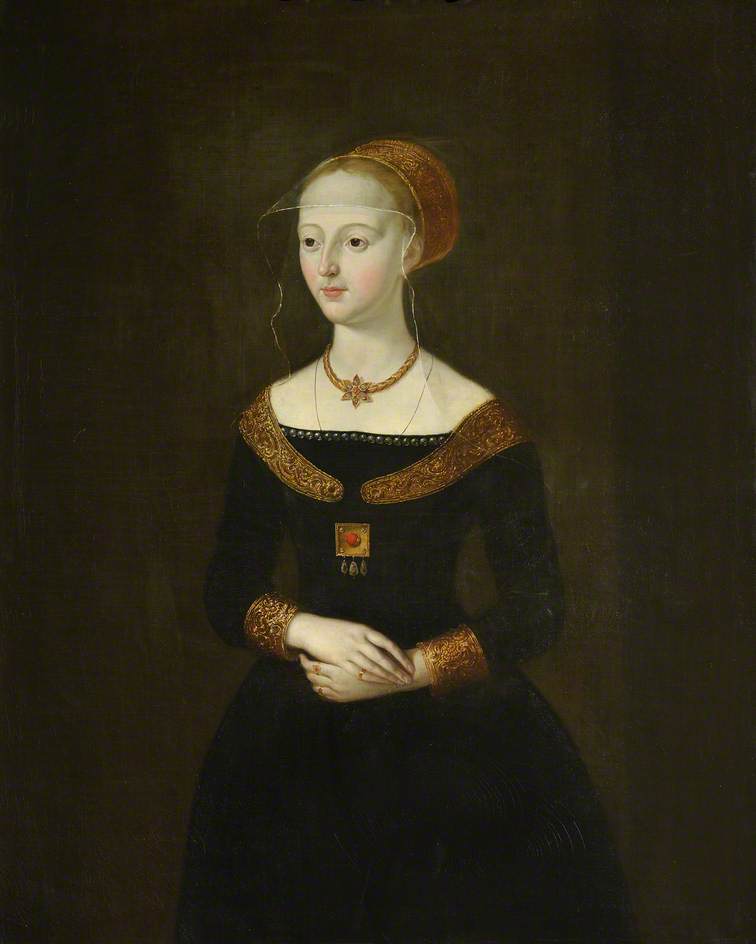
Portrait of Queen Elizabeth Woodville.

The BBC television series The White Queen, based on three of bestselling fictional novelist Philippa Gregory's novels set in the times of the Wars of the Roses, has sparked much greater interest in the extraordinary lives of royal English women who lived in context of ferocious battles, murder, bloodshed, and treachery. The TV series, of course, is horrendously inaccurate, with critics noting the appearance of zips on dresses, modern stair-rails, and quick to rage against the very modern language. I personally cannot understand why these medieval women do not wear headdresses and instead walk around dressed like prostitutes!

Queen Elizabeth Woodville, of course, was a notorious woman who was adored by her husband, Edward IV, much praised for her beauty, fairness and other qualities, but loathed by English nobles who perceived her to be arrogant, cold, ruthless, and vain. However, the life of Elizabeth's mother, Jacquetta of Luxembourg, is perhaps even more astounding than that of her eldest daughter.

Portrayed by Janet McTeer in the television series, Jacquetta had lived a life of almost unimaginable luxury and privilege before she married into the Woodville family. Perhaps born around 1416, Jacquetta was the eldest of nine children born to Pierre of Luxembourg, count of St. Pol, Conversano and Brienne and vicomte of Lille, and his wife Marguerite, daughter of the duke of Andrea. In 1433, aged seventeen, she married John duke of Bedford, who was uncle to the infant king of England, Henry VI. Thus, having been born into the European aristocracy, Jacquetta married essentially into the English royal family, cementing further her family's illustrious prestige and lineage. This marriage was not a love match, for the duke was aged around 27 years older than his new bride and had previously been married already. Instead, it was a marriage made by politics, to suit prevailing English interests in French lands at the time.

However, Jacquetta's husband John died only two years after the marriage, leaving her a widow aged 19, without children. She was, however, left extremely rich, for she was entitled to a third of her husband's lands and annuities. Just two years later, in 1437, Jacquetta married again, to her social inferior Sir Richard Woodville, who was not at all wealthy or highly ranked. Since she had, a year previously, agreed that she could not marry again without the consent of King Henry VI, she was forced to pay £1000 as a royal pardon for her transgression. This marriage clearly seems to have been a love match, for Jacquetta was willing to sacrifice her wealth, her lineage and royal connections in marrying a humble squire. Further evidence of the passionate love between them can be seen in the fact that she bore Richard at least 14 children.


Above: Were Jacquetta and her daughter Elizabeth witches, as The White Queen so controversially suggests?

Jacquetta and her new husband spent the first few years of their marriage in France, for Jacquetta was negotiating there to secure her dower lands, while Richard served there. They dwelled at Grafton, Northamptonshire, as their main English residence following their return. Their first daughter, Elizabeth Woodville, was born around 1437, and was followed by a further seven girls and seven boys, including Anthony and John. Elizabeth would prove like her mother to be extremely fertile.

In 1444, Jacquetta participated in the retinue which brought the new queen, Margaret of Anjou, to England, and it seems that the two became close friends. Jacquetta and her Woodville family were, initially, Lancastrians who supported Henry VI's regime, for the Woodvilles had been connected with the duke of Bedford, uncle to the king. However, several years later, the political and dynastic troubles which came to be known as The Wars of the Roses transformed Jacquetta's life forever. At the Battle of Towton, her husband and eldest son were arrested and imprisoned in the Tower of London, although they were later released. At this point, the Woodville family probably transferred their allegiance to the Yorkists.

Most infamously, Elizabeth, Jacquetta's eldest daughter, allegedly seduced the new Yorkist king, Edward IV, in 1464, leading him to marry her since she had, apparently, refused to become his concubine. Later stories dramatically suggested that she had held a dagger to her throat and promised to kill herself were he to attempt to use force on her. Regardless of the circumstances, Edward married Elizabeth at the Woodville's family home at Grafton on 1 May 1464, with only Jacquetta, a priest, and two gentlewomen present. This, of course, transformed the Woodville's fortunes. Jacquetta's husband became Earl Rivers and treasurer of England, while her children were married into the English nobility, causing much resentment and anger among other nobles. For instance, her 20-year old son John was, shockingly, married to Katherine Neville, the elderly dowager duchess of Norfolk, who was at least in her late 60s. Katherine Woodville married the young Duke of Buckingham, who was apparently furious, believing his new wife to be grossly inferior to himself.

Jacquetta and Elizabeth have often been linked in the public consciousness with witchcraft and sorcery. The White Queen supports these allegations, in both the TV series and in the book, by suggesting that both women engage in witchcraft to fulfil their ambitions - thus sorcery is practised to make Edward fall in love with and marry Elizabeth; to change the outcomes of battles; to wreak vengeance on enemies. Certainly, at the time rumours of witchcraft were linked to the new queen and her family. Contemporaries found it scarcely credible that their Yorkist king had married a woman so far beneath him, who had no royal blood and was, in fact, from a Lancastrian family. Richard III, brother-in-law to Elizabeth, and the Earl of Warwick both insinuated that Jacquetta and Elizabeth had inflicted sorcery on the king, rendering his marriage invalid. Thomas Wake, a Northamptonshire esquire, claimed in 1469 that Jacquetta had brought about the marriage of Edward and Elizabeth by witchcraft, having found two lead figures, one for the king and one for the queen. Jacquetta, however, when brought to trial proved her innocence and the case against her collapsed.

As with earlier medieval women such as Joan of Navarre and Eleanor duchess of Gloucester, witchcraft was often used to irrevocably damage the reputations of powerful women. There is no evidence to suggest that Elizabeth and Jacquetta were witches. Jacquetta's family was linked to Melusina, a water goddess or 'serpent woman'. However, there is no conclusive evidence to show that Elizabeth or Jacquetta strongly celebrated their links with such a legend, despite Philippa Gregory's claims to the contrary. While Jacquetta did own a copy of the ancestral romance Melusine, other fifteenth-century ladies did too, which hardly suggests that she was unique.

The main reason why Elizabeth was believed to be a witch was because other nobles could not believe that she, a mere gentlewoman of no social standing, was genuinely worthy of the king of England and had caused him to fall in love with her by natural means. Certainly, Edward's cousin and former supporter the earl of Warwick was furious, for he had been negotiating for Edward to marry a foreign princess, who was believed to be far worthier of Edward. Warwick personally resented and hated the Woodvilles, mainly because, by virtue of their relatives marrying almost all the other nobles, there were no suitable nobles left for his two daughters Isabel and Anne to marry.

The marriage between Edward and Elizabeth culminated in Warwick's defection to the Lancastrian cause, resentful of his loss of influence and power with the rise of the queen's family. He married his eldest daughter Isabel to the king's younger brother George duke of Clarence, who had become similarly angered and hostile towards his brother. Matters came to a head when Warwick left England, accompanied by his wife, his two daughters and his new son-in-law, and journeyed to visit the former queen Margaret of Anjou, promising his support of her and allegiance to the Lancastrian cause. Agreeing that his younger daughter Anne should marry Margaret's son Edward of Lancaster, a new alliance was struck up by which it was agreed that the Lancastrian king, Henry VI, should be returned to the English throne, and Edward IV forcibly removed from it.

Meanwhile, Jacquetta's personal influence with Queen Elizabeth remained firmly entrenched. She participated in her daughter's coronation, and in 1466 took part in Elizabeth's churching following the birth of her first child, the future Elizabeth of York. Misfortune overtook her, when her husband Richard and her son John were executed in 1470 on the orders of Warwick, who had returned to England in an attempt to restore Henry VI to the throne. Edward IV escaped to Europe, leaving his young wife to seek sanctuary in Westminster Abbey where, accompanied by her mother, she gave birth to the future Edward V in November 1470.

Jacquetta did not long survive the brutal deaths of her husband and son, dying on 30 May 1472, aged around 56. Where she was buried is unknown. She was an immensely powerful and wealthy woman who had been born into European royalty, marrying into the English royalty in her teens before becoming, by virtue of her second marriage, the mother of England's queen and thus grandmother of a later queen, Elizabeth of York, and great-grandmother of Henry VIII.

Rather than being a scheming and ambitious woman who only relied on witchcraft and sorcery to bring about her triumphs, it is likely that Jacquetta was, as Lucia Diaz Pascual intriguingly writes: 'a formidable woman who understood how to navigate the corridors of power and was capable of great resilience, strength, and determination to achieve her objectives'.