Showing posts with label Thomas Cranmer. Show all posts

Sunday, 13 November 2016

13 November 1553: The Trials of Queen Jane, Archbishop Cranmer, and the Dudley Brothers


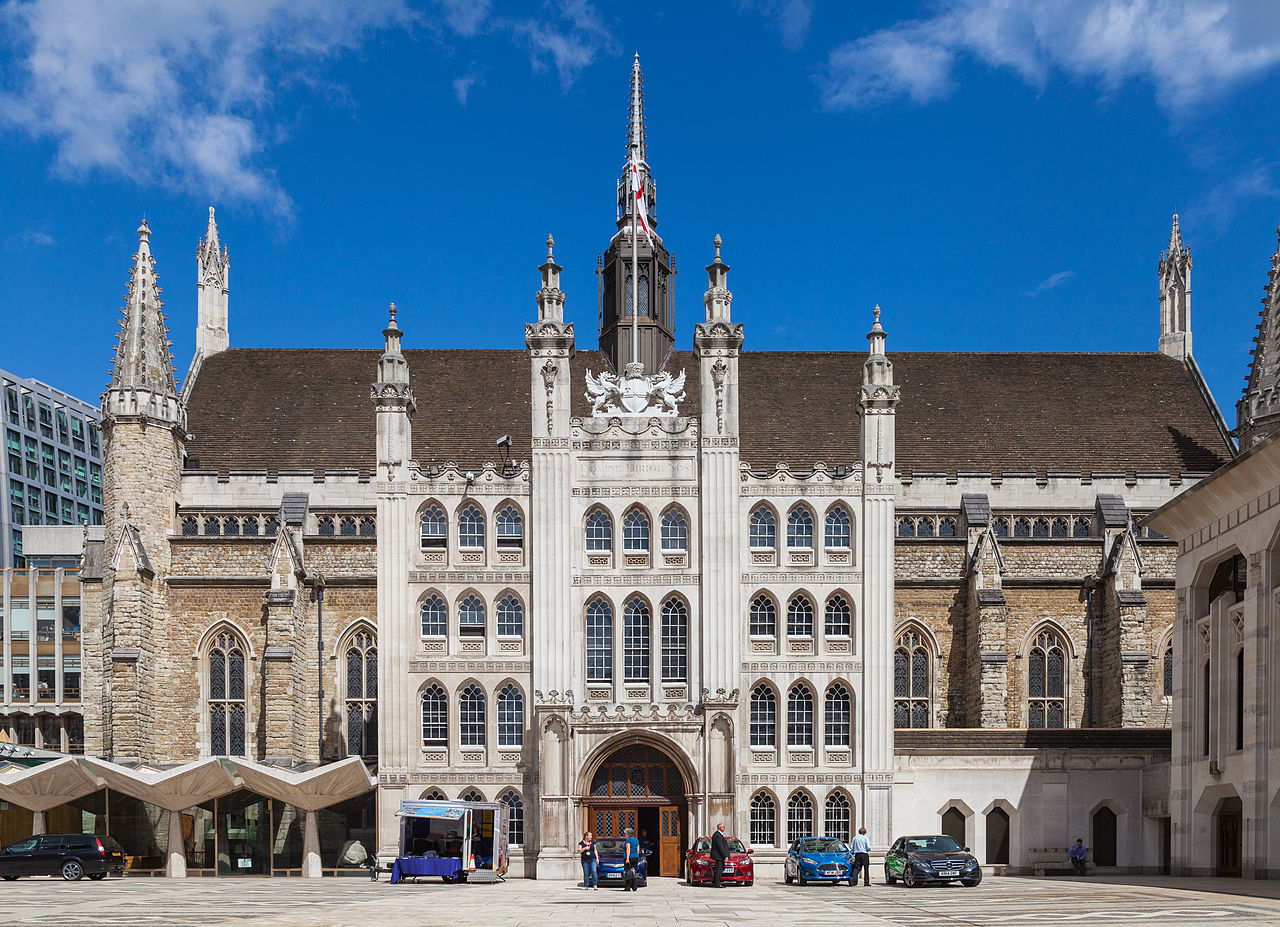
At London's Guildhall on 13 November 1553, five individuals were tried for high treason: Lady Jane Grey, the so-called 'Nine Days Queen'; her husband Guildford Dudley; his brothers Ambrose and Henry; and Thomas Cranmer, archbishop of Canterbury. Cranmer was charged with helping to seize the Tower for Jane and of levying troops for the duke of Northumberland's expeditionary force against Mary I (Northumberland himself had been executed in August that year). The beleaguered archbishop allegedly 'openly confessed his crime', although he himself later clarified that he had 'confessed more... than was true'. 

The Guildhall was the venue of several notable treason trials during the Tudor period. Francis Dereham and Thomas Culpeper, the reputed lovers of Katherine Howard, were tried and convicted at the Guildhall in 1541, while Anne Askew was tried for heresy at the same venue five years later. The five tried on 13 November 1553 proceeded from the Tower of London through the streets on foot to the Guildhall. Lady Jane - or Queen Jane; her exact title continues to rouse debate - was dressed in a sombre gown of black cloth and a black French hood. 

The commission was headed by the lord mayor, Sir Thomas White. Eric Ives notes that the commission was 'overwhelmingly Catholic in sentiment', which was surely a calculated move on Queen Mary's part, as a sign of the new order that was to be a feature of her reign. The 'Nine Days Queen' was charged with taking possession of the Tower, alongside her husband, and 'signing various writings'. In short, she had unlawfully usurped the sovereign's authority. 

Image result for lady jane greyImage result for thomas cranmer

All five were found guilty of high treason. The four men were sentenced to suffer a traitor's death: hanging, drawing and quartering. Jane was sentenced to be burned alive or beheaded according to the Queen's pleasure. The teenager faced news of her sentence bravely; she was sustained during those bleak months of imprisonment by her devout reformist faith. No date was given for the executions, and it appears that Queen Mary was, at least initially, willing to show mercy to the defendants, with the exception of Cranmer. 

The outbreak of rebellion in early 1554, however, changed that. Whether or not she was pressured by the Spanish envoys, with the promise of marriage to Philip of Spain, or by her Privy Council, Mary elected to order the executions of Guildford Dudley and Lady Jane Grey, for she feared that her security would be compromised as long as they remained alive and a focus for reformers. On 12 February, Guildford and Jane were executed. Both died bravely. Jane was subsequently represented in cultural works as an innocent victim of her scheming parents, or as a virtuous Protestant martyr. Guildford was viewed with sympathy by his contemporaries, but modern writers tend to depict him negatively as an abusive, weak-willed and vicious adolescent, a portrayal that is essentially fictional in basis.

Ambrose and Henry, Guildford's brothers, were more fortunate. Ambrose was released from the Tower in late 1554 and went on to serve Elizabeth I as her Master of the Ordnance. In 1561, he was created earl of Warwick. He died in 1590. His younger brother Henry participated with Ambrose in several tournaments held by Philip of Spain, as a demonstration of Anglo-Spanish amity. Henry participated in the Battle of St. Quentin in 1557, where he died. Archbishop Cranmer fared less well. He was tried for heresy in 1555 and went to the stake on 21 March 1556. 

Friday, 23 January 2015

Mary I and Religion


The religious policies of England's first queen regnant, Mary I (1553-58), undoubtedly defined her reign, both within her lifetime and within the historiography subsequently produced about her. Mary's infamous sobriquet, "Bloody Mary", derives from her alleged bloodthirsty persecution of 300 godly Protestants. In popular culture, the queen is often depicted as a vengeful, tyrannical and cruel woman who mercilessly ordered the deaths of hundreds of her subjects for their religious beliefs. Mary's Catholic religion was central to her sense of identity. It was recorded that she 'felt so strongly on this matter of religion that she was hardly to be moved'. Yet recent historians have, quite rightly, questioned the traditional interpretation of Mary's decision to return England to Roman Catholicism as foolish, naive and contrary to her subjects' wishes. Historians, including Eamon Duffy, have put forward compelling evidence for much of the general population's continuing loyalty to the Catholic religion and their hostility towards the Protestant reforms introduced in the reign of Edward VI. In certain geographical areas, including much of the north and southwest, Catholicism continued to be embraced wholeheartedly. The succession of a Catholic queen was viewed eagerly and delightedly, and Mary's religion indisputably contributed to the overwhelming support she received when fighting against the regime of Lady Jane Grey in the summer of 1553, a struggle that she was successful in. Susan Brigden has rightly said that, upon her accession, 'there was... popular rejoicing at the restoration of the old faith', as relics, altars and the Mass were restored to churches across the country. It is significant that the Mass, in particular, was sung across England not by royal command but 'of the people's devotion'. 

Contrary to the popular legend of Queen Mary as a bloodthirsty and tyrannical monarch who forced the unpopular Catholic religion upon her unwilling subjects, she initially demonstrated, in the words of Ann Weikel, 'flexibility and political sensitivity'. The Catholic religion was not immediately reintroduced until several months into the queen's reign. Mary may have been unsure of her subjects' attitudes and clearly desired to proceed carefully and hesitantly in so delicate and controversial a matter. On 18 August 1553, the queen issued a proclamation promising that she would not coerce any of her subjects into practising Catholicism until parliament was called, an announcement which mirrored Queen Elizabeth I's promise not to 'open windows into men's souls'. Mary faced a dilemma, however. The situation in England, both religious and political, was not the same as it had been in her youth, over twenty years earlier, when Roman Catholicism was still the state's religion as it had been for hundreds of years. The dissolution of the monasteries in the reign of her father, Henry VIII, had profited the upper and middle orders, who understandably were reluctant to renounce the wealth they had acquired from dissolved abbeys and religious houses. The queen was cautioned by Bishop Gardiner that enforcing the restoration of church lands would fatally undermine the Catholic cause, and wisely she chose not to follow that path. In October, the reforms of Edward's reign were repealed during the first session of Mary's parliament. The queen legislated that her parents' marriage had been good and lawful, and rejected the Supremacy of the Church. On 30 November 1554, England was absolved by Cardinal Pole, and two months later, the Royal Supremacy was formally repealed. Leading Protestant churchmen, including Archbishop Thomas Cranmer, John Bradford, John Rogers, John Hooper and Hugh Latimer were imprisoned. Mary disliked Cranmer, in particular, for she held him responsible for the annulment of her parents' marriage.

Mary had made an unpopular religion with Philip of Spain in July 1554, a marriage that provoked Wyatt's Rebellion in early 1554 and was linked by her resentful Protestant subjects with 'popish' tyranny and foreign domination. They had reason to worry, for in November the medieval heresy laws were revived, in which burning at the stake was issued as punishment for heretical practices and beliefs. Traditionally, historians have asserted that the queen faced an impossibly difficult uphill battle in her desire to restore Catholicism that she was never going to succeed in. As Brigden explains, 'the old world of religious unity and obedience was broken'. Ambivalence existed among the general population to the idea of papal supremacy, while traditional Catholic practices such as prayers for the dead, belief in purgatory, processions, creeping to the cross on Good Friday, palms on Palm Sunday, and the 'burial' of the Host in the Easter sepulchre proved exceptionally difficult to reintroduce across the country. However, while the Marian regime faced difficulties, it is inaccurate to view their religious policies as backward and stagnant. Altars, windows and vestments were reintroduced into parish churches alongside resplendent roods, but Cardinal Pole, who arrived in England in late 1554, was a renowned reformer who 'had deeper designs for Catholic reform than the recovery of what was past' (Brigden), and restored old practices as means of moving forward with new reforms. The Marian regime had a focus on scripture, teaching and education that had been lacking in traditional Roman Catholic systems. Thus, papal supremacy and priestly power were marginalised in the reforms of the Marian Church, while the cult of the Blessed Virgin, saints and pilgrimages played far less of a role in popular devotion than they had done previously. Catholic reformers hoped to fully restore England to the old religion by reconciliation and education, pursuing an initially peaceful and positive path that hoped to renew the traditional religion of Catholicism. The cardinal 'had considerable experience and talent to bring to the revitalization of the faith', given his excellent reputation as a humanist and his role as advocate for reform at the early sessions of the Council of Trent (Weikel). He assured Parliament in late 1554 that he had arrived in England 'to reconcyle, not to condemne... not to destroy but to build... not to compel but to call agayne'.


Above: Cardinal Reginald Pole.

Pole placed particular emphasis upon episcopal and clerical leadership and training, concentrating on the education of the clergy and, through them, the laity. These bishops produced strong defences of the Catholic faith. The Marian regime hoped to take advantage of the expanded printing press, as the Protestant regime of Edward's reign had done so so efficiently and effectively. Thomas Watson, bishop of Lincoln, and Edmund Bonner were two notable clerics who authored defences of Catholicism. In his efforts, Pole was assisted by the Pope, who later recalled him on charges of heresy. The Marian programme of Catholic restoration, however, inevitably included the pursuit of heresy; a pursuit validated and made possible by the return of the heresy laws late in 1554. It is an exaggeration to claim that most of England's Protestant subjects were brutally and cold-bloodedly sent to the stake by their hateful, murderous queen. Notable clerics were sent to the stake, including Bishops Hooper, Latimer and Ridley late in 1555 and Archbishop Cranmer in the spring of 1556. The burnings were motivated by the conviction of the queen and Pole that heresy needed to be exterminated from society in order to prevent its spread, for it was a disease that had the power to 'infect'. The Marian regime hoped to reconcile dissenting subjects and bring them back to the Catholic fold, meaning that, in the long-term, each burning was an act of failure for the regime. The martyrs were widely supported at the burnings, meaning that the executions came to be held in secret, with the hope of avoiding large crowds. They gradually became less and less popular. After June 1558, the burnings at Smithfield were halted. Mary's decision to restore the medieval heresy laws and, with them, the death by burning for heresy, has been viewed by historians as crucial evidence of her 'backward' and 'ignorant' thinking, her inability to adapt to current situations and circumstances, but it is impossible to identify who was truly responsible for the burnings, as Weikel notes: 'there is little explicit evidence for her [Mary's] continuing involvement, except for the obvious fact that as queen she could have halted the process at any moment'. 


Above: Thomas Cranmer (left) and Hugh Latimer (right) were both burned at the stake in Mary's reign.

It is important to recognise that the negative depiction of Mary I's religious policies ultimately lies in the success of Protestant propaganda and its impact on the creation of national history. As Weikel explains, this propaganda has obscured the many positive aspects of the queen's religious regime. It is virtually impossible to know with any certainty how popular her restoration of Catholicism was, for we lack the attitudes of ordinary people across the country. Historians have uncovered evidence of a desire to return to the old religion, and celebrations across England at news of Mary's accession speaks volumes about her initial popularity among her subjects. In the end, circumstances beyond the queen's control defeated her efforts at Catholic restoration: 'Mary's regime was fatally undermined, not so much by failings in policy, but by disasters beyond human control' (Brigden). Pole was recalled by a vengeful pope, which demoralised both him and the queen, while a  'devastating mortality crisis' in 1558-9 was significant in that the queen was one of its victims. Mary died in November 1558, aged only 42, with no Catholic heir and having been queen for only five years: the shortest reigning of the five Tudor monarchs. Had she given birth to a Catholic heir, had she reigned for longer, it is quite conceivable that England's return to Roman Catholicism might have been, in the long-term, successful. The Marian regime was not 'backward' or 'stagnant' in its religious reforms and policies. It was energetic, vivacious, resourceful and purposeful in seeking to restore the old religion. As eighteenth-century historian John Lingard explained, Mary's policies failed, not because they were unpopular or 'wrong', but because her reign was too short to fully establish them, while natural disasters beyond her control ultimately undid her efforts. Elizabethan propaganda skilfully 'stamped Catholicism as an alien presence in England, and has consequently prevented 'a just assessment of the aims and achievements of the Marian Church'' (Weikel and Duffy). We, however, do not have to uncritically read such propaganda in our own times. We can afford England's first queen regnant respect and admiration for her concerted attempts to restore Roman Catholicism to a country which, in many respects, cried out for its return upon her accession.