Showing posts with label hampton court palace. Show all posts

Saturday, 13 February 2016

Katherine Howard and Hampton Court Palace


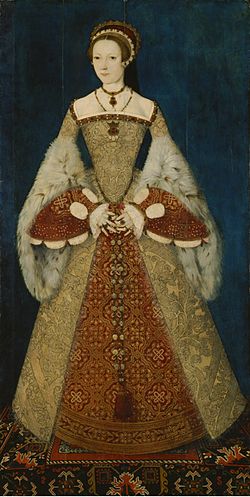
Above: Portrait of an unknown woman, possibly Katherine Howard (left).
The Haunted Gallery at Hampton Court Palace (right).

On 13 February 1542, two women were executed for treason within the walls of the Tower of London. On the same spot on which Anne Boleyn had been beheaded six years earlier, Katherine Howard was executed after making a short speech. Mercifully, her head was removed with a single blow of the axe. Following her death, it was the turn of her attendant Jane, viscountess Rochford. The viscountess had allegedly gone insane during her imprisonment; yet so determined was Henry VIII for her to die that he had her nursed back to health. Like the former queen, Jane was decapitated with a single strike. Both ladies were buried in the chapel of St. Peter ad Vincula. 

It is often believed that Katherine was executed for committing adultery with Thomas Culpeper, a groom of the privy chamber, but the Bill of Attainder passed against her clarified that she was condemned for having lived 'an old abominable life'. The attainder explained that Katherine's decision to appoint a former lover, Francis Dereham, to the position of secretary was 'proof of her will' to return to her 'vicious life'. In this respect, it was Katherine's unchaste childhood that counted against her. When it was discovered that she was not a virgin when she married Henry VIII, her meetings with Thomas Culpeper took on a sinister light. The Bill of Attainder became law on 11 February, a day after the queen had been taken to the Tower. Two days later, she and Jane Rochford were beheaded. Neither had been given the right to a trial, as Anne Boleyn had in 1536. The Act of Attainder was later repealed in the reign of Mary I.

Having endured imprisonment for two months, Katherine's end came astonishingly quickly. Within three days she was imprisoned in the Tower and then executed. The Spanish ambassador Eustace Chapuys reported that Katherine had to be forced onto the barge 'with some difficulty and resistance' when it arrived to transport her to the Tower. Although both she and Jane were to die with dignity, rumours abounded both then and now that Katherine Howard's spirit was restless. This idea soon became legend with the story of Katherine's ghost haunting a gallery at Hampton Court Palace.

Joanna Denny, in her biography of Katherine, explains this legend:

'There is a legend at Hampton Court Palace that Katherine Howard made one last, desperate attempt to see her husband. The story goes that, knowing Henry was at service in the Chapel Royal, she broke free of her rooms and ran down the long gallery to try and talk to him and convince him of her innocence. 

...It is said that Katherine's ghost is seen here, running and screaming in her panic as she calls Henry's name... She was presumably caught long before she came anywhere near the King and dragged away by her guards'.

Hampton Court Palace, on its website, provides 'anecdotal evidence' to confirm that the story is true: visitors to the gallery are often unsettled by a strange presence in the gallery, and some have fainted before. The story has moved into the realm of popular culture, and the link between Katherine Howard and the Haunted Gallery is well-known. 

It's not hard to see why. The image of a teenage queen, paralysed by fear and terror, running and begging for her life is a haunting one. The legend is often included in modern novels, such as Jean Plaidy's Rose Without a Thorn, and it is occasionally referenced in television, as in the Showtime series The Tudors (2007-10). But historians have, by and large, demonstrated that the myth is exactly that: a myth. There is no contemporary evidence that Katherine Howard ran down the gallery screaming for her life; none of the court ambassadors, including the well-informed Chapuys, reported it. 

Hampton Court Palace is central to the story of Katherine Howard. Its setting was the centre piece of her spectacular rise and was to prove the site of her calamitous downfall. Unsurprisingly, then, Katherine's ghost is almost never linked with the Tower of London, but it is always associated with Hampton Court. As a young maid of honour to Queen Anne of Cleves, Katherine had captivated the ageing Henry VIII; perhaps their first meeting occurred at Hampton Court. In August 1540, less than two weeks after Katherine married Henry at Oatlands Palace, she was acknowledged as queen for the first time at Hampton Court. Formerly in the hands of Cardinal Wolsey, it had become, by the 1540s, Henry VIII's main residence. 

As it had been the main setting for her rise to queenship, so Hampton Court was to be the setting for Katherine's downfall. Returning from the northern progress in the autumn of 1541, Henry VIII was confronted with a letter placed in the Chapel Royal informing him of his wife's unchaste childhood. Devastated, he departed the palace, never to see her again. The disgraced queen was eventually moved from Hampton Court to Syon, before making her final journey to the Tower of London.

In January 2016, I visited Hampton Court Palace for a ghost tour held one evening. The final stop on the tour was at the Haunted Gallery, where the story of Katherine Howard's ghost was recounted by the guide. Undeniably, the Gallery has an unsettling atmosphere, especially at night. One's imagination can run away; it is easy to imagine a frightened girl frantically running down the Gallery, screaming and begging for her life before being seized by her guards and taken back to her rooms. While the story of Katherine's ghost has no basis in reality, it does provide a poignant, chilling reminder of the speed of her downfall and death. For Katherine Howard, Hampton Court Palace was initially associated with happiness, glory and possibility, but it later became for her a site of fear, terror and destruction.

Sunday, 12 July 2015

12 July 1543: Henry VIII Marries Katherine Parr


On 12 July 1543 at Hampton Court Palace, King Henry VIII of England married for the sixth and final time. His bride was thirty-one year old Katherine Parr, the eldest daughter of Thomas and Maud Parr. Unlike Anne Boleyn, Jane Seymour or Katherine Howard, Katherine Parr had not spent time in royal service, although both her siblings had operated in court circles for a number of years. Known as the most married queen of England, Katherine was marrying for the third time.

Although she was not rated for her beauty, Katherine's intelligence, charisma, and deep-rooted passion for the Protestant religion were to become well known at court. She reigned until January 1547, when her mercurial husband died aged fifty-five. Katherine was not the dull, dowdy figure of Victorian historiography. She was not only a devout Protestant but an author, a literary patron, a lover of fashion and a patron of the arts. She enjoyed warm relationships with her three stepchildren and was particularly influential on her stepdaughter Elizabeth.

I recently wrote an article exploring whether Katherine Parr could be said to have espoused feminist ideas in her written works. Of course, it is anachronistic to interpret these opinions as feminist, but Katherine certainly believed with some conviction that women, as well as men, could play indispensable roles in advancing the Protestant faith. You can read the article here

Friday, 7 November 2014

November 1541: The Downfall of Katherine Howard


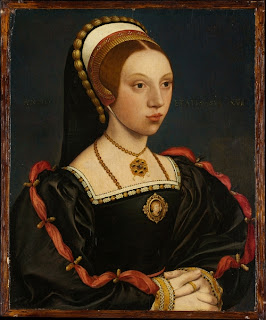
Above: A portrait miniature thought to be of Katherine Howard, c. 1540.

For Queen Katherine, the end came quickly and inexplicably. One moment she was England's adored queen, the beloved youthful consort of Henry VIII, renowned for her beauty and virtue. Finally, it seemed, Henry had married a woman who represented everything he desired in a bride: youthfulness, beauty, virtue, chasteness, fertility and, above all, innocence. Katherine seemed to share Katherine of Aragon's loyalty and humility; Anne Boleyn's sensuality and attractiveness; Jane Seymour's demureness and modesty; Anne of Cleves' good sense. Contemporaries often noted Henry's pleasure in his bride and his new found happiness. But throughout her brief reign Katherine was on the edge of a precipice. Her past harboured dark secrets, and she was well aware of the need to conceal them from public attention, if she was to be secure as England's queen.

From her marriage in the hot days of July 1540 to the autumnal beginnings of November 1541, Queen Katherine managed rather well. Recently, historians have come to dismiss the traditional notion that she was an irresponsible, reckless hedonist who spent her days partying and making merry. David Starkey noted her excellent handling of the responsibilities of queenship and credited her with bringing the Tudor family together for the first time. My research similarly suggests that Katherine took her responsibilities as queen seriously, providing for her family, dispensing patronage and maintaining good relations with the royals. She was young and inexperienced, but she moved past these drawbacks to perform her responsibilities as queen earnestly and devotedly.


Above: Possibly Katherine Howard.

Katherine's success, however, depended on her past remaining secret. Despite her apparent successes as queen, Katherine's past haunted her from the moment she married the king. Francis Dereham, a persistent and forceful young man who had been intimately involved with the queen some years before her marriage, arrived at court hoping to win her favour. When he arrived at court in spring 1541, he began boasting of his friendship with the queen and even commented that, were the king to die, he would be sure to marry Katherine. Henry Manox, a musician who had fondled Katherine some years previously, also pressed for appointment. 

In context of these dangerous rumours swirling about the queen's past, the emboldened Thomas Culpeper, a groom of the privy chamber to the king, sought out the queen and urged her to meet with him in secret. Possibly he had learned of her murky past and used it to encourage her to bestow favours upon him. Katherine, hoping to continue as England's queen, beseeched him to meet with her only in the presence of her chaperone Lady Rochford. What the two discussed is not known, but in context of dangerous allegations about the queen, it seems more credible that Culpeper had come into knowledge of Katherine's childhood liaisons and was using this knowledge to manipulate her. 


Above: Hampton Court Palace, where the queen was abandoned in November 1541.

The royal court departed on a northern progress in the summer of 1541. While they were away, an ardent reformer John Lascelles (who would be burned for heresy five years later) approached the Archbishop of Canterbury with damaging knowledge about the queen. Historians have recently considered the possibility that Katherine was the victim of a reformist conspiracy designed to bring down the conservative Howards. Certainly, it seems too much of a coincidence that Lascelles informed Cranmer of Katherine's past at this time, when rumours were also circulating of her sexual misadventures. The royal couple arrived in London in late October. On 2 November, the disbelieving king was informed of his wife's misconduct before her marriage. Four days later, distraught and emotional, Henry left Hampton Court Palace. He would never see his wife again. 

A day later, the queen was confined to her chambers. Katherine quickly guessed what was going on and suffered a full breakdown. Archbishop Cranmer referred to her 'lamentation and heaviness' when he visited her to interrogate her. He seems to have felt pity and compassion for her. The following day, Katherine had recovered sufficiently to answer Cranmer's questions. She admitted liaisons with both Manox and Dereham, but took care to emphasise her youth and vulnerability when these had occurred. She explained that Dereham had pursued her and that she had not enjoyed the affair. In a religious society valuing female chastity and honour, a loss of a girl's maidenhead proved personally and socially damaging. In view of this alongside her clear loyalty to her family, it is questionable whether Katherine would voluntarily and consensually have permitted either man, both of whom were lower in status, intimacies. She denied being Dereham's wife, possibly because canon law required that both vowtakers provide consent. 

Both Katherine and Dereham, when questioned, responded that their relationship had not continued following Katherine's royal marriage. However, Dereham asserted that Thomas Culpeper had since succeeded him in the queen's affections. Possibly he was aware of Culpeper's knowledge about Katherine's past, and assumed that the two were close. Katherine denied committing adultery with Culpeper, but did not reveal what she had discussed with him. Possibly, if their discussions had concerned the queen's past and a need to conceal it, Katherine felt reluctant to incriminate herself further by revealing sordid details of her childhood experiences.

Although Culpeper did later admit his hope to commit adultery with Katherine, 'the queen's motives remain opaque, not least because her questioners never pressed Katherine to explain why she met with Culpeper or needed to converse with him, beyond her excuse that he insisted on seeing her'. (Warnicke) Warnicke suggests that Katherine remained silent about the topics of their discussions because 'an admission that she had been attempting to deceive the king by concealing her relationship with Dereham would not have bolstered her defence'. Thus, while she may not have committed adultery, Katherine was guilty of deceit.

The king, meanwhile, experienced extreme sorrow and desolation when faced with knowledge of his wife's misbehaviour. On 12 November his privy council described his distress in a letter to Sir William Paget, resident ambassador in France. As late as April 1542 the king was described as being a different man since hearing of Katherine's past. On 14 November, the queen was relocated to Syon. Eight days later she relinquished the title of queenship, which proved easy enough to do, since she had never been crowned and had been queen purely by virtue of her marriage to the king. The following month, Dereham and Culpeper were sentenced to death, and shortly afterwards executed at Tyburn. Katherine and Lady Rochford were never brought to trial, but were found guilty by act of Attainder. They were executed at the Tower of London in February 1542.

Katherine never did admit to adultery. Although she admitted that she had been unchaste before her marriage, she insisted that she had done no more than converse with Culpeper. Because she admitted to having had a sexual relationship with Dereham, and because she confirmed that she had met secretly on several occasions with Culpeper, both early modern and modern commentators have tended to accept her guilt. If she did not commit adultery with Culpeper, then why did she become involved with him? Possibly 'fear of disclosure would... have made her vulnerable to the machinations of seasoned courtiers like Culpeper, for as she said in her confession about Dereham, 'the sorrow of my offences was ever before my eyes''. (Warnicke)


Above: Tower Green.


Friday, 24 October 2014

24 October 1537: Death of Jane Seymour


On 24 October 1537, Queen Jane Seymour died at Hampton Court Palace, aged around twenty-nine. The third wife of Henry VIII had given birth to a male heir, Prince Edward, twelve days previously, and had been thought to have been in good health following her first birth. The queen had welcomed visitors attending her son's christening on 15 October, although following protocol, neither she nor her husband attended the christening.

Jane's queenship appears to have been passive, in contrast with the strong and authoritative queenships of her two predecessors Katherine of Aragon and Anne Boleyn, but as historians have conjectured, this may well have resulted from Henry's decision to limit his wife's influence. Jane did not lead religious reform or press for a return to traditional religion: she appears to have been conservative in her religious beliefs, since Martin Luther heard that she was 'an enemy of the gospel'.


Although the birth of the prince was arduous and difficult, there is no evidence that the queen gave birth by caesarean section, a story put forward by the Catholic priest Nicholas Sander in his work defaming Henry VIII's reformation. Jane appeared to have been making a normal recovery following the birth of her son. She initially rallied after some initial consternation about her condition, but by 24 October her life was in danger and her almoner, Robert Aldrich, bishop of Carlisle, administered extreme unction and informed the king. Although the queen's attendants were blamed for allowing her to eat food that was unsuitable and allowing her to catch a cold, it seems likely that Jane developed puerperal fever, a common condition that befell many sixteenth-century women. Alternatively, it has been suggested that the queen died because of retention of parts of the placenta in her uterus, which could have led to a catastrophic haemorrhage a few days after her child's delivery.

Whatever her condition was, Jane soon developed septicaemia, and delirium set in. She died just before midnight on 24 October, less than two weeks after the birth of Prince Edward. She was either twenty-eight or twenty-nine years of age at the time of her decease, young even by sixteenth-century standards. Her husband the king was devastated, informing the king of France: 'Divine Providence has mingled my joy [at the birth of his son] with the bitterness of the death of her who brought me this happiness'. From then on, Henry VIII would fondly remember Jane Seymour as his favourite wife, the only consort, as it turned out, who provided him with a surviving male heir. He would be buried beside Jane in St George's Chapel, Windsor, when he died in 1547.

Sunday, 12 October 2014

12 October 1537: The Birth of Edward VI


On this day in history, 12 October 1537, at two a.m. the future king Edward VI was born at Hampton Court Palace. Hugh Latimer, bishop of Worcester, greeted the news of the birth of the prince with joy, 'whom we hungered for so long'. The country at large shared his joy, and there were glorious celebrations across England. Edward was the only child of Henry VIII by his third wife, Jane Seymour. After twenty-eight years on the throne, Henry VIII finally had a male heir, and he had reason to believe that the Tudor succession was finally secure after years of uncertainty, bloodshed and religious revolution.

Image result for queen jane seymour
Above: Edward's parents, Henry VIII of England and his third wife Jane Seymour.

The queen's birth had been difficult, lasting two days and three nights. Three days after the birth, the prince was christened, although, as was the custom, neither the king nor his wife attended. Contrary to popular belief, Queen Jane seems to have recovered quickly, and was soon up writing letters and receiving visitors. However, the queen soon contracted an infection and she died nine days after the birth, aged twenty-nine. The king's euphoria and relief turned to sorrow at the loss of his dear consort.

It cannot be overstated how relieved the king was at the birth of his son. When he had married Katherine of Aragon, his first wife, in 1509, he would surely not have foreseen that it would be almost thirty years before his much-desired son was born. This isn't completely true, for Katherine had given birth to three sons: Prince Henry, who lived for fifty-two days before dying in February 1511; a son in the autumn of 1513; and a son the following year, both of whom died. Katherine's marriage was annulled largely because it did not provide a male heir, and Henry married her attendant Anne Boleyn in 1533. Although Queen Anne gave birth to arguably England's greatest monarch, the future Elizabeth I, that year, she too, as with her predecessor, did not give birth to a living son. Most tragically, in January 1536 she gave birth to a stillborn son. Four months later, she was decapitated for treason.

When Henry VIII married Jane in May 1536, he was almost forty-five, and from his point of view the succession was no more secure than it had been at his accession twenty-seven years earlier (although his previous wives had both given birth to a daughter). There is evidence that, when the new queen failed to conceive soon after her marriage, the king began voicing his doubts. Luckily for Jane, in early 1537 she became pregnant. Her condition was visible throughout the summer of 1537 and in September she arrived at Hampton Court for her lying-in where, a month later, she gave birth to a prince who, unlike those born to Katherine or Anne, survived.


Above: Henry VIII with his son, Edward (left), and third wife Jane (right), c. 1545. In reality, Jane had been dead for eight years when this painting was completed. The king was, at the time, married to his sixth and final wife, Katherine Parr. The painting has been interpreted as a brilliant work of Tudor propaganda.

Friday, 1 November 2013

Katherine Howard's Past is Revealed


Above: Lynne Frederick as Katherine Howard in The Six Wives of Henry VIII (1972).

Having returned from their northern progress lasting the whole summer, Henry VIII and Katherine Howard set out to quietly celebrate their marriage by means of blessing the marriage on All Saints' Day, 1 November. Henry publicly gave thanks for his 'rose without a thorn'. But it was not long before that day was to be ruined. For the events comprising Katherine's downfall had been set into motion.

The story is an ambiguous and mysterious one, but sometime during the summer it seems that one of Katherine's childhood acquaintances, a staunch religious reformer named Mary Lascelles (who married into the Hall family), remarked to her brother, John, that she had no wish to serve the new Queen because she was light in both living and conditions. John pressed Mary for further details and she informed him that Katherine had been intimate with certain gentlemen within the Dowager Duchess of Norfolk's household. John, by virtue of his religious beliefs, was hostile to the Howards, and decided to use this story to ruin them.

He spoke with Archbishop Cranmer, himself a strong reformist, who decided to take the story to the King once the royal couple had returned from the north in the form of a letter which was left in the chapel pew in Hampton Court Palace. Henry was shattered, shocked, unable to believe what he had read. He immediately, however, ordered an investigation into the allegations.

For Katherine, it represented her worst fears. She had probably dreaded this moment ever since she had married the king and become queen. Whether she and Mary were personally hostile to one another, or whether the Lascelles were motivated solely by religious and political interests, is unknown. Mary Lascelles' allegation, however, would prove fatal. Four months later, Katherine would be dead, three others dying with her in the wake of her downfall. These events indicate the dangerous and brutal nature of power struggles at Henry VIII's court.