
Above: A portrait miniature thought to be of Katherine Howard, c. 1540.
For Queen Katherine, the end came quickly and inexplicably. One moment she was England's adored queen, the beloved youthful consort of Henry VIII, renowned for her beauty and virtue. Finally, it seemed, Henry had married a woman who represented everything he desired in a bride: youthfulness, beauty, virtue, chasteness, fertility and, above all, innocence. Katherine seemed to share Katherine of Aragon's loyalty and humility; Anne Boleyn's sensuality and attractiveness; Jane Seymour's demureness and modesty; Anne of Cleves' good sense. Contemporaries often noted Henry's pleasure in his bride and his new found happiness. But throughout her brief reign Katherine was on the edge of a precipice. Her past harboured dark secrets, and she was well aware of the need to conceal them from public attention, if she was to be secure as England's queen.
From her marriage in the hot days of July 1540 to the autumnal beginnings of November 1541, Queen Katherine managed rather well. Recently, historians have come to dismiss the traditional notion that she was an irresponsible, reckless hedonist who spent her days partying and making merry. David Starkey noted her excellent handling of the responsibilities of queenship and credited her with bringing the Tudor family together for the first time. My research similarly suggests that Katherine took her responsibilities as queen seriously, providing for her family, dispensing patronage and maintaining good relations with the royals. She was young and inexperienced, but she moved past these drawbacks to perform her responsibilities as queen earnestly and devotedly.
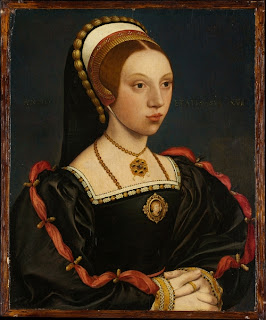
Above: Possibly Katherine Howard.
Katherine's success, however, depended on her past remaining secret. Despite her apparent successes as queen, Katherine's past haunted her from the moment she married the king. Francis Dereham, a persistent and forceful young man who had been intimately involved with the queen some years before her marriage, arrived at court hoping to win her favour. When he arrived at court in spring 1541, he began boasting of his friendship with the queen and even commented that, were the king to die, he would be sure to marry Katherine. Henry Manox, a musician who had fondled Katherine some years previously, also pressed for appointment.
In context of these dangerous rumours swirling about the queen's past, the emboldened Thomas Culpeper, a groom of the privy chamber to the king, sought out the queen and urged her to meet with him in secret. Possibly he had learned of her murky past and used it to encourage her to bestow favours upon him. Katherine, hoping to continue as England's queen, beseeched him to meet with her only in the presence of her chaperone Lady Rochford. What the two discussed is not known, but in context of dangerous allegations about the queen, it seems more credible that Culpeper had come into knowledge of Katherine's childhood liaisons and was using this knowledge to manipulate her.

Above: Hampton Court Palace, where the queen was abandoned in November 1541.
The royal court departed on a northern progress in the summer of 1541. While they were away, an ardent reformer John Lascelles (who would be burned for heresy five years later) approached the Archbishop of Canterbury with damaging knowledge about the queen. Historians have recently considered the possibility that Katherine was the victim of a reformist conspiracy designed to bring down the conservative Howards. Certainly, it seems too much of a coincidence that Lascelles informed Cranmer of Katherine's past at this time, when rumours were also circulating of her sexual misadventures. The royal couple arrived in London in late October. On 2 November, the disbelieving king was informed of his wife's misconduct before her marriage. Four days later, distraught and emotional, Henry left Hampton Court Palace. He would never see his wife again.
A day later, the queen was confined to her chambers. Katherine quickly guessed what was going on and suffered a full breakdown. Archbishop Cranmer referred to her 'lamentation and heaviness' when he visited her to interrogate her. He seems to have felt pity and compassion for her. The following day, Katherine had recovered sufficiently to answer Cranmer's questions. She admitted liaisons with both Manox and Dereham, but took care to emphasise her youth and vulnerability when these had occurred. She explained that Dereham had pursued her and that she had not enjoyed the affair. In a religious society valuing female chastity and honour, a loss of a girl's maidenhead proved personally and socially damaging. In view of this alongside her clear loyalty to her family, it is questionable whether Katherine would voluntarily and consensually have permitted either man, both of whom were lower in status, intimacies. She denied being Dereham's wife, possibly because canon law required that both vowtakers provide consent.
Both Katherine and Dereham, when questioned, responded that their relationship had not continued following Katherine's royal marriage. However, Dereham asserted that Thomas Culpeper had since succeeded him in the queen's affections. Possibly he was aware of Culpeper's knowledge about Katherine's past, and assumed that the two were close. Katherine denied committing adultery with Culpeper, but did not reveal what she had discussed with him. Possibly, if their discussions had concerned the queen's past and a need to conceal it, Katherine felt reluctant to incriminate herself further by revealing sordid details of her childhood experiences.
Although Culpeper did later admit his hope to commit adultery with Katherine, 'the queen's motives remain opaque, not least because her questioners never pressed Katherine to explain why she met with Culpeper or needed to converse with him, beyond her excuse that he insisted on seeing her'. (Warnicke) Warnicke suggests that Katherine remained silent about the topics of their discussions because 'an admission that she had been attempting to deceive the king by concealing her relationship with Dereham would not have bolstered her defence'. Thus, while she may not have committed adultery, Katherine was guilty of deceit.
The king, meanwhile, experienced extreme sorrow and desolation when faced with knowledge of his wife's misbehaviour. On 12 November his privy council described his distress in a letter to Sir William Paget, resident ambassador in France. As late as April 1542 the king was described as being a different man since hearing of Katherine's past. On 14 November, the queen was relocated to Syon. Eight days later she relinquished the title of queenship, which proved easy enough to do, since she had never been crowned and had been queen purely by virtue of her marriage to the king. The following month, Dereham and Culpeper were sentenced to death, and shortly afterwards executed at Tyburn. Katherine and Lady Rochford were never brought to trial, but were found guilty by act of Attainder. They were executed at the Tower of London in February 1542.
Katherine never did admit to adultery. Although she admitted that she had been unchaste before her marriage, she insisted that she had done no more than converse with Culpeper. Because she admitted to having had a sexual relationship with Dereham, and because she confirmed that she had met secretly on several occasions with Culpeper, both early modern and modern commentators have tended to accept her guilt. If she did not commit adultery with Culpeper, then why did she become involved with him? Possibly 'fear of disclosure would... have made her vulnerable to the machinations of seasoned courtiers like Culpeper, for as she said in her confession about Dereham, 'the sorrow of my offences was ever before my eyes''. (Warnicke)

Above: Tower Green.


.JPG)
