Showing posts with label thomas culpeper. Show all posts

Friday, 7 November 2014

November 1541: The Downfall of Katherine Howard


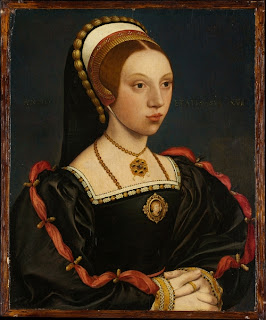
Above: A portrait miniature thought to be of Katherine Howard, c. 1540.

For Queen Katherine, the end came quickly and inexplicably. One moment she was England's adored queen, the beloved youthful consort of Henry VIII, renowned for her beauty and virtue. Finally, it seemed, Henry had married a woman who represented everything he desired in a bride: youthfulness, beauty, virtue, chasteness, fertility and, above all, innocence. Katherine seemed to share Katherine of Aragon's loyalty and humility; Anne Boleyn's sensuality and attractiveness; Jane Seymour's demureness and modesty; Anne of Cleves' good sense. Contemporaries often noted Henry's pleasure in his bride and his new found happiness. But throughout her brief reign Katherine was on the edge of a precipice. Her past harboured dark secrets, and she was well aware of the need to conceal them from public attention, if she was to be secure as England's queen.

From her marriage in the hot days of July 1540 to the autumnal beginnings of November 1541, Queen Katherine managed rather well. Recently, historians have come to dismiss the traditional notion that she was an irresponsible, reckless hedonist who spent her days partying and making merry. David Starkey noted her excellent handling of the responsibilities of queenship and credited her with bringing the Tudor family together for the first time. My research similarly suggests that Katherine took her responsibilities as queen seriously, providing for her family, dispensing patronage and maintaining good relations with the royals. She was young and inexperienced, but she moved past these drawbacks to perform her responsibilities as queen earnestly and devotedly.


Above: Possibly Katherine Howard.

Katherine's success, however, depended on her past remaining secret. Despite her apparent successes as queen, Katherine's past haunted her from the moment she married the king. Francis Dereham, a persistent and forceful young man who had been intimately involved with the queen some years before her marriage, arrived at court hoping to win her favour. When he arrived at court in spring 1541, he began boasting of his friendship with the queen and even commented that, were the king to die, he would be sure to marry Katherine. Henry Manox, a musician who had fondled Katherine some years previously, also pressed for appointment. 

In context of these dangerous rumours swirling about the queen's past, the emboldened Thomas Culpeper, a groom of the privy chamber to the king, sought out the queen and urged her to meet with him in secret. Possibly he had learned of her murky past and used it to encourage her to bestow favours upon him. Katherine, hoping to continue as England's queen, beseeched him to meet with her only in the presence of her chaperone Lady Rochford. What the two discussed is not known, but in context of dangerous allegations about the queen, it seems more credible that Culpeper had come into knowledge of Katherine's childhood liaisons and was using this knowledge to manipulate her. 


Above: Hampton Court Palace, where the queen was abandoned in November 1541.

The royal court departed on a northern progress in the summer of 1541. While they were away, an ardent reformer John Lascelles (who would be burned for heresy five years later) approached the Archbishop of Canterbury with damaging knowledge about the queen. Historians have recently considered the possibility that Katherine was the victim of a reformist conspiracy designed to bring down the conservative Howards. Certainly, it seems too much of a coincidence that Lascelles informed Cranmer of Katherine's past at this time, when rumours were also circulating of her sexual misadventures. The royal couple arrived in London in late October. On 2 November, the disbelieving king was informed of his wife's misconduct before her marriage. Four days later, distraught and emotional, Henry left Hampton Court Palace. He would never see his wife again. 

A day later, the queen was confined to her chambers. Katherine quickly guessed what was going on and suffered a full breakdown. Archbishop Cranmer referred to her 'lamentation and heaviness' when he visited her to interrogate her. He seems to have felt pity and compassion for her. The following day, Katherine had recovered sufficiently to answer Cranmer's questions. She admitted liaisons with both Manox and Dereham, but took care to emphasise her youth and vulnerability when these had occurred. She explained that Dereham had pursued her and that she had not enjoyed the affair. In a religious society valuing female chastity and honour, a loss of a girl's maidenhead proved personally and socially damaging. In view of this alongside her clear loyalty to her family, it is questionable whether Katherine would voluntarily and consensually have permitted either man, both of whom were lower in status, intimacies. She denied being Dereham's wife, possibly because canon law required that both vowtakers provide consent. 

Both Katherine and Dereham, when questioned, responded that their relationship had not continued following Katherine's royal marriage. However, Dereham asserted that Thomas Culpeper had since succeeded him in the queen's affections. Possibly he was aware of Culpeper's knowledge about Katherine's past, and assumed that the two were close. Katherine denied committing adultery with Culpeper, but did not reveal what she had discussed with him. Possibly, if their discussions had concerned the queen's past and a need to conceal it, Katherine felt reluctant to incriminate herself further by revealing sordid details of her childhood experiences.

Although Culpeper did later admit his hope to commit adultery with Katherine, 'the queen's motives remain opaque, not least because her questioners never pressed Katherine to explain why she met with Culpeper or needed to converse with him, beyond her excuse that he insisted on seeing her'. (Warnicke) Warnicke suggests that Katherine remained silent about the topics of their discussions because 'an admission that she had been attempting to deceive the king by concealing her relationship with Dereham would not have bolstered her defence'. Thus, while she may not have committed adultery, Katherine was guilty of deceit.

The king, meanwhile, experienced extreme sorrow and desolation when faced with knowledge of his wife's misbehaviour. On 12 November his privy council described his distress in a letter to Sir William Paget, resident ambassador in France. As late as April 1542 the king was described as being a different man since hearing of Katherine's past. On 14 November, the queen was relocated to Syon. Eight days later she relinquished the title of queenship, which proved easy enough to do, since she had never been crowned and had been queen purely by virtue of her marriage to the king. The following month, Dereham and Culpeper were sentenced to death, and shortly afterwards executed at Tyburn. Katherine and Lady Rochford were never brought to trial, but were found guilty by act of Attainder. They were executed at the Tower of London in February 1542.

Katherine never did admit to adultery. Although she admitted that she had been unchaste before her marriage, she insisted that she had done no more than converse with Culpeper. Because she admitted to having had a sexual relationship with Dereham, and because she confirmed that she had met secretly on several occasions with Culpeper, both early modern and modern commentators have tended to accept her guilt. If she did not commit adultery with Culpeper, then why did she become involved with him? Possibly 'fear of disclosure would... have made her vulnerable to the machinations of seasoned courtiers like Culpeper, for as she said in her confession about Dereham, 'the sorrow of my offences was ever before my eyes''. (Warnicke)


Above: Tower Green.


Thursday, 19 June 2014

The Relationship of Thomas Culpeper and Queen Katherine Howard


Above: Katherine Howard (left).
The letter Katherine supposedly wrote to the courtier Thomas Culpeper, perhaps in July 1541 (right).

Aside from being the youngest wife of Henry VIII, Katherine Howard is probably best known for her supposed adulterous affair with the handsome courtier Sir Thomas Culpeper conducted in 1541. What many historians argue began as a mutual attraction quickly developed into a powerful and dangerous adulterous liaison which eventually ended in the deaths of both queen and subject. However, the nature of the meetings between Katherine and Culpeper are shrouded in mystery, uncertainty and controversy. Only Katherine and Culpeper - and perhaps Lady Jane Rochford, the queen's attendant who arranged the meetings - know what really happened in those fatal spring and summer months in 1541.

For most historians, it seems obvious that Katherine, an oversexed, even 'promiscuous' young girl, had sexual intercourse with Culpeper, who was noted for his gallantry and, later rumours alleged, even indulged in rape (although, as I argue in my book, it seems more likely that it was actually his elder brother, confusingly also named Thomas Culpeper, whom the rumours referred to). This is supported by evidence documented by contemporaries residing near to the court. The unknown Spanish chronicler of The Chronicle of Henry VIII, compiled perhaps ten years after the events it described, suggested that 'the devil put it into this queen's heart' to fall in love with the dashing Culpeper, who slipped the queen a note one day during dancing confessing his love for her. Both proclaimed their love for one another on the scaffold, with the queen supposedly stating: 'I die a queen, but I would rather die the wife of Culpeper'. The Catholic polemicist Nicholas Harpsfield depicted an adulterous Katherine, who was 'an harlot before he [Henry VIII] married her, and an adulteress after he married her'. 

Modern historians largely agree. The bestselling popular writer Alison Weir wrote of Katherine's affair with Culpeper: 'Katherine had not only been playing with fire, but she had also been indiscreet about it, and incredibly foolish'. Antonia Fraser, in her 1992 biography of the six wives of Henry VIII, agrees: 'the repeated confessions and reports of clandestine meetings between a man notorious for his gallantry and a woman who was already sexually awakened really do not admit of any other explanation than adultery'. In his 2009 study of the Tudor queens, historian David Loades characterised Katherine as 'queen as whore'. This prevailing view has been consolidated in popular culture. In the popular TV series The Tudors (2007-10), Tamzin Merchant and Torrance Coombs depicted a headstrong young couple who engaged in sexual intercourse on a frequent basis early on in Katherine's marriage to the king. While Merchant portrayed a queen who appeared deeply in love with Culpeper, Coombs presented an unflattering portrayal of a manipulative, violent and scheming man who engaged in an affair with the queen as a means of attaining power and personal gain.


Above: Tamzin Merchant (left) as Queen Katherine and Torrance Coombs (right) as Thomas Culpeper in the television series The Tudors.

However, drawing on the seminal research of noted scholar Retha M. Warnicke, it is this article's contention that the relationship between Queen Katherine and Thomas Culpeper between April and September 1541 was, in reality, very different. It was not a carefree sexual liaison motivated either by love or recklessness, as most writers continue to believe. Thomas Culpeper was an experienced and savvy courtier who had served the king since the mid-1530s, when he had entered court as a page to Henry VIII before becoming a gentleman of the king's privy chamber, where the king ate, slept, and entertained indoors. Culpeper was, therefore, as close in proximity to Henry VIII as it was possible to get. Since Katherine had only arrived at court in the autumn of 1539, barely nine months or so before she became queen of England, Culpeper was vastly more experienced than her in court protocol and politics. He seems to have used that power and experience to his advantage, in manipulating the young queen, who found herself in a somewhat vulnerable position in the spring of 1541.

Katherine had had a sexual relationship with Francis Dereham in 1538, when she was aged around fifteen, and the aggressive Dereham seems to have been determined to marry Katherine, even making the treasonous suggestion that, once Henry VIII died, he would be sure to marry his young widow. In the spring of 1541, Dereham arrived at court and began openly boasting of his previous affair with Katherine. At this time, the king fell seriously ill and his life was despaired of. He shut his doors to everyone bar his doctors, including his young wife, whom he had previously spent the majority of his time with. As Warnicke suggests, it is therefore surely significant, in this highly charged atmosphere at court, that Culpeper began meeting with the queen at about the very time that both her former paramour was bragging of his sexual hold over her, and her ageing husband fell seriously ill. Since it was believed that the king might die, it has been credibly suggested that Culpeper began manipulating Katherine, perhaps having discovered details of her scandalous past, in the hope of acquiring greater power and position should Henry VIII suddenly die.


Above: Manipulative lover or abused victim?

Often, Katherine's meetings with Culpeper have been portrayed as playful, sexually intimate encounters, comprised of high passion and devotion. The reality was very different. The surviving records demonstrate that the queen refused to meet Culpeper unless Lady Rochford was present as chaperone, and when Lady Rochford began moving away on one occasion to allow the two to speak privately, Katherine reprimanded her for leaving her alone in the company of Culpeper, and told her to come back. It has been credibly suggested that 'Culpeper's rendezvous with the queen gave him the means to threaten and manipulative her'. In the summer of 1541, the queen wrote Culpeper a letter. Often, it has been portrayed as a love letter, but the nervous, even afraid tone does not suggest passion, but rather, fear and anxiety. A passage of the letter has been removed in the interests of this article (a passage dealing with Katherine's messenger):

Master Culpeper,
I heartily recommend me unto you, praying you to send me word how that you do. It was showed me that you was sick, the which thing troubled me very much till such time that I hear from you praying you to send me word how that you do, for I never longed so much for a thing as I do to see you and to speak with you, the which I trust shall be shortly now. The which doth comfortly me very much when I think of it, and when I think again that you shall depart from me again it makes my heart to die to think what fortune I have that I cannot be always in your company. It my trust is always in you that you will be as you have promised me, and in that hope I trust upon still, praying you that you will come when my Lady Rochford is here for then I shall be best at leisure to be at your commandment...
yours as long as life endures,
Katheryn. 

Traditionally, the queen's signature, 'yours as long as life endures', has been interpreted as a message of undying love, but as Warnicke recognises, Tudor letters typically closed with the statement 'by yours most bounden during my life', or something similar. Therefore, by changing the statement to 'yours as long as life endures', Katherine seems to have been hinting at her suffering, her anxiety, her worries that Culpeper would reveal her past to the king. 'Death and danger, not love and romance, were on her mind'. There was no evidence of love, passion or desire in this letter; no references to touching, kissing, caressing, etc. The queen was reported to be 'fearful and jittery' during their meetings, and admitted to Lady Rochford that she was terrified that these interviews would be discovered by others. Coupled with her insistence on Lady Rochford being present at all times, it seems clear that Katherine was meeting Culpeper only involuntarily, and not of her own free will.

Everyone knows how the story ends. Katherine and Culpeper were eventually discovered, while Francis Dereham and Lady Rochford were also imprisoned for their behaviour. A slew of Howard relatives and acquaintances of the queen were incarcerated in the Tower of London for concealing the truth about Katherine Howard's sexual past. Eventually, Dereham and Culpeper were convicted of adultery with the queen, although they both denied it, and they were executed in December 1541. Denying that she was guilty to the very end, the physically weak and frightened Katherine was beheaded on Tower Green on 13 February 1542 alongside her attendant Lady Rochford, who had reportedly gone insane. 


Above: a fictional portrayal of Katherine Howard and Thomas Culpeper from Henry VIII (2003).

Understanding of Tudor court politics and sixteenth-century beliefs surrounding gender and sexuality means that it is impossible to believe that Katherine Howard engaged in adultery with Thomas Culpeper. Katherine had endured something of a history of abuse. She had been seduced at a very young age by the grasping musician Henry Manox, before the aggressive Francis Dereham sexually manipulated her, perhaps even raping her. It is clear from surviving evidence that she had no real desire to meet with Thomas Culpeper and did so involuntarily and only in the presence of Lady Rochford, whom she perhaps trusted. This was not an affair of love, passion or desire. It was a relationship of power, manipulation and calculation that ended with both individuals' deaths.

Tuesday, 10 December 2013

The Execution of the Queen's Lovers


On this day in history, 10 December 1541, the alleged lovers of Queen Katherine Howard were put to death at Tyburn: Francis Dereham and Thomas Culpeper. Culpeper was first beheaded, before Dereham suffered the excruciatingly painful death of hanging, drawing and quartering. Charles Wriothesley wrote in his chronicle:

Culpeper and Dereham were drawn from the Tower of London to Tyburn, and there Culpeper, after an exhortation made to the people to pray for him, he standing on the ground by the gallows, kneeled down and had his head stricken off; and then Dereham was hanged, membered, bowelled, headed, and quartered [and both] their heads set on London Bridge.

Contrary to popular myth, Culpeper did not profess his love for Katherine on the scaffold; as Wriothesley makes clear, he merely asked the people present to pray for him, thus giving a very traditional last speech. Although Culpeper had arguably committed the worst offence of the two, in allegedly committing adultery with the queen while she was married to the King, he suffered a 'kinder' death. In my book, I speculate that Dereham suffered the more brutal death not necessarily because Culpeper was the king's favourite and thus the king was more inclined to mercy, but because Dereham had spoken openly about Henry VIII's death (a treasonable offence) and because he had sexually assaulted Katherine as a youth, a criminal offence.

Katherine Howard had become involved with Dereham in 1538, when she was aged around fourteen, and the two had commenced a sexual relationship which lasted around three months, ending in early 1539. That Katherine entered this unwillingly is clear from her confession. She appears to have sought comfort from Dereham after being abused by another young man, Henry Manox, but before long Dereham was pressuring her into marriage and sexual intercourse. When she received an appointment at court, she happily left him behind. When she became queen, however, Dereham blackmailed Katherine into giving him an appointment at court; perhaps in return for his silence regarding their past relationship.

If Katherine hoped that this would keep him silent, she was to be disappointed. Before long, Dereham was openly bragging about his relations with the queen, and intimated that, were Henry VIII to die, he would marry Katherine. Around the same time, Thomas Culpeper began meeting with the queen in secret. There is no convincing evidence that the two ever were in love or had an adulterous relationship. This of course contradicts the portrayal of the affair in The Tudors and other popular works. It is extremely plausible that Culpeper began blackmailing the young queen in return for favours, assisted by Lady Rochford.

Dereham's aggressive behaviour and Culpeper's meetings with the queen occurred at the worst possible time. In the autumn of 1541, the Archbishop Thomas Cranmer was informed by Mary Lascelles, a childhood acquaintance of Katherine, that the queen had not been a virgin when she had married the king, and had had sexual relations with both Manox and Dereham. Under interrogation, Dereham admitted to a pre-marital relationship with Katherine, but, perhaps reacting out of jealousy, claimed that Culpeper had replaced him in the queen's affections.


Above: the relationship between Thomas Culpeper and Katherine Howard was, in reality, very different to that portrayed in The Tudors.

Like Dereham, Culpeper blamed the queen entirely for what had happened. He admitted, however, that he had intended to  'do ill' with her, but claimed that he had only met with her because she had been 'dying of love' for him. A letter written by the queen to Culpeper was found and used as evidence against the pair. Far from being a love letter, the tone is fearful, anxious, afraid. It has been credibly suggested that Culpeper was blackmailing Katherine into meeting him as a means of him increasing his power, in exchange for keeping silent about her past.

Both Dereham and Culpeper were found guilty of treason and sentenced to death. In February 1542, the queen and Lady Rochford followed them to the scaffold. So ended a tragedy which had culminated in the deaths of four people and the heartbreak of an ageing king. Although there was no convincing evidence that Katherine had committed adultery with either Dereham or Culpeper, prevailing attitudes to female sexuality and honour meant that it was all too easy for the interrogators to believe that she had.

Thursday, 25 July 2013

Katherine Howard, Jane Boleyn, and Sexual Violence


Top: Were Queen Katherine Howard (above) and her lady-in-waiting Lady Jane Boleyn victims of what we would now term sexual violence?

The mysterious relationship between Queen Katherine Howard and Jane Boleyn, formerly Viscountess Rochford, has long perplexed and confused modern historians. Both would die by the axe in February 1542 for committing treasonous acts against the state, after it was alleged by the Crown that Queen Katherine had committed adultery with Thomas Culpeper, a gentleman of Henry VIII's privy chamber. She had apparently been aided and abetted by the experienced Lady Rochford, who acted personally for mysterious reasons which historians have been unable to trace. In my book, which will hopefully soon be published, I have found intriguing evidence to suggest that Queen Katherine was a victim of what would today be termed sexual violence during her childhood at the hands of Francis Dereham. Controversially, there might be evidence to indicate that her lady-in-waiting, Jane, suffered similar horrific experiences.

George Cavendish, who formerly served in the household of Cardinal Thomas Wolsey and who was thus admittedly hostile to the Boleyn family, provided disturbing evidence regarding Jane's husband, George Boleyn, who was executed for supposed incest with his sister Queen Anne. Cavendish's verses regarding George's vices read thus:

My lyfe not chast, my lyvyng bestyall,
I fforced wydowes, maydens I did deflower,
All was oon to me, I spared non at all
My appetit was all women to devoure
My study was bothe day and hower.
My onleafull lecherey, howe I myght it fulfill
Sparyng no woman to have on hyr my wyll.

Modern historians such as Retha M. Warnicke and Alison Weir have interpreted Cavendish's hostile verses to mean that George committed not only rape and buggery but also sodomy, sparing neither men or women in his pursuit of sexual gratification. Personally, I am sceptical - of course, it is possible that George did enjoy homosexual sexual intercourse alongside heterosexual sex, which could explain Cavendish's references to his 'onleafull lecherey' and 'all was oon to me'. However, I believe that the verses are intentioned to relate to how no women were spared from Rochford's licentiousness: 'I spared non at all, My appetit was all women to devoure', 'sparyng no woman'. Perhaps these verses have been misinterpreted. Rather than emphasising 'unnatural' homosexual 'perversions', Cavendish seeks to describe in horror and revulsion George's sexual violence, not stopping even at rape, using force on women to pursue sexual pleasure.

Of course, we cannot know if this relates to Jane, George's wife. Historians have traditionally believed that the marriage was singularly unhappy, perhaps even a catastrophic failure. They suggest that Jane as an earnest supporter of Queen Katherine of Aragon was resentful or jealous of Anne, George's glamorous elder sister, and it also seems likely that Jane's traditional Catholic religion led her to be hostile of the reformist Boleyns, who were identified by their enemies as Lutherans. In 1536, the Boleyn family spectacularly fell from power, as the Queen and her brother alongside four other gentlemen were accused, condemned and executed for sexual perversions, including adultery and incest. While Jane Rochford probably did not supply the crucial evidence for her husband's incestuous relations with his sister, as was traditionally believed by historians, she does appear to have assisted the Crown's case, detailing how Queen Anne had confided in her that her husband, Henry VIII, was impotent and unable to father a son on her.

It is also unlikely that Lady Rochford was assisted by Cromwell, or rewarded for providing evidence. As Warnicke notes: '... her status as his wife did not exempt her from revealing information about his treasonable activities.... she seems not to have made any deal with the crown in exchange for her testimony'. In a letter to Cromwell, she beseeched God to pardon George. But, interestingly: 'Had Rochford's attentions to other women been the cause, her contemporaries would have viewed her behaviour as a grave over-reaction because of the prevailing double standard that condoned a husband's extra-marital liaisons. Given this custom, she must have been greatly provoked to condemn him'.

Rather than believing, as Warnicke and Weir do, that Lady Rochford moved against her husband because she was revolted at his homosexual relations with other men, I believe that Cavendish's verses may insightfully supply intriguing evidence as to Lady Rochford's decision to provide assistance. If George had sexually assaulted her, or forced her to undergo sexual intercourse, she could have been personally affronted, even horrified. While women were identified as licentious, even evil in their carnal appetites, rape was to become a capital offence and during Elizabeth's reign was to become punishable by the death penalty. If Lady Rochford had been violently forced by her husband to have sex, perhaps even raped, it could explain, rather than his supposed homosexuality, her revulsion towards him and why she decided to assist Cromwell.

On a different note, there is tantalising evidence to suggest that her future queen, Katherine Howard, also endured sexual violence at the hands of Francis Dereham, who resided in the household of her step-grandmother the Dowager Duchess of Norfolk. Aged around fourteen when Dereham began pursuing her, Katherine later emphasised his use of 'force' and his 'vicious purpose', while her statement that he used her 'as a man doth his wife' could imply that he was violent towards her, for wife-beating was a serious problem particularly in London during this period. A more detailed explanation and interpretation is to be found in my full-length study. Admitting that she had not enjoyed the sexual experience, Katherine suggested that she had been unable to conceive a child because of her revulsion. When she was forced to employ Dereham in her household in 1541 in order to try and keep him quiet about their relationship, his aggressive and controlling behaviour in boasting about his intention to marry the Queen when the King died and his boasts about his acquaintance with her confirm the likelihood that he was aggressive both verbally and physically towards a girl probably at least a decade younger than him.

Around the same time that Dereham threateningly promised to marry Katherine following Henry VIII's death, the Queen became involved with Thomas Culpeper, a handsome favourite of the king who served as a gentleman of the privy chamber. Although she never committed adultery with him, Katherine was later to admit that she had become friends with Culpeper, and he also admitted his liking for the Queen. There is no evidence that Culpeper, like Dereham, was aggressive and physically violent. The association of rape and murder with him probably relate to his elder brother, confusingly also called Thomas. Lady Jane Rochford's assistance in this affair was crucial. Katherine's ladies in waiting seemed to confirm that she had encouraged Katherine from the very beginning.

While Jane's motives for helping the Queen remain obscure, this reinterpretation of both Jane's marriage and Katherine's childhood sexual experiences indicate that both women may have suffered what in the twenty-first century would be termed sexual violence. Although their contemporaries did not regard such experiences as such, they were aware of rape and sexual assault, which were classified as sexual deviance and abominable to God. Churchmen warned that sexual intercourse should be utilised only for the purpose of conceiving children. Lust was unthinkable and viewed as offensive, with women identified as licentious and eager to entrap men in unnatural perversions. Consequently, the experiences these women may have undergone would be classified as deviant, for lust was turned on its head and the purpose of conceiving children inverted for the sake of inflicting harm.

If both Jane and Katherine had endured such horrors, it may have brought the two women together. Interestingly, Jane seems to have become the Queen's confidant and favourite lady-in-waiting, despite the fact that she was aged around twenty years older than her new mistress. Aware of Katherine's marital difficulties in the spring and summer of 1541, she appears to have encouraged Katherine's blossoming friendship with Thomas, as the Queen's position was increasingly endangered by the resentful Dereham and his foolish comments. Never the pathological monster or sociopath she is often presented in modern portrayals as, Jane Rochford had perhaps been the victim of unnatural sexual force and wished to assist her Queen, who may have suffered similar experiences, as best she could.

Later, these women were associated with carnal licentiousness and treason against the king. Following their executions in 1542, Katherine has been universally condemned as a flighty and adulterous trollop and Jane Rochford a revolting abetter of the foulest of crimes. Perhaps reading their experiences in light of prevailing cultural customs and prejudices about women and sexuality should clarify and explain their actions. Their male contemporaries were unable to believe that women did not enjoy sexual intercourse, since they almost universally subscribed to the view that women, as accomplices of the Devil, eagerly and happily embraced all forms of sexual perversions, no matter how unnatural.

Tuesday, 16 April 2013

The Real Lady Rochford


Above: Sheila Burrell as Lady Rochford in The Six Wives of Henry VIII (1971).

Is it ever possible to really understand someone who lived in the past, particularly when it was as far back as almost 500 years ago? Whatever the case, history has not been kind to Jane Boleyn nee Parker, Viscountess Rochford. From the moment of her sister-in-law Queen Anne Boleyn's downfall in the early summer of 1536, when dark rumours swirled that Jane had played a crucial role in the queen's demise, right up until the present day, Jane has been demonised, condemned and detested. I'm certainly not the first to tackle Jane's tale and attempt to separate myth from reality (check out Claire Ridgeway's excellent articles on Jane and Julia Fox's biography published in 2007), but since I have been extensively researching Katherine Howard's life, writing a post on Jane seems logical.

The daughter of Henry Parker 10th Baron Morley and his wife Alice St John, Jane's birth is unknown (like most English gentlewomen), but she is recorded as having been at court from 'a young age' and since she accompanied Katherine of Aragon as a maid-of-honour to France in 1520, she must have been aged at least thirteen, the minimum age for a maid-of-honour, and so must have been born by at least 1507, probably in 1505. Jane's birth and early appointment at court placed her in a position of prestige and enviable social wealth. What we know of her is very uncertain - her appearance, qualities and duties at court are completely unknown. Since she appeared in a masque in 1522 alongside the likes of Mary Tudor queen of France and Anne and Mary Boleyn, it has been suggested that she was attractive in looks; added to this, Queen Katherine was probably aware of Jane's suitability to participate in the masque and had had some role in her selection. Jane's father was a fairly remarkable man, with a strong interest in culture and education, and his printed works still survive today.

At that masque (the Chateau Vert), one of numerous Jane probably participated in, she almost certainly met her future sister-in-law, Anne Boleyn, for the first time, a graceful and educated gentlewoman perhaps four years her senior. Anne's elder sister, Mary, also participated. Her relations with the Boleyn family were cemented at the end of 1524 when, aged about nineteen, she married the youngest surviving Boleyn child and heir George. Most historians, commentators and novelists have concluded that the marriage was unhappy, cold and unloving, particularly in light of the events of 1536. In Philippa Gregory's The Other Boleyn Girl, George openly voices his disgust and intense dislike of Jane, taking male lovers behind her back, while in the Showtime series The Tudors he does the same thing and anally rapes her, for good measure. Even historians such as Alison Weir conclude that the marriage was loveless, although Julia Fox romantically imagines the two 'snuggling up' together. Whatever the true nature of this mysterious marriage, it was unremarkable and usual for the time. Highly placed families at court arranged prestigious alliances with one another in order to strengthen their positions and increase their prestige - love did not play a hugely important part in these negotiations. Since Mary Boleyn was King Henry VIII's mistress around this time, and his desire for her sister Anne would develop a year or two later, it was a momentous time for Jane to join the rapidly prosperous Boleyn family.

Jane's position at this time was excellent; not only was she highly placed at court, serving Queen Katherine on a regular and intimate basis, but she was allied to an increasingly successful family. It must have been an exciting time for her. At this time, her husband became Viscount Rochford as a result of the king's favour for the Boleyns, and she became the Viscountess. The couple were awarded beautiful residences including Beaulieu Palace and Grimston Manor. However, even though they were living in lavish quarters and were enjoying ever greater wealth and fortune, many have assumed that Jane and George's marriage was very unhappy. Retha M. Warnicke suggests that this was the case because of George's homosexuality - something which, as an identity, did not actually exist until the 19th century, but which has been utilised in The Other Boleyn Girl, The Tudors and other works of fiction to create greater scandal. This is unlikely, since contemporary evidence compellingly suggests that George was a noted womaniser at court. However, it may be significant that the couple never had children. Perhaps Julia Fox's position is the safest one - although there is no evidence that the couple's marriage was blissful, there is equally little documentation to indicate that it was as unhappy and a failure as so often assumed.


Above: Anne Boleyn and Katherine Howard. Jane would feature heavily in both queens' downfalls.

Anne Boleyn's marriage to the King in the summer of 1533 strengthened the Boleyn family's power immeasurably, and Jane was at the centre of their glory and triumphs. She played a prominent role in Anne's coronation, and served her at court as queen. The exact nature of their relationship is, again, controversial. Jane helped Anne in 1534 to be rid of the king's mistress, and the Spanish ambassador reported that Jane had been dismissed from court as a result of her meddling (although, as has been noted, whether Jane left court for other reasons or whether she even left court at all is unknown). There is evidence dating from these years that Jane was something of a meddler, at least, although as with all historical evidence caution and scepticism is essential in using them to interpret the past. George Cavendish, who loathed the Boleyn family, offered a damning portrayal of Jane:

Withouten bridle of honest measure,
Following my lust and filthy pleasure,
Without respect of any wifely truth,
Dreadless of God, from grace also exempt,
Viciously consuming the time of this my youth.

The impression from this spiteful passage is, clearly, that Jane was not only irreligious and sinful, but that she was lusty - perverted even -, a failure as a wife, dishonest and vicious. Bearing in mind Cavendish's spite for Jane's family and the ever-present misogyny at the time, how accurate is such a description of Jane? Scandalous reports of her only surfaced in 1536 with the downfall of her husband's family. But other evidence suggests that she was involved in some murky matters - already the involvement with the Queen in 1534, and the possibility that in the autumn of 1535 she demonstrated alongside Lady William Howard in support of Princess Mary, thus setting herself up in opposition to her Boleyn relatives. Whether Jane had become disaffected with Anne and her relatives, possibly because of her own unhappy marriage, or whether the theory that she was involved in the demonstration is incorrect, is again unknown. The likelihood is that Jane had become disaffected with George, and by extension the Boleyn family, not because George was involved in homosexual relations as Warnicke believes, but because of religious differences. Jane was a traditional Catholic, as was her family, whereas the Queen and her relatives were noted evangelical reformers. It was religion, not sexual practices, which divided Jane and her husband's family.

Since Jane's father supported Princess Mary, it is possible that Jane transferred her support from the Boleyn family to Princess Mary and her supporters sometime in 1535-6. Certainly the situation at court may have influenced her, with Queen Anne's more uncertain position and the eventual rise of the Seymours. That has been the thinking of some historians, including Weir. Others, including Warnicke, downplay this, and suggest that Jane's scandalous reputation occurred only due to her involvement in Katherine Howard's downfall, not because of any involvement in Anne's, and argues instead that she turned against her husband because of the fact that he enjoyed sexual relations with other men (which cannot be proved).

Is it correct that 'the surviving evidence convincingly shows that Jane did testify to her husband having committed incest with his sister, and that she also confided to her interrogators some highly sensitive - and probably false - information'? (Weir) Fox, despite supporting Jane, thinks so, but insists that this only occurred because of the horrific environment Jane found herself in. In both The Other Boleyn Girl and The Tudors, once again, Jane plays a central role in her family's downfall. But whether or not this is historically correct is controversial.

In 1536, Anne Boleyn fell from power, caused largely by another miscarriage and the king's increasing disillusionment with his second marriage. She brought down five men with her, one of whom was her younger brother George, Anne's husband. As has been noted, Jane has traditionally been noted as being an essential part of these six people's deaths. George Wyatt, Anne's biographer, wrote of Jane as being a 'wicked wife, accuser of her own husband, even to the seeking of his blood. What she did was more to be rid of him than of true ground against him', while Bishop Burnet backed up this claim by writing how Lady Rochford 'carried many stories to the King... that there was a familiarity between the Queen and her brother beyond what so near a relationship could justify'. Another anonymous reporter wrote about 'that person who, more out of envy and jealousy than out of love towards the King, did betray this accursed secret, and together with it the names of those who had joined in the evil doings of the unchaste Queen' - although this evidence is particularly problematic since some writers have credibly argued that it doesn't refer to Jane at all, but another lady-in-waiting who supplied crucial evidence. However, the evidence against Jane is damning.

Julia Fox, however, who sees Jane as being a scapegoat, notes how Chapuys did not mention Jane as being the witness involved against Anne and George; the anonymous writer did not refer to 'that person' as Jane; Jane's eventual confession that she had lied about her husband and Anne was a forgery created years later; and other evidence, can counter the traditional belief that Jane, in a sense, was the 'particular instrument' in the Boleyns' downfall. That she was involved is certain. But what her role actually was is impossible to discern. I agree with the likes of Fox and Ridgeway; Jane has been unfairly demonised in the case of the Boleyns' downfall in 1536, and she probably wasn't the one who ensured their deaths as many people have believed. But I also caution against going too far in the opposite direction, and completely exonerating her from any guilt. She did play an important role, and I still believe that she was, at the very least, meddling.

George's execution severely crippled Jane, and she was forced to write to Master Secretary Thomas Cromwell for financial assistance, which he graciously provided her. She was further helped by being appointed one of Queen Jane Seymour's ladies in late 1536, thus enjoying social security and prestige at court once more. However, it is entirely possible that Jane had acquired a notorious reputation by now, although it is very unfair to present her as loathed by men and, in fact, insane, as Philippa Gregory has done. Jane's position became more prosperous still when her jointure was confirmed in 1539; she was later granted two manors in Warwickshire by Henry VIII. Following the queen's death in childbed, Jane served Anne of Cleves, and it has been conjectured that, once more, she played a prominent role in Anne of Cleves' divorce, providing crucial evidence that the marriage was never consummated. This, again, is uncertain. Warnicke suspects that the evidence was made up entirely. Jane probably supported Katherine Howard's cause because she came from a prominent Catholic family - since Jane was known to favour the Catholic religion, she probably viewed Katherine as a more acceptable queen than Anne of Cleves.

The winter of Jane's life, in a sense, began in the summer of 1540 when Henry VIII married Anne of Cleves' maid-of-honour, Katherine Howard, a relative of Jane's Boleyn relatives. The relationship between Jane and Katherine is entirely unknown. In Gregory's fiction, Jane manipulates and controls the young queen, largely due to the age difference between them, and manoeuvres her into working solely for the benefits of the Howard family at whatever cost. Conversely, in The Tudors (where they are much closer in age), the two seem to become close friends, and confidants. Certainly it's mysterious. Jane was at least eighteen years older than Katherine, and Katherine had other female relatives whom she might have felt she could have better trusted, including her sister-in-law and the women she had known from her childhood, including Katherine Tylney. I suspect, however, that the queen actually disliked these childhood companions, of whom Joan Bulmer was the most infamous, and only employed them at court in a naive attempt to keep them quiet. It is therefore plausible that she became involved with Lady Rochford because she quite literally had no-one else, and Jane Rochford was, by virtue of having served four queens already, an experienced courtier.

I am not suggesting, however, that Lady Rochford became involved with Katherine in order to allow the queen to commit adultery. Finding Warnicke's arguments compelling, along with my own research, it seems plausible that in the spring and summer of 1541 a situation at court which had haunted the reigns of Henry's earlier queens began to stifle Katherine - that of fertility politics. Almost certainly, she was made well aware by her family of the need to provide the king with a second son, and with his illnesses in the spring, she probably became increasingly anxious for her own future. The example of not only Anne Boleyn but Anne of Cleves was clear for her to see. So why did Katherine meet with Thomas Culpeper, an individual who was very possibly violent and manipulative, a rapist in fact? The answer lies in this situation, too often misunderstood by historians. Since Culpeper was the closest courtier to the king, attending to his most intimate needs, the queen probably began communicating with him in an effort to understand what was going on with her husband, in effect, to protect herself. It is inconceivable that, with this going on in the background, she would have rashly decided to embark on an adulterous affair.

The evidence seems to suggest that Jane initiated these meetings, perhaps out of goodwill to the queen. Not all writers have suggested this. Baldwin Smith damns Jane as being 'a pathological meddler with the instincts of a procuress who achieves a vicarious pleasure from arranging assignations' has been highly influential in fiction (above all Gregory's book), while the queen herself later accused Jane of having 'a wicked imagination'. Jane, according to the interrogations later, promised Katherine that she would never reveal her meetings with Culpeper, while the queen was reported to have been skittish and afraid during these encounters, perhaps because she was aware of what these meetings looked like. Unfortunately, a host of factors instigated both women's downfall that autumn. Rumours had swirled menacingly since the queen's marriage that she was unchaste, and this worsened in the summer when one of Katherine's former confidants, Mary Lascelles, reported to her brother that the queen was a woman of evil reputation. He consequently informed the Archbishop, who informed the king. Bearing in mind Katherine's sexual relations during her childhood were probably characterised mostly by force and manipulation, perhaps even rape, it's difficult to work out why Mary suddenly confided this. This is, in fact, the greatest problem with the evidence. If Katherine's ladies found it so strange that she was staying up until the early hours of the morning with her doors locked, only Jane for company, it is weird that they never reported this to the king or anyone else until three or four months later. Quite plausibly, the evidence was exaggerated, if not invented. Both Katherine and Culpeper insisted that they had never had sex, although Jane reported otherwise. She perhaps did so in an attempt to save herself, believing that, although the queen might suffer death, she would not.

Unfortunately, it was not to be so. Jane was imprisoned in the Tower while the queen was confined at Syon Abbey, and she was condemned to death in January 1542, aged probably thirty-six. Jane suffered a nervous breakdown, and it is possible that she lost her sanity. An Act of Attainder was specifically passed in order to allow her execution to take place, and she was executed with the young queen on 13 February. The notion that she admitted her guilt for her husband and Queen Anne's death on the scaffold is a myth. A contemporary observer reported that she merely expressed her sinfulness and the fact that she deserved her punishment, although another felt she spent far too long speaking. Following the trembling queen's end, Jane was executed, and was buried in the nearby chapel.

George Cavendish remarked that her 'slander for ever shall be rife' and her sin would ensure that she would be remembered as 'the woman of vice insatiate' has proved to have been the case. One Victorian historian even opined that 'the infamous Lady Rochford... justly deserved her fate for the concern which she had in bringing Anne Boleyn, as well as her own husband, to the block'. Many have interpreted her execution as being a case of what goes around, comes around. This is probably unfair; it seems likely that her role in the downfall of the Boleyns was much smaller than has usually been assumed.

I am not convinced that Jane was as guiltless as some have suggested. I think it's plausible to argue that she instigated the meetings between Katherine and Thomas Culpeper; why she did so, we cannot know. She certainly did provide damning evidence against her husband and Anne Boleyn. But was she the monster of television series and Gregory's The Boleyn Inheritance? Certainly not. At the very worst, Jane was meddling and probably hostile to her husband's family; maybe she instigated Katherine Howard's meetings out of a desire to help the queen in a desperate situation. It's hard to say. But her brutal end is certainly something to shy away from.

Wednesday, 13 February 2013

The Execution of That Young Girl Katherine and That Bawd, Jane Rochford


On this day, 13 February 1542, eighteen-year old Katherine Howard, fifth queen consort of Henry VIII of England, was beheaded privately on Tower Green for sexual crimes committed against her husband. Following her brutal end, her Lady of  the Bedchamber and relative Lady Jane Rochford was also executed.
Katherine, of course, was the second of Henry's queens to be beheaded, but she has not received the same compassion and pity which her more celebrated cousin, Anne Boleyn, has inspired. Often looked upon with scorn and contempt as being a scheming and spiteful whore, the true reality to the king's teenage queen is rather different.

Readers will know that I am currently researching and writing a biography of Katherine, largely because I think existing historiography on her is highly flawed, providing us with a totally false image of not only this young woman but her family, the Tudor court, her husband the king, and social and cultural beliefs in Tudor England. In 2012, I wrote an essay offering my version of why Queen Katherine fell so tragically from power in 1541, rejecting the popular belief that her sexual affairs, both before and after her marriage, were discovered by reformers who loathed the Catholic Howard family and eagerly informed the King, led by that fervent Protestant the Archbishop of Canterbury himself. There is very little evidence to support this interpretation, and my thesis is rather different concerning young Katherine's downfall in November 1541, eventually leading to her execution just 3 months later and leading to the deaths of 3 other people.

That essay led to me being invited to St Hugh's College, Oxford (I had submitted the essay for the 2012 Julia Wood Prize), as one of  the top ten applicants, something I was very honoured to participate in. Since then, I have actually modified my theories surrounding Katherine's downfall, and the reality is, I think, more disturbing. Scholars have largely neglected to realise how fundamental fertility politics were at Henry VIII's court. Bearing in mind, in its own way, fertility had destroyed the King's previous marriages - Katherine of Aragon and Anne Boleyn both rejected for failing to bear sons, Jane Seymour in the process of giving birth to one, and Anne of Cleves scandalously accused of rendering her husband impotent - it seems compelling that the fifth marriage also collapsed because of fertility issues. Rejecting the notion that Katherine, as an oversexed and lusty adolescent took multiple lovers behind her husband's back, I believe that not only did she never have sex with Thomas Culpeper, but these meetings were sinisterly interpreted by the Council as evidence of the Queen's desperate attempts to conceive a child due to Henry's impotence. That the King was impotent, I think, is obvious. It was an issue in both his marriages to Anne Boleyn and Anne of Cleves. Katherine Howard, in effect, was a scapegoat for her husband's impotence. Believing that she was trying to conceive a son since her husband could never provide her with one, this young woman was brutally destroyed, along with Jane Rochford, who was believed to be assisting her, and Francis Dereham, a manipulative individual who I believe was sexually violent towards Katherine, and Thomas Culpeper, an ambitious courtier who probably manipulated Katherine into granting him favours.

The year 1541 abounds with evidence of the royal couple's fertility problems. I won't go into it in detail here, for it will be explored fully in my biography, to be published this summer. However, what is clear is that in November 1541, days after being celebrated as the king's most loved queen in churches across England, Queen Katherine was confined to her chambers and forbidden to see her husband. Her shock, fear and confusion must have been evident. She was ruthlessly interrogated several times, but consistently maintained that she had never taken lovers behind the king's back and swore that Dereham had raped her. Most historians dispute both of these confessions, but I believe them to be true. In December, both Dereham and Culpeper were executed for treason, but Culpeper insisted that he had never slept with Katherine, which she insisted too. During this time, both the Queen and Lady Rochford were imprisoned, before being taken to the Tower of London.

Despite her repeated avowals of innocence, Katherine was condemned to die as a traitor, and Jane Lady Rochford was also condemned for misprision of treason. Jane's reputation has been abominable; with historians often arguing that it was she who brought forward charges of incest against her husband and Anne Boleyn, who were brother and sister. Whether this is true or not is unclear. Nonetheless, Jane seems to have had a full mental breakdown in the Tower, and the King passed a law allowing him to execute mad people, surely conveying his desire to be revenged upon this gentlewoman. Katherine, too, collapsed with shock and horror at what had befallen her. She was described often by several reporters as being in a highly weak state physically, and it was later suggested that she had to be physically helped up the scaffold.

On 13 February, the queen and her female attendant emerged from the Tower, proceeding on the short walk to Tower Green for their ultimate punishment. Katherine's execution has often been shrouded in a fair degree of mystery. The Spanish ambassador claimed that the night before her beheading she requested the block, in order to practice laying her head on it before the actual execution. In popular culture, she is often depicted as terrified with fright, as anyone who was seen Henry VIII (2003), with its harrowing depiction of Katherine's execution, will know. (Emily Blunt, playing the young queen, is shown screaming and crying with fear, protesting "I don't want to die!") In The Tudors, Tamzin Merchant presents Katherine as wetting herself on the scaffold with fear.

The reality is that Katherine was much braver, although the French ambassador reported that she was so weak that she could barely stand or speak. That she was in a state of shock seems clear. Her uncle had previously stated that she was tormenting herself with fear, as the Archbishop of Canterbury had also implied when he had interrogated her 3 months earlier. An eyewitness to the execution, a London merchant called Otwell Johnson, gave a very different account of Katherine and Jane's last moments. He stated that:

thay made the moost godly and christyan's end, that ever was hard tell of... uttering thayer faeth in the blode of Christe onely, and with goodly words and stedfast countenaces thay desyred all christen people to take regard unto thayer worthy and just punnishment with death for thayer offences, and agenst God hainously from thayer youth upward, in breaking all his commandements...

A notorious Catholic source, entitled The Chronicle of Henry VIII and written by an anonymous Spaniard living in London in the 1550s, gave a differing portrayal of Katherine's execution. Readers have to bear in mind that many of his reports are highly inaccurate. For instance, the king's marriages to Anne of Cleves and Katherine Howard are reversed, Cromwell interrogates Katherine (fact, he had died almost 2 years previously) and no mention is made of the executions of Dereham and Jane Rochford. He reported that the Queen apparently stated:

long before the King took me I loved Culpepper, and I wish to God I had done as he wished me, for at the time the King wanted to take me he urged me to say that I was pledged to him... I would rather have him for a husband than be mistress of the world... I die a Queen, but I would rather die the wife of Culpepper.

This famous detail, that Katherine apparently wished to die the wife of Culpepper, is entirely fictional. In the Spanish chronicler's account, the Queen embarks on a passionate love affair with this courtier, and the King is depicted as a cruel tyrant who breaks apart the couple's tender love by choosing Katherine for his wife. This, of course, is almost certainly untrue. The true reality of their relationship is complicated. I agree with David Starkey and Retha Warnicke that they never had sex, and I believe Warnicke is right when she claims that Culpeper manipulated the young and naive Queen, but I do believe Katherine had tender feelings for him. Nonetheless, my theory is that she only turned to Culpeper initially because of her mounting concerns about her husband's fertility problems, and sought out Culpeper because he was the King's closest attendant and thus fully aware about his sexual problems, and so could have enlightened her.

The Spanish chronicler described Katherine as only fifteen when she met the King, and depicted her as being very beautiful, remarking that she was the loveliest lady in the kingdom. Following Katherine's death, Jane Rochford was immediately executed. Apparently insane - as described controversially in Philippa Gregory's The Boleyn Inheritance - she made a long and rambling speech which irritated contemporaries. Fully double the Queen's age - she was born c. 1505 and so was aged around 37 - she was almost certainly not the pathological monster she has so often been depicted as. The legend that Jane admitted that she had provided evidence against Queen Anne and George Boleyn, and regretted it emotionally, is untrue. Whether it was she or Katherine who initiated the meetings with Culpeper is almost impossible to say.

I have covered the deaths of 3 Tudor Queens this month, 2 of whom were teenagers (Katherine not yet 19, Jane Grey 17). But Katherine Howard, out of all the Tudor women beheaded, is almost certainly the most misunderstood out of all of them, and yet I believe that in many respects she was the ultimate victim. A naive, kind-hearted girl who was manipulated by experienced and aggressive older men, she tried to do her best as Queen, showing genuine kindness towards several personages, and advanced her family in order to benefit them. It was not her adultery, her foolishness, her lustiness which eventually killed her. It was fertility politics, ultimately making her a scapegoat for her husband's inability to impregnate her. Increasingly suspicious and distrustful of his young queen, when evidence emerged that Katherine had employed her former lover (probably to appease him) and had had nighttime meetings with Thomas Culpeper, the King believed that she had betrayed him, hoping to fall pregnant by either, or both, these men and pass off their bastard as the King's son. Agnes Strickland described Katherine as being led like a sheep to the slaughter without having the opportunity to say a word in her own defence. Her innocence and naivety was rare in the Tudor court.