Sunday, 8 November 2015

The Forgotten Countess: Anne Beauchamp, Countess of Warwick


Above: Anne Beauchamp alongside her husband Richard Neville, earl of Warwick, in the television series The White Queen.

In fifteenth-century England, titled women, that is duchesses and countesses, enjoyed positions of great social and political importance. They were second only to queens in the power they held and influence they wielded. At that time, a duchess or countess was responsible for advising her husband; supervising her estates and assisting her adherents in a variety of matters; attending court in the queen's household; and, most importantly, bearing children (preferably sons). Even today, duchesses and countesses of fifteenth-century England remain well-known. Women such as Jacquetta, duchess of Bedford, and Cecily, duchess of York, were influential, intelligent and strong-willed. They influenced their offspring and assisted them in their schemes to take the throne. Jacquetta masterminded her daughter Elizabeth Wydeville's obscure marriage to Edward IV, while Cecily had played an important role in educating Edward and, perhaps, grooming him for kingship. Similarly, the political involvement of Margaret Beaufort, countess of Richmond and Derby, was significant. Her influence both at court and in local society ensured the continuing relevance of her son Henry Tudor's claim to the throne, and the countess emerged triumphant in the summer of 1485 with Henry's accession. 

However, one countess remains largely unknown, and yet her story was every bit as tragic, as unpredictable, and as fascinating as the stories of the women above named. Anne Beauchamp, countess of Warwick, was the wife of Richard Neville, earl of Warwick, who remains known today as the 'Kingmaker'. She was the mother of Isabel and Anne, and her younger daughter would become queen of England in 1483 as the wife of Richard III. In the television series The White Queen, the countess is not one of the main characters, but she is portrayed as a shrewd, intelligent woman who played an advisory role to her husband. She was depicted as being extremely close to her two daughters. Whether the real countess enjoyed good relations with her offspring is unknown.


Above: Anne Neville, the younger daughter of the Countess of Warwick.

Anne Beauchamp was the daughter of Richard Beauchamp, thirteenth earl of Warwick, and Isabel le Despenser, who was the sole heiress of her deceased father Thomas. She was born in July 1426 at Caversham Castle in Oxfordshire. In 1434, when Anne was only eight years old, she was betrothed to Richard Neville. She married Richard at an unknown date and gave birth to two daughters by him: Isabel (born in September 1451) and Anne (born in June 1456). Both girls were born at the family seat at Warwick Castle. Whether the couple were severely disappointed by their failure to have a son is unknown, but it is entirely possible given that Richard may have wanted the estates and title to remain within the family. The son of the earl of Salisbury, Richard acquired significant wealth and status by marrying Anne Beauchamp and inheriting the Warwick estates and title. Upon her marriage to Richard, Anne became countess of Warwick. 

The Neville family was one of the old noble families in England. They were proud of their lineage and were highly ambitious. Warwick's ambition was renowned and he played a major role in securing the accession of his cousin Edward, earl of March, in 1461. However, Warwick experienced conflict with the new king when Edward elected to marry the relatively unknown Elizabeth Wydeville. The new king's mother, Cecily, duchess of York, disliked her daughter-in-law and voiced outrage at her son's folly. Warwick similarly disliked the new queen and harboured a great deal of resentment, eventually leading him to rebel against Edward. Whether Anne Beauchamp resented Queen Elizabeth, or whether she enjoyed good relations with her, is a mystery. Certainly she would have enjoyed a favoured position at court. 

The sources are frustratingly silent about the countess. We know next to nothing about her. Did she welcome the favour shown to her family and did she feel pride at her husband's influence at the king's side? She surely harboured concern about the twists and turns of fortune. In 1470, the disaffected Warwick masterminded the restoration of the Lancastrian king Henry VI and his resourceful wife Margaret of Anjou, a woman who loathed Warwick. We cannot know whether the countess was on intimate terms with Queen Margaret, but she surely could not have envisaged that the queen would become her sister-in-law that same year. But that is exactly what happened. Anne's younger daughter, also named Anne, married Edward of Westminster at the age of fourteen and, in the process, became Princess of Wales. She was destined to be England's queen - but, unknown at the time, it would not be at the side of Edward, who was killed in battle at Tewkesbury the following year, leaving the young Anne a widow.


Above: Margaret of Anjou, briefly Anne Beauchamp's sister-in-law.

1471 was perhaps Anne Beauchamp's annus horribilis. Not only had she lost her son-in-law, but her husband Warwick was killed at the battle of Barnet that spring. With his death, the countess lost everything. Her husband was, in the eyes of the restored Edward IV's government, a traitor. The countess herself was, by association, a pariah and she was forced to keep a low profile for a time. Her position, however, was uncomfortably ambiguous. Her elder daughter Isabel had married Edward's younger brother George, duke of Clarence, in 1469. This ensured the countess' continuing closeness to the ruling house of York. Isabel died in 1476, however, and Clarence was executed for treason two years later.

These were years of sorrow and loss for the countess. In a brief period, she had lost her husband, her daughter, and both her sons-in-law. She had been respected, perhaps even loved, during Warwick's ascendancy, and she had enjoyed an influential position at court. Briefly she had been Margaret of Anjou's sister-in-law, and had Margaret triumphantly regained her position as queen with the final collapse of the house of York, then Anne's position would surely have been unrivalled as the mother-in-law of the heir to the throne. Instead, she was isolated and alone. She only had her younger daughter Anne for company, and as events were to prove, that was not necessarily a positive thing. 
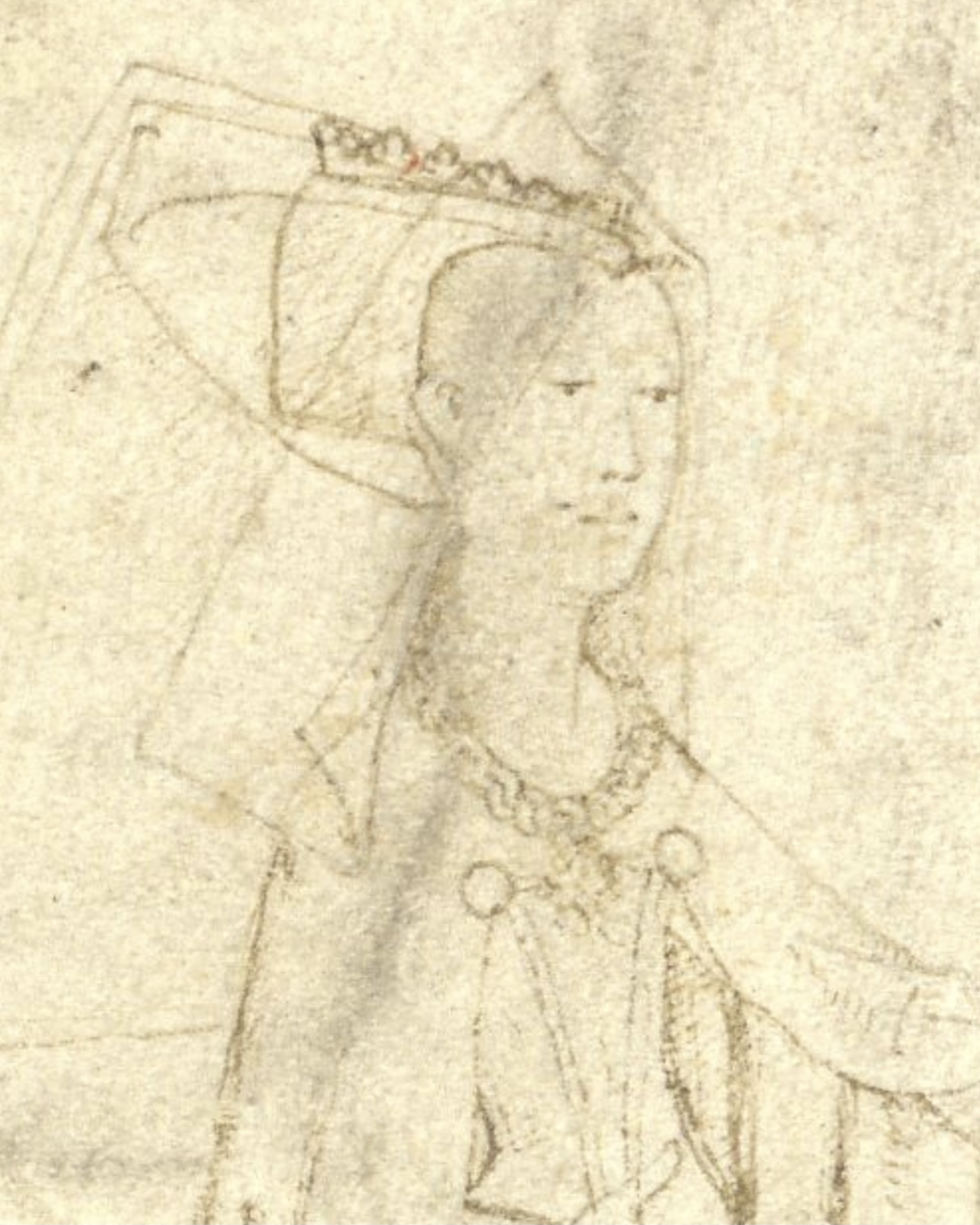


Above: Isabel Neville, duchess of Clarence, firstborn daughter of Anne Beauchamp.

The marriages of her two daughters caused the countess considerable stress. Her younger daughter Anne had married the king's youngest brother Richard, duke of Gloucester. In Clarence's lifetime, he had fought bitterly with Richard over the Neville inheritance. The countess resided in the household of her daughter, the duchess of Gloucester, but there may have been considerable ill-feeling between mother and daughter. Between them, the sons-in-law of the countess had effectively disinherited her. 

The countess did not meekly submit to the schemes of her sons-in-law. She responded furiously and expressed both outrage and disbelief. She perhaps viewed herself as betrayed by her own daughter. While in sanctuary at Beaulieu Abbey, the countess had written several letters seeking both her release and her control of her own wealth, swearing that she had 'neuer offended his most redoghted highnes' [Edward IV]. She was determined to exercise control over her own future and she would do whatever it took to do so. The countess sought the assistance of the queen, the king's mother, the queen's mother, and even the assistance of the king's eldest daughter Elizabeth. 

It was to no avail. The countess was legally treated as if she were dead. Her lands were divided between her two daughters and their avaricious husbands. She did, however, acquire an income from her son-in-law Richard III when he became king. It is worth noting that Henry VII was more generous in his treatment of the countess, providing her with 500 marks a year while granting her life estates in over two dozen manors and lordships. Henry also made her principal keeper of the forest of Wychwode. 

Anne died in 1492 aged sixty-six. Hers had been a long, tumultuous and, in many respects, tragic life. She had lost her husband in battle, her eldest daughter had died while still young, and she may have experienced conflict with her youngest daughter. Her lands and estates were seized from her by George of Clarence and Richard of Gloucester. She had been respected as the wife of the Kingmaker, but she had also been an outcast, perhaps even a pariah. She was briefly the mother of the Queen of England, but unlike Jacquetta Wydeville, Cecily Neville or Margaret Beaufort, she did not enjoy a position of power and influence as the mother of the ruler. We know very little about the countess and evidence is scarce. Whether the countess was scheming and ambitious, or whether she was more sympathetic, cannot be known. 

Tuesday, 27 October 2015

The Stereotyped Six Wives: Six: 'Never A Wife More Agreeable to His Heart'


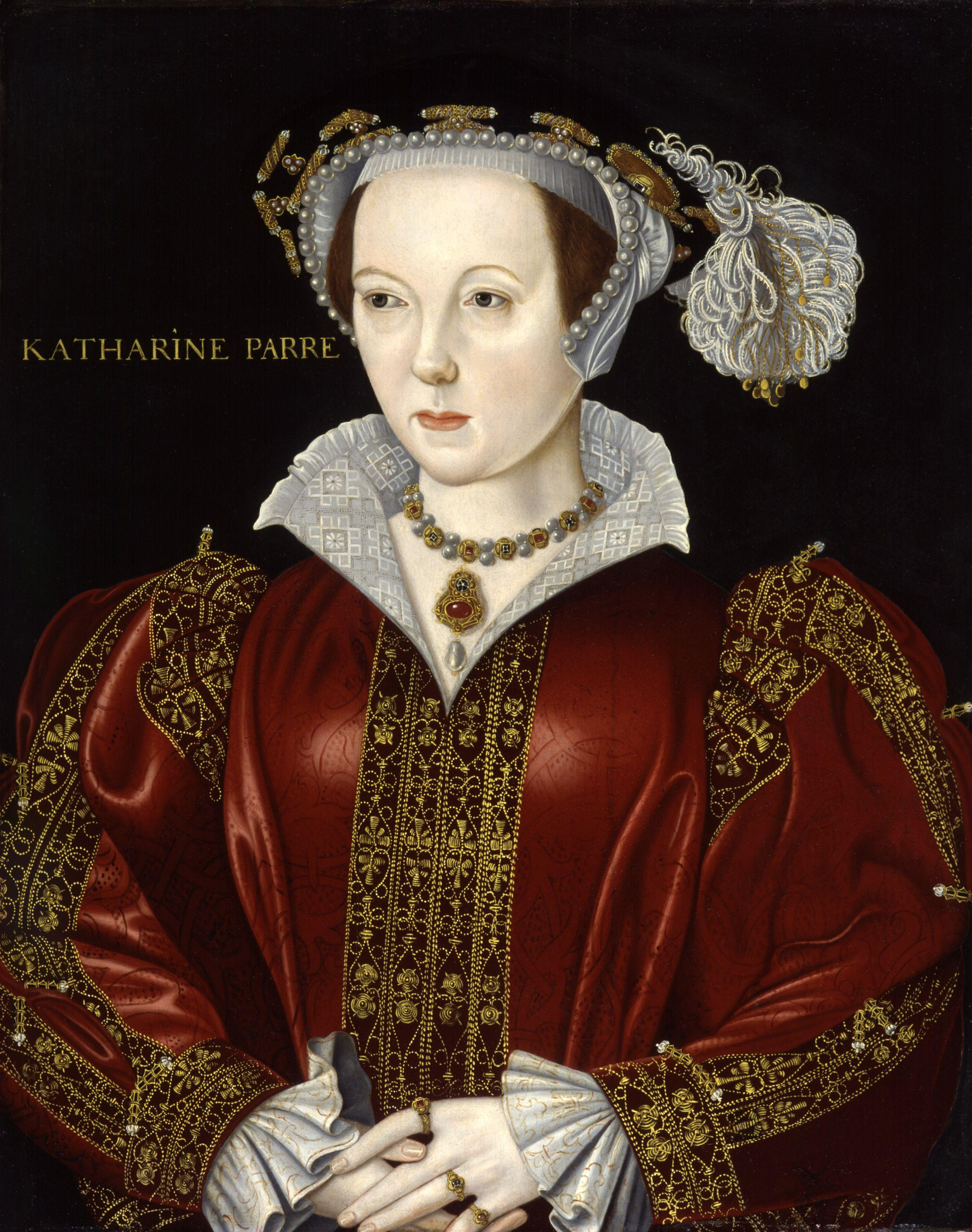
Katherine Parr, sixth wife of Henry VIII of England
Lifetime: 1512 - 5 September 1548
Reigned: July 1543 - January 1547 (3 years, 6 months)
Pregnancies: 0

In this new six-part series, I will be reexamining the lives and personalities of Henry VIII's six wives, seeking to portray their lives realistically in a process that discards prevailing stereotypes. Much scholarly work has been done on Henry's reign in recent decades, affording fresh insights into the politics and achievements of the period. Understandably, widespread interest in Henry's marital affairs remains unabated. Yet stereotypes continue to bedevil our knowledge of the wives of this most enigmatic king. 

Katherine Parr was Henry VIII's sixth wife and in many respects she differed from his other consorts. She had been twice married when Henry's eye fell on her and, at thirty-one, she was somewhat older than her predecessors. The ageing king had wed Katherine Howard because her youth seemed to promise fertility. In marrying Katherine Parr, Henry perhaps acknowledged that he might not have any more legitimate children. The new queen was a charming, educated and well-liked woman who was known for her evangelical sympathies. Katherine can be termed the first truly Protestant queen of England and she was a noted patron of reformist scholars. She was also deeply interested in the Renaissance and spent considerable sums of money on clothing, works of art and jewellery. Like her predecessor Anne Boleyn, Katherine also enjoyed music, dancing and the finer things in life. In this respect she was an ideal consort. Yet her intelligence and devotion to reform threatened to be her own undoing. Towards the end of his life, rumours circulated that the king was rapidly tiring of his opinionated wife and was considering removing her. Fortunately, Katherine emerged unscathed but she was fortunate to escape potential arrest and even execution for heresy. 

While Katherine's importance as queen was underestimated or even dismissed by nineteenth-century historians, modern scholars are keenly aware of her political, religious and cultural significance. The traditional and erroneous stereotype of her as merely her husband's nurse has been superseded by studies that demonstrate her importance to the advancement of Protestantism in England alongside her status as a Renaissance patron. She was a loving stepmother to Henry's children and was especially close to Elizabeth. Having at one time been perhaps the most misrepresented of Henry's wives, it is perhaps Katherine Parr, of all his queens, whose true character has most clearly emerged in light of advances in historical scholarship.


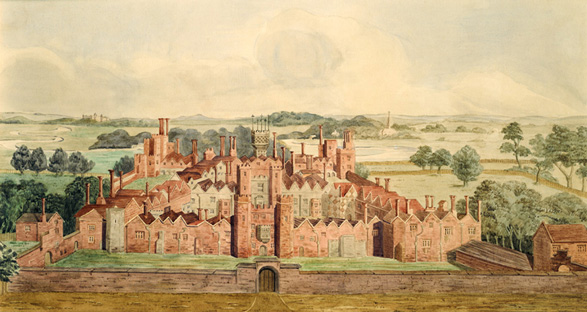
Above: Snape Castle in Yorkshire, where Katherine Parr and her stepchildren were held hostage during her time as the wife of John Neville.

Katherine Parr was the eldest daughter of Sir Thomas and Maud Parr, and was most probably born in around August 1512 at Blackfriars in London. Her brother William was born in 1513 and her sister Anne followed in about 1515. As with Anne Boleyn and Jane Seymour, Katherine's father was a close favourite of Henry VIII, while Lady Maud served as Katherine of Aragon's lady-in-waiting. Most probably the queen stood as Katherine Parr's godmother, for whom she was named. When she was five years old, Katherine's father died. Her mother, an ambitious and resourceful lady, successfully managed the family's estates, supervised her children's education, and arranged marriages for her two eldest children. In the words of Susan E. James, Maud 'set an example of female independence that was to have a lifelong effect on her elder daughter'. 

Like Anne Boleyn, Katherine was well-educated and grew to be an articulate, assertive and remarkable young woman. She was not beautiful, but she was attractive. The Spanish ambassador recorded that she was 'of small stature, graceful, and of cheerful countenance'. The Duke of Najera's secretary Pedro de Gant similarly reported that she had a 'cheerful countenance' and was 'praised for her virtue'. Katherine's skeleton, unearthed in the nineteenth-century, showed her to have stood at 5'2 inches tall, making her about the same height as Anne Boleyn and Jane Seymour and probably slightly taller than both Katherine of Aragon and Katherine Howard, who was said to be 'diminutive' in stature. She had auburn hair, grey eyes and graceful, finely shaped hands. As the above testimony indicates, she had a gracious and merry temperament. She was also passionate, intense and outspoken.

Katherine had an aptitude for languages, acquiring a knowledge of French, Latin, and Italian, and as queen she sought to learn Spanish. In the summer of 1529, at the age of seventeen, Katherine married Edward Borough, who was perhaps four years her senior. Historians have conjectured that Katherine might not have been happy during her first marriage, for her father-in-law was overbearing and bullying. The young couple resided at Kirton in Lindsey, Lincolnshire, but their marriage proved to be a short one. Katherine's first husband died, only in his mid-twenties, in the spring of 1533. A year later, Katherine remarried. Her second husband was John Neville, Baron Latimer. This was an excellent marriage for Katherine and the ambitious Parrs, for it made her a baroness. 

In puzzling over the origins of Katherine Parr's proclivity for the reformed faith, historians have wondered whether it began during her marriage to Latimer, for her husband was conservative in matters of religion. Dwelling at Snape Castle in Yorkshire, the new Lady Latimer received a fright when her husband was seized by an angry mob during the Pilgrimage of Grace in the autumn of 1536. Her husband was in a perilous position, in trying to please both the rebels and the suspicious king. In early 1537, believing that Latimer was about to betray them to the king, the rebels stormed Snape and seized Katherine and her stepchildren as hostages. Fortunately for them, Latimer managed to secure their release, and a few months later Lord and Lady Latimer departed for the south.


Whether Katherine was happy during her second marriage is unknown. If she had begun to harbour sympathies for the reformed religion around the time of the Pilgrimage of Grace, she might well have experienced tensions with her conservative husband. As in her first marriage, Katherine remained childless. In the spring of 1543, her fortunes changed drastically. Latimer died and, while serving at court in the household of Mary Tudor, Katherine attracted the ageing king. Like Anne Boleyn, Katherine reacted negatively when she learned that Henry wished to marry her. She seems to have harboured feelings for Sir Thomas Seymour, brother of Jane, and perhaps wished to marry him when her period of mourning for Latimer was at an end. Katherine, highly reluctant, eventually overcame her scruples upon concluding that it was God's will that she become queen. As she later wrote to Thomas: 'Howbeit, God withstood my will therein most vehemently... [and] made me to renounce utterly mine own will, and to follow his most willingly'. On 12 July 1543, Katherine married Henry VIII at Hampton Court Palace in a quiet ceremony.

Although Katherine Parr was fulsomely praised in her own lifetime and has been lauded by modern historians for her success as queen, she may initially have struggled for, like her predecessor Katherine Howard, she lacked experience at court. As Susan E. James writes, she was 'the only one of Henry's queens without either royal background or court service to train her for her new position'. Fortunately, Katherine quickly established excellent relations with her three stepchildren. She was already close to Mary on account of her brief time in Mary's household, and the new queen became closely involved in the education of both Elizabeth and Edward. The prince regularly wrote to Katherine informing her about the progress of his studies, while Elizabeth also frequently penned missives to her stepmother. Katherine's importance cannot be underestimated, for she was partly responsible for Henry's decision to include both Mary and Elizabeth in the line of succession.

Katherine Parr, like Katherine of Aragon, was an energetic, resourceful and active queen, and like Henry's first wife she was selected by the king to serve as regent in 1544 when he departed on a military expedition to France. Katherine's assertiveness may have caused resentment among the conservatives at court. She signed five royal proclamations as regent and was praised by her husband for her success in the role of regent. Henry appreciated Katherine's capability and aptitude for governance, but these same qualities later caused him irritation. It is interesting that Henry, after marrying the submissive Jane Seymour and Katherine Howard, once again selected an assertive and outspoken woman to be his final wife. Like Katherine of Aragon, Katherine Parr was, at least initially, not at all hesitant about speaking her mind in matters of religion and, perhaps, politics.


Above: "The Lamentation of a Sinner", published by Katherine in 1547 after Henry's death.

As stated in the introductory paragraph, of all Henry's wives, Katherine Parr's life has perhaps been described most realistically in modern times. However, one pervasive myth that concerns her is that she was something of an early feminist. Katherine's mother had been an independent, assertive and intelligent woman and, with her example in mind, it is unsurprising that Katherine grew up to value these qualities. Unlike Jane Seymour, who had submitted to Henry's control irrespective of her true feelings, or Katherine Howard, whose motto as queen was similarly grounded in her deference to Henry, Katherine Parr was outspoken, highly learned and opinionated, perhaps at times overbearing. These qualities were to place her in a position of danger. However, despite the example of her mother, Katherine was in no way a feminist transported back in time to Tudor England. 

She was the first English queen to publish her own work. As she perceived it, her most important duty was to advance the reformed religion. It had been God's will that she marry Henry, and she believed that it was God's will that she bring about the triumph of the 'godly' faith. In her analysis of Katherine's The Lamentation of a Sinner, Susan E. James argues that Katherine associated Christ with qualities that were usually linked to women: 'Christ was innocent, obedient unto his father... meek and humble in the heart... [who] came to serve... [and] despised worldly honour'. By contrast, the writer described herself as having qualities that were usually associated with men; she was 'disobedient and most stubborn... most proud and vainglorious... I coveted to rule over [my brethren]'. The Lamentation contained an inversion of contemporary gender roles, which underscored Katherine's 'interpretation of her own self-image as one who was set apart by virtue of position and understanding from her sex in general and from those restrictions commonly imposed on that sex in particular' [Susan E. James].

Katherine's assertive queenship, in which she undermined and challenged the conventional understanding of women as passive, frail and corrupt beings, had a profound influence on her younger stepdaughter Elizabeth. Perhaps Elizabeth's own triumphant style of rule was deeply affected by her experience of Katherine's queenship. However, as Susan E. James notes, it is going too far to read an early form of feminism into Katherine's beliefs. She was not denying the contemporary notion of female inferiority. In the same work, the writer instructed women to be silent and obey their husbands in all things. Women should be, according to Katherine, sober, dutiful, and submissive. Their primary role was as mother and wife. 

Even if Katherine was by no means an early feminist, her contemporaries viewed her as remarkable. John Foxe later described her as 'but a woman accompanied with all the imperfections natural to the weakness of her sex', but commented that she was 'very zealous towards the Gospel'. She was more assertive than Anne Boleyn, but she soon realised the dangers of appearing to question Henry's authority. Where Katherine of Aragon had occasionally dared to reprimand her husband, Katherine Parr was forced to deny her beliefs and submit herself entirely to her husband in order to survive.


Above: Sudeley Castle, where Katherine died in 1548.

Katherine's sympathies for the reformed religion, according to John Foxe, put her in a position of great danger. The conservatives, perhaps still harbouring resentment about the downfall and disgrace of Katherine Howard, harboured a secret desire to oust Katherine Parr from power. In the spring of 1546 Stephen Gardiner, bishop of Winchester, began plotting to destroy her and rumours of the queen's imminent disgrace began to circulate at court. In a moment of irritation, the king agreed to his wife's arrest. Fortunately for her, Katherine discovered the news of her impending arrest and, in a speech in which she submitted herself entirely to Henry's wisdom, secured her husband's forgiveness. It is possible that Katherine's speech of submission inspired that of Katherina in Shakespeare's The Taming of the Shrew. Katherine never again risked her husband's wrath and was more subdued in the final months of Henry's life.

Katherine Parr had been queen of England for three and a half years when her mercurial husband died on 28 January 1547 at Whitehall Palace in London. A few months later she remarried. Her fourth husband was the handsome Thomas Seymour, brother of Jane. Unfortunately, Katherine was not to experience lasting happiness in her new marriage. Her husband was reckless and irresponsible, and his scandalous relationship with Elizabeth Tudor caused Katherine dismay and despair. Elizabeth, who had resided in her stepmother's household, was banished. Katherine gave birth to her only child, Mary, on 30 August 1548. The child probably died before her second birthday. Katherine passed away less than a week later at the age of thirty-six. She was deeply mourned by her friends and family and was buried in Sudeley Chapel. Eleven-year-old Lady Jane Grey acted as chief mourner. 

In recent years, there have been several excellent studies of Katherine. They have established that she was an extremely important queen of England who was a key player in both the Reformation and the Renaissance in England. She was involved in the founding of Trinity College, Cambridge, and she was deeply interested in educational reform. She was also a patron of the arts, in particular music, painting, and drama. Katherine's model of queenship may have greatly influenced her stepdaughter Elizabeth's style of rule. She and Katherine of Aragon, her namesake, were probably the two most assertive and active of Henry's queens. Both were selected by the king to act as Regent of the country while he was abroad, and both shared similar personalities: they were assertive; energetic; passionate; articulate; and opinionated. Both were highly popular and were admired not only by their subjects but by foreign visitors and ambassadors at court. 

These studies have largely contributed to the dismantling of myths surrounding Katherine Parr, primarily the erroneous tale of her acting as her husband's nurse. Of all the wives, it is perhaps Katherine's personality which emerges most clearly. Admired in her own day, respected today, she is now perhaps the least stereotyped of Henry's queens. 

Monday, 26 October 2015

The Stereotyped Six Wives: Five: 'Flourishing in Youth'


Katherine Howard, fifth wife of Henry VIII of England
Lifetime: c. 1523 - 13 February 1542
Reigned: July 1540 - November 1541 (1 year, 4 months)
Pregnancies: 0

In this new six-part series, I will be reexamining the lives and personalities of Henry VIII's six wives, seeking to portray their lives realistically in a process that discards prevailing stereotypes. Much scholarly work has been done on Henry's reign in recent decades, affording fresh insights into the politics and achievements of the period. Understandably, widespread interest in Henry's marital affairs remains unabated. Yet stereotypes continue to bedevil our knowledge of the wives of this most enigmatic king. 

The pretty teenager Katherine Howard had been at court for only seven months when she became queen of England upon her marriage to Henry VIII on 28 July 1540 at Oatlands Palace. The niece of Thomas Howard, duke of Norfolk, Katherine had served as maid of honour to Queen Anne of Cleves. Henry was entranced by his wife's attractive attendant and began publicly favouring her in April. Katherine's downfall was as swift as her ascent. In November 1541, her unsavoury past was discovered by her husband and his Privy Council, who had been informed by the reformer John Lascelles, brother of Katherine's childhood acquaintance Mary Lascelles. The council also learned that the queen had met in secret several times with her husband's gentleman of the privy chamber Thomas Culpeper. Both Katherine and Culpeper insistently denied that they had engaged in sexual intercourse, but their pleas of innocence went unheard. Culpeper was executed alongside Katherine's former lover Francis Dereham, who had boasted that he would be sure to marry Katherine once Henry had died. The queen, accompanied by her lady-in-waiting Jane Rochford, followed them to the scaffold in February 1542. Katherine was reviled as an adulteress in her own time and has been systematically 'slut shamed' in modern times. However, the brief evidence of her queenship indicates that she was a noted intercessor, a patron and loyally provided for her family and friends. The traditional depiction of her as an older, knowing woman who quarrelled with her stepdaughter Mary Tudor, a woman who was 'airheaded' or 'dim', is one that is not fully supported by the extant sources. In continuing to 'slut shame' Katherine, modern historians merely perpetuate the prevailing misogyny of the period in which Katherine lived.


Above: Oatlands Palace, where Katherine Howard married Henry VIII.

Katherine Howard's origins are mostly unknown; we do not know her birth date, where she was born, or her exact number of siblings. Her contemporaries, however, were agreed that she was very young when she married Henry VIII. In his Metrical Visions, Wolsey's former gentleman usher George Cavendish referred to Katherine's youth no less than ten times; for example, he described her as 'floryshyng in youthe with beawtie freshe and pure'. The French ambassador Charles Marillac believed that Katherine was sexually involved with Dereham from the ages of thirteen to eighteen. However, he was not perceptive about women's ages: he had earlier affirmed that Anne of Cleves was thirty, rather than twenty-four, perhaps because he disliked her German clothing and manners. It is possible that Marillac was unaware of Katherine's relations with Henry Manox, but he would have known of Dereham given Dereham's position at court in Katherine's household. On the basis of hearsay that Katherine had been sexually active in 1536, and knowing that rumours had accused her of granting sexual favours to Dereham as queen, Marillac might have assumed that she was thirteen in 1536 and eighteen in 1541. 

Other observers agreed that Katherine was younger than Henry's previous wives. Richard Hilles, in his letter to Henry Bullinger written in 1541, reported that the king had married 'a young girl'. Katherine herself blamed her youth for her mistakes, which indicates that she was still in her teenage years. Warnicke has advanced the suggestion that modern historians are usually reluctant in believing Katherine may have been younger than eighteen because it depicts Henry VIII in a negative light. However, following Jane Seymour's death he had been interested in marrying the sixteen-year-old Christina of Milan, and his mistress Bessie Blount had been perhaps only fourteen years old when Henry was first attracted to her. The abundance of references to Katherine's youth indicate that she was probably born around 1523 and was about seventeen when she became Henry's wife in 1540.

Henry was probably captivated by Katherine's beauty and charm, but he was perhaps also entranced by her youth. It signalled fertility and offered the promise of a second son to secure the Tudor succession. When Katherine married Henry, his only surviving son Edward was only two years old and, given that Henry's own elder brother had died as a teenager, the king must have been deeply concerned about the future of his dynasty. Katherine's family was highly fertile: she herself was one of about six children, and her father had ten siblings. Moreover, whereas Anne of Cleves' physical appearance had indicated to Henry that she was not a virgin, Katherine's slim figure confirmed that she was a virgin. Possibly because she was less than five feet in height - reportedly being 'diminutive' in stature - and he was a tall man of over six feet inches, on his wedding night Henry seems to have failed to discern that his new wife was not a virgin as he had believed.


Above: Portrait of a young woman, thought by some to be Katherine Howard.

Modern historians have usually asserted that the new queen experienced conflict with her stepdaughter Mary Tudor. The Spanish ambassador reported that Katherine, offended because her stepdaughter had failed to treat her with the same respect shown to Jane Seymour and Anne of Cleves, had ordered two of Mary's maids to be removed from her household. However, Chapuys reported in January that Mary had not visited the queen yet. He did report that the New Year gift sent by Mary had greatly pleased the queen. In May, Katherine approved the king's decision to grant his daughter permission to reside at court. Katherine also cooperated with Mary in arranging the royal couple's visit to Prince Edward. When viewed in full, the surviving evidence hardly suggests that Katherine and Mary disliked one another and it does not indicate that Mary resented her stepmother's supposed greed or frivolousness. It suggests that their initial relations were rocky, but seems to indicate that they later experienced cooperative relations with one another.

Katherine sought to be a kind and generous mistress. She granted both her stepdaughters, Mary and Elizabeth, gifts of jewellery, and she also provided her niece-by-marriage Lady Margaret Douglas with jewels. The queen ensured that members of her family served in her household: her half-sister, for example, was the wife of Katherine's vice-chamberlain. One or two scholars have opined that Katherine was disliked by her husband's courtiers and failed to inspire loyalty; but given her youth, inexperience and newness at court, this is hardly surprising. Moreover, there is no conclusive evidence that she was unpopular or widely disliked. Chapuys was sympathetic in his reports of her, and like Jane Seymour her queenship was grounded in submission to her husband's authority, as her motto 'No Other Will But His' confirmed.

She was usually successful in the performance of her royal duties. In November 1540, she wrote to the archbishop of York requesting that he provide her chaplain with an advowson of the York archdeaconery, although she was unsuccessful. On several occasions Katherine successfully interceded; in late March she requested pardons for Sir Thomas Wyatt and Sir John Wallop, and in October she successfully beseeched her husband to pardon Helen Page. Katherine may also have been involved in the sending of clothing to the condemned Margaret Pole, countess of Salisbury, who was imprisoned in the Tower. Katherine was a loyal presence at Henry's side. In March, the king and queen travelled to Greenwich by barge and were granted by the saluting of the Tower cannons and the firing of ships' guns along the Thames, in the eyes of the chronicler Charles Wriothesley 'a goodly sight'.


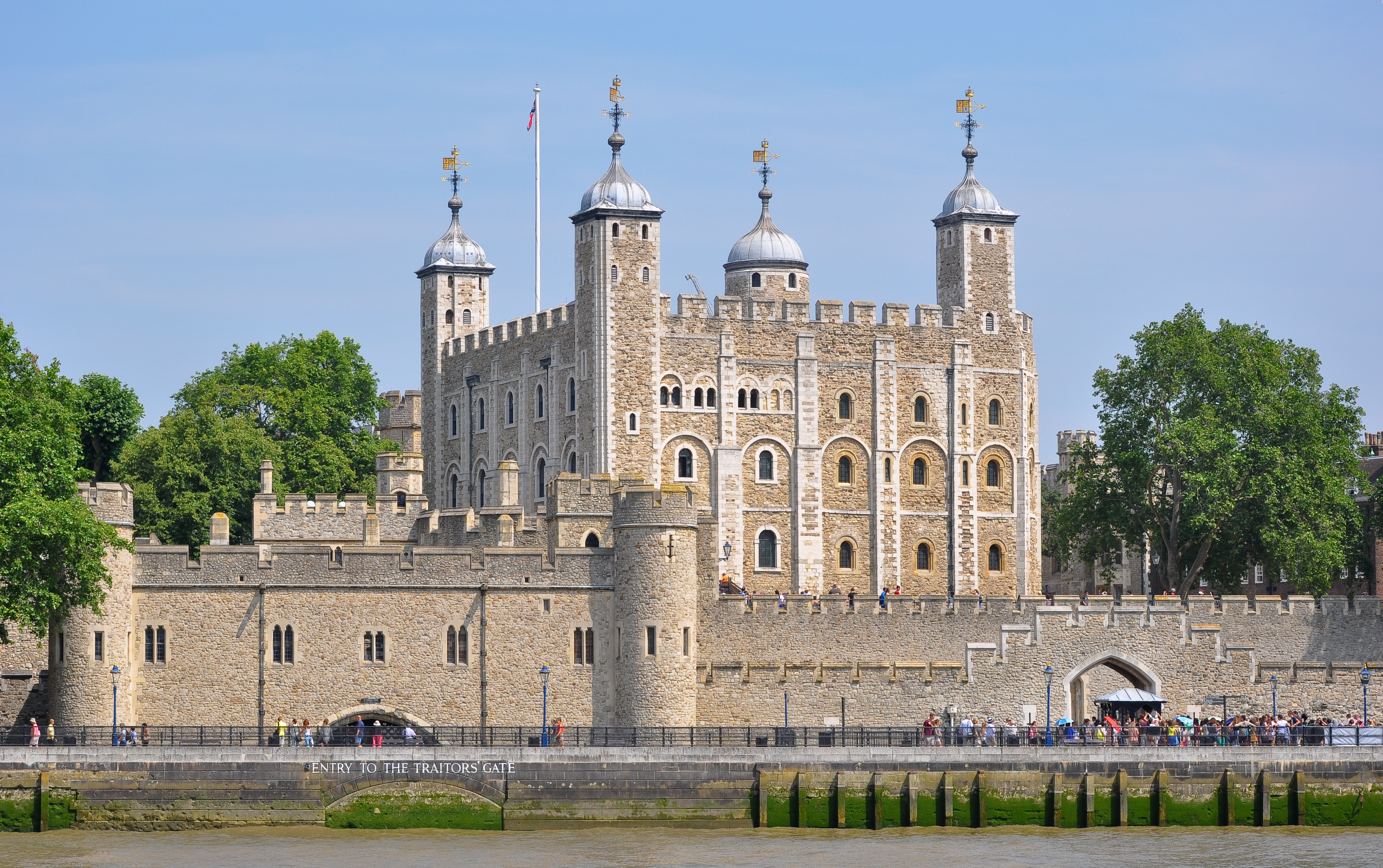
Above: The Tower of London, where Katherine was imprisoned and executed.

Unknown to her husband, Katherine had a murky past. As a young girl she had resided in the household of her step-grandmother the Dowager Duchess of Norfolk. In 1536, the Dowager Duchess arranged for a musician, Henry Manox, to provide the thirteen-year-old Katherine with music lessons. When Katherine's interrogators learned of her relations with Manox, they assumed that she was responsible for his seduction of her. Sixteenth-century observers viewed young women as sexually insatiable, believing that they were 'desirous to be married... to the end that they may be fruitful'. They were believed to provoke rape and were viewed as experiencing pleasure in it. If a woman was involved in sexual relations against her will, and subsequently fell pregnant, it was held that she could not have been raped. 

Katherine's music master was in a position of authority over her. He entreated Katherine to secretly meet with him, where he fondled her and, although she showed reluctance, he reported that she was 'content' for him to do so. As Laura Gowing has noted, Manox's confession 'shows no signs of the sense of guilty self-implication' that appears regularly in women's testimony. When the dowager duchess discovered Katherine's relationship with Manox, she beat her step-granddaughter several times and warned them never to meet together again. Two years later, in 1538, Katherine was acquainted with Francis Dereham, who was perhaps a gentleman usher to the dowager duchess. 

Whether Katherine was in love with Dereham is a question that has not often been debated. Most historians have assumed that theirs was a love affair, but as Warnicke notes, none of Katherine's later testimony suggests that she enjoyed Dereham's pursuit of her. The interrogators failed to ask her whether she had consented to Dereham's sexual advances. Katherine answered this, however, by confirming that Dereham's actions constituted 'importune forcement, and in a manner, violence, rather than of her own free consent and will'. Rather than proclaiming her knowledge of contraception, Katherine's comment 'a woman might meddle with a man and yet conceive no child unless she would for herself' can be viewed as 'a coded statement about her feelings for Dereham rather than a reference to birth control' (Warnicke). Contemporaries believed that females should enjoy sexual intercourse in order to successfully conceive. If Katherine had no wish to have sexual intercourse with Dereham, then she would have believed that she was forced to please him and would therefore not have enjoyed the experience. This explains her later denial that she was ever Dereham's wife. The church required that the marriage vows were freely given, rather than coerced.


Dereham's arrival at court in the spring of 1541 complicated matters for Katherine. Aware of the potential danger of his presence, she admonished him to keep silent about their former relationship and placated him with gifts of money in a misguided attempt to buy his silence. Perhaps fearful about the possibility that the king would discover that she was not a virgin, the queen agreed to meet with Thomas Culpeper, her distant kinsman, that spring. Culpeper was an experienced courtier and had an unfavourable reputation as a murderer and a rapist. Whether he deserved this reputation is uncertain, but certainly he was well aware of the treacherous nature of court intrigue. Simply by meeting with Culpeper in private, regardless of her intentions, Katherine placed herself in a position of great danger. Contemporaries warned that wives should not meet with men who were not their husbands. By meeting with Culpeper in secret, Katherine invited suspicion and her motives were to be interpreted in the worst possible light.

Possibly Culpeper had initially approached Lady Rochford, Katherine's attendant, because he was aware that she was closest to the queen on account of her position as Lady of the Bedchamber. Margaret Morton, who served Katherine, later reported that Lady Rochford was to bear the blame for Katherine's actions. The queen provided Culpeper with a velvet cap at their first meeting, perhaps as a reward for his promise to keep her childhood secret. Certainly, the timing of his meeting with Katherine was suspicious. In the spring of 1541, when they first met, Dereham arrived at court and openly bragged of his former sexual relationship with the queen, even claiming that, were the king to die, he would be sure to marry Katherine. At around the same time, Henry fell seriously ill and closed his doors to Katherine for several days, later inviting rumours that he had been displeased with her and had been considering annulling their marriage. It is often not appreciated how perilous Katherine's position was in the spring of 1541. As rumours emerged about her past, in the midst of her husband's incapacity, Katherine sought to silence those who knew the truth of her childhood.

The court departed on the northern progress in June and Katherine met with Culpeper on several occasions. At some point the queen wrote a letter to Culpeper, perhaps with the assistance of Lady Rochford given that the style of handwriting changes several words in. Interestingly, the letter was never mentioned in the indictments or by resident ambassadors at court, thus endowing it with mystery. Katherine's intentions cannot easily be read from the letter alone. The elaborate style and flowery sentences have usually been viewed as evidence of the queen's love for Culpeper, but the phrases were in keeping with those used in the period. Warnicke has suggested that the closing phrase, 'yours as long as life endures', provides evidence that danger and death, rather than love and romance, were on Katherine's mind at the time. She was surely well aware of Anne Boleyn's execution and knew that her actions could be interpreted in the same light. Unsurprisingly, she eventually informed Lady Rochford to instruct Culpeper not to meet with her again. 

Certainly Culpeper reported later how nervous she had been in their meetings. She had instructed Lady Rochford to remain closely nearby as a chaperone, perhaps assuming that the older woman's presence would add an air of respectability to her meetings with Culpeper. Much of the queen's ladies' later evidence was speculative. Margaret Morton believed that Katherine had looked out of a window with an expression of lust directed towards Culpeper, but one wonders why the queen's attendants did not inform the king or his council of their suspicions at the time. More likely, having heard in the wake of Katherine's downfall that she had not been a virgin when she became queen, they viewed her meetings with Culpeper in this light. Viewing her as a loose, promiscuous woman, they believed that her nighttime meetings must surely have been sexually motivated rather than anything else. Yet the evidence is mostly ambiguous. 

When the council discovered Katherine's past and interrogated her, she reacted with dismay and fell into a 'vehement rage', sobbing and weeping. Why her past came to light at this time cannot be known with certainty. Several historians have interpreted this as evidence of a court conspiracy led by the enemies of the Catholic Howards in an attempt to bring down the queen, a theory supported by the informer John Lascelles' devout Protestant faith. More likely the queen was caught up in circumstances beyond her control. In the spring her husband had fallen dangerously ill, prompting rumours of his imminent demise, and at the same time her former lover had arrived at court, boasting that he had previously enjoyed a sexual relationship with her and was hopeful of marrying her. Culpeper, perhaps hearing these rumours, approached the queen and was rewarded with gifts. She had granted Dereham money in a bid to buy his silence; it was perhaps the same with Culpeper. If so, Katherine's gift-giving was of no use.

Both Katherine and Culpeper denied that they had engaged in sexual intercourse, although Culpeper claimed that she was 'dying of love' for him and admitted he had sought sexual relations with her. He was executed alongside Dereham at Tyburn in December. Unlike Anne Boleyn, Katherine was not given the benefit of a public trial in which to proclaim her innocence. She and Lady Rochford were condemned by Act of Attainder and were executed within the walls of the Tower on 13 February 1542. The two women 'made the most godly and Christian end', asking the onlookers to pray for them and amend their own ungodly lives.

There is very little evidence for Katherine Howard's adultery. She admitted to a sexual relationship with Francis Dereham, and confirmed that, as a young girl, she had allowed the musician Henry Manox to fondle her. The interrogators failed to ask Katherine what she and Culpeper discussed in their lengthy meetings on the court progress, perhaps because they assumed that the two had committed adultery.  It is entirely possible, as Warnicke has suggested, that they discussed her past, with Katherine seeking to buy his silence by offering him gifts and attention. Fearing the king's discovery of her sexual past, Katherine was condemned and executed, viewed by her contemporaries as a deceitful wife who had manipulated the unassuming king into marrying her. 

In modern times, Katherine has been 'slut shamed' by historians, thus perpetuating the misogyny of the time in which she lived. David Loades, in his study of the Tudor queens, frequently refers to Katherine as 'a slut' or 'a whore', while Alison Plowden dubbed her 'a natural born tart'. These historians failed to consider the true nature of Katherine's relationships, focusing on the fiction rather than the fact of her involvement with men. As a young girl of thirteen, she had been seduced by Manox, who was in a position of authority over her, and two years later, she had been involved with Dereham, perhaps unwillingly. Then, she had married Henry VIII and had met with Culpeper in secret, not necessarily to commit adultery. By distorting the reality of her life, and ignoring the positive achievements of her queenship, modern historians have done Katherine a disservice. Dismissing her as an airheaded flirt or a scheming wanton perpetuates the misogyny and ignorance of Katherine's contemporaries. Despite advances made in historical scholarship, several historians continue to believe that she was born earlier than 1523, was immoral and scheming, and quarrelled with her stepdaughter out of spite.

Sunday, 25 October 2015

The Stereotyped Six Wives: Four: 'A Lady of Right Commendable Regard'


Anne of Cleves, fourth wife of Henry VIII of England
Lifetime: 22 September 1515 - 16 July 1557
Reigned: January 1540 - July 1540 (6 months)
Pregnancies: 0

In this new six-part series, I will be reexamining the lives and personalities of Henry VIII's six wives, seeking to portray their lives realistically in a process that discards prevailing stereotypes. Much scholarly work has been done on Henry's reign in recent decades, affording fresh insights into the politics and achievements of the period. Understandably, widespread interest in Henry's marital affairs remains unabated. Yet stereotypes continue to bedevil our knowledge of the wives of this most enigmatic king.

On 6 January 1540, Henry VIII married his fourth wife, Anne of Cleves, at Greenwich Palace. The briefness of Anne's time as queen - six months - has left us only with scarce information about her character, her interests and the nature of her queenship. In popular culture she continues to be viewed as the 'Flanders Mare', an unattractive, unappealing woman who lacked the courtly accomplishments prized at Henry's court. The traditional story views Anne as celebrating her escape from the increasingly bloated Henry and considers that her fate rendered her the most fortunate of Henry's wives. However, the surviving evidence - much in Anne's own words - tells a very different tale of hope, disappointment and sorrow. Anne continued to regard herself as the rightful queen of England, which is perhaps understandable given her impressive lineage; after Katherine of Aragon, she was the most nobly born of Henry's consorts. Her relations with her successor Katherine Howard were perhaps more complex than usually believed and she was allegedly contemptuous of Henry's marriage to Katherine Parr. The French ambassador reported that Anne was much loved by her English subjects; sadly for Anne, this love was not shared by Henry VIII.

Above: Greenwich Palace. Anne of Cleves married Henry VIII there on 6 January 1540.

Anne was born on 22 September 1515, the daughter of Johann, duke of Cleves, and his wife Maria. The duchy of Cleves, located in the Holy Roman Empire, was of economic and military significance and was an important cultural centre. Anne's father employed musicians and showed favour to humanist scholars. Anne's mother was responsible for overseeing her education, which placed an emphasis on needlework and reading and writing in German. Shortly before her twelfth birthday, Anne was betrothed to Francois, heir to the duchy of Lorraine. This marriage would have enabled Anne to become a duchess, a position of prime political and social significance, enhancing her prestigious lineage and extending her family's power outwards. 

However, Anne was destined not to wed Francois. Within months of Jane Seymour's death, Henry VIII's privy councillors began considering foreign brides for their ageing monarch. Early on, Anne was considered as a candidate for Henry's hand. Christopher Mont, who served in the household of Thomas Cromwell, reported that everyone at the court of Cleves praised Anne's beauty: 'one said that she excelled the Duchess [of Milan] as the golden sun did the silver moon'. She was also reportedly demure and virtuous. In the summer of 1539, Henry VIII's court painter Hans Holbein arrived in Cleves to paint Anne. Nicholas Wotton, the resident English ambassador, confirmed that Holbein's representation of Anne was accurate. Other observers commented on Anne's physical attractiveness. The notion that Anne of Cleves was ugly, or even physically disfigured, is a later myth. Only in the following century did Bishop Burnet suggest that she was a 'Flanders mare'.


Above: The miniature that persuaded Henry VIII of Anne's beauty. 

Modern research has indicated that it was largely Henry VIII, rather than Cromwell, who was enthusiastic for the alliance with Cleves. In the face of combined Franco-Imperial hostility, marrying Anne appeared a shrewd move. In October 1539, the marriage treaty between England and Cleves was signed and Anne departed for England the following month. On 31 December, she arrived at Rochester in stormy weather, and the following day was greeted by the man who was to become her husband. Henry's behaviour, in greeting Anne in disguise, was not unusual: as Warnicke has explained, he was simply following the prevailing custom of Renaissance monarchs. However, the meeting did not go as expected. Upon sight of Anne, the king doubted that she was truly a virgin. He based his judgement on 'the looseness of her breasts and other tokens', an accepted sixteenth-century understanding of virginity. At the time, contemporaries followed Castiglione's belief that 'outward beauty is a true sign of inner goodness' and 'for the most part the ugly are also evil'.

Maidens were expected to have slim figures, thus Anne's fuller figure caused Henry to worry that, perhaps, his prospective bride was no virgin. The ambassador of Cleves' failure to deliver a copy of the Lorraine contract fuelled the king's concerns. As Warnicke suggests, because Henry believed that Anne was truly the wife of Francois, she 'had therefore been symbolically deprived of her maidenhead'. Anne's ambassadors, however, informed Cromwell that she was not Francois' wife and promised to have a copy of the contract sent to England. Two days later, Anne became Henry's wife. She had been publicly greeted by Henry some days earlier at Blackheath Common in a lavish welcome attended by the nobility of the land. The chronicler Hall referred to her impressive dress and her long golden hair. Contemporaries were impressed by their new queen's dignity and gracious nature, and de Marillac, the resident French ambassador, reported that she was much-loved by her English subjects, who esteemed her as the kindest queen they had ever had.

Anne's kind nature, however, was not sufficient to win the heart of Henry VIII. Believing her to be Francois' wife, he was later to admit that he had failed to consummate his new marriage. Far from being ignorant, as she is often depicted, Anne endeavoured to communicate with Cromwell about her marital difficulties. Cromwell informed the earl of Rutland, Anne's lord chamberlain, to behave more pleasantly towards Henry, perhaps hoping that her gracious behaviour would encourage the king to consummate the marriage. It was to no avail. The king suffered relative impotence with her. As Warnicke has noted: 'contemporary medical experts, who were unaware of psychogenic sexual dysfunction, blamed witchcraft for causing relative impotence'.

Above: Thomas Cromwell. He was executed on 28 July 1540, merely weeks after the annulment of Anne's marriage. 

Henry's failure to consummate his union caused Anne dismay and concern. As noted, she had communicated to Cromwell her concerns about the king's behaviour. Shrewdly, she maintained her dignity and performed her queenly functions with success. She accompanied her husband to Westminster in February by barge and was festively greeted by the Londoners. Anne enjoyed warm relations with her stepchildren, as displayed by her decision to order her stepson Edward a bonnet; while the seeds of her long friendship with Mary Tudor were sown. At her coronation in October 1553, Mary provided Anne with a prominent place in the procession, sitting alongside her other stepdaughter Elizabeth. 

Although she was respected and loved by her subjects, Anne's position was perilous. Her last public appearance alongside her husband was at the May Day celebrations, and shortly afterwards she learned of Henry's growing infatuation with her maid-of-honour Katherine Howard. In June, Anne revealed to Harst, the Cleves ambassador, that the king's council had requested her removal to Richmond Palace, and she admitted to him that she feared that Katherine of Aragon's fate would become her own.

Anne consented to the annulment of her marriage, but it is hardly likely that she consented happily. Her ambassador later reported that she had screamed and cried loudly, thus breaking his heart. Her settlement was generous: she was granted possession of Richmond and Bletchingley Manor for life (and later Hever Castle); precedence over all of Henry's subjects except himself, his children and his new wife; and the allowance of 8000 nobles for the maintenance of her household. However, her correspondence with Cleves was censored, thus dishonouring her. 

How Anne felt about Henry's hasty marriage to her former attendant Katherine Howard is not known. Six months later, at the New Year celebrations, Anne was invited to court and publicly greeted the new queen, who later bestowed upon her the gift of a ring and two small dogs. It is often assumed that Anne bore no ill-will towards Katherine, but the truth is perhaps more complex. As Elizabeth Norton has suggested: 'Despite her acquiescence, Anne always believed herself to be the legitimate wife of the king and the true queen. In spite of this she was, first and foremost, a survivor and, if the price of that survival was a denial of her status in exchange for a life of opulent retirement, she was prepared to play along, even if that meant accepting a new lower status beside her former maid, Queen Catherine Howard'.

More likely, Anne was biding her time. The annulment of her marriage, in her eyes, had brought great shame upon herself and her family. Her correspondence with her family was heavily censored and her position remained, to put it mildly, highly ambiguous. Even the king's subjects were uncertain how to view the former queen. Rumours spread that Anne had been delivered of a son in the summer of 1541, which indicates that some, at least, continued to view her as Henry's true wife. Chapuys reported that she was delighted at the news of Katherine Howard's downfall, probably because she viewed it as indicative of her return to queenship. She was to be highly disappointed. Henry married Katherine Parr, rather than Anne, and the former queen was reportedly in great despair at the news. She allegedly made negative remarks about the new queen's appearance.


It is simplistic and probably erroneous to view Anne of Cleves as lucky, the most fortunate of Henry's wives. She herself did not view her situation that way. Not only had Henry publicly dishonoured her by annulling her marriage and marrying her attendant, but her situation as the king's 'sister' was uncomfortably ambiguous. When Henry failed to correspond with her she reportedly became melancholy. Anne later informed her brother that she felt like a stranger in England and longed to return to Cleves.

Moreover, her financial situation experienced strain following Henry's death. In 1547 Edward VI's council confiscated her manors of Bletchingley and Richmond, leading her to request her brother's assistance. Her situation remained unresolved when Mary succeeded her brother on the throne. Anne's final years were further troubled by household disputes. She died shortly before her forty-second birthday, on 16 July 1557, at her manor of Chelsea, and was later buried at Westminster Abbey. Authors, writing in memory of her, praised her gentleness, her household management, and her piety.

Anne of Cleves was a popular queen, much respected by her subjects, and has usually been viewed in modern times as the unattractive but kindly fourth wife of Henry VIII, who had the luckiest fate of all his wives. While it might appear that way today, Anne herself did not regard her situation so positively. She longed to be queen of England and was greatly distressed when Henry married Katherine Howard and, later, Katherine Parr. As Norton suggests, she continued to regard herself as the rightful queen and believed the annulment of her marriage had inflicted shame and dishonour upon her. Marriage was the primary vocation of sixteenth-century women, in particular royal women, and thus the annulment was viewed as a failure, a perversion of Anne's destiny and a slur upon her womanhood. She longed to return to her home country, believing herself an anomaly in England. This kindly, virtuous woman, who was reportedly attractive, has been much maligned and misrepresented in modern times. Perhaps of all of Henry's queens, Anne of Cleves remains the most stereotyped. This is a pity, for the evidence suggests that she was popular, much-praised, and in her short tenure as queen, she enjoyed success in her queenly role.  

Saturday, 24 October 2015

The Stereotyped Six Wives: Three: 'As Gentle A Lady'


Jane Seymour, third wife of Henry VIII of England
Lifetime: c. 1508/9 - 24 October 1537
Reigned: May 1536 - October 1537 (1 year, 5 months)
Pregnancies: 1
Edward VI of England: 12 October 1537 - 6 July 1553

In this new six-part series, I will be reexamining the lives and personalities of Henry VIII's six wives, seeking to portray their lives realistically in a process that discards prevailing stereotypes. Much scholarly work has been done on Henry's reign in recent decades, affording fresh insights into the politics and achievements of the period. Understandably, widespread interest in Henry's marital affairs remains unabated. Yet stereotypes continue to bedevil our knowledge of the wives of this most enigmatic king. 

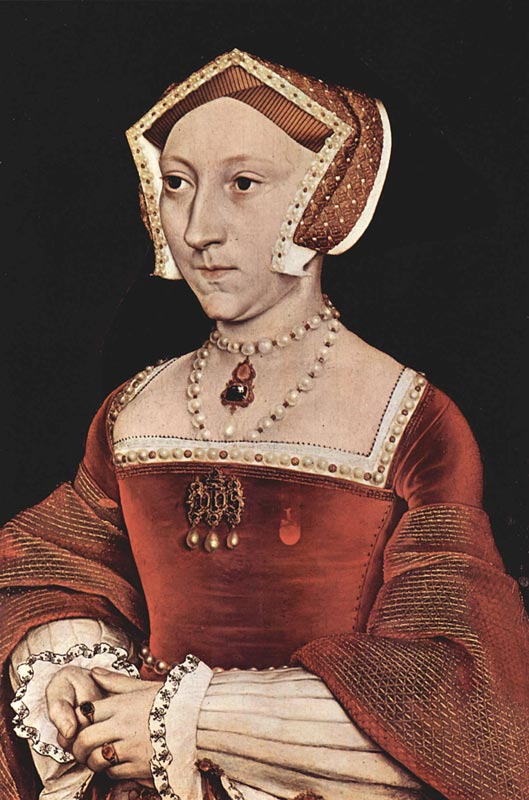
Jane Seymour, third wife of Henry VIII, became Queen of England upon her predecessor's execution for treason in May 1536. An unassuming woman in her late twenties, Jane is perhaps the most elusive of Henry's queens. Scarcely any evidence survives for her true personality. She was Henry's wife for merely seventeen months; yet her period as queen was tumultuous, in that it witnessed the restoration of Mary Tudor to favour, the unrest of the Pilgrimage of Grace, and the long-awaited birth of a healthy son to the king. Jane has attracted few biographers because of the shortage of evidence concerning her. In many ways, though, the mystery of Jane Seymour makes her as fascinating a person of study as Henry's other wives. Whether Henry VIII truly did love Jane, his 'entirely beloved' third wife, as legend has it, is an issue that has provoked considerable debate. In actuality, the tantalising evidence we have suggests that the story is more complex. Jane's queenship was passive and her famously meek, subdued character may have owed far more to the control of her domineering husband than is usually considered.

Above: Hampton Court Palace, where Jane Seymour died merely twelve days after the birth of her son.

Jane was the fifth child and eldest daughter of Sir John Seymour and Margery Wentworth. Twenty-nine ladies walked at her funeral procession in 1537 to mark her age: whether that means she had reached her twenty-ninth birthday, or whether she was in her twenty-ninth year, is uncertain, but it indicates that she was born either in 1508 or 1509. As with Anne Boleyn, Jane's father was much favoured by Henry VIII. Sir John Seymour, a 'gentle, courteous man', had been knighted by Henry VII at the battle of Blackheath in 1497 and later accompanied Henry VIII on the French campaign in 1513. By 1532 he had become a Gentleman of the Bedchamber, and had acted as Sheriff of Wiltshire and Dorset. Sometime in the late 1520s, Jane arrived at court to serve Queen Katherine of Aragon. It is often assumed, with little supporting evidence, that Jane was loyal to Katherine and modelled herself on her. Aside from Jane's preference for gable hoods, which Katherine also liked, and Jane's later friendship with Katherine's daughter Mary, there is barely anything to suggest that Jane particularly admired Katherine or empthasised with her during the annulment proceedings.

Although she is rarely termed stupid, Jane is often regarded as being poorly educated. Indeed, there is no evidence that she had an aptitude for languages, and unlike Anne Boleyn she was not selected to participate in court masques, which suggests that her dancing and musical ability were unexceptional. Yet she was renowned for her talent in needlework and embroidery, with some of her work surviving well into the following century. Her contemporaries were also not especially enthusiastic about her appearance. Polydore Vergil described her flatteringly as 'a woman of the utmost charm both in appearance and character', but the Spanish ambassador was of the opinion that she was 'of middle stature and no great beauty', with a 'pure white' complexion. He also reported rumours that she was both 'haughty' and 'proud'. 

Indeed, it is the very absence of evidence which makes it so difficult to grasp Jane's true personality. Most historians often refer to her piety and virtue, but aside from Luther's belief that she was 'an enemy of the gospel' - in other words, she was a devout adherent of the Catholic faith - there is barely anything to suggest that she was especially pious. In contrast to Anne Boleyn, who assisted religious reformers, or Katherine Parr, who wrote evangelical works of devotion, Jane was entirely conventional in her religious devotions and may not have been interested in taking an active role in religious politics. The absence of her involvement in court masques and dances, or poetry celebrating her talents, can tentatively be interpreted to mean that she was not talented musically or artistically. 


For whatever reason, by early 1536 Jane Seymour remained unwed. At the age of twenty-six, it was certainly strange that her father had not arranged an advantageous marriage alliance for her, and even more unusual given that she was the eldest daughter. Her younger sister, Elizabeth, had married in 1531 and later remarried, to the son of Thomas Cromwell. Why no marriage had been arranged for Jane remains a mystery. We can only wonder how she herself felt about this: did she passively accept her fate as God's will, something to be accepted with resignation? Did she rebel, passionately hoping for an excellent marriage one day? We can only guess. Jane's fortunes, however, took a dramatically unexpected turn in the spring of 1536. Devastated by his wife's miscarriage, and uncertain whether his second marriage had won him divine favour, Henry VIII was susceptible to a new flirtation. For reasons that have puzzled historians for centuries, the object of his affections was Jane Seymour, the unassuming and apparently unremarkable attendant of the queen. 

Historians have generally suggested that Henry VIII was attracted to Jane because she 'was unquestionably virginal' and because 'there was certainly no threatening sexuality about her'. In short, it was her virtue, her piety and her goodness that charmed the ageing king. By extension, these same historians seem to imply that these were qualities decidedly lacking in Anne Boleyn, thus conveniently ignoring the considerable evidence of Anne's piety and the importance she placed on her virtue. While Henry may have been captivated by Jane's demeanour, there may be a darker story at place here.

As queen, Jane selected the motto 'Bound to Obey and Serve', thus confirming her submission to Henry VIII's will both as her husband and as her king. How far the king himself directed his new wife in this, however, should be considered. Henry VIII had been dangerously obsessed by Anne Boleyn, an assertive, educated and independent young woman who had refused to become involved with him because it offended her piety and endangered her virtue. Anne's inability to provide the much-desired male heir had gradually reduced Henry VIII's burning love to burning hatred, leaving him with a strong desire to destroy her and rejoicing in her execution, to the surprise even of Ambassador Chapuys. With Jane, he had no wish to be denied and no wish to be told 'no'. Jane's motto confirmed her husband's control of her and signalled to the world that passivity and submission, rather than the proactiveness of Katherine of Aragon and Anne Boleyn, would characterise Jane's rule. 

Above: Edward VI of England was born on 12 October 1537, only child of Jane Seymour.

Just as it is problematic to view Anne Boleyn as directly responsible for Katherine of Aragon's rustication from court and ill-treatment, so it is erroneous to view Jane as responsible for Anne's brutal end, as Victorian historians often did. In questioning her morals and condemning her actions, as Agnes Strickland did, these historians failed to understand the position Jane was in and the character of the man she married. Like Anne, she simply could not say no. With the passing of time, Henry had become increasingly autocratic and, on the single occasion that Jane did dare to voice her true opinion, she was brutally put in her place by her irascible husband, who warned her to consider her predecessor's fate before involving herself in affairs of state. There is scarcely any evidence for Jane's supposed love and admiration of Queen Katherine, and there is next to no evidence that she was hostile to Anne or resented her rise to queenship. While she did offer friendship to Mary Tudor once she had married Henry, this is understandable given their closeness in age and their shared devotion to the Catholic faith. In 1536, perhaps Jane, mindful of Henry's rejection of Anne and indifference to his second daughter, wisely judged it best not to antagonise her husband by showing marked favour to her stepdaughter Elizabeth. 

The absence of evidence for her inner feelings means that we cannot suggest that Jane was hostile to Anne Boleyn or deliberately sought to bring her down because of her aversion to the reformed faith favoured by Anne or because of her supposed loyalty to Katherine. In rejecting Henry's advances, in refusing to accept presents of money from him, in behaving 'modestly' rather than flirtatiously, perhaps Jane intended to signal a lack of interest that may well have been genuine. Her true feelings for Henry are usually ignored in the rush to condemn her supposedly callous behaviour. Jane Seymour's personality and motivations are swathed in mystery and remain largely inscrutable. She may have been ambitious, but equally she may have felt that she had no choice, as Katherine Parr did when presented with an unwanted marriage proposal by the king in 1543. Perhaps Jane resented Anne, but equally she may have accepted her as her mistress and wished to show her no ill-will. What does seem likely, however, is that Jane was coached by her ambitious relatives to attract the besotted king. Certainly they profited handsomely from her rise: her brother Edward became Viscount Beauchamp and her brother Thomas was knighted. It is uncertain whether Jane was a willing participant in the schemes of 1536 or whether she was manipulated by her family to serve their own ends.

Jane was never crowned as queen and her reign was entirely passive, as Pamela Gross noted in her academic study of Jane. She has usually been credited with restoring Mary Tudor to favour, but it is more likely that it was Henry himself who approved and brought about his daughter's return to court only after she had grovelled to him for her disobedience: 'I beseech your Majesty to countervail my transgressions with my repentance for the same'. Jane may have been sympathetic to Mary but she was not responsible for the latter's return to favour. Even if she had wished to enjoy Mary's company, Jane would not have forgotten for a second that her primary duty as queen was to provide a male heir, and would have acknowledged that Mary's position as the bastard of an unlawful union was a foreboding reminder of her own perilous position. As Henry himself warned Jane ominously: 'She ought to study the welfare and exaltation of her own children, if she had any by him, instead of looking out for the good of others'. 


Despite the oft-repeated legend that Jane Seymour was Henry VIII's most beloved wife, there is, in fact, surprisingly little evidence of his love for her dating from her own lifetime. As noted earlier, when she had voiced sympathy for Mary her husband had bluntly advised her to concern herself with producing an heir herself. If the story of her plea for the abbeys to be saved from dissolution is true, then Henry's response, in brutally reminding her of Anne's fate, is indicative of a bullying husband seeking to control a wife and prevent her from becoming unruly. Within days of his marriage to Jane, Henry VIII reportedly was acquainted with two beautiful women and voiced regret that he had not met them before he had remarried. The Second Act of Succession, which was passed in the summer of 1536, vested the succession either in Jane Seymour's offspring or in the offspring the king might have with any future wife. How Jane viewed this Act cannot be known, but as the months passed without a pregnancy, she must have lived in considerable anxiety, if not fear.

Described by Cromwell as 'a most virtuous lady', Jane conformed entirely to Henry's wishes. If she had ambition, she suppressed it. If she held opinions, she chose not to voice them. If she disagreed with her husband's policies, she did not inform him. How far Jane willingly assented to her marginalisation, how wholeheartedly she embraced her motto 'Bound to Obey and Serve', are questions that simply cannot be answered. Yet she had witnessed Katherine of Aragon's determined refusal to obey Henry's wishes, and she had heard of the ill-treatment inflicted on the proud queen in consequence. Jane's own marriage had been made in blood: her former mistress had been imprisoned, tried and executed in less than three weeks mainly because she had failed to give her husband a son. 

Jane's queenship is characterised by most historians as passive, but they have not usually considered whether she was willing in the circumscribing of her queenly authority. In concerning herself solely with domestic affairs, Jane sought to please her husband, but his threatening behaviour on several occasions towards her was a chilling reminder of the danger she faced if she displeased him. By giving birth to her son Edward on 12 October 1537 at Hampton Court Palace, Jane earned Henry's undying love and appreciation, but during her own lifetime he never demonstrated the constant passion he felt for Anne Boleyn, or the unswerving devotion he experienced for Katherine Howard. In her own lifetime, Jane was a cipher. During her brief tenure as queen, she walked on a knife edge. Her two predecessors had been rusticated and had died, alone and shamed, for their failures to give birth to a son. This thought must have constantly been in Jane's mind, and her overriding emotion at providing the male heir in the autumn of 1537 may well have been relief.

Philippa Gregory's new novel The Taming of the Queen, which describes the life of Katherine Parr as queen, focuses on the circumscribing of the queen's authority, the restriction of her power and the utter submission of the queen to her husband. This portrayal could, with some fairness, apply to Jane Seymour. Her reign has been viewed as unremarkable and devoid of achievements, with the exception of Prince Edward's birth. Historians have appreciated that, outside of her immediate household, the queen was little more than a cipher, never exercising the militant authority of Katherine of Aragon or seeking to influence religious policies, as did Anne Boleyn. But they have, tellingly, failed to consider how willing Jane was in the restrictions she faced. Perhaps she willingly accepted them, perhaps she accepted her submission as the price of her queenship. Or perhaps she resented the limits imposed on her and bridled when faced with her husband's suffocating presence.

There is no evidence to suggest that Jane was unquestionably hostile to Anne Boleyn and sought her destruction, nor is there evidence that she admired and revered Katherine of Aragon. There is scarcely any evidence for Henry's supposed love for her. It was only after her death that Jane became 'entirely beloved' and her memory revered. Only in 1544 was she celebrated in Holbein's painting as Henry's one true wife, rather than Katherine Parr, his queen at the time. Jane Seymour's queenship was circumscribed, 'tamed'. She remains a mystery because she was a cipher at court. What emerges from the sources is the strong likelihood that it was Henry VIII who was responsible for holding her in submission and curtailing her authority to ensure that she pleased him and conformed to his will.